Reishi (Ganoderma lucidum)
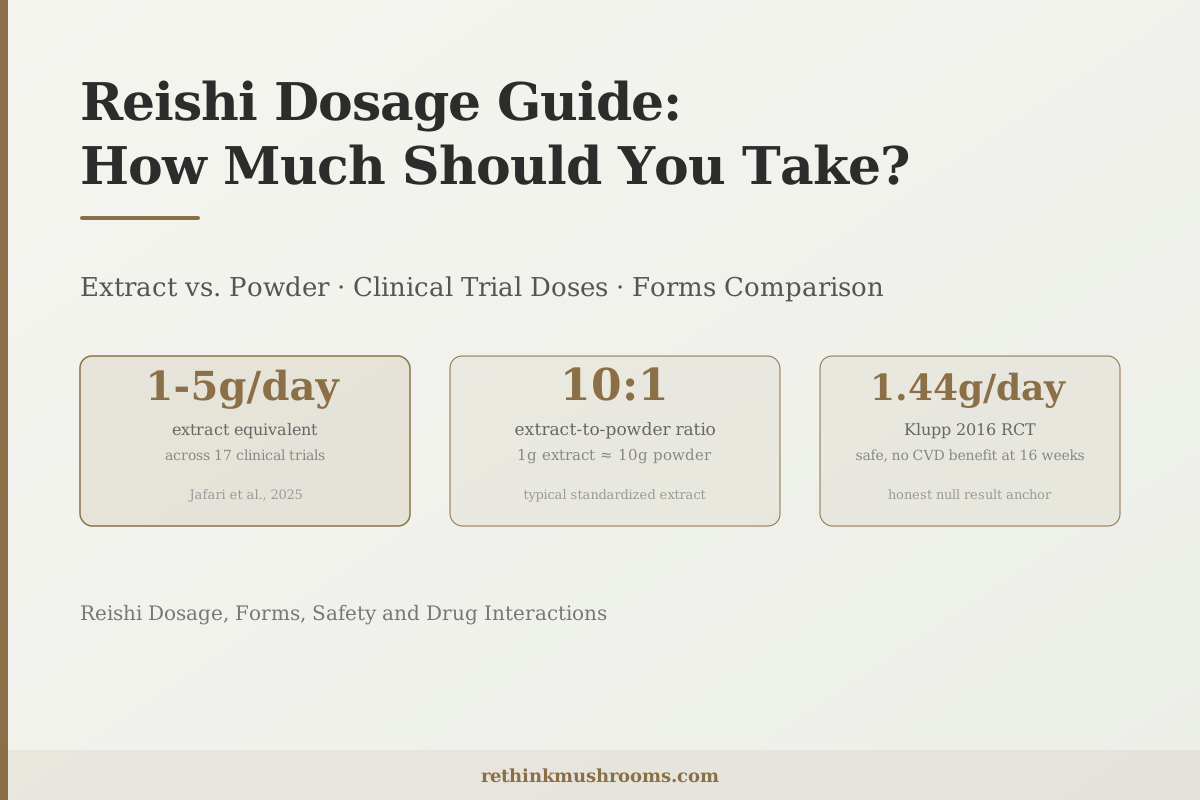
1-5g/day extract equivalent
Jafari et al. (2025) reviewed 17 Reishi clinical trials and found doses ranging from 1,000mg to 5,400mg/day extract equivalent. No single standardized dose has been established; effective dose depends on the form, the product's concentration, and the indication being studied.
Jafari et al., Food Science & Nutrition, 2025
10:1
typical extract-to-powder concentration: 1g standardized extract is roughly equivalent to 10g whole mushroom powder
1.44g/day
the dose in the Klupp 2016 cardiovascular RCT — well-tolerated but no significant effect on metabolic syndrome markers
1g/day
dose of cracked spore powder in the Zhao 2012 breast cancer fatigue trial — the only RCT testing spore preparations
Jafari et al., Food Science & Nutrition, 2025
 View as image ↗
Reishi dosage questions on supplement labels are often answered with a number that has almost no meaning without context. "Take 500mg daily" tells you nothing useful if the product is a whole mushroom powder — because a 500mg serving of whole powder contains very different amounts of active compounds compared to 500mg of a 10:1 standardized extract. The single most important concept in reishi dosage is that form determines potency, and the dose number only makes sense after you know what that number represents.
This guide focuses on what clinical trials actually used and what the conversion between forms looks like. For the broader introduction to Reishi's research base, see the complete guide to Reishi mushroom.
Key Takeaways
- No single standardized reishi dose has been established; clinical trials used doses from 1,000mg to 5,400mg/day extract equivalent (Jafari 2025 meta-analysis of 17 RCTs)[3]
- Whole mushroom powder and standardized extract are not interchangeable at the same dose: a 10:1 extract is approximately 10 times more concentrated per gram than whole powder, so a 1g extract dose corresponds roughly to 10g of powder
- Klupp and colleagues (2016) tested 1.44g/day standardized extract for 16 weeks — it was well-tolerated but produced no significant improvement in blood pressure, lipids, or glucose; a directly useful null result showing this dose is safe but not sufficient for cardiovascular endpoints[2]
- Zhao et al. (2012) used 1g/day cracked spore powder for 4 weeks and found significant improvement in cancer-related fatigue — the only human trial specifically testing spore preparations at a defined dose[5]
- Ahmad et al. (2021) found extract forms supported by safety data up to 1 year; powdered whole mushroom has safety evidence to approximately 16 weeks but limited longer-term human data[4]
- Jafari et al.'s 2025 GRADE assessment rated evidence quality as very low across all outcomes; clinical dose guidance is currently empirical rather than derived from high-quality dose-finding trials[3]
Reishi Dosage by Form: Clinical Reference
| Form | Typical Dose Range | Clinical Trial Anchors |
|---|---|---|
| Whole mushroom powder | 1.5-9g/day | Traditional range; lower bioavailability due to chitin cell walls |
| Hot-water extract | 750mg-2g/day | Captures beta-glucans; limited triterpene content |
| Dual extract (water + ethanol) | 500mg-1.5g/day | Captures both beta-glucans and triterpenes; preferred for full-spectrum use |
| Cracked spore powder | 500mg-1g/day | Zhao 2012: 1g/day for cancer fatigue (n=48, significant result) |
| Spore oil | 250-500mg/day | High triterpene concentration; no specific dose-finding RCT |
| 10:1 extract equivalent | 1g extract ≈ 10g powder | Use this ratio when comparing product labels |
Clinical trial dose range across 17 RCTs (Jafari 2025): 1,000-5,400mg/day extract equivalent.[3]
Why the Same Number Means Something Different on Every Label
The core challenge with reishi dosing is that "500mg of reishi" on a product label can mean almost anything, depending on what that 500mg actually is.
Whole mushroom powder is exactly what it sounds like: dried Ganoderma lucidum ground into powder. The beta-glucans, triterpenes, and other compounds are present but bound within the mushroom's intact cell structure. The human digestive system cannot efficiently break down chitin, the material forming mushroom cell walls, which limits how much of the active content reaches circulation.
Standardized extracts concentrate the active compounds. A 10:1 extract means 10 kilograms of mushroom were processed to produce 1 kilogram of extract — a 10-fold concentration by weight. A 1g serving of this extract contains roughly the same compound content as 10g of whole powder. This means a product listing "500mg 10:1 reishi extract" contains substantially more active content than a product listing "2,000mg reishi powder," despite the larger number on the second label.
The extraction solvent matters too. Water extracts dissolve beta-glucans — the polysaccharide immune compounds — but leave behind most of the triterpenes (ganoderic acids), which are fat-soluble. Alcohol extracts dissolve triterpenes but leave behind most beta-glucans. Dual extracts use both solvents and capture both compound classes.
Ahmad and colleagues (2021) reviewed the full toxicological and clinical literature on Reishi and noted that powdered whole mushroom and extract forms have different safety profiles — with the handful of hepatotoxicity cases in the literature clustering around crude powder forms rather than standardized extracts.[4] This is one reason to prefer well-standardized extracts when possible.
For the mechanism differences between beta-glucans and triterpenes, see how Reishi triterpenes differ from polysaccharides in mechanism. For more on choosing between forms, see Reishi extract vs. whole mushroom powder: which is better.
What Clinical Trials Actually Used
Jafari and colleagues (2025) systematically reviewed 17 published Reishi RCTs and noted that doses across trials ranged from 1,000mg to 5,400mg per day in extract equivalent terms.[3] The variation reflects different indications and preparation types rather than a dose-finding consensus. No Reishi dose-escalation trial — the kind of study specifically designed to find the minimum effective dose — has been completed.
The two most practically useful clinical anchors:
Wicks and colleagues (2007) tested Ganoderma lucidum extract in 80 healthy volunteers over 12 weeks in a double-blind placebo-controlled design.[1] The dose was at the lower end of the supplement range. No significant adverse events were recorded versus placebo. This is the primary safety reference for standard supplement dosing — it establishes that common commercially available doses are tolerated in healthy people over a 12-week period.
Klupp and colleagues (2016) administered 1.44g/day standardized Ganoderma lucidum extract to patients with metabolic syndrome risk factors over 16 weeks.[2] The extract was well-tolerated. The primary result: no significant improvement in blood pressure, blood lipids, or blood glucose compared to placebo. This provides a concrete dose and duration at which reishi was safe but did not produce cardiovascular benefit. It is a useful anchor for what 1.44g/day extract over 16 weeks does not achieve.
The honest takeaway from the clinical trial range: doses between 1 and 5g/day extract equivalent have been tested in human trials and are generally safe. Effective dose for specific outcomes is not established by clean dose-finding studies; the 1-5g range reflects what researchers chose to test, not a proven minimum or optimal dose.
Cracked Spore Powder: A Different Dosage Framework
Spore preparations follow different rules from fruiting body extract or powder.
Ganoderma lucidum spores are microscopic reproductive cells encased in a dense chitin wall called the sporoderm. Intact spores pass through the digestive system essentially unchanged, because human digestive enzymes cannot penetrate the sporoderm. Breaking this wall — a process called sporoderm cracking, done through physical, chemical, or combined methods — releases the enclosed triterpenes and nucleosides and dramatically improves bioavailability. Products labeled "cracked spore" or "sporoderm-broken" have undergone this process; intact spore products have negligible bioavailability.
Zhao and colleagues (2012) conducted the only human RCT using a cracked spore preparation.[5] In 48 breast cancer patients on endocrine therapy, 1g/day of cracked Ganoderma spore powder for 4 weeks significantly reduced cancer-related fatigue, anxiety, depression, and appetite loss compared to placebo. This is currently the best evidence for clinical benefit at a spore-specific dose.
Spore oil, extracted from cracked spores using high-pressure CO2 extraction, is more concentrated still. The "70× more potent" marketing claim refers to the concentration ratio involved in producing the oil, not a head-to-head efficacy comparison with other forms. No RCT has directly compared spore oil to fruiting body extract on clinical outcomes.
For the full analysis of whether spore oil is worth the price difference, see Reishi spore oil: is it worth the premium.
Duration: How Long Before Reishi Takes Effect?
Reishi is not an acute intervention like caffeine. The documented clinical effects — immune modulation, fatigue reduction, QoL improvements in cancer patients — were measured after weeks to months of consistent use.
The Zhao 2012 spore trial showed significant fatigue reduction at 4 weeks. The Klupp 2016 cardiovascular trial ran 16 weeks and showed no effect. The Wicks 2007 safety trial ran 12 weeks without adverse events.
Ahmad et al. (2021) synthesized the safety duration data: standardized extracts have human safety evidence extending up to approximately 1 year; powdered whole mushroom has human safety data to roughly 16 weeks, with limited evidence beyond that window.[4]
The practical implication: a 4-8 week trial at consistent dose is the minimum timeframe for assessing whether a response is occurring. Benefits are unlikely to appear in the first days of use.
The Evidence Quality Limit: Why These Numbers Are Empirical, Not Proven
The dosage numbers in this guide come from actual clinical trials. What they do not come from is high-quality dose-finding research designed to establish minimum effective doses, dose-response curves, or form-to-form equivalence with precision.
Jafari et al.'s 2025 systematic review assigned GRADE evidence quality ratings to outcomes across 17 Reishi RCTs.[3] The rating across all outcomes was very low. This reflects small trial sizes, inconsistent preparations, and short follow-up durations — not lack of evidence that Reishi compounds have biological activity, but genuine uncertainty about which doses, in which forms, produce which outcomes in which populations.
The dosage table at the top of this article reflects the ranges studied in human trials and the basic extraction chemistry. It does not represent proven optimal doses because those have not been determined.
For safety considerations when dosing, including drug interaction risks, see Reishi side effects and drug interactions: a safety review. For species authenticity considerations when selecting a product, see red Reishi vs. other Ganoderma species: key differences.
The Bottom Line
Reishi dosage depends primarily on product form. Standardized extracts (500mg-2g/day) are more concentrated per gram than whole mushroom powder (1.5-9g/day); a 10:1 extract roughly equals 10g whole powder per gram. Clinical trials used 1,000-5,400mg/day extract equivalent across indications. Klupp 2016 showed 1.44g/day was safe but ineffective for cardiovascular risk factors over 16 weeks. Zhao 2012 showed 1g/day cracked spore powder improved cancer-related fatigue at 4 weeks. Jafari et al.'s 2025 GRADE meta-analysis rated all Reishi clinical evidence as very low quality — dosing guidance remains empirical rather than definitively established.
Frequently Asked Questions
Sources & References
- 1RTHM-00123·Wicks, Sheila M et al. (2007). “Safety and tolerability of Ganoderma lucidum in healthy subjects: a double-blind randomized placebo-controlled trial..” The American journal of Chinese medicine.Study breakdown →PubMed →↩
- 2RTHM-00429·Klupp, Nerida L et al. (2016). “A double-blind, randomised, placebo-controlled trial of Ganoderma lucidum for the treatment of cardiovascular risk factors of metabolic syndrome..” Scientific reports.Study breakdown →PubMed →↩
- 3RTHM-02098·Jafari, Ali et al. (2025). “The Nutritional Significance of Ganoderma lucidum on Human Health: A GRADE-Assessed Systematic Review and Meta-Analysis of Clinical Trials..” Food science & nutrition.Study breakdown →PubMed →↩
- 4RTHM-01321·Ahmad, Rizwan et al. (2021). “Ganoderma lucidum (Reishi) an edible mushroom; a comprehensive and critical review of its nutritional, cosmeceutical, mycochemical, pharmacological, clinical, and toxicological properties..” Phytotherapy research : PTR.Study breakdown →PubMed →↩
- 5RTHM-00276·Zhao, Hong et al. (2012). “Spore Powder of Ganoderma lucidum Improves Cancer-Related Fatigue in Breast Cancer Patients Undergoing Endocrine Therapy: A Pilot Clinical Trial..” Evidence-based complementary and alternative medicine : eCAM.Study breakdown →PubMed →↩