Reishi Dosage, Forms & Safety
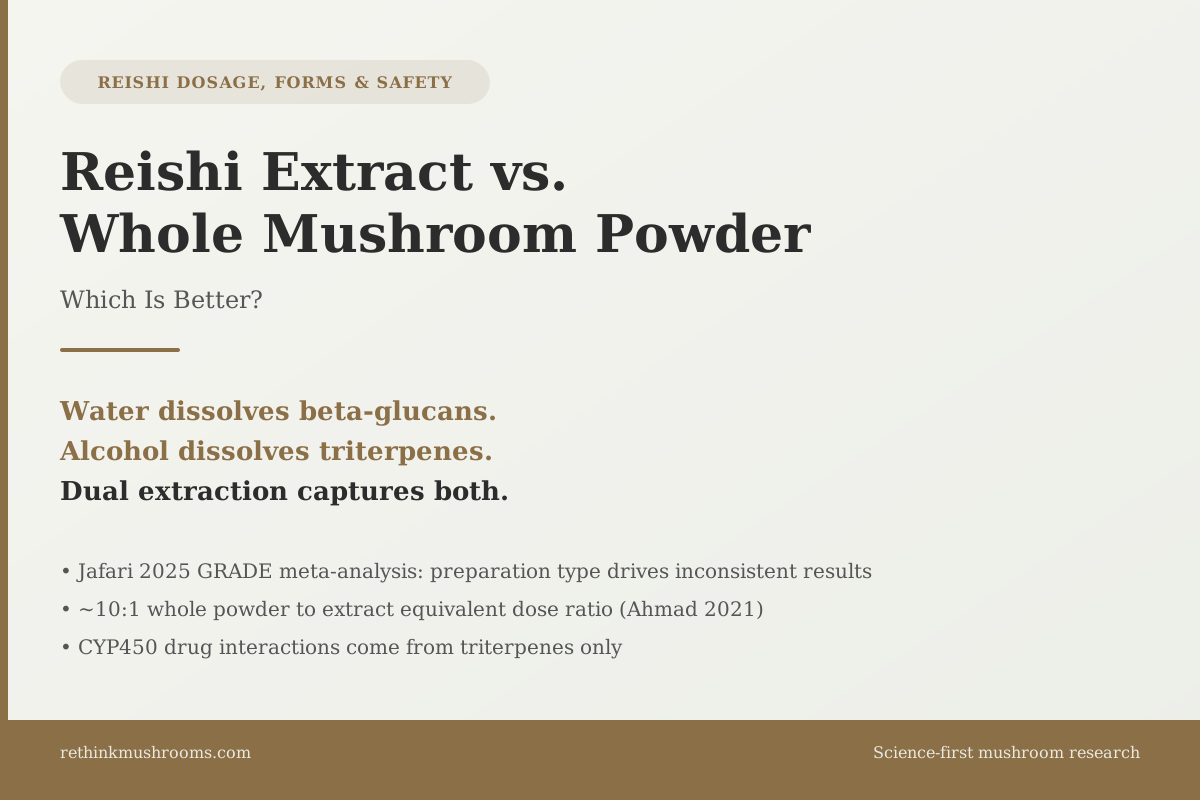
~10:1 powder-to-extract ratio
Approximately 10g of whole reishi mushroom powder provides the bioactive equivalent of 1g of standardized extract, but chitin cell walls in whole powder limit how much actually reaches the bloodstream.
Ahmad et al., Phytotherapy Research, 2021
Dual extract
is the only form capturing both water-soluble beta-glucans and alcohol-soluble triterpenes
Preparation type
identified as a key driver of inconsistent clinical results in the Jafari 2025 GRADE meta-analysis
CYP450 risk
drug interactions come from triterpenes only; water-only extracts carry substantially lower interaction risk
Ahmad et al., Phytotherapy Research, 2021
 View as image ↗
Reishi extract vs. whole mushroom powder is a question of chemistry before it's a question of cost. The two forms are not the same product at different price points. They're different products with different compound profiles, different bioavailability characteristics, and different risks. Whether one is "better" depends on which compounds you want and what you're taking reishi alongside.
The core issue is chemistry. Reishi contains two main classes of bioactive compounds: polysaccharides (primarily beta-glucans, which are water-soluble) and triterpenes including ganoderic acids (which are fat-soluble and require alcohol to extract). Whole powder contains both but makes neither fully available. Water extract captures the polysaccharides but misses the triterpenes almost entirely. Only dual extraction, using both water and alcohol as solvents, captures both compound classes.
This distinction matters because the clinical evidence is inconsistent, and a 2025 GRADE-assessed meta-analysis identified preparation type as one of the key reasons why. This article covers what each form contains, what the research shows about bioavailability and outcomes, and what that means for choosing between them. For the broader context of how reishi works and what it's been studied for, the complete reishi guide provides the foundation.
Key Takeaways
- Reishi's two main bioactive compound classes require different solvents: beta-glucans (polysaccharides) dissolve in water; triterpenes and ganoderic acids dissolve in alcohol. Whole powder contains both but delivers neither optimally[2]
- Chitin cell walls in whole mushroom powder resist human digestive enzymes, reducing how much of either compound class is absorbed compared to extracted products[3]
- The Jafari 2025 GRADE-assessed meta-analysis identified preparation heterogeneity (water-only vs. dual extraction) as a key source of inconsistent results across reishi clinical trials[1]
- Reishi triterpenoids inhibit CYP2E1, CYP1A2, and CYP3A4 enzymes that metabolize warfarin, statins, and cancer drugs; products without alcohol extraction contain far fewer triterpenes and therefore carry substantially lower drug interaction risk[4]
- The Ahmad 2021 comprehensive review found crude whole mushroom powder had more adverse events than standardized extract, particularly regarding the rare hepatotoxicity cases, which were associated with the powder form[2]
- Dual extraction (water plus alcohol) is the only preparation method that captures both beta-glucans for immune support and triterpenes for anti-inflammatory and cholesterol-related effects
Reishi Extract vs. Powder: The Chemistry Behind the Comparison
Understanding why reishi forms differ starts with solubility: the basic chemistry of what each solvent can pull out of the mushroom's cells.
Beta-glucans and polysaccharides are long-chain carbohydrates that dissolve readily in water. They are the primary immunomodulating compounds in reishi and the compounds most consistently associated with immune activity in clinical studies. They survive hot-water extraction well and are preserved in water-extract powders.
Triterpenes and ganoderic acids are carbon-rich, fat-like compounds that do not dissolve in water. They require an alcohol solvent (ethanol is the standard in commercial extraction) to be pulled from the mushroom tissue. These are the compounds associated with reishi's anti-inflammatory, cholesterol-inhibiting, and cytokine-modulating activity. A product made only with water extraction contains negligible amounts of them.
Chitin forms the structural cell walls of fungal tissue. It is resistant to human digestive enzymes. This matters for whole mushroom powder specifically: even though all compounds are physically present in the powder, chitin cell walls act as a barrier that limits how much of them is actually released and absorbed in the digestive tract. Extraction breaks down or bypasses this barrier, making compounds more bioavailable.
Wang and colleagues' work on sporoderm disruption (using reishi spores as the model system) demonstrated this with >95% sporoderm disruption needed for meaningful bioavailability of enclosed compounds from chitin-encased material.[3] The same chitin barrier principle applies to the cell walls of the fruiting body in whole mushroom powder, explaining why extraction improves access to the compounds inside.
Whole Mushroom Powder: Complete Profile, Lower Bioavailability
Whole reishi mushroom powder is produced by drying and grinding the fruiting body (or mycelium) into a fine powder without any solvent extraction. It contains the full range of compounds present in the mushroom: beta-glucans, triterpenes, proteins, fiber, minerals, and secondary metabolites.
The case for whole powder is completeness. Nothing is selectively removed. If reishi contains beneficial compounds that haven't been identified and studied yet, they're in the powder. The fiber content from the chitin and other structural components is also preserved.
The case against is bioavailability. Because chitin cell walls remain intact, the compounds inside mushroom cells are not fully accessible to digestive absorption. The full compound profile is present but not fully delivered. Ahmad and colleagues' comprehensive review of Ganoderma found that crude whole mushroom powder preparations showed higher rates of adverse events compared to standardized extracts, attributed at least partly to variable compound concentrations in unprocessed material and the presence of compounds not removed by the extraction and standardization process.[2]
Whole mushroom powder also has a practical concentration issue: because it's not concentrated by extraction, achieving the doses used in clinical trials requires far more powder by weight. Ahmad's review suggests approximately a 10:1 powder-to-extract ratio, meaning 10g of whole powder provides roughly equivalent bioactives as 1g of standardized extract. Most commercial capsules contain 400-600mg per capsule; reaching clinical trial doses in powder form requires taking far more capsules.
Hot-Water Extract: Good for Beta-Glucans, Poor for Triterpenes
Hot-water extraction heats dried mushroom material in water, dissolving the water-soluble compounds and leaving behind the insoluble chitin and fat-soluble compounds. The resulting liquid is then spray-dried or concentrated into a powder.
Water extracts are reliably rich in beta-glucans, the polysaccharides associated with immune modulation and which are specified in the beta-glucan potency claims on most supplement labels. Hot-water extraction preserves and concentrates these compounds effectively.
What water extraction does not pull out: triterpenes, ganoderic acids, and other fat-soluble compounds. These simply don't dissolve in water. A product made exclusively with hot-water extraction contains essentially no triterpenes, regardless of how potent the beta-glucan content is. This is a key limitation for anyone taking reishi specifically for its anti-inflammatory or cholesterol-related properties, where the triterpene content is pharmacologically relevant.
There is one context where this limitation becomes an advantage: people taking medications metabolized by CYP450 enzymes. Li and colleagues' 2024 in vitro study demonstrated that reishi triterpenoids specifically inhibit CYP2E1, CYP1A2, and CYP3A4 (the enzyme system that metabolizes warfarin, many statins, most cancer chemotherapy drugs, acetaminophen, and NSAIDs).[4] When reishi triterpenoids slow these enzymes, blood levels of the medications they process rise, potentially causing toxicity. A water-only reishi extract, having negligible triterpene content, carries substantially lower risk of this interaction than a dual extract or whole powder. This is worth knowing for anyone on anticoagulants, statins, or chemotherapy.
For the full drug interaction picture, the reishi side effects and drug interactions review covers the CYP450 mechanism and other interactions in detail.
Dual Extraction: The Clinical Evidence Argument
Dual extraction uses both hot water and ethanol sequentially or separately, then combines the results. The water step captures beta-glucans; the alcohol step captures triterpenes. The resulting product contains both compound classes in concentrated form.
The clinical evidence argument for dual extraction comes from the 2025 Jafari meta-analysis, which assessed the quality and consistency of evidence from reishi clinical trials using GRADE methodology (a systematic framework for evaluating evidence quality).[1]
Jafari and colleagues found low-to-moderate quality evidence for reishi's effects on immune function and fatigue across trials. One specific finding is relevant to the extract vs. powder question: the meta-analysis identified preparation heterogeneity, specifically the difference between water-only and dual extraction preparations, as a key source of inconsistency in clinical results across studies. Trials using different preparation methods produced different results, and this was cited as a confounding factor in the meta-level analysis.
The implication is direct: the choice of extraction method isn't just a quality label issue. It affects what compounds are delivered and therefore what effects (or lack of effects) a given study might show. A clinical trial using water-only extract is testing a different product than one using dual extract, even if both are labeled "reishi supplement."
For people whose primary interest in reishi is immune support (the most studied application), water extraction may be sufficient because beta-glucans are the primary immunomodulating class and water extraction captures them well. For people whose interest is anti-inflammatory activity, cholesterol support, or the adaptogenic effects associated with ganoderic acids, dual extraction is necessary to deliver the relevant compound class.
For more on how the triterpene and polysaccharide classes differ in their mechanisms, how reishi triterpenes differ from polysaccharides in mechanism covers the distinction in depth. The ganoderic acid extraction and potency article covers which ganoderic acids survive different processing methods.
Understanding Extract Ratio Labels: What 10:1 Actually Means
Many reishi products use extract ratio labels like "10:1" or "20:1." These numbers describe the concentration ratio, not efficacy: a 10:1 extract was made from 10 parts raw material to produce 1 part extract.
These ratios don't directly compare compound concentrations between products unless the compounds are standardized. A 10:1 extract made only with water extraction concentrates beta-glucans but still contains no triterpenes. A less concentrated dual extract (5:1) would provide more triterpenes than a 20:1 water extract.
The Ahmad 2021 comprehensive review indicates that standardized extracts specifying both beta-glucan percentage and triterpene/ganoderic acid percentage give the most reliable information about what a product contains.[2] A certificate of analysis (CoA) showing both beta-glucan content (typically 15-40% for commercial extracts) and triterpene content (typically 2-8%) is the clearest way to verify a dual extract has delivered on both compound classes.
The Safety Difference Between Forms
Beyond potency and bioavailability, the two forms differ in their adverse event profiles.
Ahmad and colleagues' review of published Ganoderma toxicological data found that crude whole mushroom powder had more reported adverse events than standardized extract preparations. This reflects two factors: the variability of compound concentrations in unprocessed material (any given batch of whole powder contains unpredictable amounts of each compound class depending on growing conditions, harvest timing, and drying method) and the documented association between the powder form and the rare but serious hepatotoxicity cases in the literature.[2]
The hepatotoxicity cases involving reishi (approximately 5 published cases in world literature as of 2023) were associated with prolonged high-dose use of the powder form, often combined with other risk factors like alcohol use or pre-existing liver disease. Standardized extracts at typical doses have not been associated with the same pattern. This is a rare but nonzero safety consideration.
The Jafari 2025 meta-analysis found adverse events in clinical trials using reishi extract to be generally mild and gastrointestinal in nature (loose stools, mild nausea, dry mouth) at the doses studied (1,000-5,400mg/day extract equivalent).[1] Standardized extracts at these doses appear well-tolerated in short-to-medium-term use.
For reishi dosage guidance that ties to specific clinical trial doses, the reishi dosage guide covers each form with corresponding dose anchors from trial data. For spore-based products specifically, the reishi spore oil: is it worth the premium article covers that separate preparation type.
The Bottom Line
Whole reishi powder, water extract, and dual extract are chemically distinct products: whole powder contains all compounds but with reduced bioavailability due to chitin cell walls; water extract is rich in beta-glucans but contains negligible triterpenes; dual extraction is the only form capturing both compound classes. The Jafari 2025 GRADE meta-analysis identified preparation heterogeneity as a key reason for inconsistent clinical results across trials, directly supporting dual extraction for applications where both compound classes are relevant. For people on warfarin, statins, or cancer drugs, the CYP450 inhibition from reishi triterpenoids means water-only extracts carry substantially lower drug interaction risk.
Frequently Asked Questions
Sources & References
- 1RTHM-02098·Jafari, Ali et al. (2025). “The Nutritional Significance of Ganoderma lucidum on Human Health: A GRADE-Assessed Systematic Review and Meta-Analysis of Clinical Trials..” Food science & nutrition.Study breakdown →PubMed →↩
- 2. Source details for this reference are not yet available.
- 3RTHM-00496·Wang, Jiajia et al. (2017). “Breaking the sporoderm of Ganoderma lucidum spores by combining chemical reaction with physical actuation..” Natural product research.Study breakdown →PubMed →↩
- 4RTHM-01926·Li, Dawei et al. (2024). “Triterpenoids from Ganoderma lucidum inhibit cytochrome P450 enzymes interfering with the metabolic process of specific clinical drugs..” Frontiers in pharmacology.Study breakdown →PubMed →↩