Mushrooms and Diabetes / Blood Sugar
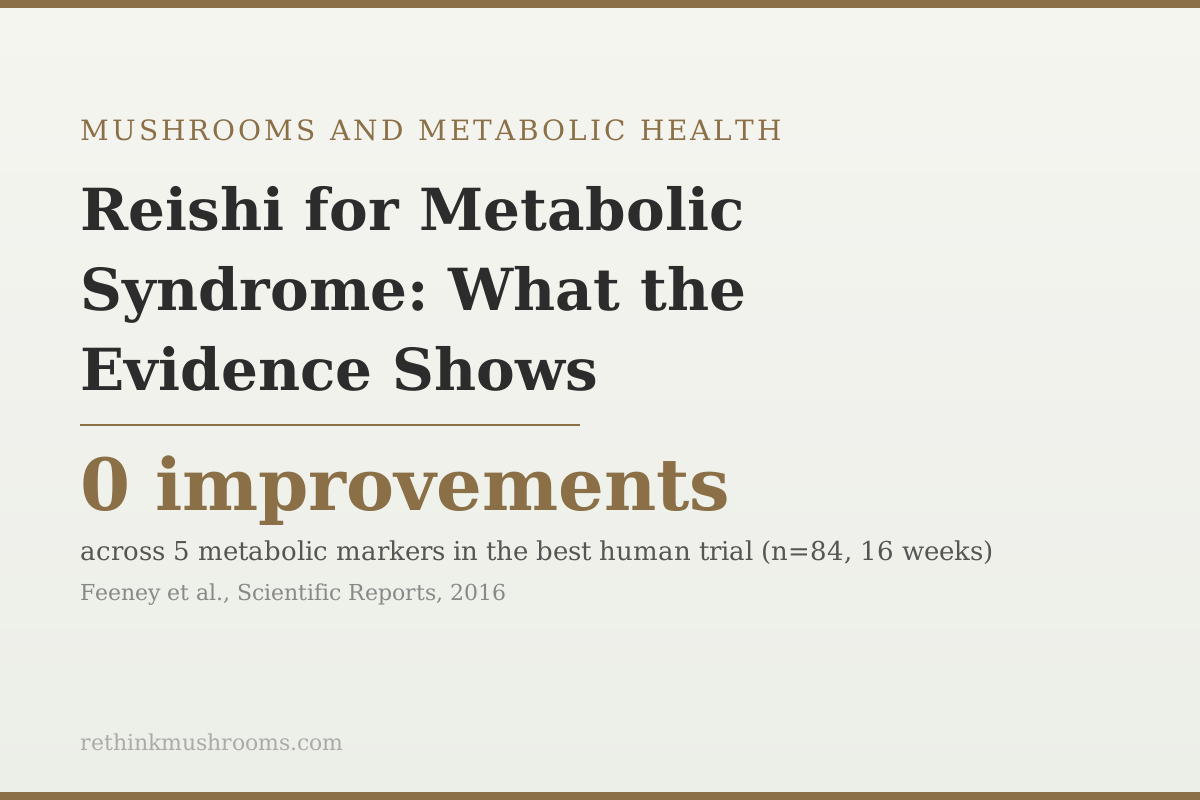
0 improvements across HbA1c, fasting glucose, lipids, and blood pressure in the best human trial of reishi for metabolic syndrome
The Feeney 2016 double-blind RCT (n=84, 16 weeks) found no significant improvement in any metabolic syndrome marker with Ganoderma lucidum supplementation. This is the most rigorous human test of reishi for this condition, and the null result is rarely mentioned.
Feeney et al., Scientific Reports, 2016
n=84
participants in the definitive Feeney 2016 reishi metabolic syndrome RCT
16 weeks
duration of the trial, longer than most mushroom supplement studies
5 markers
measured (HbA1c, glucose, lipids, blood pressure, waist), none improved significantly
Feeney et al., Scientific Reports, 2016
 View as image ↗
Most articles about reishi and metabolic syndrome highlight the positive animal studies and skip the human trial. This one leads with the human trial, because that is the most honest and useful thing to do for anyone researching whether reishi can help with their blood sugar, cholesterol, or blood pressure.
The short answer: in the best-designed human trial conducted to date, it did not. A double-blind, randomized, placebo-controlled study in 84 people with metabolic syndrome over 16 weeks found no significant improvement in HbA1c, fasting glucose, triglycerides, HDL, LDL, blood pressure, or waist circumference with Ganoderma lucidum supplementation.[1]
Understanding why researchers expected it to work, what earlier studies showed, and where the evidence points now is the full story. For the broader mushroom and blood sugar landscape, see Mushrooms and Type 2 Diabetes: A Research Guide by Species.
Key Takeaways
- A 2016 double-blind RCT (n=84, 16 weeks) found no significant improvement in any metabolic syndrome marker with Ganoderma lucidum, including HbA1c, fasting glucose, lipids, or blood pressure.
- Earlier smaller trials showed modest positive trends for reishi and cardiovascular risk factors, but a 2015 systematic review found these studies had high bias risk and poor reporting quality.
- A 2023 animal study confirmed reishi mycelium extract improved carbohydrate and lipid metabolism in fructose-induced metabolic syndrome rats, showing the mechanism is biologically plausible but has not transferred to human clinical results.
- Reishi contains ganoderic acids that inhibit HMG-CoA reductase (the same enzyme targeted by statins), triterpenoids that reduce inflammation via NF-κB, and polysaccharides with preclinical hypoglycemic activity.
- The evidence gap between mechanistic plausibility and clinical results may reflect dose, extract type, duration, or the specific patient population tested.
- For metabolic syndrome specifically, other mushroom species show stronger human evidence: Tremella for HbA1c, oyster mushroom for GLP-1 and postprandial glucose, Maitake for insulin sensitivity.
What Metabolic Syndrome Is
Metabolic syndrome is not a single disease. It is a cluster of five cardiometabolic risk factors that frequently co-occur and collectively increase the risk of type 2 diabetes and cardiovascular disease. The five criteria are: elevated waist circumference (central obesity), high triglycerides, low HDL cholesterol, elevated blood pressure, and elevated fasting glucose. Having any three of the five qualifies as metabolic syndrome.
The condition is extremely common. Approximately one-third of adults in the United States meet the criteria. The pathophysiology involves insulin resistance as a central driver, with chronic low-grade inflammation, dyslipidemia, and adipose tissue dysfunction all playing interconnected roles.
From a research perspective, metabolic syndrome is a meaningful target: interventions that address it comprehensively are more valuable than those that improve only one marker. This is the premise behind researching Ganoderma lucidum for this condition, since reishi's bioactive compounds span mechanisms relevant to several of the five criteria simultaneously.
The Feeney 2016 RCT: The Test That Gave a Null Result
The clearest human evidence comes from a 2016 trial by Feeney et al. published in Scientific Reports.[1] This was a double-blind, randomized, placebo-controlled study. Eighty-four adults with metabolic syndrome received either Ganoderma lucidum extract (5.2g/day, with or without Cordyceps) or placebo for 16 weeks.
The researchers measured HbA1c, fasting blood glucose, total cholesterol, LDL, HDL, triglycerides, blood pressure, and waist circumference. Across all primary and secondary outcomes, there were no statistically significant improvements in the Ganoderma group compared to placebo.
This is a well-designed trial. The sample size (84 participants) is meaningful. Sixteen weeks is long enough to detect changes in HbA1c, which reflects three months of average blood sugar control. The double-blind design controls for placebo effects. The use of placebo for comparison is the appropriate standard. By any measure of clinical trial quality, this is the study that should anchor the evidence assessment for reishi and metabolic syndrome.
The result is null. That is the honest starting point for this topic.
What Earlier Studies Showed, and Why the Picture Was Misleading
Before Feeney 2016, the evidence landscape looked more promising. A 2015 systematic review and meta-analysis by Klupp et al. in BMJ Open examined available trials of Ganoderma lucidum for cardiovascular risk factors.[2] The review found modest short-term reductions in blood pressure, blood glucose, and triglycerides in some earlier trials.
However, the review's critical finding was methodological: reporting quality across those trials was poor, and bias risk was high. Small sample sizes, lack of adequate blinding, short durations, and publication bias (the tendency for positive results to get published and negative results to be buried) are all factors that inflate apparent efficacy in early research.
Klupp et al. concluded that the available evidence at the time was insufficient to support using Ganoderma lucidum for cardiovascular risk reduction, specifically because the study quality was inadequate to draw reliable conclusions. The Feeney 2016 trial was a direct response to this gap: a properly designed large trial to test the hypothesis rigorously.
The Feeney result tells us that the earlier modest positive findings did not replicate under rigorous conditions. This is a common pattern in nutrition and supplement research: small exploratory studies show trends, generate excitement, and then a larger, better-designed trial finds no effect. The story of reishi and metabolic syndrome follows this arc.
The Mechanistic Rationale: Why Reishi Should Work in Theory
The null clinical result does not mean reishi has no metabolically relevant biological activity. It means the specific doses, duration, and patient population tested did not produce measurable clinical benefit. Understanding what reishi does at the molecular level helps explain why researchers expected benefit in the first place.
A 2020 review in the International Journal of Molecular Sciences by Musso et al. comprehensively mapped how mushroom bioactives target all five metabolic syndrome criteria.[4] For Ganoderma specifically, three compound classes are relevant:
Ganoderic acids and triterpenoids contain structural similarities to sterols and have been shown to inhibit HMG-CoA reductase in cell-based assays. HMG-CoA reductase is the enzyme that statins inhibit to lower cholesterol. Ganoderic acid B and related compounds have demonstrated this activity in vitro. Whether oral doses produce adequate systemic concentrations to reproduce this effect in humans is not established.
Ganoderic acids also suppress NF-κB, the master inflammatory signaling protein that drives the chronic low-grade inflammation underlying metabolic syndrome. A 2013 review by Guillamón et al. in LWT identified NF-κB suppression as a primary mechanism by which reishi triterpenoids could address the inflammatory component of metabolic syndrome.[6]
Beta-glucan polysaccharides from Ganoderma have shown hypoglycemic activity in multiple animal models, likely through improved insulin signaling, reduced intestinal glucose absorption, and gut microbiota modulation. These are the same mechanisms through which beta-glucans from other sources (oats, barley) reduce postprandial blood glucose in humans.
Antiobesity effects via lipase inhibition and adipogenesis modulation have been documented across multiple mushroom species, including reishi. A 2018 review by Shao et al. covering anti-obesity mechanisms of medicinal mushrooms found that reishi triterpenoids inhibit pancreatic lipase, the enzyme responsible for fat absorption in the gut.[5]
Each of these mechanisms is real at the molecular or cellular level. The gap is in translating them from cell assays or animal studies to clinically measurable outcomes in humans at achievable supplement doses.
What the Animal Evidence Shows
The mechanistic rationale is supported by animal research. A 2023 study by Petryn et al. tested reishi mycelium extract in Wistar rats with fructose-induced metabolic syndrome, a standard animal model.[3] The reishi group showed improved carbohydrate metabolism and better lipid profiles compared to the untreated metabolic syndrome controls.
This finding confirms that the mechanism is biologically active in a living system. Fructose-induced metabolic syndrome in rodents is a model with known limitations for predicting human outcomes: rats and humans differ in hepatic fructose metabolism, gut microbiome composition, and baseline metabolic rate. Animal models are useful for mechanistic validation but poor predictors of clinical efficacy.
The Petryn 2023 animal result and the Feeney 2016 human null result can coexist without contradiction. Reishi extracts can improve metabolic parameters in rodents with induced metabolic syndrome while not producing detectable benefit in humans with metabolic syndrome at doses tested for 16 weeks. The gap is not about mechanism. It is about translation.
Which Metabolic Markers Show Stronger Mushroom Evidence
Reishi's null result in the Feeney 2016 trial is important context, but it does not mean mushrooms broadly are unhelpful for metabolic syndrome. Other species show different evidence profiles.
The 2020 Musso review identified polysaccharide-mediated hypoglycemic and hypolipidemic effects as the strongest mechanistic category across mushroom species, with beta-glucan-rich species like oyster mushroom showing the most consistent acute glycemic effects.[4] For the evidence on GLP-1 stimulation from oyster mushroom and what that means for metabolic regulation, see Mushrooms and GLP-1: Can Fungi Mimic the Ozempic Effect?.
Maitake mushroom has specific evidence for insulin sensitivity via the SX-Fraction extract, a different mechanism than Ganoderma's approach. That evidence is reviewed at Maitake and Metabolic Regulation: Beyond Blood Sugar to Full Metabolic Health.
For the mechanistic framework of how different mushroom species target the five metabolic syndrome criteria, see Mushrooms and Metabolic Syndrome: Targeting All Five Criteria.
Where Reishi's Evidence Is Actually Strong
The null metabolic syndrome result is specific to that indication. Reishi has robust evidence in other areas.
Its strongest clinical evidence is as a cancer adjuvant. PSK, a purified reishi-class compound, has 40+ years of clinical use and multiple meta-analyses showing survival benefit in cancer patients alongside chemotherapy. Its evidence for immune modulation, fatigue reduction, and sleep quality is also meaningfully supported by clinical research.
The mechanistic case for metabolic benefits is coherent. If future trials test higher doses, different extract preparations (particularly those standardized for specific ganoderic acid content), longer durations, or specific metabolic syndrome phenotypes, results may differ from Feeney 2016. One trial is not the final word. But it is the most rigorous word currently available.
For the broader mushroom prediabetes evidence, including species with positive human RCT data, see Mushrooms for Prediabetes: Can Early Intervention Prevent Type 2?. For the HbA1c-specific evidence across species, see The Mushroom Diet and HbA1c: Can Regular Consumption Improve Long-Term Blood Sugar?.
The Bottom Line
The most rigorous human trial of reishi for metabolic syndrome, a double-blind RCT with 84 participants over 16 weeks, found no significant improvement in HbA1c, fasting glucose, lipids, blood pressure, or waist circumference. Earlier smaller studies showed modest positive trends but had high bias risk and poor reporting quality. Animal research confirms mechanistic plausibility (reishi compounds inhibit HMG-CoA reductase, suppress NF-κB inflammation, and improve lipid/glucose metabolism in metabolic syndrome models), but this has not translated to clinical benefit in the human evidence available. Other mushroom species show stronger human evidence for specific metabolic markers; reishi's clinical strength lies in immune modulation and cancer support, not metabolic syndrome.
Frequently Asked Questions
Sources & References
- 1. Source details for this reference are not yet available.
- 2. Source details for this reference are not yet available.
- 3. Source details for this reference are not yet available.
- 4. Source details for this reference are not yet available.
- 5. Source details for this reference are not yet available.
- 6. Source details for this reference are not yet available.