Cordyceps and Cancer
Preclinical evidence only
The Cordyceps-cancer literature is broad and mechanistically coherent in cell culture and rodent studies, but no randomized controlled human cancer trial of Cordyceps or its extracts has been published.
Chen et al., Molecules, 2021
Cordycepin
principal small-molecule anticancer candidate
Polysaccharides
documented immunomodulatory and antitumor activity
0 human RCTs
in any cancer indication to date
Chen et al., Molecules, 2021
 View as image ↗
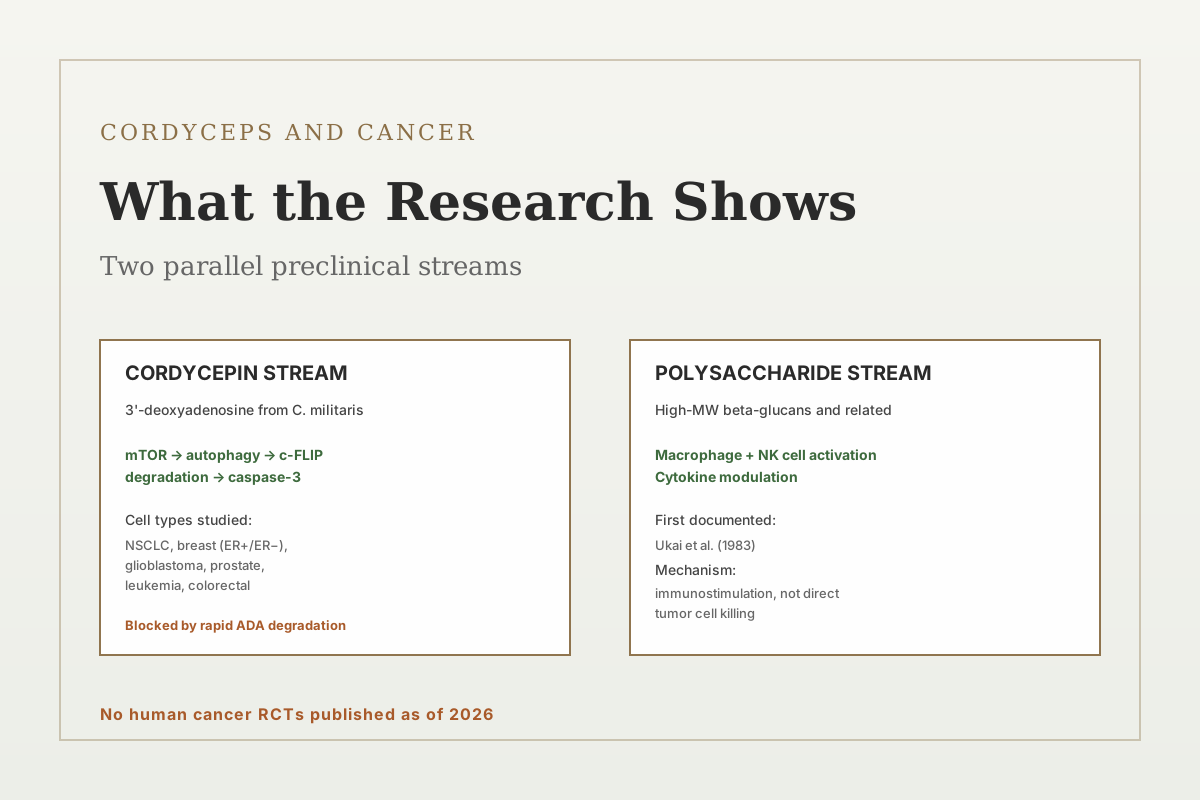
The Cordyceps-cancer research base has two distinct streams. The first is the cordycepin stream: 3'-deoxyadenosine and its mechanistic effects on cancer cells (mTOR suppression, autophagy induction, apoptosis). The second is the polysaccharide stream: high-molecular-weight beta-glucans and other polysaccharides with immunomodulatory and antitumor effects in tumor-bearing animals. Both streams have been active since the 1980s, both have produced large volumes of preclinical data, and neither has yet produced a randomized controlled human cancer trial. This article surveys what the literature actually shows, where the mechanistic evidence is strongest, and why the translation gap to human treatment remains wide.
For the autophagy mechanism in depth, see cordycepin and autophagy: how Cordyceps triggers cancer cell self-destruction. For the chemotherapy-adjunct framing, see Cordyceps as a cancer adjunct: evidence for chemotherapy support. For leukemia-specific data, see cordycepin and leukemia research: preclinical findings. For the broader tumor-growth mechanisms, see cordycepin and tumor growth inhibition: mechanisms of action.
Key Takeaways
- Ukai et al. (1983) demonstrated antitumor activity of polysaccharides isolated from multiple fungi including Cordyceps, establishing the polysaccharide stream of the Cordyceps cancer research
- Chen et al. (2021) reviewed cordycepin's role in anti-cancer and health promoting effects, with autophagy-apoptosis coupling as the central mechanism across cancer cell types
- Preclinical cordycepin anticancer evidence spans non-small cell lung cancer, breast cancer, glioblastoma, prostate cancer (LNCaP), leukemia, and colorectal cancer cell lines and xenografts
- In breast cancer, cordycepin induces apoptosis and autophagy in both estrogen receptor-positive (MCF-7) and estrogen receptor-negative (MDA-MB-231) cell lines, indicating hormone-independent mechanism (Choi et al., 2011)
- In prostate and brain cancer models, autophagy induction is upstream of and required for cordycepin-induced apoptosis; blocking autophagy attenuates the death response (Lee et al., 2014; Chaicharoenaudomrung et al., 2018)
- Cordycepin is rapidly deaminated by adenosine deaminase to inactive 3'-deoxyinosine, giving poor oral bioavailability and requiring drug-development strategies (ADA inhibitor co-administration, nanoparticle delivery) to achieve therapeutic exposure (Chen et al., 2023)
- Phull et al. (2022) reviewed C. militaris as a functional food, concluding the evidence base supports continued research but does not yet support Cordyceps supplements as cancer therapy in humans
- No randomized controlled clinical trial of Cordyceps or cordycepin has been published for any cancer indication as of 2026
The Two Research Streams
The Cordyceps-cancer literature began to appear in the 1980s in two distinct directions that have developed in parallel ever since.
The polysaccharide stream
Ukai et al. (1983) isolated polysaccharides from Dictyophora indusiata, Ganoderma japonicum, Cordyceps cicadae, and other fungi and tested them for antitumor activity in mouse tumor models. The polysaccharides showed dose-dependent tumor growth inhibition that was attributed to immunostimulation rather than direct cytotoxic effect. This established a pattern that held through subsequent fungal polysaccharide research: the active fraction is high-molecular-weight, mostly beta-glucan, and the mechanism involves macrophage and NK cell activation rather than tumor cell killing.[1]
Cordyceps polysaccharide antitumor activity has since been documented across many mouse tumor models with mechanisms including NK cell activation, macrophage polarization, cytokine modulation, and effects on the tumor microenvironment. The effect sizes in mice are substantial and consistent, but no Cordyceps polysaccharide preparation has progressed to randomized human cancer trials.
The cordycepin stream
Cordycepin (3'-deoxyadenosine) from Cordyceps militaris acts through a different mechanism: direct effects on cancer cell signaling and survival. Chen et al. (2021) reviewed the role of autophagy in cordycepin's anticancer effects, mapping the pathway from adenosine A3 receptor engagement through mTOR suppression, autophagy induction, c-FLIP degradation, and caspase-mediated apoptosis.[2]
The cordycepin stream has accumulated mechanism papers across cancer types: non-small cell lung cancer, breast cancer, glioblastoma, prostate cancer, leukemia, colorectal cancer, melanoma, and others. The mechanistic convergence across cell types is one of the strongest features of this literature.
Cancer Cell Type-Specific Findings
Choi et al. (2011) treated MCF-7 (estrogen receptor-positive) and MDA-MB-231 (estrogen receptor-negative) human breast cancer cell lines with cordycepin and documented apoptosis and autophagy induction in both, demonstrating that the mechanism does not depend on estrogen receptor status.[3] This is clinically meaningful because many existing breast cancer therapies work only in ER-positive disease, and the cordycepin pathway appears agnostic to that axis.
Lee et al. (2014) examined cordycepin in LNCaP human prostate carcinoma cells and found autophagy and apoptosis co-induction. Genetic (Atg5 siRNA) or pharmacological (LY294002) blockade of autophagy reduced the apoptotic response, establishing autophagy as upstream of apoptosis in prostate cancer cells.[4]
Chaicharoenaudomrung et al. (2018) studied cordycepin in U251 glioblastoma cells. Cordycepin induced mitochondrial membrane potential collapse, Bax/Bcl-2 imbalance, cytochrome c release, and caspase-9 and caspase-3 activation. Autophagy markers were also elevated, supporting the same autophagy-apoptosis coupling seen in other cell types.[5]
The consistent pattern across cell types is that cordycepin produces a dual autophagy-apoptosis response, that the two processes are not alternatives but a coupled pipeline, and that the specific protein targets downstream of autophagy (c-FLIP in lung, mitochondrial factors in brain, prostate-specific targets in LNCaP) can differ while the overall mechanism remains intact.
The Bioavailability Barrier
Chen et al. (2023) reviewed cordycepin bioavailability and pharmacokinetics. The central finding is that cordycepin is rapidly deaminated by adenosine deaminase (ADA) to 3'-deoxyinosine, which has minimal biological activity. The elimination half-life of oral cordycepin is very short and systemic exposure from oral dosing is much lower than the concentrations used in the mechanism papers.[6]
This is the single most important fact for anyone trying to translate the preclinical literature to a human treatment decision. The cell culture IC50 values for cordycepin against cancer cell lines are often in the 10-100 μM range; achieving and sustaining comparable serum concentrations from oral Cordyceps supplementation is not realistic with current delivery strategies.
Drug development strategies to address this include:
- Co-administration with ADA inhibitors (pentostatin) to extend half-life
- Phosphate-protected prodrug forms that resist deamination
- Nanoparticle or liposome encapsulation for preferential tumor delivery
- Intravenous administration to bypass gut metabolism
An older cordycepin-pentostatin combination (NSC-63878 plus deoxycoformycin) was tested in refractory leukemia in the 1980s-90s with demonstrated pharmacology but no approved product. Contemporary cordycepin drug development is ongoing but slow.
The Human Trial Gap
As of 2026, no randomized controlled clinical trial of Cordyceps or cordycepin has been published for any cancer indication. The evidence base at the human level is limited to:
- Case reports and small observational series using Cordyceps as supportive care in traditional medicine contexts
- A handful of small studies testing Cordyceps-containing formulations for cancer-related fatigue and quality of life in patients undergoing conventional therapy
- Safety and pharmacokinetic data from healthy-volunteer or non-cancer patient studies
This is the honest state of the evidence, and it is substantially different from the state of the evidence for other mushroom species in oncology. Turkey tail (Trametes versicolor) has multiple randomized trials of its polysaccharide preparations (PSK/Krestin in Japan) as adjuncts to conventional chemotherapy. Reishi (Ganoderma lucidum) has randomized trials for cancer-related fatigue (Zhao et al., 2012, in breast cancer patients undergoing endocrine therapy). Maitake (Grifola frondosa) has immune-parameter studies. Cordyceps does not.
Phull et al. (2022) reviewed Cordyceps militaris as a functional food and while the review documents the preclinical evidence base, it does not overclaim human cancer efficacy.[7]
What This Means for Cancer Patients and Supplement Users
The following statements are supported by the evidence:
- Cordycepin is a biologically active molecule with well-characterized effects on cancer cell signaling pathways in vitro
- Cordyceps polysaccharides modulate immune function in animal models in ways that inhibit tumor growth
- C. militaris fruiting body extracts have measurable biological activity in humans (fatigue, exercise, immune markers)
The following claims are not supported:
- That Cordyceps supplementation treats any human cancer
- That the preclinical cordycepin IC50 values translate to achievable human serum concentrations at supplement doses
- That Cordyceps is a suitable substitute for or addition to cancer therapy without oncologist oversight
The appropriate framing is that Cordyceps is a legitimate object of cancer pharmacology research, that some of its constituents may eventually yield approved cancer drugs through proper development, and that as of 2026, that translation has not happened. Cancer patients interested in Cordyceps should discuss it with their oncology team for potential drug interactions and appropriateness as part of comprehensive care, rather than substitute it for evidence-based therapy.
For the specific chemotherapy-adjunct literature, see Cordyceps as a cancer adjunct: evidence for chemotherapy support.
The Bottom Line
The Cordyceps-cancer research base consists of two parallel streams: polysaccharide immunomodulation (established by Ukai et al., 1983 and subsequently expanded across mouse tumor models) and cordycepin direct cell signaling effects (autophagy-apoptosis coupling, reviewed by Chen et al., 2021). Both streams have produced consistent preclinical findings across cancer types but neither has yielded a randomized controlled human cancer trial. The translation gap is driven primarily by rapid adenosine deaminase degradation of cordycepin, which constrains peripheral exposure achievable through oral supplementation. Cordyceps supplements should not be framed as cancer therapy, though the research base continues to be active and may produce approved drug products through proper pharmaceutical development.
Frequently Asked Questions
Sources & References
- 1RTHM-00004·Ukai, S et al. (1983). “Polysaccharides in fungi. XIII. Antitumor activity of various polysaccharides isolated from Dictyophora indusiata, Ganoderma japonicum, Cordyceps cicadae, Auricularia auricula-judae, and Auricularia species..” Chemical & pharmaceutical bulletin.Study breakdown →PubMed →↩
- 2RTHM-00680·Chen, Yu-Ying et al. (2021). “The Role of Autophagy in Anti-Cancer and Health Promoting Effects of Cordycepin..” Molecules (Basel.Study breakdown →PubMed →↩
- 3RTHM-00212·Choi, Sunga et al. (2011). “Cordycepin-induced apoptosis and autophagy in breast cancer cells are independent of the estrogen receptor..” Toxicology and applied pharmacology.Study breakdown →PubMed →↩
- 4RTHM-00334·Lee, Hye Hyeon et al. (2014). “Involvement of autophagy in cordycepin-induced apoptosis in human prostate carcinoma LNCaP cells..” Environmental toxicology and pharmacology.Study breakdown →PubMed →↩
- 5RTHM-00501·Chaicharoenaudomrung, Nipha et al. (2018). “Cordycepin induces apoptotic cell death of human brain cancer through the modulation of autophagy..” Toxicology in vitro : an international journal published in association with BIBRA.Study breakdown →PubMed →↩
- 6RTHM-00817·Chen, Min et al. (2023). “Cordycepin: A review of strategies to improve the bioavailability and efficacy..” Phytotherapy research : PTR.Study breakdown →PubMed →↩
- 7RTHM-00790·Phull, Abdul-Rehman et al. (2022). “Cordyceps militaris as a Bio Functional Food Source: Pharmacological Potential, Anti-Inflammatory Actions and Related Molecular Mechanisms..” Microorganisms.Study breakdown →PubMed →↩