Cordyceps Cancer
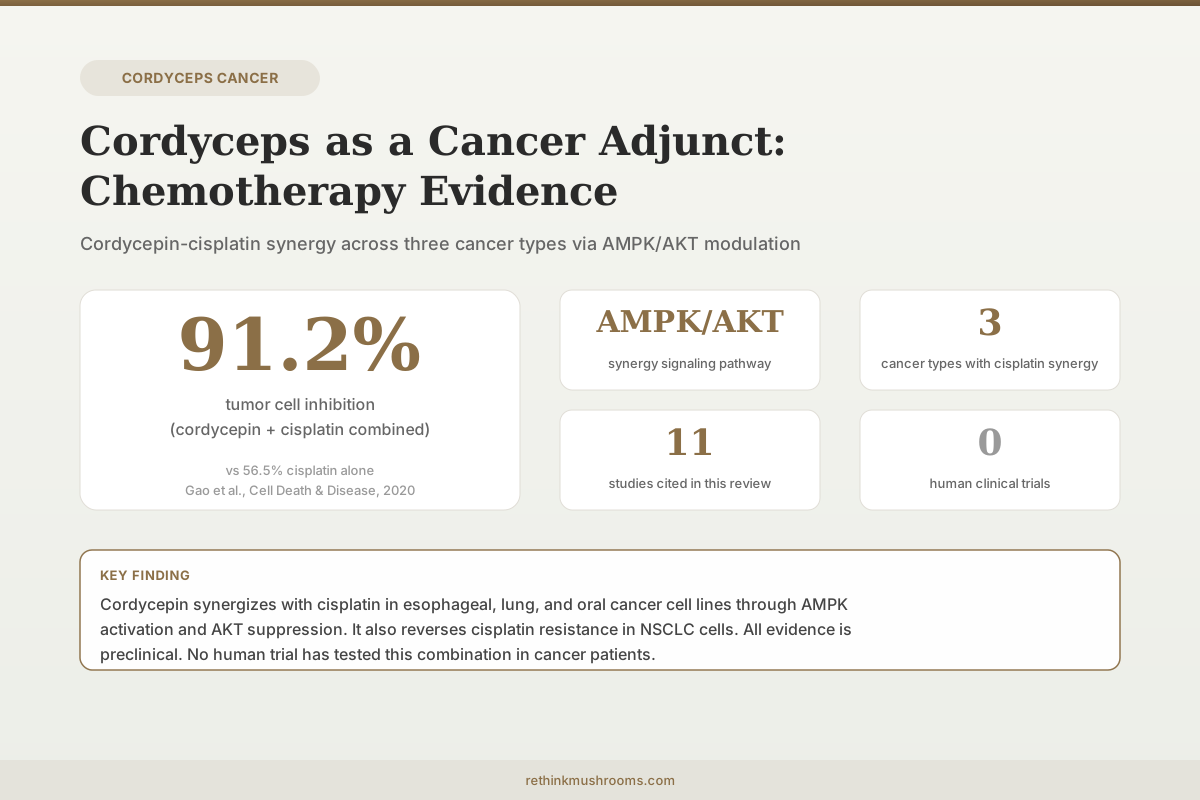
91.2% inhibition
When cordycepin was combined with cisplatin in esophageal cancer cells, tumor cell inhibition rose from 56.5% (cisplatin alone) to 91.2%, a synergistic effect mediated through AMPK activation.
Gao et al., Cell Death & Disease, 2020
AMPK/AKT
key synergy pathway
3 Cancer Types
cisplatin synergy demonstrated
0 Human Trials
on cordyceps + chemo
Gao et al., Cell Death & Disease, 2020
 View as image ↗
The question of whether cordyceps can support cancer treatment alongside conventional chemotherapy has generated a specific body of preclinical research. The evidence centers on cordycepin's ability to enhance the cancer-killing effects of cisplatin, a widely used chemotherapy drug, while potentially reducing the dose needed for therapeutic effect. Three independent studies have now demonstrated synergistic interactions between cordycepin and cisplatin in esophageal cancer, non-small cell lung cancer (NSCLC), and oral cancer cell lines, all converging on the same molecular mechanism: AMPK activation coupled with AKT pathway suppression. No human clinical trial has tested this combination, but the mechanistic consistency across cancer types has made it one of the more actively pursued areas in cordyceps pharmacology. For the broader picture of what cordyceps cancer research shows, that overview article covers the full evidence landscape.
Key Takeaways
- Cordycepin combined with cisplatin increased esophageal cancer cell inhibition from 56.5% to 91.2%, a synergistic effect confirmed by combination index analysis (Gao et al., 2020)
- In cisplatin-resistant NSCLC cells, cordycepin reversed drug resistance by activating AMPK and inhibiting the AKT signaling pathway (Liao et al., 2020)
- Cordycepin plus cisplatin synergistically induced apoptosis in oral cancer cells through JNK/caspase-7/PARP pathway activation (Chen et al., 2014)
- Cordycepin suppresses tumor angiogenesis by regulating focal adhesion kinase, cutting off blood supply to growing tumors (Lin et al., 2019)
- Cordycepin enhanced NK cell cytotoxicity against cholangiocarcinoma by upregulating NKG2D receptors and granzyme B secretion (Chaicharoenaudomrung et al., 2023)
- No published human trial has tested cordyceps or cordycepin as an adjunct to chemotherapy in cancer patients
Cordycepin and Cisplatin: The Synergy Evidence
Cisplatin is a platinum-based chemotherapy drug used against esophageal, lung, ovarian, bladder, and head-and-neck cancers. Its effectiveness is limited by two problems: dose-dependent toxicity (particularly to kidneys) and acquired drug resistance. Both problems create a rationale for combination agents that could enhance cisplatin's cancer-killing effect at lower doses or overcome resistance mechanisms.
Esophageal Cancer: Gao et al. (2020)
Gao et al. (2020) published the most detailed synergy study in Cell Death & Disease. In esophageal cancer cell lines, cisplatin alone inhibited cell growth by 56.5%. Adding cordycepin increased inhibition to 91.2%. Combination index (CI) analysis confirmed the interaction was synergistic (CI < 1), not merely additive.[1]
The mechanism involved dual pathway modulation. Cordycepin activated AMPK (AMP-activated protein kinase), the cellular energy sensor that suppresses growth when activated. Simultaneously, it suppressed AKT phosphorylation, shutting down the PI3K/AKT/mTOR survival pathway that cancer cells rely on to resist apoptosis. The downstream effects included increased cleaved caspase-3 and Bax (pro-apoptotic markers) and decreased Bcl-2 (anti-apoptotic). In vivo, the combination inhibited tumor growth in xenograft mouse models more effectively than either agent alone.
Non-Small Cell Lung Cancer: Liao et al. (2020)
Liao et al. (2020) addressed the resistance problem directly. Using cisplatin-resistant NSCLC cell lines (A549/DDP and H1299/DDP), they showed cordycepin reversed drug resistance through the same AMPK activation and AKT inhibition mechanism. The combination of cordycepin and cisplatin had synergistic effects in both sensitive and resistant cell lines.[2]
This is mechanistically important because cisplatin resistance is one of the primary reasons lung cancer treatment fails. If cordycepin can resensitize resistant cells, it could theoretically extend the clinical utility of cisplatin. The convergence on the same AMPK/AKT mechanism as the Gao et al. esophageal cancer study suggests a generalizable pathway rather than a cancer-type-specific interaction.
Oral Cancer: Chen et al. (2014)
Chen et al. (2014) tested cisplatin and cordycepin, individually and in combination, on OC3 human oral cancer cells. The combination produced synergistic apoptosis through a different downstream pathway: JNK/caspase-7/PARP activation. Morphological analysis showed increased chromatin condensation and nuclear fragmentation characteristic of programmed cell death.[3]
The JNK pathway involvement alongside the AMPK/AKT mechanism identified in later studies suggests cordycepin engages multiple pro-apoptotic cascades, which may explain why the synergy with cisplatin appears across different cancer types.
Beyond Cisplatin: Other Anti-Cancer Mechanisms
Interaction with Etoposide
Thomadaki et al. (2008) examined cordycepin's interaction with etoposide, another chemotherapy drug, in HL-60 leukemia cells. Cordycepin, as a polyadenylation inhibitor, affected the balance between pro- and anti-apoptotic gene expression. The study found that cordycepin could either enhance or modulate etoposide-induced apoptosis depending on the timing and concentration, highlighting that the interactions between cordycepin and chemotherapy drugs are context-dependent.[4]
Synergy with HMGB1 Knockdown in Leukemia
Chen et al. (2015) combined cordycepin with HMGB1 (high-mobility group box 1) knockdown in K562 chronic myeloid leukemia cells. HMGB1 is overexpressed in leukemia and promotes cell survival. The combination of HMGB1 suppression and cordycepin treatment produced enhanced anti-leukemic effects compared to either intervention alone.[5]
For the specific evidence on cordycepin and leukemia, that article covers the full range of leukemia cell line studies.
Anti-Angiogenesis: Cutting Off Tumor Blood Supply
Lin et al. (2019) demonstrated that cordycepin suppresses tumor angiogenesis through focal adhesion kinase (FAK) regulation. In endothelial cells, cordycepin inhibited proliferation, migration, and tube formation, the three processes required for new blood vessel growth. In mouse tumor models, cordycepin reduced tumor volume and microvessel density.[6]
Anti-angiogenic effects are particularly relevant to adjunct therapy because tumors depend on new blood vessel formation to grow beyond a few millimeters. Combining an anti-angiogenic agent with a cytotoxic drug like cisplatin attacks the tumor through two independent mechanisms, which is the basis for several approved cancer combination therapies.
Immune Enhancement Against Cancer Cells
Chaicharoenaudomrung et al. (2023) showed cordycepin enhances the ability of human NK cells to kill cancer cells. Cordycepin upregulated NKG2D activating receptors on NK cells, increased granzyme B and IFN-γ secretion, and improved killing of cholangiocarcinoma cells in co-culture experiments.[7]
This immune-mediated anti-cancer effect operates through a completely different mechanism than the direct cytotoxic effects of cisplatin combination. If cordycepin can simultaneously make chemotherapy more effective and enhance immune surveillance against cancer cells, the therapeutic rationale strengthens. The article on cordyceps and NK cell activity covers the immune enhancement evidence in detail.
HSP90 Inhibition: A Novel Cancer Target
Lee et al. (2022) identified a previously unknown mechanism: cordycepin suppresses heat shock protein 90 (HSP90) function. HSP90 is a molecular chaperone that stabilizes many oncoproteins, making it a cancer drug target. Several pharmaceutical HSP90 inhibitors are in clinical trials. Cordycepin's ability to disrupt HSP90 function through adenosine deaminase-dependent metabolism provides an additional mechanistic pathway for anti-tumor activity.[8]
The Autophagy Connection
Chen et al. (2021) reviewed the role of autophagy in cordycepin's anti-cancer effects. Autophagy, the process by which cells digest their own damaged components, can either promote cancer cell survival or trigger cell death depending on context. Cordycepin induces autophagy-dependent cell death in several cancer types through the adenosine A3 receptor and EGFR pathways.[9]
For the specific molecular details, see Cordycepin and Autophagy: How Cordyceps Triggers Cancer Cell Self-Destruction. The relationship between autophagy, apoptosis, and the AMPK pathway helps explain why cordycepin appears to enhance multiple chemotherapy drugs through overlapping mechanisms.
Cordyceps Extract vs. Purified Cordycepin
Hahne et al. (2014) tested whole Cordyceps sinensis extract (rather than purified cordycepin) against human endometrial cancer cells, alongside a Ganoderma/Agaricus blend. The cordyceps extract inhibited cancer cell growth and induced apoptosis. This is relevant because patients who use cordyceps alongside chemotherapy typically consume whole extracts, not purified cordycepin.[10]
The distinction matters for translation. Most synergy studies use purified cordycepin at defined concentrations. Whether commercial cordyceps supplements deliver sufficient cordycepin to replicate these effects in human tissue is unknown. The 2024 pharmacological review by Zhang et al. noted that cordycepin bioavailability is limited by rapid deamination by adenosine deaminase in vivo, suggesting that the concentrations used in cell studies may not be achievable through oral supplementation alone.[11]
The Translation Gap
Every study cited in this article is preclinical: cell lines, animal xenograft models, or in vitro co-culture systems. No randomized controlled trial has tested cordyceps or cordycepin as an adjunct to chemotherapy in cancer patients. The reasons are both scientific and regulatory.
Scientifically, the pharmacokinetic challenges are substantial. Cordycepin has a short plasma half-life due to rapid deamination. The concentrations that produce synergy with cisplatin in cell culture (typically 10-100 μM) may not be achievable in tumor tissue after oral ingestion of cordyceps supplements. Intravenous cordycepin delivery would require pharmaceutical-grade formulation and clinical-stage safety testing.
Regulatorily, testing a natural compound as a chemotherapy adjunct requires the same rigorous Phase I-III trial pathway as any new drug combination. The cost runs into hundreds of millions of dollars, and natural compounds cannot be patented, removing the financial incentive for pharmaceutical companies to fund such trials.
The preclinical evidence is mechanistically consistent and scientifically promising. The path from cell culture synergy to clinical adjunct therapy remains long and uncertain.
The Bottom Line
Cordycepin enhances cisplatin-mediated cancer cell killing in esophageal, lung, and oral cancer models through AMPK activation and AKT pathway suppression. Additional mechanisms include anti-angiogenesis via FAK regulation, NK cell enhancement through NKG2D upregulation, and HSP90 inhibition. All evidence is preclinical. No human trial has tested cordyceps as a chemotherapy adjunct. Bioavailability limitations due to rapid cordycepin deamination and the absence of pharmaceutical industry incentive to fund natural compound combination trials explain the translation gap.
Frequently Asked Questions
Sources & References
- 1RTHM-01190·Gao, Ying et al. (2020). “Cordycepin enhances the chemosensitivity of esophageal cancer cells to cisplatin by inducing the activation of AMPK and suppressing the AKT signaling pathway..” Cell death & disease.Study breakdown →PubMed →↩
- 2RTHM-01238·Liao, Xiao-Zhong et al. (2020). “Cordycepin Reverses Cisplatin Resistance in Non-small Cell Lung Cancer by Activating AMPK and Inhibiting AKT Signaling Pathway..” Frontiers in cell and developmental biology.Study breakdown →PubMed →↩
- 3RTHM-00581·Chen, Ying-hui et al. (2014). “Apoptotic effect of cisplatin and cordycepin on OC3 human oral cancer cells..” Chinese journal of integrative medicine.Study breakdown →PubMed →↩
- 4RTHM-00147·Thomadaki, Hellinida et al. (2008). “The role of cordycepin in cancer treatment via induction or inhibition of apoptosis: implication of polyadenylation in a cell type specific manner..” Cancer chemotherapy and pharmacology.Study breakdown →PubMed →↩
- 5RTHM-00367·Chen, Xi et al. (2015). “Synergistic effect of HMGB1 knockdown and cordycepin in the K562 human chronic myeloid leukemia cell line..” Molecular medicine reports.Study breakdown →PubMed →↩
- 6RTHM-00573·Lin, Yi-Ting et al. (2019). “Cordycepin Suppresses Endothelial Cell Proliferation, Migration, Angiogenesis, and Tumor Growth by Regulating Focal Adhesion Kinase and p53..” Cancers.Study breakdown →PubMed →↩
- 7RTHM-00816·Chaicharoenaudomrung, Nipha et al. (2023). “Cordycepin Enhances the Cytotoxicity of Human Natural Killer Cells against Cancerous Cells..” Biological & pharmaceutical bulletin.Study breakdown →PubMed →↩
- 8RTHM-00777·Lee, Su-Chan et al. (2022). “Cordycepin (3'-Deoxyadenosine) Suppresses Heat Shock Protein 90 Function and Targets Tumor Growth in an Adenosine Deaminase-Dependent Manner..” Cancers.Study breakdown →PubMed →↩
- 9RTHM-00680·Chen, Yu-Ying et al. (2021). “The Role of Autophagy in Anti-Cancer and Health Promoting Effects of Cordycepin..” Molecules (Basel.Study breakdown →PubMed →↩
- 10RTHM-00324·Hahne, Jens C et al. (2014). “The effect of Cordyceps extract and a mixture of Ganoderma lucidum/Agaricus Blazi Murill extract on human endometrial cancer cell lines in vitro..” International journal of oncology.Study breakdown →PubMed →↩
- 11RTHM-00918·Zhang, Jinming et al. (2024). “Structural and pharmacological insights into cordycepin for neoplasms and metabolic disorders..” Frontiers in pharmacology.Study breakdown →PubMed →↩