Cordyceps Immune
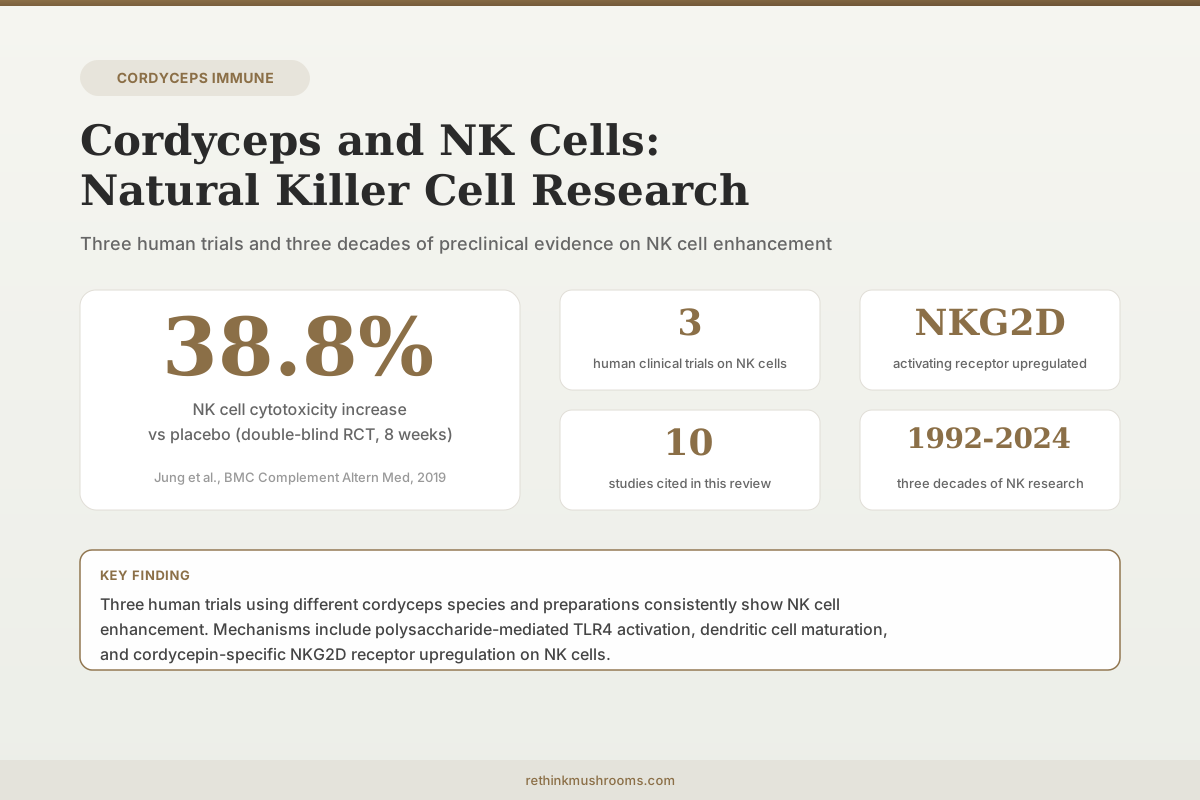
38.8% NK boost
In a randomized, double-blind trial, healthy adults taking a Cordyceps mycelium extract for 8 weeks showed a 38.8% increase in NK cell cytotoxic activity versus placebo.
Jung et al., BMC Complement Altern Med, 2019
3 Human Trials
measuring NK cell outcomes
NKG2D
activating receptor upregulated
1992-2024
three decades of NK research
Jung et al., BMC Complement Altern Med, 2019
 View as image ↗
Natural killer cells are the immune system's first-line surveillance against virus-infected and cancerous cells. They kill without needing prior sensitization, making them distinct from T cells, which require antigen presentation. Cordyceps has been studied for NK cell enhancement since 1992, when Xu et al. first demonstrated that an ethanol extract of Cordyceps sinensis increased both murine and human NK cell activity in vitro and in vivo. Three decades later, three human clinical trials have confirmed that cordyceps extracts increase NK cell cytotoxic activity in healthy adults, with two randomized double-blind placebo-controlled trials showing approximately 38% enhancement after 8 weeks. The mechanisms involve both polysaccharide-mediated innate immune activation and cordycepin-specific upregulation of NK cell activating receptors. For the broader picture of how these effects fit into cordyceps immunomodulatory research, that article covers the full immune landscape.
Key Takeaways
- A double-blind RCT found 1.68 g/day of Cordyceps mycelium extract (CBG-CS-2) increased NK cell cytotoxicity by 38.8% versus placebo over 8 weeks in 79 healthy adults (Jung et al., 2019)
- A 2024 RCT confirmed NK cell activity increases from a fermented C. militaris beverage, with effects appearing at 4 weeks in men and 8 weeks in women (Ontawong et al., 2024)
- Cordycepin upregulated NKG2D activating receptor expression on human NK cells and increased granzyme B and IFN-γ secretion, enhancing killing of cholangiocarcinoma cells in vitro (Chaicharoenaudomrung et al., 2023)
- In a 1992 foundational study, C. sinensis ethanol extract significantly enhanced both in vivo and in vitro murine NK activity and reduced B16 melanoma lung colony formation (Xu et al., 1992)
- C. militaris supplementation in healthy Korean men increased NK cell activity, lymphocyte proliferation, IL-2, and IFN-γ compared to placebo (Kang et al., 2015)
- Exo-polymers from C. sinensis augmented NK cytotoxicity against Yac-1 tumor cells and inhibited experimental lung metastasis of colon carcinoma (Yoon et al., 2008)
What NK Cells Do and Why They Matter
Natural killer cells are large granular lymphocytes that belong to the innate immune system. Unlike cytotoxic T cells, NK cells do not require major histocompatibility complex (MHC) recognition or prior antigen exposure to identify and destroy target cells. They detect stressed cells through a balance of activating and inhibitory receptors on their surface. When activating signals (from receptors like NKG2D, NKp30, NKp44) outweigh inhibitory signals (from killer immunoglobulin-like receptors recognizing MHC class I), the NK cell releases cytotoxic granules containing perforin and granzymes that trigger target cell death.
NK cell activity declines with age, chronic stress, and various disease states. Low NK cell activity is associated with increased susceptibility to viral infections and higher cancer incidence in epidemiological studies. This makes NK cell enhancement a target for immunomodulatory interventions, including medicinal mushrooms. Among beta-glucan-containing mushrooms that activate immune cells, cordyceps stands out for having the strongest human clinical trial evidence specifically for NK cell outcomes.
Human Clinical Trials: Three Studies, Consistent Results
Jung et al. (2019): The CBG-CS-2 Double-Blind RCT
The strongest evidence comes from Jung et al. (2019), who conducted a randomized, double-blind, placebo-controlled trial in 79 healthy Korean adults. The treatment group received 1.68 g/day of a Cordyceps sinensis mycelium culture extract (Paecilomyces hepiali, branded CBG-CS-2) in capsule form for 8 weeks.[1]
NK cell cytotoxic activity, measured as the ability of isolated NK cells to kill K562 target cells, increased by 38.8% from baseline in the treatment group. This increase was statistically significant compared to placebo. The study also measured T cell subsets (CD3+, CD4+, CD8+) and found no significant changes, suggesting the effect was specific to innate immune cells rather than adaptive immunity. Safety monitoring showed no adverse events, and liver and kidney function markers remained normal throughout the trial.
Ontawong et al. (2024): The C. militaris Beverage RCT
Ontawong et al. (2024) randomized healthy adults to receive either a fermented Cordyceps militaris beverage containing 2.85 mg cordycepin or placebo for 8 weeks. NK cell activity was measured at baseline, 4 weeks, and 8 weeks.[2]
NK cell activity increased in men at 4 weeks and in women at 8 weeks compared to baseline. The study also measured cytokine changes: IL-1β decreased in men and IL-6 decreased in women. The sex-dependent timing of response is notable and has not been fully explained, though hormonal differences in immune regulation may play a role. This trial used a different cordyceps species (C. militaris vs. C. sinensis) and a different preparation (fermented beverage vs. mycelium extract capsule) than Jung et al., yet produced similar NK cell enhancement.
Kang et al. (2015): Cell-Mediated Immunity in Korean Men
Kang et al. (2015) enrolled healthy Korean men in a trial of Cordyceps militaris supplementation. The treatment group showed statistically significant increases in NK cell activity (measured at effector-to-target ratio of 200:1), lymphocyte proliferation index, and the cytokines IL-2 and IFN-γ compared to placebo.[3]
This trial is notable because it measured not only NK cell killing activity but also the cytokine environment that supports NK cell function. IL-2 is a key growth factor for NK cells, and IFN-γ is both produced by and activates NK cells in a positive feedback loop. The simultaneous increase in both the cells and their supporting cytokines suggests that cordyceps activates the NK cell compartment through multiple mechanisms.
Together, these three trials tested two different cordyceps species, three different preparations, and both male and female participants, yet all showed NK cell enhancement. This consistency across different study designs strengthens the evidence considerably.
The Foundational Animal Evidence
Xu et al. (1992): The First NK Cell Study
Xu et al. (1992) published the first study directly examining cordyceps and NK cell activity. Using an ethanol extract of C. sinensis (CS-II), they demonstrated that both in vivo and in vitro murine NK activities increased after treatment. The study also showed that CS-II inhibited colony formation of B16 melanoma cells in mouse lungs, a functional readout of enhanced immune surveillance.[4]
The melanoma colony inhibition finding is important because it connects NK cell enhancement to an actual anti-tumor outcome, not just a surrogate marker. NK cells are the primary immune defense against metastatic seeding in the lungs, so increased NK activity correlating with reduced lung colonies provides mechanistic coherence.
Yoon et al. (2008): Polysaccharide-Mediated NK Enhancement
Yoon et al. (2008) prepared exo-polymers (EPS) from C. sinensis by submerged culture and tested their effects on innate immunity. Intravenous administration of EPS (100 μg/mouse) significantly augmented NK cell cytotoxicity against Yac-1 tumor cells within 2 days. The treatment also inhibited experimental lung metastasis of colon 26-M3.1 carcinoma. Peritoneal macrophages from EPS-treated mice showed increased production of TNF-α, IL-1, IL-6, and IL-10.[5]
This study is mechanistically informative because it identifies polysaccharides (not cordycepin) as the active fraction for innate immune stimulation. The rapid 2-day response timeline and the macrophage activation data suggest that cordyceps polysaccharides work through innate immune pattern recognition receptors rather than through the adenosine-receptor-mediated pathways that cordycepin uses.
Peng et al. (2016): NK Cells as Mediators of Liver Protection
Peng et al. (2016) showed that cultured mycelium C. sinensis protected against CCl4-induced liver fibrosis by activating hepatic NK cells. The critical evidence: when NK cells were depleted using an anti-ASGM1 antibody, the protective effect of cordyceps disappeared entirely. This demonstrated that NK cells were not just coincidentally activated but were the necessary mediators of the therapeutic effect.[6]
This finding extends NK cell enhancement beyond cancer surveillance into tissue protection, suggesting cordyceps-activated NK cells may play roles in resolving fibrosis and chronic inflammation. The article on cordyceps and inflammation covers the broader anti-inflammatory evidence.
How Cordycepin Directly Enhances NK Cell Killing
Chaicharoenaudomrung et al. (2023) investigated how cordycepin specifically affects human NK cell function against cancer cells. Treating NK cells with cordycepin upregulated NKG2D, a key activating receptor that recognizes stress ligands on tumor cells. Cordycepin also increased secretion of IFN-γ (which activates macrophages and enhances antigen presentation) and granzyme B (the serine protease that enters target cells through perforin pores and triggers apoptosis).[7]
When cordycepin-treated NK cells were co-cultured with cholangiocarcinoma (bile duct cancer) cells, cancer cell death increased compared to untreated NK cells. This study provides a molecular explanation for the enhanced killing observed in clinical trials: cordycepin does not just increase NK cell numbers but makes individual NK cells more cytotoxic by arming them with more activating receptors and cytolytic molecules.
Polysaccharide and Dendritic Cell Pathways
NK cell activity does not exist in isolation. Dendritic cells (DCs) are professional antigen-presenting cells that also produce IL-12, a critical activator of NK cells. Two studies connect cordyceps polysaccharides to DC maturation.
Kim et al. (2010) showed that cordlan, a polysaccharide isolated from C. militaris, induced dendritic cell maturation through Toll-like receptor 4 (TLR4). Mature DCs produced IL-12, which activates NK cells and shifts the immune response toward cell-mediated immunity.[8]
Song et al. (2011) demonstrated that an exopolysaccharide from a C. sinensis anamorph similarly stimulated dendritic cell maturation ex vivo. The matured DCs showed increased surface markers (CD80, CD86, MHC class II) and enhanced cytokine production.[9]
For a deeper analysis of this pathway, see Cordyceps and Dendritic Cell Maturation: Training the Immune System. The DC-NK cell axis is also relevant to how combining immune mushrooms might produce synergistic effects.
Clinical Application: Renal Transplant Immunomodulation
Li et al. (2009) tested C. sinensis as an adjunct to immunosuppressive therapy in 202 renal transplant patients. The treatment group received 1.0 g of C. sinensis three times daily alongside standard immunosuppression. After 3 months, the cordyceps group showed improved renal function markers and a lower incidence of complications compared to the control group.[10]
This study is relevant because it demonstrates that cordyceps can modulate immunity in a clinical context where immune balance is critical. Transplant patients need enough immune suppression to prevent rejection but enough immune function to fight infections. The finding that cordyceps improved outcomes alongside immunosuppressants suggests immunomodulation (balancing immune function) rather than simple immunostimulation (boosting everything indiscriminately).
For more on this clinical application, see Cordyceps for Immune Support After Illness or Surgery.
Limitations and Open Questions
The human trial evidence is encouraging but limited in scope. All three NK cell trials enrolled healthy adults, so whether cordyceps enhances NK cell activity in immunocompromised patients, elderly individuals with age-related NK decline, or cancer patients remains untested. Sample sizes were modest (79 participants in the largest trial). The sex-dependent timing differences observed by Ontawong et al. need replication and explanation.
The animal studies use intravenous or intraperitoneal administration of purified polysaccharide fractions, which does not reflect oral supplementation. Whether polysaccharide fractions survive gastrointestinal digestion and reach immune cells in sufficient concentrations after oral dosing is an important translational question. The human trials used whole extracts or fermented preparations, so the specific fractions responsible for NK cell enhancement in humans have not been identified.
Dose standardization is another gap. The three human trials used different preparations at different doses, making it difficult to determine an optimal dosage. Whether the NK cell enhancement is dose-dependent, whether it plateaus, and whether it persists after discontinuation are all unanswered.
The Bottom Line
Three human clinical trials consistently show that cordyceps extracts enhance NK cell cytotoxic activity in healthy adults, with two double-blind RCTs demonstrating approximately 38% increases after 8 weeks. The mechanisms involve both polysaccharide-mediated innate immune activation through TLR4 and dendritic cell maturation, and cordycepin-specific upregulation of NKG2D activating receptors on NK cells. Animal studies dating to 1992 connect enhanced NK activity to functional anti-tumor outcomes. Whether these effects translate to clinical benefit in immunocompromised or elderly populations remains untested.
Frequently Asked Questions
Sources & References
- 1RTHM-00563·Jung, Su-Jin et al. (2019). “Immunomodulatory effects of a mycelium extract of Cordyceps (Paecilomyces hepiali; CBG-CS-2): a randomized and double-blind clinical trial..” BMC complementary and alternative medicine.Study breakdown →PubMed →↩
- 2RTHM-00899·Ontawong, Atcharaporn et al. (2024). “A randomized controlled clinical trial examining the effects of Cordyceps militaris beverage on the immune response in healthy adults..” Scientific reports.Study breakdown →PubMed →↩
- 3RTHM-00378·Kang, Ho Joon et al. (2015). “Cordyceps militaris Enhances Cell-Mediated Immunity in Healthy Korean Men..” Journal of medicinal food.Study breakdown →PubMed →↩
- 4RTHM-00012·Xu, R H et al. (1992). “Effects of cordyceps sinensis on natural killer activity and colony formation of B16 melanoma..” Chinese medical journal.Study breakdown →PubMed →↩
- 5RTHM-00149·Yoon, Taek Joon et al. (2008). “Innate immune stimulation of exo-polymers prepared from Cordyceps sinensis by submerged culture..” Applied microbiology and biotechnology.Study breakdown →PubMed →↩
- 6RTHM-00440·Peng, Yuan et al. (2016). “Cultured Mycelium Cordyceps sinensis allevi¬ates CCl4-induced liver inflammation and fibrosis in mice by activating hepatic natural killer cells..” Acta pharmacologica Sinica.Study breakdown →PubMed →↩
- 7RTHM-00816·Chaicharoenaudomrung, Nipha et al. (2023). “Cordycepin Enhances the Cytotoxicity of Human Natural Killer Cells against Cancerous Cells..” Biological & pharmaceutical bulletin.Study breakdown →PubMed →↩
- 8RTHM-00188·Kim, Hyung Sook et al. (2010). “Cordlan polysaccharide isolated from mushroom Cordyceps militaris induces dendritic cell maturation through toll-like receptor 4 signalings..” Food and chemical toxicology : an international journal published for the British Industrial Biological Research Association.Study breakdown →PubMed →↩
- 9RTHM-00235·Song, Dan et al. (2011). “Ex vivo stimulation of murine dendritic cells by an exopolysaccharide from one of the anamorph of Cordyceps sinensis..” Cell biochemistry and function.Study breakdown →PubMed →↩
- 10RTHM-00161·Li, Y et al. (2009). “Clinical application of Cordyceps sinensis on immunosuppressive therapy in renal transplantation..” Transplantation proceedings.Study breakdown →PubMed →↩