Cordyceps & Immunity
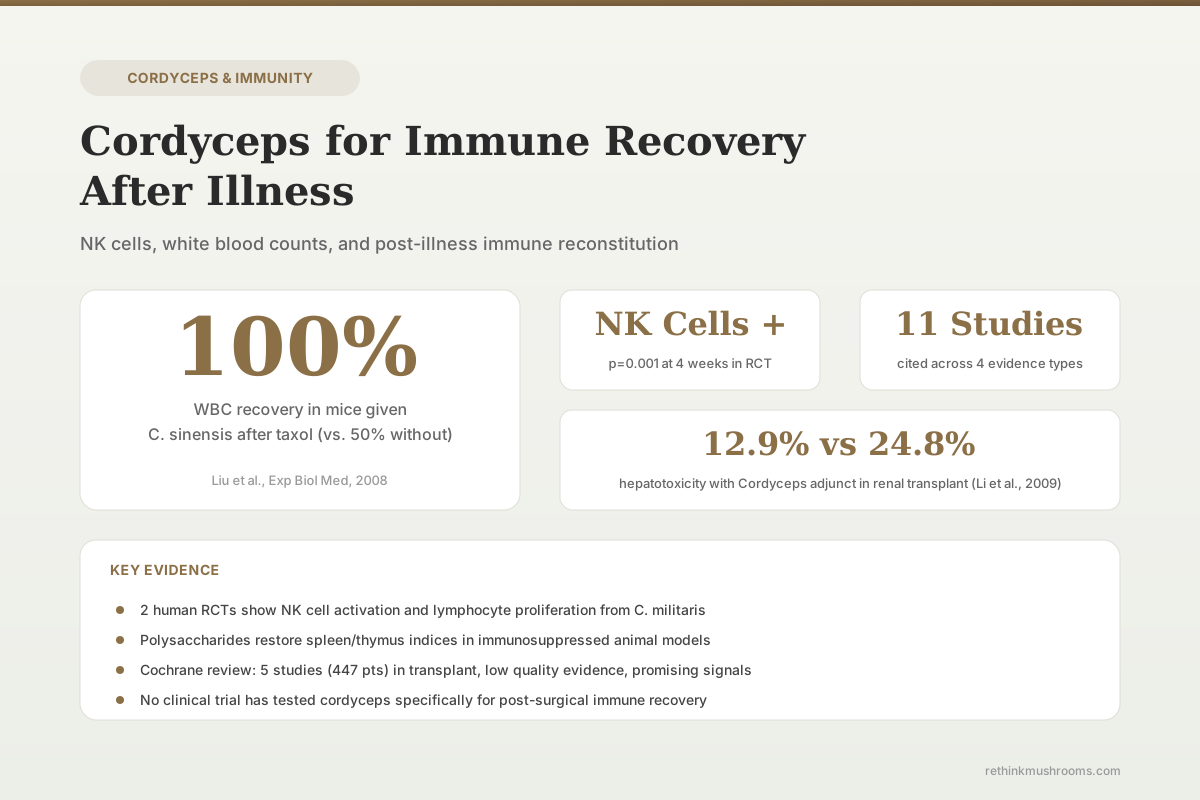
100% WBC Recovery
In cyclophosphamide-suppressed mice, Cordyceps militaris polysaccharides restored white blood cell counts and reversed spleen and thymus shrinkage within 21 days.
Wang et al., Carbohydrate Polymers, 2012
NK Cells
significantly increased after 4 weeks of C. militaris in healthy men (Kang et al., 2015)
50% → 100%
WBC recovery in taxol-treated mice given C. sinensis vs. 50% without (Liu et al., 2008)
12.9% vs 24.8%
hepatotoxicity in renal transplant patients using Cordyceps adjunct vs. control (Li et al., 2009)
Wang et al., Carbohydrate Polymers, 2012
 View as image ↗
Illness, surgery, and chemotherapy suppress the immune system through overlapping but distinct mechanisms: bone marrow suppression, lymphocyte depletion, cortisol elevation, and tissue inflammation that diverts immune resources from surveillance to wound repair. Cordyceps, a genus of parasitic fungi used for centuries in Chinese medicine to speed recovery from exhaustion, has accumulated a body of preclinical and clinical research testing whether its bioactive compounds can accelerate immune reconstitution in these states. For a broad overview of cordyceps immunology, see cordyceps and the immune system: immunomodulatory research. The evidence ranges from animal models of drug-induced immunosuppression to randomized controlled trials in healthy humans, with a smaller set of clinical data from transplant recipients. Most findings are promising but early-stage, and the gap between mouse immunology and human clinical outcomes remains wide.
Key Takeaways
- In a double-blind RCT, 1.5 g/day of Cordyceps militaris for 4 weeks significantly increased NK cell activity (p=0.001) and lymphocyte proliferation (p<0.0001) in 39 healthy men versus 40 placebo controls (Kang et al., 2015)
- A Cordyceps militaris beverage containing 2.85 mg cordycepin increased NK cell activity in men at 4 weeks and in women at 8 weeks compared to placebo in a randomized controlled trial (Ontawong et al., 2024)
- In taxol-treated mice, oral Cordyceps sinensis extract restored white blood cell counts to 100% of normal by day 28, versus 50% recovery without treatment (Liu et al., 2008)
- Cordyceps militaris polysaccharides reversed cyclophosphamide-induced immunosuppression in BALB/c mice, restoring spleen/thymus indices and increasing superoxide dismutase, catalase, and glutathione peroxidase levels (Wang et al., 2012)
- In 202 renal transplant patients, Cordyceps sinensis adjunct therapy reduced hepatotoxicity from 24.8% to 12.9% and nephrotoxicity from 33.9% to 19.4% while allowing lower cyclosporine doses (Li et al., 2009)
- A Cochrane review of 5 studies (447 participants) found Cordyceps may improve graft function and reduce infection rates in kidney transplant recipients, but evidence quality was low (Hong et al., 2015)
How Illness and Surgery Suppress Immunity
The immune system does not simply "weaken" during illness or after surgery. Specific compartments are affected in measurable ways. Major surgery triggers a systemic inflammatory response that suppresses cell-mediated immunity for days to weeks: NK cell cytotoxicity drops, T-cell proliferation decreases, and the balance between pro-inflammatory and anti-inflammatory cytokines shifts toward immunosuppression.
Chemotherapy compounds this further. Cytotoxic drugs like taxol (paclitaxel) and cyclophosphamide destroy rapidly dividing cells indiscriminately, depleting bone marrow progenitors and causing leukopenia, the clinical hallmark of treatment-induced immune vulnerability. Recovery from chemotherapy-induced leukopenia depends on the regenerative capacity of hematopoietic stem cells and the bone marrow microenvironment that supports them.
Chronic illness creates a third pattern: sustained low-grade inflammation that exhausts immune reserves. In this state, the immune system is not suppressed so much as misdirected, spending resources on inflammatory processes while leaving gaps in pathogen surveillance and tissue repair.
Cordyceps as an Immunomodulator: What the Research Shows
Cordyceps species produce several classes of bioactive compounds that interact with immune cells through distinct mechanisms. The two most studied are polysaccharides (primarily beta-glucans and galactomannans) and cordycepin (3'-deoxyadenosine), a nucleoside analog unique to Cordyceps.[1]
A 2020 review classified these effects by extraction method: water extracts and polysaccharides from C. militaris tend to promote type 1 immunity (NK cell activation, IFN-gamma production, macrophage stimulation), while ethanol extracts and cordycepin tend to promote type 2 immunity (anti-inflammatory cytokine production, regulatory T-cell modulation).[2] This distinction matters for recovery contexts: type 1 promotion helps fight infections during immunosuppression, while type 2 promotion helps control excessive inflammation after surgery. For more on cordycepin's anti-inflammatory mechanisms specifically, see cordycepin and TNF-alpha suppression: molecular anti-inflammatory evidence.
The broad review by Das et al. (2020) cataloged cytokine responses to Cordyceps extracts across multiple models, finding consistent increases in IL-1-beta, IL-2, IL-6, IL-8, IL-10, IL-12, and TNF-alpha, alongside enhanced macrophage phagocytosis and nitric oxide production.[1] These are not uniform "boosting" effects but context-dependent immune modulation, which is why the same genus can both enhance anti-pathogen responses and reduce inflammatory damage.
NK Cell and Lymphocyte Activation: Human Evidence
Two randomized controlled trials have directly measured immune cell changes in healthy adults taking Cordyceps militaris.
Kang et al. (2015) randomized 79 healthy Korean men to receive either 1.5 g/day of ethanol-treated C. militaris capsules (n=39) or placebo (n=40) for 4 weeks. The cordyceps group showed significant increases in NK cell activity at the 200:1 effector-to-target ratio (p=0.001), lymphocyte proliferation index (p<0.0001), IL-2 (p=0.0096), and IFN-gamma (p=0.0126) compared to placebo. No adverse reactions reached statistical significance.[3] This is the strongest human evidence that cordyceps activates cell-mediated immunity, the branch most suppressed after illness and surgery. For deeper analysis of NK cell mechanisms, see cordyceps and NK cell activity: natural killer cell enhancement.
Ontawong et al. (2024) tested a C. militaris fermented beverage containing 2.85 mg of cordycepin in a double-blind placebo-controlled trial with 10 men and 10 women per group over 8 weeks. NK cell activity increased significantly in men from baseline to 4 weeks (p=0.049) and in women from baseline to 8 weeks versus placebo (p=0.023). IL-1-beta levels decreased in men (p=0.049), and IL-6 decreased in women (p=0.047), suggesting concurrent anti-inflammatory effects alongside immune activation. No liver, kidney, or blood toxicity was detected.[4]
Both trials enrolled healthy volunteers, not patients recovering from illness or surgery. The findings establish that cordyceps can measurably activate immune cells in humans, but the clinical question of whether this translates to faster recovery in immunocompromised patients remains unresolved by direct evidence.
Rebuilding White Blood Cells After Chemotherapy
The animal evidence for cordyceps in chemotherapy recovery is more directly relevant to immune reconstitution than the healthy volunteer trials.
Liu et al. (2008) treated mice with taxol (17 mg/kg) one day before starting daily oral Cordyceps sinensis extract (50 mg/kg) for 3 weeks. By day 28, white blood cell counts in untreated taxol-exposed mice remained at 50% of normal. In mice receiving cordyceps, WBC counts had recovered completely to 100% of normal levels.[5]
The mechanism went beyond simple immune stimulation. In vitro assays showed cordyceps enhanced colony-forming ability of both granulocyte-macrophage progenitors (GM-CFU) and osteogenic cells from bone marrow, and promoted differentiation of bone marrow mesenchymal stromal cells into osteoblasts. This is relevant because osteoblasts are a critical component of the hematopoietic stem cell niche. Cordyceps appeared to protect and restore the structural microenvironment where blood cells are produced, not just stimulate existing immune cells to divide faster. The authors attributed this to enhanced expression of Cbfa1 and BMP-2 with concurrent suppression of RANK ligand. This mechanism is distinct from colony-stimulating factor drugs (G-CSF) that directly drive neutrophil production. For more on cordyceps as a chemotherapy adjunct, see cordyceps as a cancer adjunct: evidence for chemotherapy support.
Yamaguchi et al. (1990) tested C. sinensis extract in tumor-bearing mice and found it augmented macrophage chemotaxis approximately fourfold compared to untreated controls. In mice treated with cyclophosphamide (100 mg/kg), cordyceps restored macrophage phagocytic activity to above normal levels. Tumor-bearing mice receiving cordyceps also survived significantly longer after systemic Salmonella enteritidis infection, suggesting functional immune protection against secondary infection.[6]
These are animal studies with small sample sizes and cannot be directly extrapolated to human post-chemotherapy recovery. The doses used in mouse studies do not translate linearly to human dosing, and the immune systems of mice and humans differ in ways that can affect treatment responses.
Cordyceps in Post-Transplant Immune Management
Organ transplant recovery presents a paradox for immune support: the patient needs enough immune function to fight infections and heal wounds, but not so much that the immune system attacks the transplanted organ. Cordyceps has been studied in this context specifically in Chinese renal transplant programs.
Li et al. (2009) randomized 202 kidney transplant patients to receive either standard immunosuppressive therapy alone (n=109) or the same regimen plus Cordyceps sinensis at 1.0 g three times daily (n=93). Over follow-up, the cordyceps group showed significantly lower rates of hepatotoxicity (12.9% vs. 24.8%, p<0.05) and nephrotoxicity (19.4% vs. 33.9%, p<0.05). The cordyceps group required significantly lower cyclosporine doses at 2-6 months post-transplant, and fewer patients needed thymoglobulin antirejection therapy (3 vs. 13 cases, p=0.014). The incidence of chronic allograft nephropathy was also lower (7.5% vs. 18.4%, p=0.024).[7]
A Cochrane systematic review (Hong et al., 2015) evaluated five studies with 447 participants comparing cordyceps to azathioprine or cordyceps plus low-dose cyclosporine versus standard-dose cyclosporine. Compared to azathioprine, cordyceps showed no significant difference in graft or patient survival but may have improved graft function and reduced acute rejection episodes, anemia, leukopenia, and infection rates. The review concluded that limited reporting, small study sizes, and high risk of bias prevented confident conclusions, and that longer-term, adequately powered studies are needed.[8]
These findings are intriguing but carry important caveats. All included studies were conducted in China, and the Cochrane reviewers flagged unclear risks of bias across the board. The drug interaction profile of cordyceps with immunosuppressants is not fully characterized. For a review of known interactions, see cordyceps drug interactions: blood thinners, immunosuppressants, and more.
Polysaccharides and Immune Organ Recovery
Polysaccharides are the compound class most directly linked to immune organ recovery in animal models. For more detail on this compound class, see cordyceps militaris polysaccharides and immune activation.
Wang et al. (2012) treated 90 BALB/c mice with cyclophosphamide to induce immunosuppression, then administered C. militaris polysaccharides (CMP) at 17.5, 35, or 70 mg/kg body weight. CMP reversed cyclophosphamide-induced immunosuppression across multiple measures: spleen and thymus indices increased significantly, spleen lymphocyte proliferation was restored, and macrophage phagocytic function improved. Beyond immune cell metrics, CMP increased antioxidant enzyme levels (superoxide dismutase, catalase, glutathione peroxidase) and total antioxidant capacity while decreasing malondialdehyde, a marker of oxidative damage.[9]
Meng et al. (2019) used polysaccharides from a different species, Cordyceps gunnii, at 125-500 mg/kg in cyclophosphamide-suppressed BALB/c mice. The polysaccharide fraction elevated spleen and thymus indices, boosted NK cell cytotoxicity and lymphocyte proliferation, and accelerated recovery of peripheral white blood cells, red blood cells, hemoglobin, and platelets. Serum IL-2, IL-12, IFN-gamma, and IgG levels increased, while TGF-beta decreased. Western blotting identified the TLR4/TRAF6/NF-kB signaling pathway as the mechanism of immune activation.[10]
The spleen and thymus are primary and secondary lymphoid organs where immune cells mature and proliferate. Their shrinkage under immunosuppressive drugs is a direct measure of immune system damage, and their recovery is a prerequisite for immune reconstitution. The consistent finding that cordyceps polysaccharides restore these organ indices across species and drug models is mechanistically coherent with the clinical observations of reduced infection rates.
Cytokine Regulation During Recovery
Recovery from illness or surgery requires not just immune activation but precise calibration. Excess inflammation delays wound healing, damages tissues, and can trigger complications like sepsis. Cordyceps appears to modulate cytokines bidirectionally depending on the immunological context.
Sun et al. (2014) tested C. militaris micron powder at three doses in a human study and found that it downregulated inflammatory cytokines and chemokines, including GRO, sCD40L, TNF-alpha, IL-12(p70), IP-10, and MIP-1-beta.[11] This contrasts with the Kang et al. (2015) trial that showed increased IL-2 and IFN-gamma in a different preparation. The apparent contradiction likely reflects the Lee et al. (2020) classification: different extraction methods yield compounds with different immunological profiles. Water extracts and polysaccharides tend toward immune activation (type 1), while cordycepin-rich preparations tend toward anti-inflammatory regulation (type 2).[2]
For post-surgical recovery, both effects are theoretically valuable at different stages: early immune activation to prevent infection, followed by anti-inflammatory regulation as healing progresses. No study has tested this sequential approach. For broader context on cordyceps anti-inflammatory properties, see cordyceps and inflammation: anti-inflammatory mechanisms.
What the Evidence Does Not Show
The gap between these findings and clinical application for post-illness or post-surgical immune recovery is substantial.
No published clinical trial has tested cordyceps specifically in patients recovering from surgery, acute illness, or chemotherapy-induced immunosuppression. The human RCTs (Kang 2015, Ontawong 2024) enrolled healthy volunteers. The transplant studies (Li 2009) measured side effects and drug doses rather than immune cell recovery directly. The animal studies showing white blood cell recovery (Liu 2008, Wang 2012, Meng 2019) used drug-induced immunosuppression models that approximate but do not replicate post-surgical immune states.
The dose-response relationship in humans is poorly defined. Kang used 1.5 g/day of ethanol-extracted C. militaris; Ontawong used a beverage with 2.85 mg cordycepin; Sun used micron powder at varying doses. These are not comparable preparations, and the optimal form, dose, and duration for immune recovery are unknown.
Species and preparation matter. C. sinensis and C. militaris are different organisms with overlapping but distinct bioactive profiles. Wild-harvested, cultivated mycelium, cultivated fruiting body, and fermented preparations each contain different ratios of active compounds.
Cordyceps may increase bleeding risk, and the standard clinical guidance is to stop supplementation at least 2 weeks before scheduled surgery. This creates a practical constraint: the period of greatest immune vulnerability (immediately post-surgery) is precisely when cordyceps use carries the most concern. For information on drug interactions, see cordyceps drug interactions: blood thinners, immunosuppressants, and more.
The Bottom Line
Cordyceps demonstrates measurable immune-activating effects across multiple evidence types: human RCTs show increased NK cell activity and lymphocyte proliferation in healthy adults, animal studies show complete white blood cell recovery after chemotherapy-induced suppression, and transplant data suggest reduced infection rates and drug toxicity. The specific application to post-illness and post-surgical recovery lacks direct clinical testing. The compounds are biologically active, the mechanisms are plausible, and the safety profile in existing studies is reassuring, but the clinical evidence to guide use in immunocompromised recovery remains preclinical.
Frequently Asked Questions
Sources & References
- 1RTHM-01184·Das, Gitishree et al. (2020). “Cordyceps spp.: A Review on Its Immune-Stimulatory and Other Biological Potentials..” Frontiers in pharmacology.Study breakdown →PubMed →↩
- 2RTHM-01226·Lee, Chun-Ting et al. (2020). “Trends in the Immunomodulatory Effects of Cordyceps militaris: Total Extracts, Polysaccharides and Cordycepin..” Frontiers in pharmacology.Study breakdown →PubMed →↩
- 3RTHM-00378·Kang, Ho Joon et al. (2015). “Cordyceps militaris Enhances Cell-Mediated Immunity in Healthy Korean Men..” Journal of medicinal food.Study breakdown →PubMed →↩
- 4RTHM-00899·Ontawong, Atcharaporn et al. (2024). “A randomized controlled clinical trial examining the effects of Cordyceps militaris beverage on the immune response in healthy adults..” Scientific reports.Study breakdown →PubMed →↩
- 5RTHM-00266·Liu, Wei-Chung et al. (2008). “Cordyceps sinensis health supplement enhances recovery from taxol-induced leukopenia..” Experimental biology and medicine (Maywood.Study breakdown →PubMed →↩
- 6RTHM-00028·Yamaguchi, N et al. (1990). “Augmentation of various immune reactivities of tumor-bearing hosts with an extract of Cordyceps sinensis..” Biotherapy (Dordrecht.Study breakdown →PubMed →↩
- 7RTHM-00161·Li, Y et al. (2009). “Clinical application of Cordyceps sinensis on immunosuppressive therapy in renal transplantation..” Transplantation proceedings.Study breakdown →PubMed →↩
- 8RTHM-00375·Hong, Tao et al. (2015). “Cordyceps sinensis (a traditional Chinese medicine) for kidney transplant recipients..” The Cochrane database of systematic reviews.Study breakdown →PubMed →↩
- 9RTHM-00497·Wang, Mi et al. (2012). “Cordyceps militaris polysaccharides can enhance the immunity and antioxidation activity in immunosuppressed mice..” Carbohydrate polymers.Study breakdown →PubMed →↩
- 10RTHM-01107·Meng, Meng et al. (2019). “Protective effects of polysaccharides from Cordyceps gunnii mycelia against cyclophosphamide-induced immunosuppression to TLR4/TRAF6/NF-κB signalling in BALB/c mice..” Food & function.Study breakdown →PubMed →↩
- 11RTHM-00649·Sun, Yong et al. (2014). “Regulation of human cytokines by Cordyceps militaris..” Journal of food and drug analysis.Study breakdown →PubMed →↩