Cordyceps Immune Support & Recovery
32% polysaccharide
In a placebo-controlled human trial, Cordyceps militaris capsules standardized to 32% polysaccharide content significantly increased NK cell activity in healthy adults.
Kang et al., Journal of Medicinal Food, 2015
TLR2, TLR4, Dectin-1
the three surface receptors through which polysaccharides activate macrophages (Lee et al., Carbohydrate Polymers, 2015)
PD-L1/PD-1 disruption
C. militaris polysaccharide reversed immunosuppressive macrophage polarization by disrupting the immune checkpoint axis (Bi et al., 2020)
Polysaccharides vs. cordycepin
separate fractions produce distinct immune effects: polysaccharides drive macrophage activation; cordycepin modulates cytokines and NK cytotoxicity (Lee et al., 2020)
Kang et al., Journal of Medicinal Food, 2015
 View as image ↗
Most supplement articles treat Cordyceps extract as a single thing. But when researchers separated the mushroom into its component fractions, a clear picture emerged: the polysaccharides do most of the immune heavy lifting, and they do it through a specific signaling pathway that begins at the surface of an immune cell and ends with a macrophage in active attack mode.
A 2020 review in Frontiers in Pharmacology analyzed the cordyceps militaris polysaccharides immune research systematically and separated three active fractions (total extracts, polysaccharides, and cordycepin) and found that each produces distinct immune effects.[2] Polysaccharides are the primary activators of innate immunity: they turn on macrophages, stimulate dendritic cell maturation, and enhance natural killer cell activity. Cordycepin, the nucleoside compound that receives most of the supplement marketing attention, works through a different mechanism with more anti-inflammatory and cytotoxic properties.
This separation matters because it explains what you are actually buying when you purchase a Cordyceps supplement. For the broader context of what Cordyceps is and what it is used for, see what is Cordyceps: the science behind the energy mushroom.
Key Takeaways
- A 2020 Frontiers in Pharmacology systematic review established that polysaccharides, cordycepin, and total extracts each produce distinct and separable immune effects; polysaccharides are the primary innate immune activators
- C. militaris polysaccharides bind TLR2, TLR4, and Dectin-1 receptors on macrophage surfaces, triggering calcium release and MAPK/NF-κB signaling cascades that activate phagocytosis, nitric oxide production, and cytokine secretion (Lee et al., 2015; Liu et al., 2024)
- Cordlan polysaccharide (isolated from C. militaris) triggers dendritic cell maturation specifically via TLR4 signaling, an upstream activation step that subsequently trains T-cell responses (Kim et al., 2010)
- C. militaris polysaccharide converted tumor-associated macrophages from an immunosuppressive state to an immune-activating state by disrupting the PD-L1/PD-1 checkpoint axis (Bi et al., 2020); this finding is not covered in any competing consumer article
- In a placebo-controlled RCT, C. militaris capsules standardized to 32% polysaccharide significantly increased NK cell activity at 4 weeks in men and 8 weeks in women (Kang et al., 2015)
- A 2024 randomized trial in healthy adults found measurable immune response improvements from a C. militaris beverage, providing recent clinical support for polysaccharide efficacy (Ontawong et al., 2024)
What Cordyceps militaris Polysaccharides Are, and Why They Differ from Cordycepin
Cordyceps militaris contains two types of bioactive compounds that affect immunity through very different mechanisms.
Polysaccharides are long chains of sugar molecules that form the structural backbone of the fungal cell wall. They are large, water-soluble molecules that cannot enter cells directly. Instead, they work by binding to receptors on the outer surface of immune cells and triggering a signaling cascade from the outside in.
Cordycepin (3'-deoxyadenosine) is a nucleoside. It resembles adenosine and can enter cells and interact with intracellular machinery directly. It works through RNA and DNA pathways, suppresses certain inflammatory signals via NF-κB, and directly enhances the cytotoxic (killing) activity of natural killer cells.
Lee and colleagues, in their 2020 Frontiers in Pharmacology review, synthesized the research on both fractions and established the clearest description of how they differ.[2] Polysaccharides drive broad innate immune activation: they turn on macrophages, boost phagocytosis, stimulate cytokine production, and help dendritic cells mature. Cordycepin plays a more targeted role, regulating specific cytokines and enhancing the killing precision of NK cells.
The most comprehensive recent review, published in Molecules in 2024, confirmed this picture with coverage of more than a decade of polysaccharide-specific studies.[1] It documented polysaccharide activity across macrophages, lymphocytes, and dendritic cells, with animal studies showing protection from cyclophosphamide-induced immunosuppression and drug-induced immune damage.
For the molecular details on how cordycepin specifically inhibits NF-κB and suppresses inflammatory signaling, see cordycepin and NF-κB: how it suppresses inflammatory pathways.
The Three Receptors: How Polysaccharides Signal to the Immune System
When a Cordyceps militaris polysaccharide molecule encounters a macrophage, it binds to one or more of three surface proteins: TLR2, TLR4, or Dectin-1. These are pattern recognition sensors that immune cells use to detect the molecular signatures of microbes and fungi. Polysaccharides, which form the outer walls of fungi and bacteria, carry the right molecular pattern to trigger these sensors.
Lee and colleagues mapped this receptor mechanism in detail in a 2015 Carbohydrate Polymers study.[3] They found that C. militaris polysaccharide binds to TLR2, TLR4, and Dectin-1 simultaneously. Each receptor can trigger the activation pathway independently, but all three together produce a stronger and more coordinated response. After receptor binding, calcium is released inside the cell. That calcium pulse activates a family of signaling proteins, in particular MAPK enzymes and NF-κB, which function like relay switches passing the alarm signal deeper into the cell.
A 2024 study in Molecules confirmed and extended the MAPK finding.[4] Liu and colleagues showed that C. militaris polysaccharide activated mouse macrophages through MAPK phosphorylation, producing measurable increases in phagocytosis (the macrophage's capacity to engulf and destroy pathogens), nitric oxide production (a chemical used to kill bacteria and infected cells), and inflammatory gene expression. The receptor profile was consistent with the Lee 2015 findings: TLR2, TLR4, and Dectin-1 as the entry points.
Earlier foundational work by Yoon and colleagues in 2008 established that the exo-polymers (polysaccharides released into the culture medium by growing C. sinensis) were sufficient to activate macrophages and trigger cytokine production on their own, establishing the polysaccharide fraction as the active innate immune component even before the receptor mechanisms were mapped.[9]
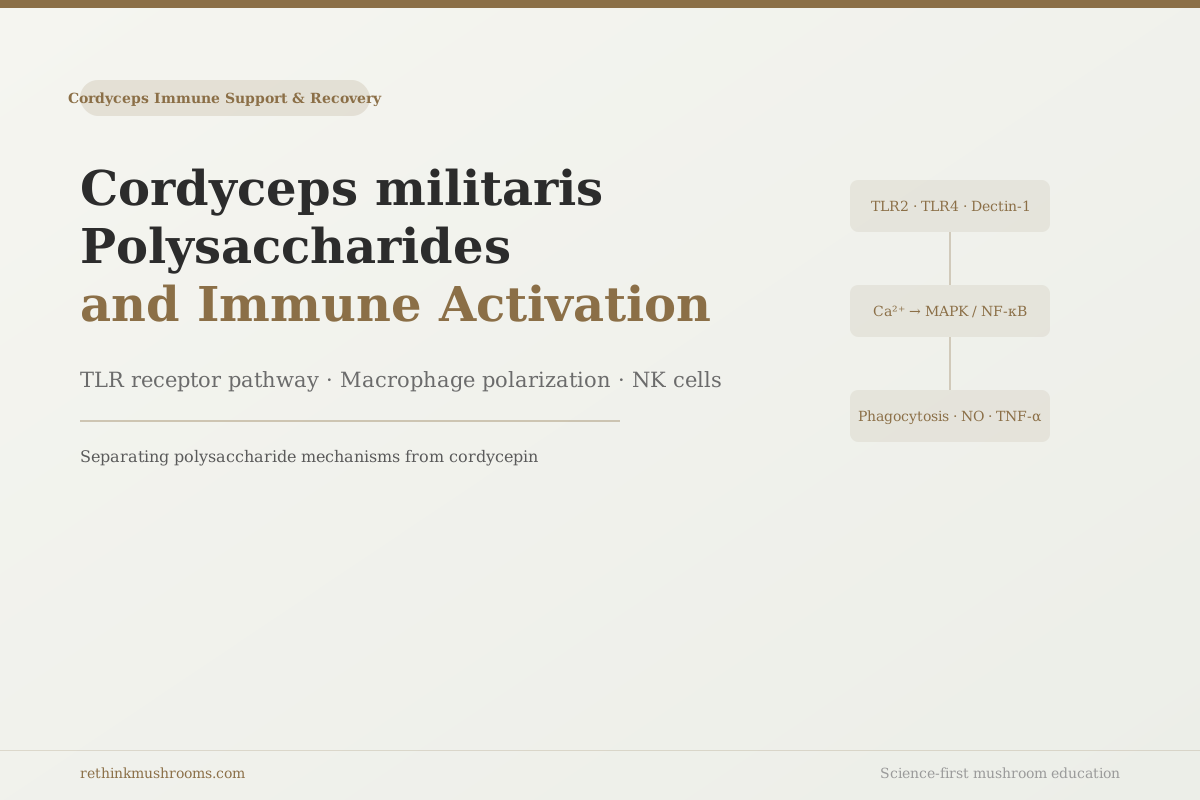
How this pathway produces immune activation can be summarized as follows: polysaccharide binds TLR2/TLR4/Dectin-1, triggering calcium release and MAPK/NF-κB signaling, which shifts the macrophage into active mode with increased phagocytosis, nitric oxide production, cytokine secretion, and downstream recruitment of additional immune cells.
Mechanism · Receptor Signaling
From Polysaccharide to Activated Macrophage
One polysaccharide molecule binds all three surface receptors at once. Each can fire the pathway alone; together they produce a stronger, more coordinated response.
TLR2
Toll-like receptor 2 — senses microbial wall patterns
TLR4
Toll-like receptor 4 — the receptor Cordlan signals through for DC maturation
Dectin-1
Lectin receptor that recognizes fungal beta-glucan structures
Calcium release → MAPK / NF-κB signaling
relay switches pass the alarm deeper into the cell
Macrophage in active mode
Phagocytosis
macrophage engulfs and destroys pathogens
Nitric oxide
chemical used to kill bacteria and infected cells
Cytokine secretion
IL-6, TNF-alpha and others recruit more immune cells
Source: Lee et al. (Carbohydrate Polymers, 2015); Liu et al. (Molecules, 2024)
View as image ↗From Macrophages to Dendritic Cells: Polysaccharides Train Adaptive Immunity
Macrophage activation is the first line of innate immune response. But polysaccharides also interact with dendritic cells (the immune system's professional trainers that link innate responses to the adaptive immune system).
Dendritic cells (the name describes their branching tree-like shape) sample the environment for foreign material, digest it, and then present fragments of it to T cells. This presentation step is how the adaptive immune system "learns" to recognize specific threats and produce targeted antibody and cellular responses.
Kim and colleagues isolated a specific polysaccharide from C. militaris called Cordlan and tested its effects on dendritic cells in 2010.[7] They found that Cordlan triggered dendritic cell maturation specifically through TLR4 signaling. Mature dendritic cells are more effective at presenting antigens to T cells, meaning that polysaccharide-triggered DC maturation represents an upstream step that amplifies the downstream adaptive immune response.
Song and colleagues extended this in 2013, showing that Cordyceps sinensis exopolysaccharide also modulated dendritic cell behavior, providing further evidence that the DC-modulating mechanism is consistent across Cordyceps species and polysaccharide types.[8]
This dendritic cell mechanism distinguishes Cordyceps polysaccharides from simpler immune stimulants. Compounds that only activate macrophages produce a generalized innate response. Compounds that also mature dendritic cells have the potential to shape the longer-lasting adaptive immune memory. For a deeper look at this dendritic cell pathway and its implications, see Cordyceps and dendritic cell maturation: training the immune system.
The PD-L1 Discovery: When Polysaccharides Override Immune Suppression
The most striking finding in recent Cordyceps polysaccharide research has received almost no attention outside the academic literature.
Cancer cells and the tumors they form can turn off the immune cells that surround them. They do this by displaying a surface protein called PD-L1 (programmed death-ligand 1). When PD-L1 binds to a receptor called PD-1 on the surface of T cells, it tells the T cell to stop attacking. Tumor-associated macrophages (the macrophages that infiltrate tumors) can be converted to an immunosuppressive state where they help amplify this PD-L1 signal, further protecting the tumor from immune attack.
Bi and colleagues showed in 2020 that C. militaris polysaccharide disrupts this mechanism through two simultaneous actions.[6] First, it reduced PD-L1 expression on the surface of tumor-associated macrophages, weakening the stop signal sent to T cells. Second, it reprogrammed those macrophages from an immunosuppressive state (called M2 polarization) to an immune-activating state (called M1 polarization). M1 macrophages release inflammatory signals that help kill tumor cells rather than shelter them.
The result was a restoration of T-cell activity in the tumor environment: T cells that had been silenced by PD-L1 signaling became active again.
This is an in vitro finding, not a clinical trial. It does not mean Cordyceps polysaccharide has been shown to treat cancer in humans. But the mechanism it describes is biologically meaningful: polysaccharides operating on the same checkpoint axis that pharmaceutical checkpoint inhibitors (pembrolizumab, nivolumab) target, through a different approach. No consumer-facing Cordyceps article covers this finding. For the broader immune research, see Cordyceps and the immune system: immunomodulatory research.
NK Cells, Cytokines, and How Polysaccharides Compare to Cordycepin
Beyond macrophages and dendritic cells, polysaccharides also influence natural killer cells and the broader cytokine environment.
Lee and colleagues showed in 2011 that purified C. militaris polysaccharides significantly enhanced NK cell activity and phagocytosis in immune cell assays, and established the polysaccharide fraction (not total extract, not cordycepin) as the primary immunostimulatory component responsible for NK enhancement.[5]
Sun and colleagues added a cytokine dimension in 2014, showing that C. militaris extract regulated a broad panel of human cytokines including IL-2, IL-6, TNF-alpha, and IFN-gamma.[10] These cytokines coordinate communication between different immune cells: IL-2 drives T-cell proliferation; IFN-gamma activates macrophages; TNF-alpha recruits more immune cells to sites of infection or damage.
Cordycepin takes a different approach to NK cells. Chaicharoenaudomrung and colleagues showed in 2023 that cordycepin directly enhanced NK cell cytotoxic activity against cancer cells by upregulating NKG2D (a surface receptor that NK cells use to recognize cancer cells as targets) and perforin (the molecule NK cells use to kill those targets).[11]
The distinction is meaningful. Polysaccharides enhance NK cell activity through the upstream macrophage and DC activation pathway; the immune system as a whole becomes more alert and better coordinated. Cordycepin enhances NK cell killing directly by sharpening the cellular weapons NK cells use. These are complementary mechanisms, not redundant ones. For a dedicated look at NK cell research, see Cordyceps and NK cell activity: natural killer cell enhancement.
Clinical Evidence: Do Cordyceps militaris Polysaccharides Activate Immunity in Humans?
The cell culture and animal research above maps the mechanisms. Two randomized controlled trials ask whether the polysaccharide immune effects observed in the lab translate to humans.
Kang and colleagues ran a placebo-controlled trial testing C. militaris capsules standardized to 32% polysaccharide content in healthy Korean adults.[12] They measured NK cell activity before and after supplementation. Men showed significantly increased NK cell activity at the 4-week measurement. Women showed the same effect at 8 weeks. No significant adverse effects were observed. This is one of the clearest confirmations in the clinical literature that the polysaccharide-mediated NK activation seen in cell studies translates to measurable effects in healthy human participants, though the sex-dependent response timeline suggests the effect magnitude or rate of onset may vary.
Ontawong and colleagues published a more recent randomized controlled clinical trial in Scientific Reports in 2024, testing a C. militaris beverage formulation in healthy adults.[13] The trial found measurable improvements in immune response markers over the trial period, providing independent confirmation from a different formulation and study group.
Kang et al. (2015) · Journal of Medicinal Food
- Population
- Healthy Korean adults
- Intervention
- C. militaris capsules standardized to 32% polysaccharide content
- Comparator
- Placebo
- Finding
- NK cell activity increased significantly versus placebo — at 4 weeks in men and 8 weeks in women. No significant adverse effects were reported.
positive A direct human confirmation that polysaccharide-mediated NK activation seen in cell studies translates to measurable effects in people; the sex-dependent timeline suggests onset rate may vary.
Kang et al., Journal of Medicinal Food, 2015
Ontawong et al. (2024) · Scientific Reports
- Population
- Healthy adults
- Intervention
- C. militaris beverage formulation
- Comparator
- Control
- Finding
- Measurable improvements in immune response markers over the trial period, from a different formulation and study group than the 2015 capsule trial.
positive Independent, more recent confirmation — but again in healthy adults, not patient populations.
Ontawong et al., Scientific Reports, 2024
Both trials were conducted in healthy adults without immune deficiencies. Whether polysaccharide immune activation produces the same effect in immunocompromised patients, older adults, or people recovering from illness is a separate question that the available RCTs do not fully answer. For the clinical evidence on Cordyceps in post-illness and surgical recovery contexts specifically, see Cordyceps for immune support after illness or surgery.
The clinical evidence is consistent with the preclinical picture but limited in depth: two relatively small trials in healthy populations, no dose-optimization data comparing different polysaccharide concentrations, and no head-to-head trials separating polysaccharide from total extract effects in humans.
For a broader look at Cordyceps safety and what happens when its immune-activating effects interact with medications or surgical procedures, see Cordyceps side effects: what the safety research shows.
- Cell & Lab Studiescompleted
Receptor mapping (TLR2/TLR4/Dectin-1), MAPK/NF-κB signaling, NK and dendritic-cell activation, and the PD-L1 macrophage-reprogramming finding (Lee 2015; Liu 2024; Lee 2011; Kim 2010; Bi 2020)
- Animal Studiescompleted
Protection from cyclophosphamide-induced immunosuppression and drug-induced immune damage (reviewed in Chen 2024)
- Case Reports & Early Seriescompleted
Early exo-polymer and exopolysaccharide work established the polysaccharide fraction as the active innate-immune component (Yoon 2008; Song 2013)
- Small Human Trialscurrent
Two RCTs in healthy adults: Kang 2015 (NK activity) and Ontawong 2024 (immune markers)
- Large Randomized Trialsmissing
No large multi-center trials; no dose-optimization or head-to-head polysaccharide-vs-extract trials in humans
- Meta-Analyses & Systematic Reviewsmissing
No human meta-analysis of polysaccharide immune endpoints
The mechanism is exceptionally well-characterized in cells and animals, but human evidence stops at two small trials in healthy adults. There is no large-trial, dose-optimization, or patient-population data — so 'activates immunity in humans' is supported but not yet robustly established.
Aggregate of the cited preclinical studies plus Kang 2015 and Ontawong 2024
Safety — immune activation in context
ModerateImmune activation is not automatically a benefit for everyone
Concern
Cordyceps polysaccharides are designed to turn the immune system up. For people on immunosuppressive medication (after an organ transplant or for autoimmune disease), or those approaching surgery, increased immune activity could in principle work against their treatment. The human trials were run only in healthy adults, so this interaction has not been studied directly.
What the research says
Treat immune-stimulating supplements as something to clear with a clinician if you take immunosuppressants, have an autoimmune condition, or have surgery scheduled. The benefit shown in trials was in healthy people with normal immune systems.
Particularly relevant for: People on immunosuppressants, with autoimmune disease, or scheduled for surgery
What to do
Consult a physician before use if any of the above applies. This article is educational and is not medical advice.
Safety framing based on the populations excluded from Kang 2015 and Ontawong 2024
The Bottom Line
Cordyceps militaris polysaccharides activate innate immunity through a well-characterized receptor pathway: binding to TLR2, TLR4, and Dectin-1 on macrophage and dendritic cell surfaces triggers calcium release and MAPK/NF-κB signaling, producing phagocytosis, nitric oxide, cytokine secretion, and dendritic cell maturation. A separate finding (Bi et al., 2020) showed polysaccharides can reverse M2 macrophage immunosuppression by disrupting the PD-L1/PD-1 checkpoint axis. These mechanisms are distinct from cordycepin, which modulates cytokines and sharpens NK cell killing. Two human RCTs confirm NK cell activation in healthy adults, though clinical evidence in patient populations remains limited.
Frequently Asked Questions
Sources & References
- 1RTHM-01868·Chen, Liping et al. (2024). “Cordyceps Polysaccharides: A Review of Their Immunomodulatory Effects..” Molecules (Basel.Study breakdown →PubMed →↩
- 2RTHM-01226·Lee, Chun-Ting et al. (2020). “Trends in the Immunomodulatory Effects of Cordyceps militaris: Total Extracts, Polysaccharides and Cordycepin..” Frontiers in pharmacology.Study breakdown →PubMed →↩
- 3RTHM-00707·Lee, Jong Seok et al. (2015). “Mechanism of macrophage activation induced by polysaccharide from Cordyceps militaris culture broth..” Carbohydrate polymers.Study breakdown →PubMed →↩
- 4RTHM-01938·Liu, Yan et al. (2024). “Immunomodulatory Effect of Cordyceps militaris Polysaccharide on RAW 264.7 Macrophages by Regulating MAPK Signaling Pathways..” Molecules (Basel.Study breakdown →PubMed →↩
- 5RTHM-00412·Lee, Jong Seok et al. (2011). “Immunostimulating activity of the polysaccharides isolated from Cordyceps militaris..” International immunopharmacology.Study breakdown →PubMed →↩
- 6RTHM-01171·Bi, Sixue et al. (2020). “Cordyceps militaris polysaccharide converts immunosuppressive macrophages into M1-like phenotype and activates T lymphocytes by inhibiting the PD-L1/PD-1 axis between TAMs and T lymphocytes..” International journal of biological macromolecules.Study breakdown →PubMed →↩
- 7RTHM-00188·Kim, Hyung Sook et al. (2010). “Cordlan polysaccharide isolated from mushroom Cordyceps militaris induces dendritic cell maturation through toll-like receptor 4 signalings..” Food and chemical toxicology : an international journal published for the British Industrial Biological Research Association.Study breakdown →PubMed →↩
- 8RTHM-00307·Song, Dan et al. (2013). “Regulation of the exopolysaccharide from an anamorph of Cordyceps sinensis on dendritic cell sarcoma (DCS) cell line..” European journal of nutrition.Study breakdown →PubMed →↩
- 9RTHM-00149·Yoon, Taek Joon et al. (2008). “Innate immune stimulation of exo-polymers prepared from Cordyceps sinensis by submerged culture..” Applied microbiology and biotechnology.Study breakdown →PubMed →↩
- 10RTHM-00649·Sun, Yong et al. (2014). “Regulation of human cytokines by Cordyceps militaris..” Journal of food and drug analysis.Study breakdown →PubMed →↩
- 11RTHM-00816·Chaicharoenaudomrung, Nipha et al. (2023). “Cordycepin Enhances the Cytotoxicity of Human Natural Killer Cells against Cancerous Cells..” Biological & pharmaceutical bulletin.Study breakdown →PubMed →↩
- 12RTHM-00378·Kang, Ho Joon et al. (2015). “Cordyceps militaris Enhances Cell-Mediated Immunity in Healthy Korean Men..” Journal of medicinal food.Study breakdown →PubMed →↩
- 13RTHM-00899·Ontawong, Atcharaporn et al. (2024). “A randomized controlled clinical trial examining the effects of Cordyceps militaris beverage on the immune response in healthy adults..” Scientific reports.Study breakdown →PubMed →↩