Cordyceps Safety
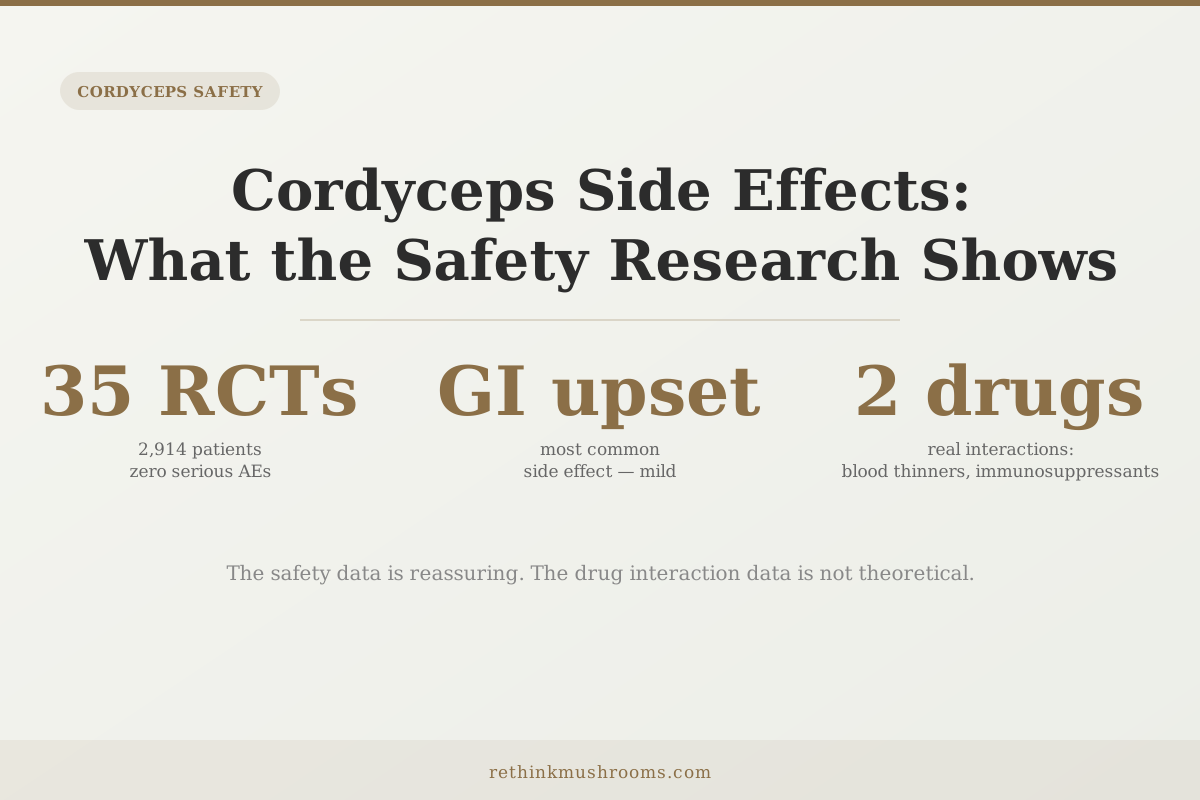
35 RCTs, 2,914 dialysis patients — adverse events lower vs. control
A 2024 systematic review of 35 RCTs in 2,914 dialysis patients found Ophiocordyceps sinensis as adjunctive therapy improved nutritional and renal markers; 4 trials specifically reported on adverse drug reactions, and the rate trended lower in the cordyceps arm than control. Underlying evidence certainty was rated very low to low.
Liu et al., 2024 systematic review and meta-analysis
GI upset
most common side effect in healthy-adult RCTs — mild and transient
2 weeks
common pre-surgical discontinuation window for products with antiplatelet activity
No liver injury
NIH LiverTox database: no clinically apparent hepatotoxicity reported for Cordyceps
Liu et al., 2024 systematic review and meta-analysis
 View as image ↗
Most questions about cordyceps side effects come from people who've read either an alarming warning list or a reassuring supplement brand page — neither of which cites actual clinical data. The research picture is more nuanced than either extreme. Cordyceps is well tolerated in human trials across a wide range of populations, including vulnerable groups like dialysis patients. But it has specific, mechanistically documented interactions with blood thinners and immunosuppressants that are real precautions, not theoretical hedging. Understanding both sides requires looking at what the studies actually measured.
For a broader overview of what Cordyceps is and how it works, see what is Cordyceps: the science behind the energy mushroom.
Key Takeaways
- A 2024 systematic review of 35 RCTs in 2,914 dialysis patients reported lower adverse drug reactions in the Ophiocordyceps sinensis arm than control across the 4 RCTs that monitored AEs; underlying evidence certainty was very low to low (Liu et al., 2024)
- A 2026 review of Cordyceps militaris in vitro, in vivo, and clinical-trial literature concluded CM is "safe for administration" while focusing on immunomodulatory effects rather than a comprehensive adverse-event audit (Yang et al., Phytotherapy Research, 2026)
- Minor side effects that do appear across multiple RCTs: GI upset (nausea, loose stools, dry mouth) in a subset of participants — generally mild enough not to cause trial dropout
- The blood thinner interaction has a documented molecular mechanism: cordycepin-enriched WIB-801CE directly inhibits platelet aggregation via collagen/ADP pathways ex vivo, in vivo, and in vitro (Kwon et al., 2016), making this a real pharmacological interaction, not a precautionary hedge
- Cordyceps militaris is immunostimulatory in healthy adults (n=79 RCT, 4 weeks, 1.5 g/day, NK cell activity and lymphocyte proliferation increased); this creates a genuine counteraction concern for people on organ-transplant immunosuppressants (Kang et al., 2015)
- The NIH LiverTox database states no clinically apparent liver injury has been reported for Cordyceps — the most commonly documented contamination-linked safety issues arise from raw-powder product quality problems, not Cordyceps itself
The Safety Record: What 35 Clinical Trials Show
The largest and most rigorous safety dataset for Cordyceps comes from a context most consumer articles overlook: dialysis patients.
Liu and colleagues published a 2024 systematic review and meta-analysis synthesizing 35 randomized controlled trials that used Ophiocordyceps sinensis preparations as adjuvant treatment in patients receiving hemodialysis or peritoneal dialysis.[1] Across the 35 RCTs covering 2,914 patients, only 4 RCTs specifically reported on adverse drug reactions; in those, the rate was lower in the cordyceps arm than control (MD 1.81, 95% CI 0.88-3.74). The preparations were associated with improved nutritional status and renal function markers (CRP, creatinine, BUN, albumin, hemoglobin), but the GRADE certainty for these outcomes was rated very low to low. The other 31 RCTs in the pool either did not monitor adverse events or did not report them in a way the meta-analysts could pool.
For Cordyceps militaris specifically — the cultivated species in most modern supplements — a 2026 review by Yang and colleagues covering in vitro, in vivo, and clinical-trial literature concluded that CM "is safe for administration" while focusing primarily on immunomodulatory pharmacology rather than a structured adverse-event audit.[2]
The Bee 2019 systematic review of 12 hemodialysis-adjunct trials (655 patients) reached a similar conclusion on benefit but flagged the limitation directly: "most trials either did not monitor adverse events or poorly documented them," so the absence-of-signal claim rests on weak monitoring rather than active safety capture.[7]
The honest summary: the cumulative clinical literature has not produced a pattern of serious adverse events from properly identified, uncontaminated Cordyceps preparations, but the underlying RCTs were generally not designed for active pharmacovigilance, and most trial-level evidence quality is low.
Minor Side Effects That Do Appear
Saying there are no serious adverse events doesn't mean no side effects. Several recur consistently enough across trials to be worth noting.
Gastrointestinal effects are the most commonly reported in the broader supplement-safety literature for medicinal-mushroom products. The 2024 Ontawong healthy-adult RCT of a C. militaris fermented beverage (n=10 men + 10 women, 8 weeks) and the 2019 Jung RCT of Paecilomyces hepiali Cordyceps mycelium extract (n=79, 8 weeks) primarily measured immune endpoints, with both reporting overall safety in their abstracts.[3][5] Where mild GI symptoms (nausea, loose stools, stomach discomfort) appear in mushroom-supplement trials, they are typically transient and rarely cause discontinuation.
Dry mouth is sometimes reported anecdotally for adaptogenic mushroom products, but the mechanism for any Cordyceps-specific dry-mouth effect has not been formally characterized in the trials reviewed here.
Both effects are more commonly reported at higher doses. Kang and colleagues' 4-week, 79-person RCT using 1.5 g/day of ethanol-treated C. militaris in healthy Korean men reported no statistically significant adverse reactions, consistent with clinical trials that typically use 1-3 g/day ranges.[4]
For dosage guidance grounded in clinical trial data, see cordyceps dosage guide: how much should you take?.
The Blood Thinner Interaction Has a Specific Mechanism
The most consistently cited safety concern for Cordyceps is its interaction with anticoagulant and antiplatelet medications. This is one of the drug interactions that is real and mechanistically documented.
Kwon and colleagues published the key mechanistic study in 2016, testing the effects of a cordycepin-enriched C. militaris extract on platelet aggregation and thrombus formation.[8] The extract directly inhibited platelet aggregation via collagen/ADP-induced pathways, and reduced thrombus formation in animal models. Cordycepin, the primary bioactive nucleoside in C. militaris, was identified as the active component driving this antiplatelet activity.
What this means clinically: Cordyceps doesn't just have a theoretical anticoagulant effect that warrants precaution. It has a documented molecular mechanism by which it inhibits platelet aggregation. When combined with medications that work through the same or complementary pathways — aspirin, warfarin, clopidogrel, apixaban, rivaroxaban, and similar antiplatelet or anticoagulant drugs — the combined antiplatelet effect could exceed the intended therapeutic dose.
For a complete breakdown of the drug interactions and their mechanistic basis, see cordyceps drug interactions: blood thinners, immunosuppressants, and more.
For surgery specifically: the antiplatelet effect is the standard reason the general recommendation is to discontinue Cordyceps at least 2 weeks before scheduled surgery. This recommendation exists for many herbal products with antiplatelet activity and follows standard pre-surgical supplement protocols.
Immunosuppressants: Why the Concern Is Grounded in RCT Data
The second major drug interaction concern is for people on immunosuppressant medications — particularly organ transplant recipients on calcineurin inhibitors (cyclosporine, tacrolimus) or other immunosuppressants.
Kang and colleagues' RCT provides direct evidence for why this concern is legitimate.[4] In 79 healthy Korean men, 4 weeks of ethanol-treated C. militaris at 1.5 g/day significantly enhanced NK cell activity (measured as NK200), lymphocyte proliferation index, and the Th1 cytokines IL-2 and IFN-γ — markers of heightened cell-mediated immunity. A separate 8-week RCT in 79 healthy adults using a Paecilomyces hepiali Cordyceps mycelium extract (CBG-CS-2, 1.68 g/day) found a 38.8% increase in NK cell cytotoxic activity in the treatment group versus placebo (Jung et al., 2019), reinforcing that Cordyceps-class preparations consistently push the immune system upward.[5] This immune-stimulating effect is generally considered a benefit for healthy people.
For someone on immunosuppressant drugs after a transplant, however, immune stimulation directly counteracts the drug's intended effect. The immunosuppressants are keeping the immune system from attacking the transplanted organ; a compound that activates immune cell activity moves in the opposite therapeutic direction.
Li and colleagues studied the specific clinical context in a 2009 randomized comparison in 202 renal transplant patients (treatment n=93, control n=109). Patients in the treatment arm received C. sinensis 1.0 g three times daily as an adjunct to standard immunosuppression with cyclosporine.[9] Patient and graft survival did not differ between groups, but the C. sinensis arm showed significantly lower rates of cyclosporine-induced hepatotoxicity (12.9% vs 24.8%) and nephrotoxicity (19.4% vs 33.9%), with reduced cyclosporine dose requirements and lower whole-blood trough concentrations needed at 2-6 months post-transplant. This use — carefully supervised, as an adjunct, in a monitored clinical setting — is very different from unsupervised self-supplementation in a transplant patient. The distinction matters: the concern is not that C. sinensis is inherently unsafe for this population in a clinical trial setting, but that the same immunomodulatory activity that supports kidney function in monitored use could also alter immunosuppressant pharmacokinetics in unmonitored use.
People with autoimmune conditions are in a related but different category. Active autoimmune disease involves an already overactive immune response. Immune-stimulating supplements may worsen symptoms. This is not specific to Cordyceps — it's a general consideration for any immunomodulatory compound.
Can Cordyceps Cause Liver Damage? The NIH Answer
Concern about liver toxicity is common for herbal supplements. The NIH LiverTox database — a comprehensive clinical reference for herbal hepatotoxicity maintained by the National Library of Medicine — is explicit on Cordyceps: no clinically apparent liver injury has been reported.
Liu and colleagues' 2015 review of C. sinensis chemical constituents catalogued anti-inflammatory, antioxidant, antiapoptotic, and immunomodulatory actions across the literature; the review does not document hepatotoxic signals from Cordyceps preparations.[6] The Li 2009 renal-transplant trial discussed above specifically reported that C. sinensis adjunctive therapy was associated with significantly lower hepatotoxicity (12.9% vs 24.8% in control) in patients receiving cyclosporine.[9]
The Liu 2024 systematic review of dialysis-adjunct trials did not surface a liver-injury signal, though as noted earlier, only 4 of 35 RCTs reported on adverse drug reactions in a poolable way.[1]
The honest summary: liver toxicity from Cordyceps is not supported by clinical data. The fear exists partly because general herbal supplement caution often groups all herbs together, and partly because some health authorities are appropriately cautious with any unregulated preparation.
What Product Quality Matters More Than Cordyceps Safety
There is a documented safety risk associated with Cordyceps products — but it doesn't come from Cordyceps itself.
Wild-harvested Ophiocordyceps sinensis powder has been the subject of contamination concerns, including documented cases of lead and heavy metal contamination in unregulated products. Lead poisoning cases have been traced to adulterated or low-quality Cordyceps powder where lead was used to increase the weight of the product (a practice called "lead padding" that has been documented in several herbal supplement investigations). Cultivated C. militaris in standardized extract form does not carry this risk when produced under quality controls, but raw powder products — particularly those with unclear supply chains — are a different matter.
The practical implication: the safety risks most people fear (organ toxicity, drug interactions with normal use) are either absent from the clinical evidence or manageable with precautions. The safety risk that does exist in the market is product contamination, which is a manufacturing and sourcing issue, not a property of cordyceps itself. Third-party testing for heavy metals is the relevant quality check.
Special Populations: Pregnancy, Children, Autoimmune Conditions
Pregnancy and breastfeeding: There are no human safety studies for Cordyceps in pregnancy or breastfeeding. The absence of data means the risk is unknown, not confirmed safe. Standard supplement precaution applies.
Children: Similarly, no pediatric safety trials exist for Cordyceps. The clinical data in this article is from adult populations only.
Autoimmune conditions: The immune-stimulating activity documented in RCTs (NK cell activation, lymphocyte proliferation) is the relevant concern. For people with inactive, well-controlled autoimmune disease, the risk may be lower than for people with active flares. This is a medical decision that involves the treating physician's knowledge of the individual's disease activity.
Blood sugar medications: Cordyceps has blood glucose-lowering effects in some preclinical and limited clinical data. In people on insulin or oral hypoglycemic agents, an additive blood sugar-lowering effect is possible. Glucose monitoring is appropriate if someone on diabetes medications begins Cordyceps. For detailed dosage context and how to start, see cordyceps for beginners: starting dose and what to expect.
The Bottom Line
The clinical safety record for Cordyceps is reassuring with caveats: a 2024 systematic review of 35 RCTs in 2,914 dialysis patients found adverse drug reactions trended lower in the cordyceps arm than control across the 4 trials that monitored AEs, though most underlying trials had very-low to low certainty evidence and weak adverse-event capture. Two drug interactions are mechanistically grounded and warrant genuine caution: blood thinners (Kwon 2016 documented antiplatelet activity ex vivo, in vivo, and in vitro for cordycepin-enriched extract) and immunosuppressants (Kang 2015 and Jung 2019 RCTs both show NK and lymphocyte activation in healthy adults, which counteracts immunosuppressive therapy). Liver toxicity is not supported by clinical data; the Li 2009 renal-transplant RCT actually showed lower cyclosporine-induced hepatotoxicity in the C. sinensis arm. The primary product-related safety risk is heavy metal contamination in unregulated raw powder products.
Frequently Asked Questions
Sources & References
- 1RTHM-01936·Liu, Meixi et al. (2024). “Effects and safety of Ophiocordyceps sinensis preparation in the adjuvant treatment for dialysis patients: a systematic review and meta-analysis..” Frontiers in pharmacology.Study breakdown →PubMed →↩
- 2RTHM-02247·Yang, Eun-Ju et al. (2026). “An Immunomodulatory Mushroom, Cordyceps militaris, and Its Constituents: A Review of In Vitro/In Vivo Studies and Clinical Trials..” Phytotherapy research : PTR.Study breakdown →PubMed →↩
- 3RTHM-00899·Ontawong, Atcharaporn et al. (2024). “A randomized controlled clinical trial examining the effects of Cordyceps militaris beverage on the immune response in healthy adults..” Scientific reports.Study breakdown →PubMed →↩
- 4RTHM-00378·Kang, Ho Joon et al. (2015). “Cordyceps militaris Enhances Cell-Mediated Immunity in Healthy Korean Men..” Journal of medicinal food.Study breakdown →PubMed →↩
- 5RTHM-00563·Jung, Su-Jin et al. (2019). “Immunomodulatory effects of a mycelium extract of Cordyceps (Paecilomyces hepiali; CBG-CS-2): a randomized and double-blind clinical trial..” BMC complementary and alternative medicine.Study breakdown →PubMed →↩
- 6RTHM-00723·Liu, Yi et al. (2015). “The Chemical Constituents and Pharmacological Actions of Cordyceps sinensis..” Evidence-based complementary and alternative medicine : eCAM.Study breakdown →PubMed →↩
- 7RTHM-01033·Bee Yean, Ong et al. (2019). “Efficacy of Cordyceps sinensis as an adjunctive treatment in hemodialysis patients: a systematic review and Meta-analysis..” Journal of traditional Chinese medicine = Chung i tsa chih ying wen pan.Study breakdown →PubMed →↩
- 8RTHM-00798·Kwon, Hyuk-Woo et al. (2016). “Antiplatelet and antithrombotic effects of cordycepin-enriched WIB-801CE from Cordyceps militaris ex vivo, in vivo, and in vitro..” BMC complementary and alternative medicine.Study breakdown →PubMed →↩
- 9RTHM-00161·Li, Y et al. (2009). “Clinical application of Cordyceps sinensis on immunosuppressive therapy in renal transplantation..” Transplantation proceedings.Study breakdown →PubMed →↩