Cordyceps Practical Guide
202 Transplant Patients
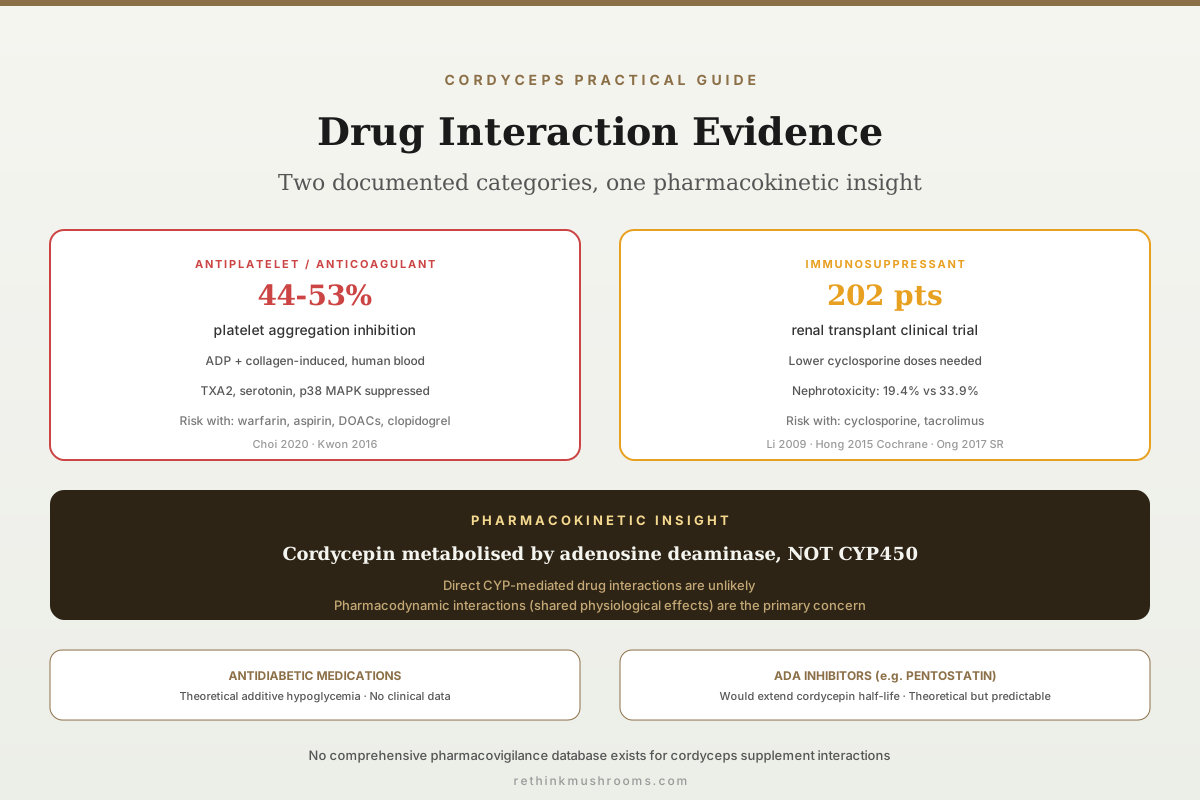
The largest clinical study of cordyceps drug interactions enrolled 202 renal transplant patients receiving cyclosporine. The Cordyceps sinensis group required lower cyclosporine doses and had lower rates of nephrotoxicity (19.4% vs 33.9%) and hepatotoxicity (12.9% vs 24.8%) compared to controls (Li et al., Transplantation Proceedings, 2009).
Li et al., Transplantation Proceedings, 2009
Antiplatelet
Cordyceps militaris ethanol extract inhibited ADP and collagen-induced platelet aggregation by 44.9-53.4% in human blood samples (Choi et al., 2020)
ADA metabolism
Cordycepin is primarily degraded by adenosine deaminase rather than CYP450 enzymes, with a short plasma half-life in rats (Tsai et al., 2010)
Cochrane review
A 2015 Cochrane review found insufficient evidence to confirm or deny cordyceps safety with immunosuppressants in transplant patients (Hong et al., 2015)
Li et al., Transplantation Proceedings, 2009
 View as image ↗
Drug interactions with cordyceps fall into two categories with meaningful evidence: anticoagulant/antiplatelet drugs and immunosuppressants. The antiplatelet evidence comes from preclinical studies showing Cordyceps militaris extracts and cordycepin inhibit platelet aggregation through defined molecular mechanisms.[1][2] The immunosuppressant evidence comes from clinical data in renal transplant patients, where Cordyceps sinensis co-administered with cyclosporine altered drug levels and toxicity profiles.[3] For the safety profile beyond drug interactions, see cordyceps side effects: what the safety research shows; for dosing context, see cordyceps dosage guide: how much should you take?.
Key Takeaways
- Choi et al. (2020) in Mycobiology showed C. militaris ethanol extract inhibited ADP-induced platelet aggregation by 44.9-53.4% and collagen-induced aggregation in a dose-dependent manner in human blood samples, with prolonged occlusion times in a mouse thrombosis model
- Kwon et al. (2016) in BMC Complementary and Alternative Medicine demonstrated cordycepin-enriched WIB-801CE inhibited platelet aggregation ex vivo and in vivo by removing thrombogenic molecules (TXA2, serotonin) and suppressing downstream signalling (p38 MAPK, ERK2)
- Li et al. (2009) in Transplantation Proceedings found that adding C. sinensis 1 g three times daily to standard immunosuppression in 202 renal transplant patients allowed lower cyclosporine doses while reducing nephrotoxicity (19.4% vs 33.9%) and hepatotoxicity (12.9% vs 24.8%)
- Hong et al. (2015) in the Cochrane Database of Systematic Reviews reviewed cordyceps for kidney transplant recipients and concluded the evidence was insufficient to establish definitive safety or efficacy claims with immunosuppressive regimens
- Ong et al. (2017) in Complementary Therapies in Medicine conducted a systematic review and meta-analysis of cordyceps as adjunctive therapy in kidney transplant patients, finding signals of reduced cyclosporine-related toxicity but noting low evidence quality across included studies
- Tsai et al. (2010) in the Journal of Agricultural and Food Chemistry characterised cordycepin pharmacokinetics in rats, showing rapid degradation by adenosine deaminase rather than cytochrome P450 metabolism, with a short plasma half-life
Anticoagulants and Antiplatelet Drugs
The interaction with anticoagulant and antiplatelet medications represents the most clearly documented pharmacological concern for cordyceps supplementation. Two preclinical studies establish the mechanism.
Choi et al. (2020) tested C. militaris ethanol extract (CMEE) against human platelet aggregation induced by ADP and collagen, the two standard laboratory agonists. CMEE inhibited ADP-induced aggregation by 44.9-53.4% across tested concentrations and inhibited collagen-induced aggregation in a dose-dependent manner. In a mouse model of thrombosis (FeCl3-induced arterial injury), CMEE significantly prolonged the time to vessel occlusion without causing abnormal bleeding symptoms or body weight changes.[1]
The antithrombotic activity was attributed to the antiplatelet mechanism rather than an anticoagulation effect, meaning cordyceps does not directly interfere with the coagulation cascade (factors II, VII, IX, X) the way warfarin does. Instead, it inhibits platelet activation and aggregation, which is mechanistically closer to aspirin or clopidogrel.
Kwon et al. (2016) narrowed the mechanism to cordycepin specifically. Cordycepin-enriched WIB-801CE from C. militaris inhibited platelet aggregation both ex vivo (in human blood samples) and in vivo (in mouse thrombosis models). The molecular mechanism involved removal of thrombogenic mediators (thromboxane A2, serotonin) and suppression of downstream signalling molecules (arachidonic acid, thromboxane A synthase, p38 MAPK, ERK2).[2]
The practical implication is that cordyceps supplementation could potentiate the effects of anticoagulants (warfarin, heparin, enoxaparin), antiplatelet agents (aspirin, clopidogrel, prasugrel, ticagrelor), and direct oral anticoagulants (DOACs such as rivaroxaban, apixaban, and dabigatran). No human clinical study has directly measured the magnitude of this interaction, but the preclinical antiplatelet potency (44-53% inhibition) is pharmacologically substantial. Patients taking any blood-thinning medication should be aware of this documented effect. For how these antiplatelet mechanisms relate to cordyceps cardiovascular effects, see cordyceps and myocardial ischemia: protecting the heart under stress.
Immunosuppressants: The Transplant Evidence
The most clinically relevant drug interaction data comes from renal transplantation, where C. sinensis has been used alongside calcineurin inhibitors (cyclosporine A, tacrolimus) in Chinese transplant centres.
Li et al. (2009) conducted the largest clinical study: 202 renal transplant patients randomised to receive standard immunosuppression plus C. sinensis 1 g three times daily (n=93) or standard immunosuppression alone (n=109). At 2-6 months post-transplantation, the cordyceps group required significantly lower cyclosporine A dosages, and whole-blood trough cyclosporine concentrations were significantly lower at 3-6 months. The rates of cyclosporine-induced nephrotoxicity (19.4% vs 33.9%) and hepatotoxicity (12.9% vs 24.8%) were both significantly lower in the cordyceps group. Patient and graft survival rates did not differ, indicating that the reduced cyclosporine levels did not increase rejection risk.[3]
This finding raises two interpretive possibilities. The optimistic interpretation: cordyceps has independent immunomodulatory activity that supplements cyclosporine, allowing lower doses with preserved efficacy and reduced toxicity. The cautious interpretation: cordyceps may alter cyclosporine metabolism or bioavailability, changing drug exposure in ways that could be unpredictable in individual patients.
Ong et al. (2017) systematically reviewed cordyceps as adjunctive therapy in kidney transplant recipients. Their meta-analysis of available trials found signals of reduced cyclosporine-related toxicity and potentially improved graft function, but the evidence quality was low across all included studies, limited by small sample sizes, heterogeneous preparations, and inadequate blinding.[4]
Hong et al. (2015) conducted a Cochrane systematic review of cordyceps for kidney transplant recipients. Their conclusion was that existing evidence was insufficient to make definitive safety or efficacy claims. The review included studies using various cordyceps preparations (natural, fermented, mycelium-derived) at different doses alongside different immunosuppressive regimens, making pooled conclusions difficult.[5]
The transplant data collectively suggest that cordyceps interacts with cyclosporine pharmacokinetics or pharmacodynamics. Whether this interaction is net beneficial (reduced toxicity) or represents a safety concern (altered drug levels requiring monitoring) depends on clinical context and monitoring capacity. Patients on any immunosuppressive regimen should disclose cordyceps use to their transplant team.
Antidiabetic Medications
Cordyceps preparations have documented hypoglycemic effects across multiple animal models. Cordycepin activates AMPK and promotes insulin receptor substrate-1 (IRS-1) and GLUT-4 expression in skeletal muscle, and C. militaris polysaccharides have independent glucose-lowering properties through gut microbiome modulation (see cordyceps and blood sugar: hypoglycemic research). While no clinical study has directly measured interaction with insulin or oral antidiabetic drugs, the theoretical concern is additive hypoglycemia.
The risk is most relevant for patients on medications with narrow therapeutic windows for glucose control: sulfonylureas (which stimulate insulin secretion regardless of glucose levels), insulin (where any additional glucose-lowering agent increases hypoglycemia risk), and SGLT2 inhibitors (where additive effects could theoretically increase the risk of euglycemic ketoacidosis in vulnerable patients). For metformin, which also activates AMPK, the shared molecular target raises questions about whether cordyceps could potentiate metformin's effects through pathway convergence.
No case reports of clinically significant hypoglycemic interactions have been published, but the preclinical glucose-lowering data across multiple mechanistic pathways support monitoring blood glucose when combining cordyceps with antidiabetic medications. The absence of published case reports may reflect underreporting rather than absence of risk, given that most cordyceps consumers do not report supplement use to their physicians.
Pharmacokinetic Profile: Why CYP450 Interactions Are Unlikely
Most drug-drug interactions occur through cytochrome P450 enzyme inhibition or induction. Tsai et al. (2010) characterised cordycepin pharmacokinetics in rats and found that cordycepin is primarily metabolised by adenosine deaminase (ADA), which rapidly deaminates it to 3'-deoxyinosine. This metabolic pathway is fundamentally different from CYP450-mediated drug metabolism.[6]
Cordycepin's short plasma half-life (due to rapid ADA degradation) and its primary elimination through nucleoside metabolism rather than hepatic CYP450 enzymes suggest that direct CYP450-mediated drug interactions are unlikely. However, this does not rule out pharmacodynamic interactions (where cordyceps and a drug affect the same physiological process through different mechanisms), which is exactly what the antiplatelet and immunomodulatory data demonstrate.
The ADA-dependent metabolism also means that drugs inhibiting adenosine deaminase (such as pentostatin, used in hairy cell leukaemia treatment) could dramatically extend cordycepin's plasma half-life and potentially increase both its therapeutic and adverse effects. This interaction is theoretical but pharmacologically predictable. In oncology research, the combination of cordycepin with ADA inhibitors has been explored specifically to overcome cordycepin's rapid degradation and achieve sustained plasma concentrations. Outside oncology, this interaction would be rare but clinically significant if encountered, as even standard cordyceps supplementation could produce unexpectedly high and prolonged cordycepin exposure in patients taking ADA inhibitors.
Perioperative Considerations
The antiplatelet evidence has direct implications for surgical patients. Standard perioperative guidelines require discontinuation of antiplatelet agents 5-7 days before surgery to reduce bleeding risk. Cordyceps supplementation, given its documented inhibition of platelet aggregation by 44-53% in vitro, falls into the same category as other supplements with antiplatelet activity (garlic, ginkgo, fish oil) that surgical guidelines recommend discontinuing 1-2 weeks before elective procedures.
No perioperative cordyceps study has been published, and the clinical significance of the in vitro antiplatelet effect during actual surgery is unknown. However, the pharmacological magnitude of the effect (comparable to low-dose aspirin in some assays) supports the precautionary approach of discontinuing cordyceps supplements before planned surgical procedures, particularly those with high bleeding risk. For how cordyceps blood-thinning properties relate to cardiovascular protection, see best time to take cordyceps: morning, pre-workout, or evening?.
What Is Not Known
No systematic pharmacovigilance database tracks adverse events or drug interactions from cordyceps supplements specifically. The FDA's FAERS system and WHO's VigiBase contain limited cordyceps-related reports, partly because dietary supplements are not subject to the same adverse event reporting requirements as pharmaceutical drugs. Most safety data comes from the clinical trials described above, which were not designed or powered to detect rare interactions.
No study has tested cordyceps interactions with commonly used medications outside the transplant setting: statins, antihypertensives, SSRIs, proton pump inhibitors, or other supplements. The theoretical interaction categories (antiplatelet, immunomodulatory, hypoglycemic) are based on pharmacological extrapolation from mechanism-of-action data, not from observed clinical events. The absence of documented interactions in these drug classes reflects the absence of studies, not evidence of safety. This is a fundamental limitation of the supplement interaction literature generally: the regulatory framework does not require pre-market interaction testing for dietary supplements the way it does for pharmaceutical drugs.
The dose-dependence of interactions has not been established. The transplant studies used C. sinensis at 3 g/day. The antiplatelet studies used concentrated extracts at concentrations achievable in blood. Whether standard supplemental doses (1-3 g/day of C. militaris powder) produce clinically meaningful interactions at the antiplatelet or immunomodulatory level is unknown. The rapid metabolism of cordycepin by adenosine deaminase may limit systemic exposure at standard oral doses, potentially reducing interaction risk compared to what in vitro studies suggest. For beginner dosing context, see cordyceps for beginners: starting dose and what to expect.
The Bottom Line
Cordyceps has two documented categories of drug interactions with meaningful evidence. Antiplatelet activity is established through preclinical studies showing 44-53% inhibition of platelet aggregation, relevant for patients on warfarin, aspirin, or DOACs. Immunosuppressant interaction is documented in a 202-patient transplant study showing cordyceps altered cyclosporine levels and reduced toxicity. Cordycepin's metabolism through adenosine deaminase rather than CYP450 enzymes makes direct hepatic drug interactions unlikely, though pharmacodynamic interactions remain the primary concern.
Frequently Asked Questions
Sources & References
- 1RTHM-01182·Choi, Eunhyun et al. (2020). “Antithrombotic and Antiplatelet Effects of Cordyceps militaris..” Mycobiology.Study breakdown →PubMed →↩
- 2RTHM-00798·Kwon, Hyuk-Woo et al. (2016). “Antiplatelet and antithrombotic effects of cordycepin-enriched WIB-801CE from Cordyceps militaris ex vivo, in vivo, and in vitro..” BMC complementary and alternative medicine.Study breakdown →PubMed →↩
- 3RTHM-00161·Li, Y et al. (2009). “Clinical application of Cordyceps sinensis on immunosuppressive therapy in renal transplantation..” Transplantation proceedings.Study breakdown →PubMed →↩
- 4RTHM-00486·Ong, Bee Yean et al. (2017). “Efficacy of Cordyceps sinensis as an adjunctive treatment in kidney transplant patients: A systematic-review and meta-analysis..” Complementary therapies in medicine.Study breakdown →PubMed →↩
- 5RTHM-00375·Hong, Tao et al. (2015). “Cordyceps sinensis (a traditional Chinese medicine) for kidney transplant recipients..” The Cochrane database of systematic reviews.Study breakdown →PubMed →↩
- 6RTHM-00199·Tsai, Yung-Jen et al. (2010). “Pharmacokinetics of adenosine and cordycepin, a bioactive constituent of Cordyceps sinensis in rat..” Journal of agricultural and food chemistry.Study breakdown →PubMed →↩