Cordyceps Practical Guide
1-4g/day
Most clinical trials testing cordyceps in humans used daily doses between 1 and 4 grams for periods of 3 to 12 weeks. Higher doses (3-4.5g/day) and longer durations tended to produce stronger effects.
Compiled from published clinical trials
8 Trials
with specific dosing protocols reviewed in this article
3-12 Weeks
typical treatment duration in cordyceps clinical studies
No Serious AEs
reported across studies lasting up to 12 weeks
Compiled from published clinical trials
 View as image ↗
The question of how much cordyceps to take has a straightforward answer and a complicated one. The straightforward answer: most human clinical trials used between 1 and 4 grams per day. The complicated answer: those trials tested different species (Cordyceps sinensis vs. Cordyceps militaris), different preparations (whole mycelium vs. standardized extracts vs. fermented products), and different endpoints (exercise performance, immune function, kidney transplant outcomes, respiratory function). The dose that produced measurable effects for one outcome may not apply to another. This article maps the actual dosing protocols from published clinical trials rather than providing a single number. For guidance on timing, see best time to take cordyceps: morning, pre-workout, or evening?.
Key Takeaways
- In a double-blind RCT of 20 healthy adults aged 50-75, Cs-4 (Cordyceps sinensis) at approximately 1g/day (333mg three times daily) for 12 weeks did not improve VO2max or exercise endurance compared to placebo (Chen et al., 2010)
- Higher doses showed results: Cordyceps militaris at 4g/day of a mushroom blend for 3 weeks improved VO2max by 11% and ventilatory threshold by 8.5% in younger adults (Hirsch et al., 2017)
- Cordyceps militaris beverage at 1.5g/day in a Korean RCT with 79 healthy adults produced measurable increases in NK cell activity and IL-2, IFN-gamma cytokine levels over 8 weeks (Ontawong et al., 2024)
- In kidney transplant recipients, 3g/day (1g three times daily) of Bailing capsules alongside standard immunosuppression for 6+ months reduced chronic allograft nephropathy from 18.35% to 7.53% (Li et al., 2009)
- No serious adverse events were reported across any of the reviewed clinical trials at doses up to 4g/day for up to 12 weeks
Exercise Performance: Where Dose Made the Difference
Exercise performance is the most studied endpoint for cordyceps supplementation, and it provides the clearest dose-response data.
Parcell et al. (2004) tested CordyMax Cs-4 (a standardized Cordyceps sinensis preparation) in healthy male cyclists at approximately 3g/day for 5 weeks. The study found no improvement in endurance exercise performance, maximal oxygen consumption (VO2max), or submaximal exercise parameters compared to placebo.[1]
Chen et al. (2010) conducted a double-blind, placebo-controlled trial with 20 healthy older adults (ages 50-75) taking Cs-4 at approximately 1g/day (333mg capsules three times daily) for 12 weeks. While the study reported some metabolic improvements (increased metabolic threshold), there was no improvement in VO2max or endurance exercise capacity compared to baseline or placebo. The authors noted that the dose may have been too low or the participant population too small to detect an effect.[2]
Hirsch et al. (2017) tested a higher dose of Cordyceps militaris. Twenty-eight subjects received 4g/day of a mushroom blend containing C. militaris. After acute supplementation (1 week), there were no changes. After chronic supplementation (3 weeks total), VO2max increased by approximately 11% and ventilatory threshold improved by approximately 8.5% compared to baseline in the supplement group. The placebo group showed no changes.[3]
Choi et al. (2020) provided additional evidence for C. militaris at higher doses, demonstrating beneficial effects on exercise performance through enhanced cellular energy production. The study confirmed that the ergogenic potential of C. militaris is dose and duration dependent.[4]
The pattern across exercise studies is consistent: doses at or below 1g/day and durations under 5 weeks generally did not produce measurable performance improvements, while doses of 3-4g/day sustained for 3+ weeks showed effects. This dose-response relationship is important because many commercial supplements provide 500-1,000mg per serving, which falls in the range where clinical trials found no benefit for exercise endpoints.
A critical caveat applies to the negative studies: the absence of an effect at a given dose does not prove cordyceps is inactive for that endpoint. It may indicate an insufficient dose, too short a supplementation period, an inappropriate preparation, or a population too small to detect a real but modest effect. The Chen et al. study had only 20 participants, which severely limits statistical power. The Parcell et al. study used young, trained cyclists who may have less room for improvement than older or sedentary populations. The positive results at higher doses from Hirsch et al. came from a study with similarly trained individuals, but the larger dose and different species (C. militaris vs. Cs-4) make direct comparison difficult.
Immune Function: What 1.5g/Day Accomplished
Immune modulation appears to respond to lower cordyceps doses than exercise performance, though the evidence base is smaller.
Ontawong et al. (2024) conducted a randomized controlled clinical trial with 79 healthy Korean adults consuming a Cordyceps militaris beverage providing 1.5g/day of C. militaris extract for 8 weeks. The study measured natural killer (NK) cell activity, lymphocyte proliferation index, and cytokine levels. The cordyceps group showed statistically increases in NK cell activity (measured by NK200), lymphocyte proliferation index, and levels of IL-2 and IFN-gamma compared to baseline levels. No serious adverse events were reported, and liver enzymes, kidney markers, and blood counts remained within normal ranges.[5]
Jung et al. (2019) tested a mycelium extract of Cordyceps (Paecilomyces hepiali, strain CBG-CS-2) in a randomized, double-blind clinical trial. The immunomodulatory effects included increased NK cell activity and T-cell proliferation, supporting the finding that cordyceps can modulate immune function at moderate doses in controlled settings.[6]
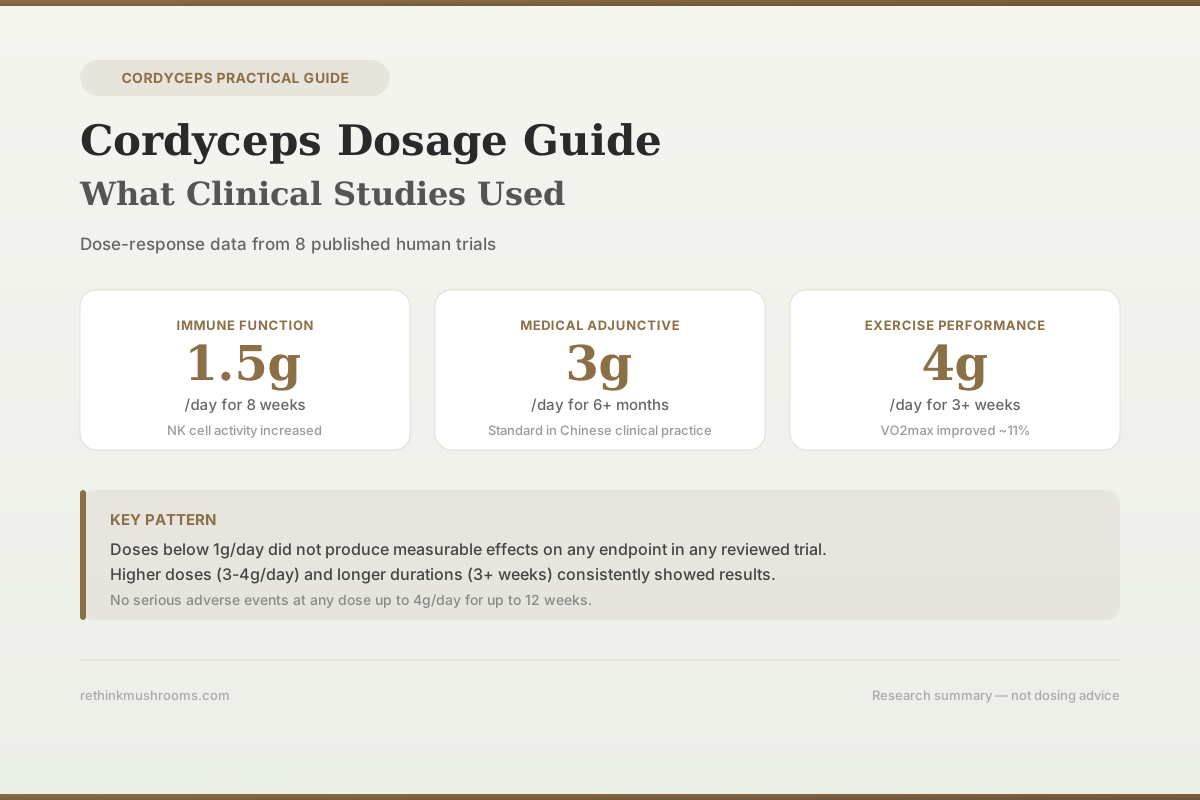
The immune function data suggest that cordyceps produces measurable immunomodulatory effects at lower doses (1.5g/day) than those required for exercise performance benefits (3-4g/day). This may reflect the difference between modulating a regulatory system (immunity) versus enhancing a performance parameter (oxygen utilization). For context on how cordyceps interacts with immunosuppressant medications, see cordyceps drug interactions: blood thinners, immunosuppressants, and more.
Kidney and Respiratory: Medical Context Doses
Clinical studies in medical contexts have used cordyceps as an adjunctive therapy alongside pharmaceutical treatments, providing dosing data from populations with existing conditions.
Li et al. (2009) administered Bailing capsules (a standardized Cordyceps sinensis preparation) at 1.0g three times daily (3g total/day) to kidney transplant recipients alongside standard immunosuppressive therapy. Over a follow-up period of at least 6 months, the cordyceps group showed lower hepatotoxicity (12.9% vs 24.8%), lower nephrotoxicity (19.4% vs 33.9%), and reduced chronic allograft nephropathy (7.53% vs 18.35%) compared to controls. Graft survival and rejection rates were comparable between groups.[7]
Shu et al. (2024) evaluated the efficacy and safety of Cordyceps sinensis (Hirsutella sinensis, strain Cs-C-Q80) in patients with chronic bronchitis. The study found that the cordyceps preparation improved symptoms alongside standard treatment, with a favorable safety profile. Liver enzymes, kidney markers, and standard laboratory values remained stable throughout the treatment period.[8]
These medical-context studies consistently used 3g/day of pharmaceutical-grade preparations. This dose level appears to be the established standard in Chinese clinical practice for cordyceps as an adjunctive therapy in kidney, liver, and respiratory conditions.
Species and Preparation Differences That Affect Dosing
One number cannot capture the appropriate dose because the product landscape is fragmented in ways that affect bioactive compound delivery.
Cordyceps sinensis vs. Cordyceps militaris. Wild C. sinensis is harvested from infected caterpillar larvae at altitudes above 3,500 meters on the Tibetan Plateau. It is rare, expensive ($20,000-$100,000/kg), and cannot be cultivated at scale. Most clinical trials used either Cs-4 (a fermented mycelium preparation from Paecilomyces hepiali, the anamorph of C. sinensis) or cultured mycelium preparations like Bailing and Jinshuibao capsules. C. militaris, by contrast, can be commercially cultivated and produces higher concentrations of cordycepin (the principal bioactive nucleoside analog). Supplements marketed as "cordyceps" without species specification typically contain C. militaris.
Extract vs. whole fruiting body vs. mycelium. Standardized extracts concentrate bioactive compounds and allow more precise dosing. Whole fruiting body powders contain all compounds but at lower concentrations per gram. Mycelium grown on grain substrates may contain significant starch from the growth medium, diluting the fungal bioactives. A "1,000mg" serving of each represents very different amounts of cordycepin, polysaccharides, and adenosine.
Cordycepin content. The bioactive most consistently linked to pharmacological effects is cordycepin (3'-deoxyadenosine). Cordycepin content varies dramatically: C. militaris fruiting bodies typically contain 1-8mg/g, while Cs-4 mycelium preparations contain much less. Clinical trial dosing was based on total supplement weight, not cordycepin content, making it impossible to determine the effective dose of the actual bioactive compound from these studies alone.
This means that a consumer taking 3g/day of a C. militaris fruiting body extract with standardized cordycepin content is not taking the same thing as a clinical trial participant who took 3g/day of Cs-4 fermented mycelium.
Safety Across Dose Ranges
Across all reviewed clinical trials, no serious adverse events were attributed to cordyceps at doses up to 4g/day for up to 12 weeks. The safety data include:
- Normal liver enzyme levels maintained throughout treatment periods
- Stable kidney function markers (creatinine, BUN)
- No significant changes in blood counts, cholesterol, or glucose
- Mild gastrointestinal effects (nausea, diarrhea) reported occasionally but not at rates significantly different from placebo groups
- No drug interactions documented in the controlled trial settings
The longest safety data come from kidney transplant studies where patients took 3g/day of Bailing capsules for 6-18 months alongside immunosuppressive drugs, with favorable safety profiles. However, these studies did not systematically assess long-term effects beyond 18 months, and the interaction between cordyceps and specific pharmaceutical agents has not been comprehensively studied.
One important limitation of the safety data: all reviewed studies enrolled generally healthy adults or patients under close medical supervision. The safety profile in populations with specific liver disease, bleeding disorders, autoimmune conditions, or those taking anticoagulants, antidiabetic medications, or other drugs with narrow therapeutic windows is not established from these trials. Cordycepin's structural similarity to adenosine means it could theoretically interact with adenosine receptor-mediated pathways involved in cardiovascular regulation and platelet function. For a detailed review of safety considerations, see cordyceps side effects: what the safety research shows.
What the Dose Data Actually Show
The clinical trial data converge on several patterns:
1-1.5g/day produced measurable effects on immune markers (NK cell activity, cytokines) over 8-12 weeks, but did not improve exercise performance endpoints.
3g/day is the standard dose in Chinese clinical practice for adjunctive therapy in kidney, liver, and respiratory conditions. This dose level has the most safety data and the most consistent clinical outcomes.
3-4g/day for 3+ weeks produced exercise performance improvements (VO2max, ventilatory threshold) in younger, healthy adults.
Below 1g/day did not produce measurable effects on any studied endpoint in any reviewed trial.
These ranges come from specific preparations tested in specific populations. They cannot be directly applied to different formulations with unknown bioactive concentrations. For practical guidance on starting a cordyceps regimen, see cordyceps for beginners: starting dose and what to expect.
The Bottom Line
Clinical trials testing cordyceps in humans used doses of 1-4g/day for 3-12 weeks. Lower doses (1-1.5g) affected immune markers; higher doses (3-4g) were needed for exercise performance and medical adjunctive effects. No serious adverse events occurred at any tested dose. Product differences (species, preparation, cordycepin content) mean that the same gram dose delivers different amounts of bioactive compounds across supplements.
Frequently Asked Questions
Sources & References
- 1RTHM-00075·Parcell, Allen C et al. (2004). “Cordyceps Sinensis (CordyMax Cs-4) supplementation does not improve endurance exercise performance..” International journal of sport nutrition and exercise metabolism.Study breakdown →PubMed →↩
- 2RTHM-00176·Chen, Steve et al. (2010). “Effect of Cs-4 (Cordyceps sinensis) on exercise performance in healthy older subjects: a double-blind, placebo-controlled trial..” Journal of alternative and complementary medicine (New York.Study breakdown →PubMed →↩
- 3RTHM-00473·Hirsch, Katie R et al. (2017). “Cordyceps militaris Improves Tolerance to High-Intensity Exercise After Acute and Chronic Supplementation..” Journal of dietary supplements.Study breakdown →PubMed →↩
- 4RTHM-00613·Choi, Eunhyun et al. (2020). “Beneficial Effect of Cordyceps militaris on Exercise Performance via Promoting Cellular Energy Production..” Mycobiology.Study breakdown →PubMed →↩
- 5RTHM-00899·Ontawong, Atcharaporn et al. (2024). “A randomized controlled clinical trial examining the effects of Cordyceps militaris beverage on the immune response in healthy adults..” Scientific reports.Study breakdown →PubMed →↩
- 6RTHM-00563·Jung, Su-Jin et al. (2019). “Immunomodulatory effects of a mycelium extract of Cordyceps (Paecilomyces hepiali; CBG-CS-2): a randomized and double-blind clinical trial..” BMC complementary and alternative medicine.Study breakdown →PubMed →↩
- 7RTHM-00161·Li, Y et al. (2009). “Clinical application of Cordyceps sinensis on immunosuppressive therapy in renal transplantation..” Transplantation proceedings.Study breakdown →PubMed →↩
- 8RTHM-00910·Shu, Xinyang et al. (2024). “Efficacy and safety of Cordyceps sinensis (Hirsutella sinensis, Cs-C-Q80) in chronic bronchitis..” Frontiers in pharmacology.Study breakdown →PubMed →↩