Cordyceps and the Immune System
TLR4 the receptor that recognizes cordlan
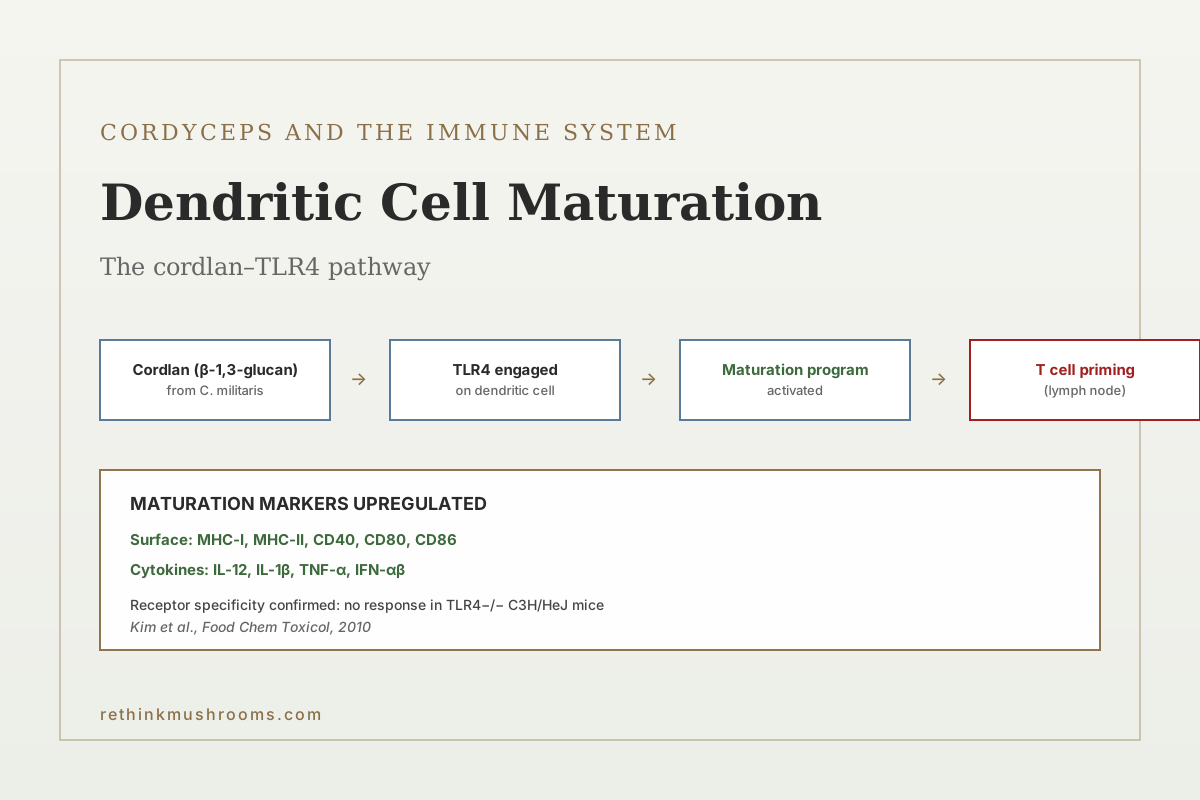
Cordlan polysaccharide from Cordyceps militaris drives dendritic cell maturation through Toll-like receptor 4 signaling, upregulating MHC class I and II, CD40, CD80, CD86, and pro-inflammatory cytokines.
Kim et al., Food Chem Toxicol, 2010
CD80, CD86, MHC II
surface markers upregulated
IL-12, TNF-α, IL-1β
cytokines induced
TLR4-dependent
confirmed via TLR4−/− mice
Kim et al., Food Chem Toxicol, 2010
 View as image ↗
Dendritic cells are the professional antigen-presenting cells of the immune system. They patrol tissues in an immature state, continuously sampling their environment, and when they encounter a pathogen signature they undergo maturation: upregulating MHC class I and II, the costimulatory molecules CD40, CD80, and CD86, migrating to lymph nodes, and activating naive T cells. Cordyceps polysaccharides have been repeatedly shown to drive this maturation process, primarily through Toll-like receptor 4 (TLR4) signaling. The work establishes a specific molecular mechanism linking a defined Cordyceps constituent to a specific immune output, which is unusual in the mushroom-immunology literature.[1]
This article walks through the dendritic cell maturation process, the Cordyceps polysaccharides that drive it, the TLR4 signaling evidence, and what this mechanism does and does not imply for Cordyceps supplements as immune support. For the broader immunomodulation context, see Cordyceps and the immune system: immunomodulatory research. For NK cell effects specifically, see Cordyceps and NK cell activity: natural killer cell enhancement. For the polysaccharide fraction specifically, see Cordyceps militaris polysaccharides and immune activation.
Key Takeaways
- Kim et al. (2010) isolated cordlan, a beta-(1→3)-glucan from Cordyceps militaris, and showed it induces phenotypic and functional maturation of dendritic cells with upregulation of CD40, CD80, CD86, MHC-I, MHC-II, and pro-inflammatory cytokines IL-12, IL-1β, TNF-α, and IFN-αβ
- The cordlan effect is TLR4-dependent: cordlan induces maturation of TLR4+/+ dendritic cells from C3H/HeN mice but not TLR4−/− dendritic cells from C3H/HeJ mice, establishing TLR4 as the relevant pattern-recognition receptor
- Song et al. (2011) demonstrated that an exopolysaccharide from a Cordyceps sinensis anamorph promoted MHC II, CD40, CD80, and CD86 surface expression on murine dendritic cells and reduced their antigen-ingestion capacity, consistent with the immature-to-mature transition
- Kim et al. (2011) showed that polysaccharide from Paecilomyces cicadae (a Cordyceps-adjacent entomopathogenic fungus) similarly induces dendritic cell maturation with CD80, CD86, MHC-I, MHC-II upregulation and IL-12, IL-1β, TNF-α production
- Song et al. (2013) extended the Cordyceps sinensis exopolysaccharide work to dendritic cell sarcoma cell line regulation, providing additional mechanistic detail
- Ontawong et al. (2024) published the first randomized controlled clinical trial of a Cordyceps militaris beverage on immune response in healthy adults, reporting changes in immune markers consistent with immunomodulatory activity
- Dendritic cell maturation is upstream of T cell priming, which means Cordyceps polysaccharide effects on DCs should translate into adaptive immune consequences, though this downstream translation has not been as cleanly demonstrated in humans
Dendritic Cell Biology: Why Maturation Matters
Dendritic cells exist in two principal functional states. Immature DCs reside in peripheral tissues and continuously sample their environment by endocytosis and macropinocytosis; they are good at antigen capture and poor at antigen presentation. Mature DCs, triggered by pattern-recognition receptor (PRR) engagement, downregulate endocytosis and upregulate antigen presentation machinery, migrate to draining lymph nodes, and prime naive T cells.
The transition from immature to mature is the central event in linking innate immune recognition to adaptive immune response. A drug or dietary component that drives DC maturation is functionally acting as an immune adjuvant: it increases the probability that an antigen encountered during or around the maturation event will be efficiently presented to T cells and produce a robust adaptive response.
The specific maturation markers that researchers measure are:
- MHC class I and II (antigen presentation to CD8+ and CD4+ T cells respectively)
- CD40 (costimulatory ligation with CD40L on T cells)
- CD80 and CD86 (costimulatory ligation with CD28 on T cells; the second signal required for naive T cell activation)
- CCR7 (chemokine receptor for migration to lymph nodes)
- IL-12, TNF-α, IL-1β (cytokines that shape the type of T cell response)
A compound that upregulates all of these in parallel while suppressing endocytosis is a classical DC maturation signal.
The Cordlan / TLR4 Finding
Kim et al. (2010) purified cordlan, a beta-(1→3)-glucan polysaccharide from Cordyceps militaris, and tested it on bone marrow-derived dendritic cells (BMDCs). The findings:
- Phenotypic maturation: CD40, CD80, CD86, MHC-I, and MHC-II were all significantly upregulated on cordlan-treated DCs compared to untreated controls
- Functional maturation: cordlan-treated DCs produced substantially more IL-12, IL-1β, TNF-α, and IFN-αβ than controls
- Receptor specificity: the same experiment in C3H/HeJ mice, which carry a loss-of-function TLR4 allele, showed no DC maturation response to cordlan. C3H/HeN mice (TLR4 wild-type, same strain background) showed the full response.[1]
The TLR4−/− versus TLR4+/+ comparison is methodologically important: it distinguishes between cordlan being an LPS contaminant (which would also act through TLR4) and cordlan itself engaging TLR4 as a ligand. Kim et al. included LPS depletion controls and verified purity, which supports the conclusion that the beta-glucan polysaccharide is the active agent and TLR4 is the engaged receptor.
TLR4 is a pattern-recognition receptor classically associated with bacterial lipopolysaccharide (LPS) recognition, but it has been shown to respond to some fungal-derived polysaccharide structures as well. The cordlan result fits into a broader literature of fungal beta-glucans engaging TLR4 in parallel to or in addition to Dectin-1 (the classical beta-glucan receptor).
The Cordyceps sinensis Exopolysaccharide Work
Song et al. (2011) worked with an exopolysaccharide (EPS) from an anamorph of Cordyceps sinensis (the liquid-fermentation mycelium form). The EPS induced murine DC maturation with upregulation of MHC II, CD40, CD80, and CD86, and reduced the DCs' antigen-ingestion capacity, which is the endocytosis-to-presentation switch characteristic of maturation.[2]
Song et al. (2013) extended this to a dendritic cell sarcoma (DCS) cell line, demonstrating that the EPS regulates DC-lineage cells beyond primary cultures.[3]
The C. sinensis EPS work parallels the C. militaris cordlan work: both species produce polysaccharide preparations that drive DC maturation with the same set of markers. The specific receptor engagement for C. sinensis EPS has not been as cleanly characterized with TLR knockouts as cordlan has, but the phenotypic output is similar.
The Paecilomyces Parallel
Kim et al. (2011) tested polysaccharide from Paecilomyces cicadae (an entomopathogenic fungus closely related to Cordyceps) on murine DCs, documenting the same phenotypic and functional maturation pattern: CD80, CD86, MHC-I, MHC-II upregulation and IL-12, IL-1β, TNF-α production.[4] The convergence across three Cordyceps-adjacent species suggests that this is a phylogenetically conserved mechanism in this fungal clade rather than a quirk of one species.
Functional Consequences: What DC Maturation Implies
DCs that mature and present antigen more efficiently are expected to drive several downstream effects:
- Improved response to vaccines. DC maturation is what adjuvants do; a DC-maturing supplement could in principle act as a dietary adjuvant.
- Enhanced antitumor immunity. DCs that present tumor-associated antigens with high costimulation are better at priming tumor-specific CD8+ T cells.
- Amplified response to infection. In the context of an ongoing infection, enhanced DC function could accelerate adaptive immune response.
- Risk of inflammation in wrong contexts. DC maturation is not a categorically good thing; in autoimmune disease or allergy, excessive DC maturation to self or allergen antigens would worsen pathology.
The translation from the in vitro and animal work to humans is where the literature thins. The primary human trial on Cordyceps immune function is Ontawong et al. (2024), which examined a C. militaris beverage in healthy adults and reported changes in immune markers consistent with immunomodulation.[5] This does not reproduce the TLR4-cordlan mechanism in human DCs, but it demonstrates that a consumer-form Cordyceps product produces measurable immune-parameter changes.
What This Does and Does Not Tell Supplement Users
The following can be said with reasonable confidence:
- Cordyceps polysaccharides are bona fide DC maturation signals in vitro and in animal models
- The mechanism is specific (TLR4-mediated for cordlan) and replicates across related fungal species
- The DC-maturation effect is upstream of T cell priming, which in principle connects to adaptive immunity in health-relevant ways
The following cannot be said:
- That oral Cordyceps supplementation in humans produces comparable DC maturation in vivo
- That Cordyceps-driven DC maturation translates to clinical outcomes like reduced infection rates or better vaccine response in humans
- That dose-response and consistency of effect across Cordyceps product formulations have been established
The practical interpretation is that Cordyceps has one of the better-characterized immune mechanisms in the medicinal mushroom literature, that the mechanism is plausible as a human immune-support story, and that the translation from mouse DC cultures to human clinical outcomes has not been completed. Claims of immediate immune benefit from supplementation are not supported by human clinical trials at the level the mechanism papers describe.
For related reading, see Cordyceps for immune support after illness or surgery.
The Bottom Line
Cordlan, a beta-(1→3)-glucan polysaccharide from Cordyceps militaris, induces phenotypic and functional dendritic cell maturation through Toll-like receptor 4 signaling (Kim et al., 2010). The mechanism replicates with Cordyceps sinensis exopolysaccharide (Song et al., 2011; Song et al., 2013) and Paecilomyces cicadae polysaccharide (Kim et al., 2011), suggesting a conserved mechanism across the Cordyceps-adjacent fungal clade. The one randomized controlled human trial (Ontawong et al., 2024) documented immune-parameter changes after Cordyceps militaris supplementation but did not directly demonstrate DC maturation in vivo. The mechanism is among the better-characterized in mushroom immunology but has not yet been linked to clinical outcomes in humans.
Frequently Asked Questions
Sources & References
- 1RTHM-00188·Kim, Hyung Sook et al. (2010). “Cordlan polysaccharide isolated from mushroom Cordyceps militaris induces dendritic cell maturation through toll-like receptor 4 signalings..” Food and chemical toxicology : an international journal published for the British Industrial Biological Research Association.Study breakdown →PubMed →↩
- 2RTHM-00235·Song, Dan et al. (2011). “Ex vivo stimulation of murine dendritic cells by an exopolysaccharide from one of the anamorph of Cordyceps sinensis..” Cell biochemistry and function.Study breakdown →PubMed →↩
- 3RTHM-00307·Song, Dan et al. (2013). “Regulation of the exopolysaccharide from an anamorph of Cordyceps sinensis on dendritic cell sarcoma (DCS) cell line..” European journal of nutrition.Study breakdown →PubMed →↩
- 4RTHM-00221·Kim, Hyung Sook et al. (2011). “Phenotypic and functional maturation of dendritic cells induced by polysaccharide isolated from Paecilomyces cicadae..” Journal of medicinal food.Study breakdown →PubMed →↩
- 5RTHM-00899·Ontawong, Atcharaporn et al. (2024). “A randomized controlled clinical trial examining the effects of Cordyceps militaris beverage on the immune response in healthy adults..” Scientific reports.Study breakdown →PubMed →↩