Cordyceps and Immunity
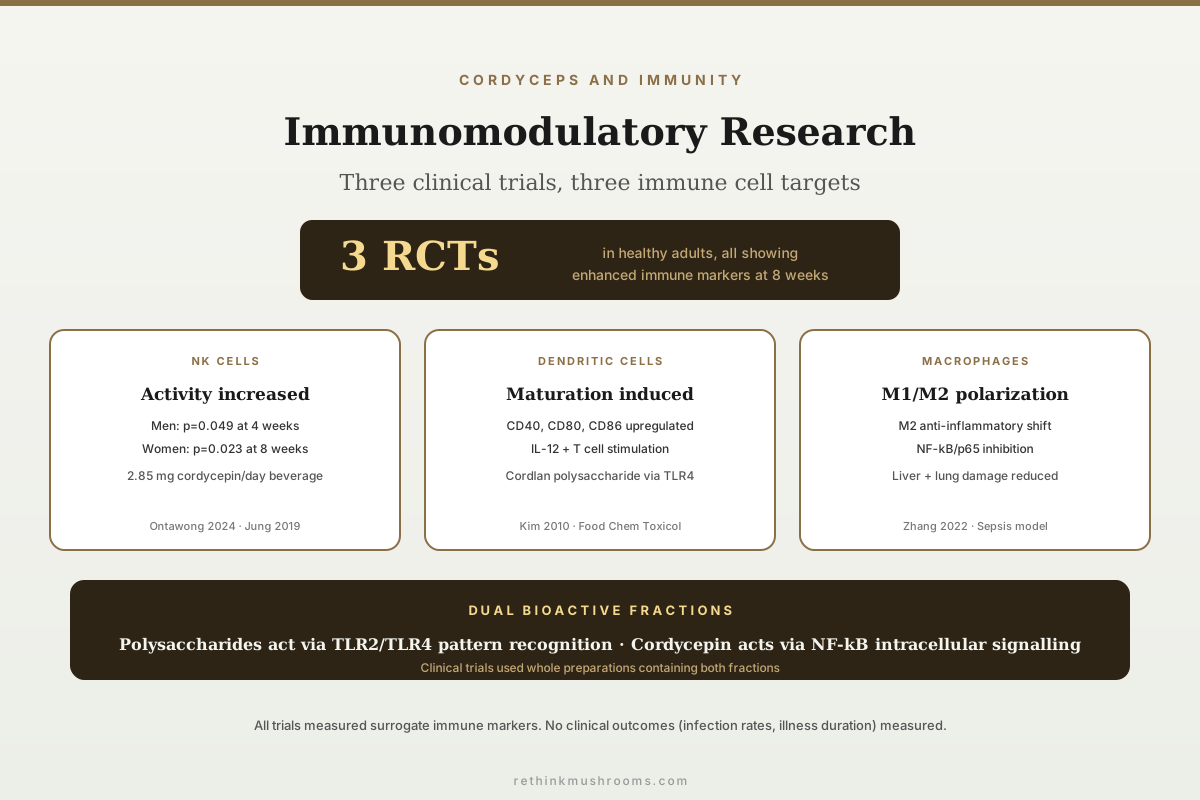
3 RCTs in Healthy Adults
Three randomised, double-blind, placebo-controlled clinical trials in healthy adults (total n > 150) have measured cordyceps immunomodulatory effects. All three found enhanced NK cell activity or cell-mediated immune markers after 8-12 weeks of supplementation.
Kang et al., J Medicinal Food, 2015; Jung et al., BMC CAM, 2019; Ontawong et al., Sci Rep, 2024
NK cell ↑
Cordyceps militaris beverage significantly increased NK cell activity in both men (p=0.049 at 4 weeks) and women (p=0.023 at 8 weeks) versus placebo (Ontawong et al., 2024)
DC maturation
Cordlan polysaccharide from C. militaris induced dendritic cell maturation via TLR4 signalling, upregulating CD40, CD80, CD86, and IL-12 (Kim et al., 2010)
M1/M2 balance
Cordycepin shifted macrophage polarization from pro-inflammatory M1 toward anti-inflammatory M2 phenotype via NF-kB/p65 inhibition in sepsis mice (Zhang et al., 2022)
Kang et al., J Medicinal Food, 2015; Jung et al., BMC CAM, 2019; Ontawong et al., Sci Rep, 2024
 View as image ↗
Cordyceps is one of the most extensively studied medicinal mushrooms for immune function, with research spanning clinical trials in healthy humans, mechanistic studies in isolated immune cells, and animal models of immune suppression and sepsis. The distinguishing feature of the cordyceps immune literature, compared to other immunomodulatory mushrooms, is that it includes three randomised, placebo-controlled clinical trials in healthy adults, all showing measurable immune enhancement.[1][2][3] A 2026 comprehensive review in Phytotherapy Research catalogued the full evidence base for Cordyceps militaris immunomodulation across in vitro, in vivo, and clinical settings.[4] For how cordyceps specifically affects NK cells, see cordyceps and NK cell activity: natural killer cell enhancement; for the dendritic cell mechanism, see cordyceps and dendritic cell maturation: training the immune system.
Key Takeaways
- Kang et al. (2015) in the Journal of Medicinal Food showed 1.5 g/day of ethanol-treated C. militaris for 8 weeks enhanced cell-mediated immunity in 39 healthy Korean men, with increased lymphocyte proliferation and cytokine production compared to 40 placebo controls
- Jung et al. (2019) in BMC Complementary and Alternative Medicine found 1.68 g/day of CBG-CS-2 (Cordyceps mycelium extract) for 8 weeks significantly increased NK cell activity and modulated serum cytokine levels in 39 healthy adults versus 40 placebo controls in a double-blind RCT
- Ontawong et al. (2024) in Scientific Reports demonstrated a C. militaris beverage containing 2.85 mg cordycepin significantly increased NK cell activity in healthy men at 4 weeks (p=0.049) and in women at 8 weeks (p=0.023) compared to placebo
- Kim et al. (2010) in Food and Chemical Toxicology showed cordlan polysaccharide from C. militaris induced dendritic cell maturation via TLR4 signalling, upregulating CD40, CD80, CD86, MHC-I/II, IL-12, and TNF-alpha while stimulating allogenic T cell proliferation
- Zhang et al. (2022) in The Journal of Pharmacy and Pharmacology demonstrated cordycepin shifted macrophage polarization from M1 (pro-inflammatory) to M2 (anti-inflammatory) phenotype via NF-kB/p65 inhibition in a sepsis mouse model, reducing liver and lung damage
- Yoon et al. (2008) showed exo-polymers from submerged C. sinensis culture stimulated innate immune responses in macrophages, establishing that the polysaccharide fraction acts independently of cordycepin
Clinical Trial 1: Cell-Mediated Immunity in Healthy Men (Kang et al., 2015)
The first clinical trial specifically designed to test cordyceps immunomodulation enrolled 79 healthy Korean men in a randomised, double-blind, placebo-controlled design. The experimental group (n=39) received 1.5 g/day of ethanol-treated Cordyceps militaris in capsules; the control group (n=40) received identical placebo capsules. The intervention lasted 8 weeks with immune markers assessed at baseline and endpoint.[1]
The primary outcome was cell-mediated immunity, measured through lymphocyte proliferation assays and cytokine production. The C. militaris group showed enhanced lymphocyte proliferative response compared to placebo, indicating improved T cell function. Cytokine profiles shifted toward enhanced cell-mediated immunity. Safety monitoring showed no adverse effects, and liver and kidney function markers remained normal throughout the study.
The strength of this trial is its adequate sample size for a pilot study, its inclusion of only healthy subjects (avoiding confounding from underlying disease), and the use of a standardised C. militaris preparation. The limitation is that it enrolled only men, leaving the sex-specific immune response question unanswered until the 2024 trial.
Clinical Trial 2: NK Cell Activity with Cordyceps Mycelium (Jung et al., 2019)
Jung et al. conducted a similar trial using a different preparation: CBG-CS-2, a mycelium culture extract of Paecilomyces hepiali (an anamorph of Cordyceps sinensis). Seventy-nine healthy adults (39 intervention, 40 placebo) took 1.68 g/day for 8 weeks in a randomised, double-blind design.[2]
The primary outcome was NK cell cytotoxic activity, measured as the ability of peripheral blood NK cells to kill target cells ex vivo. The CBG-CS-2 group showed significantly increased NK cell activity compared to placebo. Serum levels of monocyte-derived inflammatory mediators were also modulated, suggesting broad immune activation beyond just NK cells. The safety profile was clean, with no significant differences in adverse events between groups.
This trial complements the Kang et al. study by testing a C. sinensis-derived preparation rather than C. militaris, and by using NK cell activity as the primary endpoint rather than lymphocyte proliferation. The consistent finding of immune enhancement across different species, preparations, and immune endpoints strengthens the overall evidence base. The preparation used (CBG-CS-2) is a commercially available product in Asia, making the results directly applicable to a real-world supplement.
Clinical Trial 3: Sex-Specific NK Cell Responses (Ontawong et al., 2024)
The most recent trial addressed sex-specific differences and used a food-format intervention. Twenty healthy adults (10 men, 10 women) received either a fermented C. militaris (FCM) beverage containing 2.85 mg cordycepin or placebo daily for 8 weeks. Immune cell markers were assessed at baseline, 4 weeks, and 8 weeks.[3]
NK cell activity increased significantly in men at 4 weeks (p=0.049) compared to baseline, and in women at 8 weeks (p=0.023) compared to placebo. The sex-specific timing difference is notable: men showed earlier NK cell activation while women required a longer supplementation period for the same endpoint. The study also measured lymphocyte subsets, cytokine profiles, and immunoglobulin levels.
The smaller sample size (n=20 total) is this trial's primary limitation. However, the sex-stratified analysis, the time-course data with an intermediate measurement point, and the use of a fermented beverage format (with quantified cordycepin content) add dimensions not present in the earlier trials. The finding that the cordycepin content of the intervention was precisely measured (2.85 mg/day) provides the first dose-response anchor point for human immunomodulatory effects.
Dendritic Cell Maturation: The Innate-Adaptive Bridge
Dendritic cells (DCs) are the primary antigen-presenting cells that bridge innate and adaptive immunity. Immature DCs patrol tissues sampling antigens; upon activation, they mature and migrate to lymph nodes where they present antigens to T cells, initiating adaptive immune responses. Deficient DC maturation is a key mechanism by which tumours evade immune surveillance.
Kim et al. (2010) isolated cordlan, a polysaccharide from C. militaris, and tested its effects on bone marrow-derived dendritic cells. Cordlan induced phenotypic DC maturation, demonstrated by elevated surface expression of co-stimulatory molecules CD40, CD80, CD86, and antigen-presenting molecules MHC-I and MHC-II. Functional maturation was confirmed by increased production of IL-12 (the key cytokine driving Th1 immune polarization), IL-1β, TNF-α, and IFN-αβ. Mature DCs treated with cordlan showed enhanced ability to stimulate allogenic T cell proliferation and reduced endocytic capacity (a hallmark of the mature, antigen-presenting state).[5]
The mechanism was mapped to Toll-like receptor 4 (TLR4) signalling. Cordlan activated TLR4 on DCs, triggering the downstream MyD88/NF-kB cascade that drives DC maturation gene expression. This is the same receptor that recognises bacterial lipopolysaccharide (LPS), suggesting that cordlan mimics a bacterial pattern to activate innate immune recognition. For comparison with other mushroom species that activate similar pathways, see chaga beta-glucans and immune cell activation.
Macrophage Polarization: The M1/M2 Balance
Macrophages exist on a spectrum between M1 (classically activated, pro-inflammatory, anti-microbial) and M2 (alternatively activated, anti-inflammatory, tissue-repair) phenotypes. The M1/M2 balance determines whether the immune response is tuned for pathogen elimination or tissue homeostasis. Zhang et al. (2022) investigated how cordycepin modulates this balance.
In a mouse sepsis model (cecal ligation and puncture), cordycepin shifted macrophage polarization from predominantly M1 toward M2 phenotype. Flow cytometry showed increased F4/80+CD206+ M2-like macrophages and decreased F4/80+iNOS+ M1-like macrophages. The M2 shift was accompanied by reduced expression of pro-inflammatory mediators (TNF-α, IL-1β, IL-6) and increased expression of anti-inflammatory mediators (IL-10, TGF-β). This polarization shift reduced liver and lung damage in the sepsis model and improved survival.[6]
The mechanism involved NF-kB/p65 inhibition. Cordycepin suppressed NF-kB p65 nuclear translocation in macrophages, reducing the transcriptional programme that drives M1 polarization and inflammatory cytokine production. This is consistent with the broader NF-kB inhibition documented across multiple cordycepin cell models (see cordycepin and NF-kB: how it suppresses inflammatory pathways).
The sepsis context is informative because sepsis involves immune dysregulation in both directions: initial hyperinflammation followed by immunosuppression. Cordycepin's ability to modulate M1/M2 balance toward M2 during the hyperinflammatory phase suggests a regulatory rather than purely stimulatory immune effect. This dual character (immune-enhancing in healthy individuals, immune-modulating in hyperinflammatory states) is the hallmark of a true immunomodulator versus a simple immune stimulant.
Polysaccharide-Mediated Innate Immunity
Yoon et al. (2008) demonstrated that the immunomodulatory activity of Cordyceps sinensis is not limited to cordycepin. Exo-polymers (extracellular polysaccharides) prepared from submerged C. sinensis culture stimulated innate immune responses in macrophages, activating phagocytic activity and cytokine production through pathways distinct from cordycepin's nucleoside-mediated effects.[7]
This is mechanistically important because commercial cordyceps supplements contain both cordycepin and polysaccharides. The clinical trials used whole preparations (not isolated compounds), meaning the observed immune enhancement likely reflects combined contributions from both bioactive fractions acting through different receptors and pathways. Polysaccharides act primarily through pattern recognition receptors (TLR2, TLR4, Dectin-1) on innate immune cells, while cordycepin acts through intracellular signalling pathways (NF-kB, AMPK). For how mushroom polysaccharide immune mechanisms compare across species, see combining immune mushrooms: is a blend better than one species?.
Limitations
The three clinical trials collectively enrolled fewer than 160 participants. While all used randomised, double-blind, placebo-controlled designs, sample sizes are small by pharmaceutical standards. The Ontawong et al. (2024) trial included only 20 participants total. None of the trials was pre-registered in a clinical trial registry, and none reported a priori power calculations.
All three trials enrolled healthy adults. Whether cordyceps enhances immune function in immunocompromised populations (cancer patients, post-transplant, elderly with immunosenescence) has not been tested in controlled human trials, though this is the population where immune enhancement would be most clinically meaningful. For the post-illness recovery angle, see cordyceps for immune support after illness or surgery.
The immune markers used (NK cell activity, lymphocyte proliferation, cytokine levels) are surrogate endpoints. None of the trials measured clinical outcomes such as infection rates, illness duration, or vaccine response. An increase in NK cell activity does not necessarily translate to better infection resistance or improved health outcomes.
The preparations differed across trials: ethanol-treated C. militaris (Kang), C. sinensis mycelium extract (Jung), and fermented C. militaris beverage (Ontawong). While all three showed immune enhancement, the optimal species, preparation method, and dose remain undefined. Cordycepin content was quantified only in the Ontawong trial (2.85 mg/day); the other two trials did not report the cordycepin content of their preparations.
The Bottom Line
Three randomised, double-blind clinical trials in healthy adults consistently show cordyceps preparations enhance immune markers including NK cell activity and cell-mediated immunity over 8-week supplementation periods. Mechanistic studies identify at least three cellular targets: dendritic cell maturation via TLR4 (polysaccharide-driven), macrophage M1/M2 polarization via NF-kB (cordycepin-driven), and innate immune activation via pattern recognition receptors (polysaccharide-driven). The clinical evidence is consistent but limited by small sample sizes, surrogate endpoints, and the absence of clinical outcome data.
Frequently Asked Questions
Sources & References
- 1RTHM-00378·Kang, Ho Joon et al. (2015). “Cordyceps militaris Enhances Cell-Mediated Immunity in Healthy Korean Men..” Journal of medicinal food.Study breakdown →PubMed →↩
- 2RTHM-00563·Jung, Su-Jin et al. (2019). “Immunomodulatory effects of a mycelium extract of Cordyceps (Paecilomyces hepiali; CBG-CS-2): a randomized and double-blind clinical trial..” BMC complementary and alternative medicine.Study breakdown →PubMed →↩
- 3RTHM-00899·Ontawong, Atcharaporn et al. (2024). “A randomized controlled clinical trial examining the effects of Cordyceps militaris beverage on the immune response in healthy adults..” Scientific reports.Study breakdown →PubMed →↩
- 4RTHM-02247·Yang, Eun-Ju et al. (2026). “An Immunomodulatory Mushroom, Cordyceps militaris, and Its Constituents: A Review of In Vitro/In Vivo Studies and Clinical Trials..” Phytotherapy research : PTR.Study breakdown →PubMed →↩
- 5RTHM-00188·Kim, Hyung Sook et al. (2010). “Cordlan polysaccharide isolated from mushroom Cordyceps militaris induces dendritic cell maturation through toll-like receptor 4 signalings..” Food and chemical toxicology : an international journal published for the British Industrial Biological Research Association.Study breakdown →PubMed →↩
- 6RTHM-00808·Zhang, Yudan et al. (2022). “Cordycepin induces M1/M2 macrophage polarization to attenuate the liver and lung damage and immunodeficiency in immature mice with sepsis via NF-κB/p65 inhibition..” The Journal of pharmacy and pharmacology.Study breakdown →PubMed →↩
- 7RTHM-00149·Yoon, Taek Joon et al. (2008). “Innate immune stimulation of exo-polymers prepared from Cordyceps sinensis by submerged culture..” Applied microbiology and biotechnology.Study breakdown →PubMed →↩