Cordyceps Inflammation
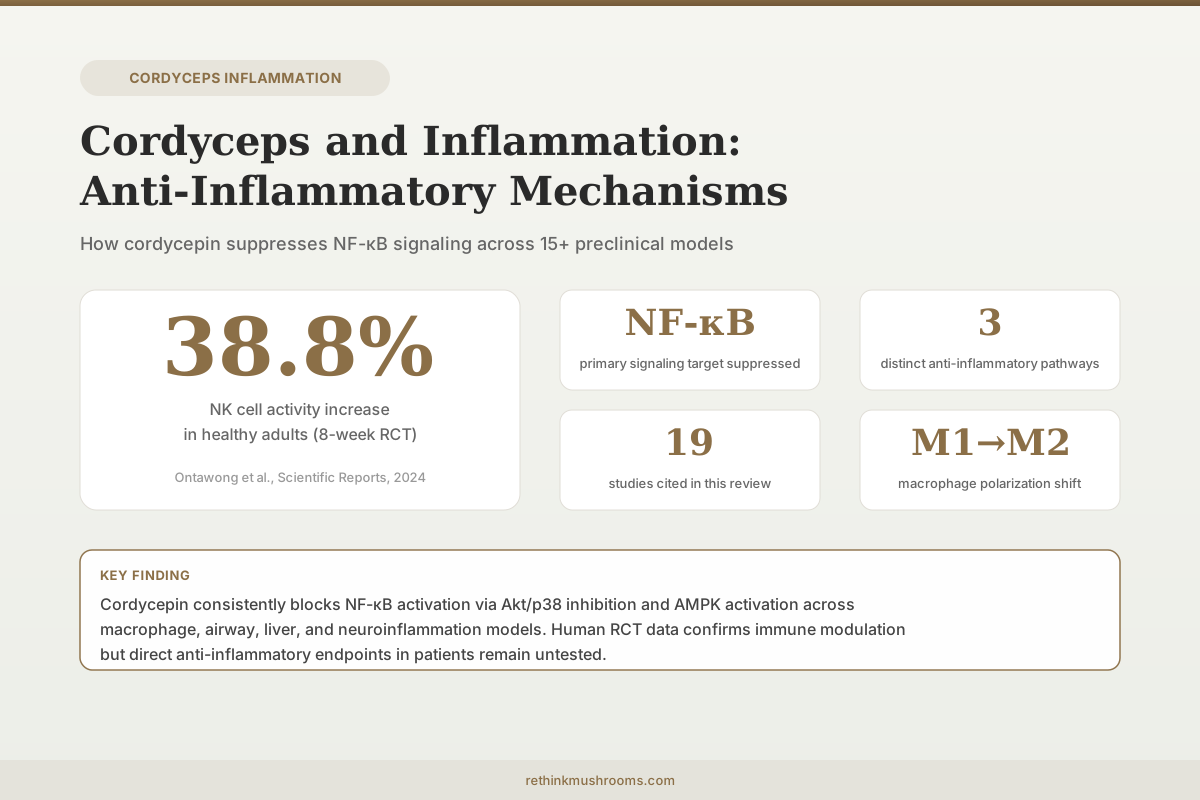
38.8% NK boost
In a 2024 randomized controlled trial, healthy adults drinking a Cordyceps militaris beverage for 8 weeks showed a 38.8% increase in natural killer cell activity compared to baseline.
Ontawong et al., Scientific Reports, 2024
NF-κB Suppression
primary signaling target
Cordycepin
key bioactive compound
15+ Models
disease contexts studied
Ontawong et al., Scientific Reports, 2024
 View as image ↗
Cordyceps species produce a compound called cordycepin that, across more than a dozen preclinical models, consistently suppresses the same inflammatory signaling cascade: NF-κB. That single pathway controls the production of TNF-α, IL-6, IL-1β, and other cytokines that drive chronic inflammation in joints, airways, liver tissue, and the brain. The consistency of this effect across cell types and organ systems is what makes cordyceps anti-inflammatory research notable. Two randomized controlled trials in humans have now confirmed immune-modulating effects, though direct anti-inflammatory endpoints in human subjects remain limited. For a deeper look at the molecular details of how cordycepin suppresses NF-κB, that dedicated article covers the signaling cascade step by step.
Key Takeaways
- Cordycepin suppressed NF-κB activation and reduced iNOS and COX-2 expression by inhibiting Akt and p38 phosphorylation in LPS-stimulated macrophages (Kim et al., 2006)
- In a mouse asthma model, Cordyceps militaris extract reduced eosinophil infiltration and lowered IgE, IL-4, and IL-5 levels in bronchoalveolar lavage fluid (Hsu et al., 2008)
- Cordycepin at 40 mg/kg attenuated airway hyperresponsiveness and suppressed Th2 cytokines in ovalbumin-sensitized mice (Yang et al., 2015)
- A 2024 RCT found Cordyceps militaris beverage reduced IL-1β in men and IL-6 in women over 8 weeks compared to baseline (Ontawong et al., 2024)
- Cordycepin shifted macrophage polarization from pro-inflammatory M1 to anti-inflammatory M2 phenotype in septic mice, reducing liver and lung damage (Zhang et al., 2022)
- In a rotenone-induced Parkinson's model, cordycepin inhibited NLRP3 inflammasome activation by blocking Drp1-mediated mitochondrial fission (Zhang et al., 2021)
What Makes Cordyceps Anti-Inflammatory?
Two classes of bioactive compounds in Cordyceps species drive the anti-inflammatory effects observed in research. The first is cordycepin (3'-deoxyadenosine), a modified nucleoside produced primarily by Cordyceps militaris. Cordycepin is structurally similar to adenosine, which allows it to interact with adenosine receptors and AMP-activated protein kinase (AMPK) signaling.[1] The second class is polysaccharides, particularly beta-glucans, which activate immune cells through Toll-like receptor 4 (TLR4) and modulate cytokine release patterns.[2]
These two compound classes work through different mechanisms. Cordycepin primarily suppresses inflammatory signaling by inhibiting transcription factor activation. Polysaccharides modulate immune cell behavior more broadly, sometimes stimulating immune responses (immunostimulation) and sometimes dampening excessive inflammation (immunomodulation), depending on the context and cell type involved.[3]
Cordyceps sinensis and Cordyceps militaris are the two most-studied species. Most mechanistic work on cordycepin uses C. militaris extracts or purified cordycepin, while clinical trials have used both species. The pharmacokinetic profile of cordycepin in rats shows rapid absorption and a short half-life, which has implications for how these findings translate to human use.[1]
How Cordycepin Suppresses NF-κB Signaling
The NF-κB pathway is a master regulator of inflammatory gene expression. When immune cells encounter bacterial endotoxin (LPS), a signaling cascade activates NF-κB, which translocates to the nucleus and switches on genes for TNF-α, IL-6, iNOS, and COX-2.
Kim et al. (2006) demonstrated that cordycepin blocks this cascade at multiple points in RAW 264.7 macrophages. It inhibited phosphorylation of both Akt and p38 MAPK in a dose-dependent manner, suppressed IκBα phosphorylation, and prevented NF-κB translocation to the nucleus. Downstream, iNOS and COX-2 expression dropped, and nitric oxide production fell.[4]
Choi et al. (2014) expanded on this, showing cordycepin also acts through the TLR4 receptor itself. In LPS-stimulated macrophages, cordycepin suppressed TLR4-mediated activation of both MAPK and NF-κB pathways. The study measured reductions in TNF-α, IL-1β, IL-6, and PGE2 production, with the effects scaling to cordycepin concentration.[5]
A 2022 study by Ding et al. confirmed these pathways in a hepatic ischemia/reperfusion injury model. Mice pretreated with cordycepin (25 or 50 mg/kg) for seven days before liver surgery showed reduced MAPK and NF-κB activation, lower serum ALT and AST levels, and less hepatocyte apoptosis.[6]
For the complete molecular signaling analysis, see Cordycepin and NF-κB: How It Suppresses Inflammatory Pathways.
TNF-α and Cytokine Reduction
TNF-α is one of the earliest cytokines released during an inflammatory response and a key therapeutic target in autoimmune conditions. Zhang et al. (2014) investigated cordycepin's effect on TNF-α specifically, finding it suppressed LPS-induced TNF-α production in both mouse macrophages and peripheral blood mononuclear cells (PBMCs) from Kawasaki disease patients. The mechanism involved AMPK activation: cordycepin phosphorylated AMPK, which in turn suppressed TNF-α gene expression.[7]
This AMPK-dependent mechanism is distinct from the Akt/p38 pathway identified by Kim et al., suggesting cordycepin engages multiple anti-inflammatory pathways simultaneously. The Zhang et al. study is particularly notable because it used human patient-derived cells, not just mouse macrophage cell lines.
Zhang et al. (2022) demonstrated that cordycepin shifts macrophage polarization from the pro-inflammatory M1 phenotype to the anti-inflammatory M2 phenotype in a sepsis model. Immature mice with cecal ligation and puncture-induced sepsis treated with cordycepin showed increased F4/80+CD206+ M2 macrophages, decreased M1 markers, and reduced liver and lung tissue damage. The effect was mediated through NF-κB/p65 inhibition.[8]
The detailed evidence on cordycepin and TNF-α suppression covers additional molecular targets.
Airway Inflammation and Asthma Models
Respiratory inflammation is one of the better-studied applications of cordyceps. Hsu et al. (2008) tested cultivated Cordyceps militaris in an ovalbumin-sensitized mouse asthma model. Mice receiving C. militaris extract showed reduced eosinophil infiltration in bronchoalveolar lavage fluid, lower serum IgE, and decreased IL-4 and IL-5 concentrations. Airway hyperresponsiveness to methacholine was attenuated compared to untreated asthmatic mice.[9]
Yang et al. (2015) used purified cordycepin in a similar ovalbumin-sensitized model and found dose-dependent effects. At 40 mg/kg, cordycepin attenuated airway hyperresponsiveness, reduced mucus hypersecretion, and suppressed Th2 cytokines (IL-4, IL-5, IL-13) while increasing the Th1 cytokine IFN-γ. This Th1/Th2 rebalancing is mechanistically important because asthma involves Th2-skewed immune responses.[10]
Wang et al. (2016) moved from animal models to humans. In a clinical study of 120 patients with moderate-to-severe persistent asthma, those receiving Cordyceps sinensis (Corbin capsule) for 3 months showed improved health-related quality of life scores compared to the control group. This is one of the few human studies examining cordyceps in an inflammatory airway condition, though it measured quality of life rather than inflammatory biomarkers directly.[11]
For a detailed analysis of this research area, see Cordyceps and Asthma: Anti-Inflammatory Airway Effects.
Organ-Specific Anti-Inflammatory Effects
Lung Injury
Qing et al. (2018) tested cordycepin in rats with LPS-induced acute lung injury. Intravenous cordycepin (1, 10, or 30 mg/kg) administered one hour after LPS challenge reduced the lung wet-to-dry weight ratio, decreased myeloperoxidase activity, and lowered TNF-α, IL-1β, and IL-6 in lung tissue. The protective mechanism involved activation of the Nrf2/HO-1 antioxidant pathway, linking anti-inflammatory and antioxidant effects.[12]
Liver Inflammation
Peng et al. (2016) examined cultured mycelium Cordyceps sinensis in a CCl4-induced liver fibrosis model. The extract reduced liver inflammation and fibrosis by activating hepatic natural killer (NK) cells. When the researchers depleted NK cells using an anti-ASGM1 antibody, the protective effect disappeared, confirming NK cells as the mediators rather than direct anti-inflammatory action on hepatocytes.[13]
Tan et al. (2024) used transcriptomic and metabolomic analyses in piglets with LPS-induced acute liver injury. Both cordycepin and Cordyceps militaris extract supplementation decreased C-reactive protein and liver damage markers. The multi-omics approach identified altered metabolic pathways including amino acid metabolism and lipid metabolism alongside the expected inflammatory pathway changes.[14]
Disc Degeneration
Li et al. (2016) applied cordycepin to rat nucleus pulposus cells stimulated with LPS. Cordycepin inhibited expression of matrix metalloproteinases (MMP-3, MMP-13) and inflammatory mediators (iNOS, COX-2, PGE2) while preserving aggrecan and collagen II expression. This suggests cordycepin may protect against inflammation-driven cartilage and disc breakdown, though this remains in vitro evidence only.[15]
For research on how these organ-protective effects relate to broader chronic conditions, see Cordyceps for Chronic Inflammatory Conditions: Research Review.
Neuroinflammation and Brain Protection
Zhang et al. (2021) investigated cordycepin in rotenone-induced Parkinson's disease models (both cell culture and mice). Cordycepin inhibited NLRP3 inflammasome activation, a key driver of neuroinflammation, by blocking Drp1-mediated mitochondrial fission. In BV2 microglial cells, cordycepin reduced IL-1β and IL-18 release. In mice, it improved motor function and reduced dopaminergic neuron loss in the substantia nigra.[16]
The NLRP3 inflammasome connection is significant because this pathway has been implicated in Alzheimer's disease, Parkinson's disease, and other neurodegenerative conditions. Cordycepin's ability to block this inflammasome through mitochondrial dynamics rather than through NF-κB alone suggests it may have broader anti-inflammatory mechanisms than previously appreciated.
This intersects with the wider field of mushroom neuroinflammation research, where several species show neuroprotective properties through different mechanisms. The role of beta-glucans in immune activation also connects to how fungal compounds modulate neuroinflammatory responses.
Human Clinical Evidence
The strongest limitation of cordyceps anti-inflammatory research is the gap between animal/cell data and human outcomes. Two randomized controlled trials have examined immune effects in healthy adults.
Ontawong et al. (2024) randomized healthy adults to receive a fermented Cordyceps militaris beverage containing 2.85 mg cordycepin or placebo for 8 weeks. NK cell activity increased in the treatment group (38.8% increase from baseline in men at 4 weeks, with women showing increases at 8 weeks). IL-1β levels decreased in men, and IL-6 levels decreased in women.[17]
Jung et al. (2019) tested a Cordyceps sinensis mycelium extract (CBG-CS-2, 1.68 g/day) in 79 healthy adults for 8 weeks. The treatment group showed a 38.8% enhancement in NK cell cytotoxic activity compared to placebo. The study measured immune activation rather than anti-inflammatory endpoints specifically, but the NK cell enhancement suggests immunomodulatory rather than purely immunostimulatory effects.[18]
Neither trial measured classical inflammatory biomarkers (CRP, ESR) as primary endpoints. The Ontawong trial's cytokine data (IL-1β, IL-6 reductions) comes closest to direct anti-inflammatory evidence in humans, but the sample was healthy adults, not people with inflammatory conditions. Wang et al.'s 2016 asthma trial measured quality of life, not inflammation markers.[11]
Where the Evidence Stands
The preclinical case for cordyceps anti-inflammatory activity is robust. Cordycepin consistently suppresses NF-κB signaling across macrophage cell lines, animal asthma models, liver injury models, sepsis models, and neurodegenerative disease models. It operates through at least three distinct mechanisms: Akt/p38 inhibition, AMPK activation, and Drp1-mediated mitochondrial fission blockade. The Phull et al. (2022) review catalogued these pathways across dozens of studies and noted the consistency of NF-κB as the convergence point.[3]
The human evidence, however, remains thin. Two RCTs show immune modulation in healthy adults, one asthma trial shows quality-of-life improvement, and a COPD study using metabolomics analysis showed reduced TNF-α, IL-8, and MMP-9 in rat models.[19] No large-scale human trial has yet measured standardized inflammatory biomarkers (CRP, IL-6, TNF-α) as primary outcomes in patients with inflammatory conditions. Cordycepin's short half-life in vivo also raises questions about bioavailability and dosing that animal studies, which use intraperitoneal or intravenous administration, do not answer for oral supplementation.
The gap between the mechanistic clarity in preclinical research and the limited human data defines the current state of this field.
The Bottom Line
Cordyceps species, primarily through cordycepin, suppress NF-κB-driven inflammation across multiple organ systems in preclinical models. The mechanisms are well-characterized: Akt/p38 inhibition, AMPK activation, NLRP3 inflammasome blockade, and M1-to-M2 macrophage polarization shifting. Human evidence from three clinical trials shows immune modulation and some cytokine reduction, but no large trial has yet measured standard inflammatory biomarkers as primary endpoints in patients with inflammatory disease.
Frequently Asked Questions
Sources & References
- 1RTHM-00605·Ashraf, Syed Amir et al. (2020). “Cordycepin for Health and Wellbeing: A Potent Bioactive Metabolite of an Entomopathogenic Cordyceps Medicinal Fungus and Its Nutraceutical and Therapeutic Potential..” Molecules (Basel.Study breakdown →PubMed →↩
- 2RTHM-00188·Kim, Hyung Sook et al. (2010). “Cordlan polysaccharide isolated from mushroom Cordyceps militaris induces dendritic cell maturation through toll-like receptor 4 signalings..” Food and chemical toxicology : an international journal published for the British Industrial Biological Research Association.Study breakdown →PubMed →↩
- 3RTHM-00790·Phull, Abdul-Rehman et al. (2022). “Cordyceps militaris as a Bio Functional Food Source: Pharmacological Potential, Anti-Inflammatory Actions and Related Molecular Mechanisms..” Microorganisms.Study breakdown →PubMed →↩
- 4RTHM-00103·Kim, Ho Gyoung et al. (2006). “Cordycepin inhibits lipopolysaccharide-induced inflammation by the suppression of NF-kappaB through Akt and p38 inhibition in RAW 264.7 macrophage cells..” European journal of pharmacology.Study breakdown →PubMed →↩
- 5RTHM-00317·Choi, Yung Hyun et al. (2014). “Anti-inflammatory effects of cordycepin in lipopolysaccharide-stimulated RAW 264.7 macrophages through Toll-like receptor 4-mediated suppression of mitogen-activated protein kinases and NF-κB signaling pathways..” Drug design.Study breakdown →PubMed →↩
- 6RTHM-00754·Ding, Jiameng et al. (2022). “Cordycepin Protects against Hepatic Ischemia/Reperfusion Injury via Inhibiting MAPK/NF-κB Pathway..” Mediators of inflammation.Study breakdown →PubMed →↩
- 7RTHM-00361·Zhang, Jian-Li et al. (2014). “Cordycepin inhibits lipopolysaccharide (LPS)-induced tumor necrosis factor (TNF)-α production via activating amp-activated protein kinase (AMPK) signaling..” International journal of molecular sciences.Study breakdown →PubMed →↩
- 8RTHM-00808·Zhang, Yudan et al. (2022). “Cordycepin induces M1/M2 macrophage polarization to attenuate the liver and lung damage and immunodeficiency in immature mice with sepsis via NF-κB/p65 inhibition..” The Journal of pharmacy and pharmacology.Study breakdown →PubMed →↩
- 9RTHM-00136·Hsu, Chia-Hsiu et al. (2008). “Effects of the immunomodulatory agent Cordyceps militaris on airway inflammation in a mouse asthma model..” Pediatrics and neonatology.Study breakdown →PubMed →↩
- 10RTHM-00411·Yang, Xiaofeng et al. (2015). “Cordycepin alleviates airway hyperreactivity in a murine model of asthma by attenuating the inflammatory process..” International immunopharmacology.Study breakdown →PubMed →↩
- 11RTHM-00456·Wang, Ningqun et al. (2016). “Herbal Medicine Cordyceps sinensis Improves Health-Related Quality of Life in Moderate-to-Severe Asthma..” Evidence-based complementary and alternative medicine : eCAM.Study breakdown →PubMed →↩
- 12RTHM-00526·Qing, Rui et al. (2018). “Cordycepin alleviates lipopolysaccharide-induced acute lung injury via Nrf2/HO-1 pathway..” International immunopharmacology.Study breakdown →PubMed →↩
- 13RTHM-00440·Peng, Yuan et al. (2016). “Cultured Mycelium Cordyceps sinensis allevi¬ates CCl4-induced liver inflammation and fibrosis in mice by activating hepatic natural killer cells..” Acta pharmacologica Sinica.Study breakdown →PubMed →↩
- 14RTHM-00912·Tan, Ding et al. (2024). “Transcriptomic and Metabolomic Analyses Reveal the Attenuating Role of Cordycepin and Cordyceps militaris Extract on Acute Liver Injury Induced by LPS in Piglets..” Animals : an open access journal from MDPI.Study breakdown →PubMed →↩
- 15RTHM-00433·Li, Yan et al. (2016). “Cordycepin inhibits LPS-induced inflammatory and matrix degradation in the intervertebral disc..” PeerJ.Study breakdown →PubMed →↩
- 16RTHM-00735·Zhang, Xiao-Ling et al. (2021). “Anti-inflammatory and neuroprotective effects of natural cordycepin in rotenone-induced PD models through inhibiting Drp1-mediated mitochondrial fission..” Neurotoxicology.Study breakdown →PubMed →↩
- 17RTHM-00899·Ontawong, Atcharaporn et al. (2024). “A randomized controlled clinical trial examining the effects of Cordyceps militaris beverage on the immune response in healthy adults..” Scientific reports.Study breakdown →PubMed →↩
- 18RTHM-00563·Jung, Su-Jin et al. (2019). “Immunomodulatory effects of a mycelium extract of Cordyceps (Paecilomyces hepiali; CBG-CS-2): a randomized and double-blind clinical trial..” BMC complementary and alternative medicine.Study breakdown →PubMed →↩
- 19RTHM-00939·Liu, Ying-Ying et al. (2025). “Therapeutic potential of Cordyceps sinensis targeting oxidative stress and inflammatory response in the treatment of COPD rats: insights from metabolomics analysis..” Journal of Asian natural products research.Study breakdown →PubMed →↩