Cordycepin and Cancer
4 distinct mechanisms on tumors
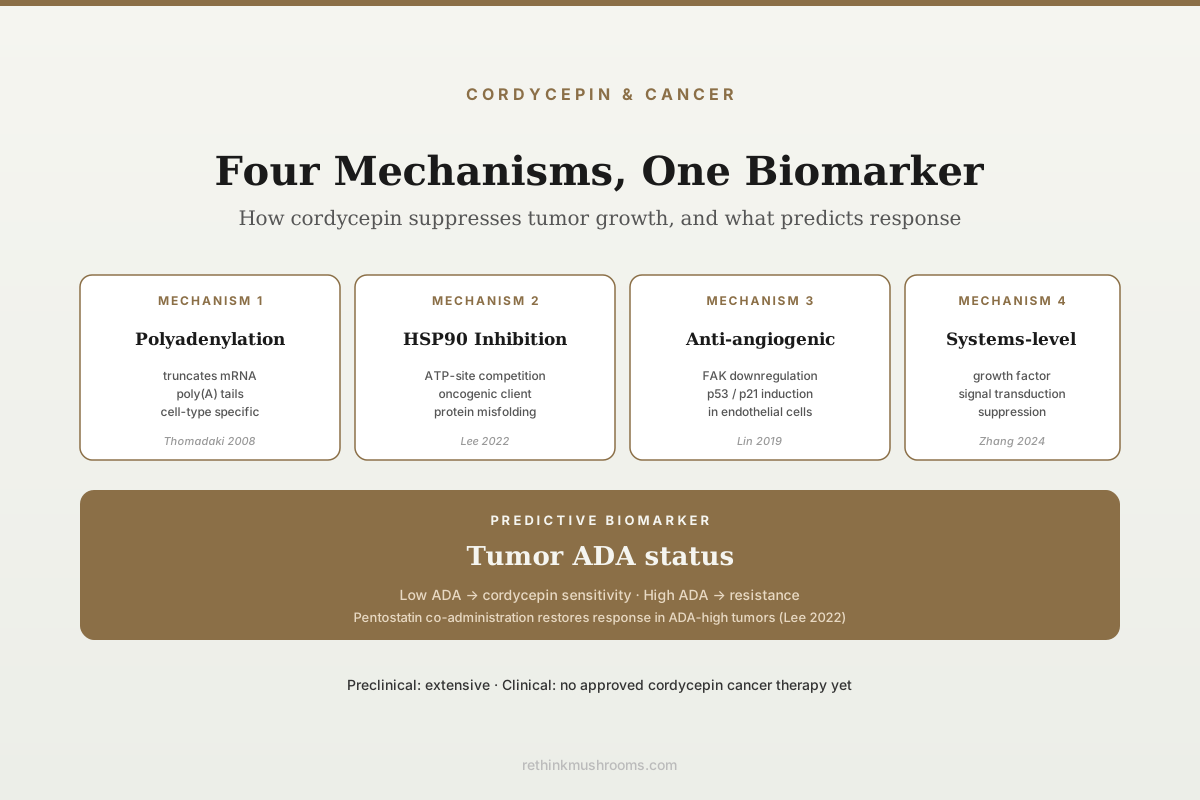
Cordycepin suppresses tumor growth through polyadenylation inhibition, HSP90 functional impairment, anti-angiogenic FAK/p53 modulation, and broad growth factor signal transduction disruption. Response depends on tumor adenosine deaminase (ADA) status.
Lee et al., Cancers, 2022; Lin et al., Cancers, 2019; Thomadaki et al., 2008
Polyadenylation Target
short-half-life oncogenic mRNAs disproportionately affected
HSP90 Inhibition
ADA-low tumors sensitive; ADA-high resistant
Anti-Angiogenic Action
FAK downregulation + p53/p21 induction in endothelium
Lee et al., Cancers, 2022; Lin et al., Cancers, 2019; Thomadaki et al., 2008
 View as image ↗
The preclinical evidence that cordycepin inhibits tumor growth is consistent across decades of research, across cell culture and rodent xenograft models, and across multiple tumor types. The more interesting and more recent observation is that the mechanism is multi-target rather than singular, and that response depends on a tumor's adenosine deaminase (ADA) status. Lee and colleagues (2022) in Cancers provided the clearest current framework: cordycepin suppresses heat shock protein 90 (HSP90) function by competing with ATP at the HSP90 N-terminal ATP-binding site, and the anti-tumor effect is dependent on low ADA expression or activity in the tumor, because ADA rapidly deaminates cordycepin to inactive 3'-deoxyinosine.[1] This is a pharmacology paper that makes ADA a predictive biomarker, not just a metabolic nuisance.
For related mechanisms see cordycepin (3'-deoxyadenosine): the multi-target mushroom drug, cordycepin and autophagy: how cordyceps triggers cancer cell self-destruction, cordycepin and leukemia research: preclinical findings, cordyceps and cancer: what the research shows and cordyceps as a cancer adjunct: evidence for chemotherapy support.
Key Takeaways
- Lee et al. (2022) identified cordycepin as a novel HSP90 inhibitor that competes with ATP at the N-terminal binding site and suppresses tumor growth in xenograft models, with efficacy dependent on low tumor adenosine deaminase (ADA) activity
- Thomadaki et al. (2008) reviewed the polyadenylation inhibition mechanism and showed cell-type-specific effects on apoptosis, with induction in some lines (HL-60) and suppression in others (U937, K562)
- Lin et al. (2019) demonstrated that cordycepin suppresses endothelial cell proliferation, migration, angiogenesis, and tumor growth via downregulation of focal adhesion kinase (FAK) and induction of p53 and p21
- Zhang et al. (2024) reviewed cordycepin's broad effects on growth factor signal transduction, positioning it as a systems-level modulator of mitogenic signalling rather than a single-target agent
- Wong et al. (2020) summarised the breast cancer mushroom-extract literature in which cordycepin-containing Cordyceps extracts appeared alongside other mushroom compounds with documented tumor-suppressive activity
- The translation from preclinical to clinical tumor treatment is blocked primarily by ADA-mediated inactivation, and the Chen et al. (2023) review of bioavailability strategies (prodrugs, pentostatin co-administration, nanoparticle formulations) maps the solutions under active development
Framing: A Multi-Target Compound On Tumors
Early cordycepin anticancer literature treated the compound as a polyadenylation inhibitor, and the cell-culture effects on apoptosis in various leukaemia lines dominated the narrative. The 2019–2024 wave of publications has expanded the picture substantially. Cordycepin acts on tumors through at least four distinct mechanisms that are not reducible to each other:
- Polyadenylation inhibition. 3'-dATP, the phosphorylated active metabolite, truncates mRNA poly(A) tails and destabilises the transcriptome, with disproportionate impact on short-half-life oncogenic mRNAs.
- HSP90 functional inhibition. Cordycepin competes with ATP at the HSP90 N-terminal ATP-binding site, impairing the folding of oncogenic HSP90 client proteins.
- Anti-angiogenic activity. Cordycepin downregulates FAK in vascular endothelial cells and induces p53/p21, suppressing tumor vasculature.
- Broad growth factor signal transduction suppression. Systems-pharmacology work has shown cordycepin affects multiple converging growth factor pathways, producing a generalised antimitogenic signature.
Each of these has independent literature support. The therapeutic question is not which mechanism is correct but how each contributes to the total effect in a specific tumor type, and which mechanism dominates at what concentration.
Mechanism 1: Polyadenylation Inhibition And Cell-Type Specificity
Thomadaki and colleagues (2008) reviewed cordycepin's role in cancer via polyadenylation inhibition and documented a critical complication: the effects on apoptosis are cell-type specific.[2] In some cancer cell lines the compound induces apoptosis, and in others it suppresses the apoptotic process. The review identified HL-60 leukaemia cells as responsive to apoptosis induction, while U937 and K562 lines showed apoptosis suppression.
This heterogeneity is mechanistically consistent with what polyadenylation inhibition should do. Each cell type has a transcriptome with a different set of short-poly(A) mRNAs underlying proliferation versus survival decisions. Inhibiting polyadenylation globally affects proliferation-critical transcripts in some cells and survival-critical transcripts in others. The clinical implication is that cordycepin is not a universal pro-apoptotic agent, and simple claims that it "kills cancer cells" across the board are not supported at the mechanism level.
Zhang 2024 extended this understanding into a systems-pharmacology view of cordycepin's effects on mitogenic signal transduction, showing that the polyadenylation mechanism preferentially affects genes whose mRNAs have short half-lives and are induced rapidly in response to growth factors.[3] These are disproportionately the oncogenic transcripts associated with proliferation and invasion, which explains why cordycepin's antimitogenic effect is broader than a pure transcriptional inhibitor would predict.
Mechanism 2: HSP90 Inhibition With ADA Dependency
HSP90 is a molecular chaperone that many oncogenic client proteins (including HER2, AKT, RAF, CDK4, mutant p53, BCR-ABL) depend on for proper folding. Pharmacological HSP90 inhibition is a validated anticancer strategy and the subject of multiple drug development programmes. Lee and colleagues (2022) identified cordycepin as a novel HSP90 inhibitor with a different binding mode than classical HSP90 inhibitors: it competes with ATP at the N-terminal ATP-binding site, inhibiting the HSP90 ATPase cycle that drives client protein folding.[1]
The most clinically consequential finding of Lee 2022 is the ADA dependency. The team tested cordycepin against a panel of difficult-to-treat cancer cell lines and xenograft models (uveal melanoma, retinoblastoma, atypical teratoid rhabdoid tumors, diffuse midline gliomas) and found that cordycepin's anti-tumor effect was dependent on low tumor ADA expression or activity. Tumors with higher ADA converted cordycepin to inactive 3'-deoxyinosine too rapidly for the compound to engage HSP90 effectively. When the team inhibited ADA with siRNA or pharmacological tools (pentostatin), ADA-high tumors regained sensitivity to cordycepin, with increased apoptosis, reduced clonogenic capacity and slower migration.
This is a predictive biomarker framework. ADA status in a tumor becomes a pre-treatment test that predicts cordycepin response, and pentostatin co-administration becomes a rescue strategy for ADA-high tumors. The practical consequence is that cordycepin therapy is better thought of as a cordycepin + ADA-status strategy than as a pure single-agent programme.
Mechanism 3: Anti-Angiogenesis Via FAK/P53
Solid tumors depend on recruiting their own blood supply through angiogenesis, and anti-angiogenic agents are a validated class of cancer therapeutics. Lin and colleagues (2019) demonstrated that cordycepin suppresses endothelial cell proliferation, migration, angiogenesis and tumor growth by regulating focal adhesion kinase (FAK) and p53.[4] The mechanism is FAK downregulation and reduced FAK-Tyr397 phosphorylation in endothelial cells, combined with induction of p53 and p21.
The in vitro endpoints (endothelial proliferation, wound healing, transwell migration, tube formation) all responded consistently to cordycepin treatment, and xenograft models showed reduced vascularity in treated tumors compared with controls. This is a mechanism distinct from polyadenylation and HSP90: the target is tumor vasculature rather than tumor cells, and the effect is mediated by endothelial cell biology.
The anti-angiogenesis mechanism has a broader implication. A compound that impairs both tumor cell proliferation and tumor vascularisation can produce effect sizes larger than either mechanism alone would predict. The combination is characteristic of some of the most successful anticancer drug classes.
Mechanism 4: Broad Growth Factor Signal Transduction
A systems-pharmacology analysis of cordycepin by Lawrence and colleagues (2025) in FEBS Letters showed that cordycepin generally inhibits growth factor signal transduction across multiple pathways, producing a broader antimitogenic signature than single-pathway inhibitors. This systems-level effect is consistent with, and partly overlaps, the polyadenylation mechanism described above, because many growth factor-induced mRNAs are short-half-life poly(A)-dependent transcripts.
The practical pharmacological implication is that cordycepin is not likely to produce resistance through the narrow single-pathway escape mechanisms that drive resistance to targeted kinase inhibitors. Broad systems-level inhibition is harder for tumors to escape by upregulating parallel pathways, because cordycepin's effect is not one pathway but a pattern across pathways. The trade-off is that systems-level inhibition also has broader off-target effects in normal tissue, which returns the clinical translation to the same bioavailability and selectivity challenges discussed in the broader cordycepin literature (Ashraf 2020, Sharma 2022, Chen 2023).[5] [6] [7]
In Vivo Xenograft Evidence
The strongest integrative preclinical evidence for cordycepin anticancer activity comes from xenograft studies that test intact-tumor outcomes rather than cell culture endpoints. Lee 2022 xenografts in ADA-low and ADA-high tumor models produced divergent response consistent with the mechanistic prediction: ADA-low tumors shrank, ADA-high tumors did not until pentostatin was added, and ADA-modulation rescued response.[1] The Lin 2019 xenografts showed reduced tumor vascularity at 20 mg/kg cordycepin, with tumors visibly paler than controls.[4]
Zhang 2024's review placed these xenograft results in the context of the broader neoplasm-targeting literature and identified the common pattern: cordycepin consistently reduces tumor volume and tumor vasculature in rodent xenograft models, with effect size that varies by tumor type and ADA status.[3] Phull and colleagues (2022) reviewed Cordyceps militaris as a bio-functional food with pharmacological anti-cancer activity and integrated the xenograft evidence with the whole-extract literature.[8]
Wider Tumor-Extract Context
Wong and colleagues (2020) reviewed mushroom extracts and compounds with suppressive action on breast cancer, drawing on cell culture, tumor-bearing animal models and clinical trials.[9] Cordycepin and Cordyceps extracts appear in the review alongside other mushroom compounds with documented tumor-suppressive activity. The broader context matters because no one argues cordycepin is the only bioactive mushroom compound with anti-tumor activity; the comparative question is where cordycepin ranks and how its mechanism differs from other mushroom-derived compounds.
The distinctive features of cordycepin's anticancer profile, relative to other mushroom compounds:
- Single small-molecule active (not a polysaccharide fraction of variable composition)
- Multi-mechanism action on tumor cells and vasculature
- Predictive biomarker (ADA status)
- Clear clinical development strategy (prodrugs, pentostatin combinations) already in preclinical pipeline
Clinical Translation: Still Preclinical
The central honest statement about cordycepin anticancer work is that it remains preclinical. No cordycepin-based therapy has been approved for any cancer indication, no cordycepin oncology drug is in late-stage clinical trials, and no consumer supplement has demonstrated anti-tumor efficacy in human cancer patients at rigorously controlled clinical endpoints. The preclinical evidence is extensive and biologically coherent, but translation to approved therapy has been blocked by the same ADA-mediated inactivation problem that complicates all cordycepin pharmacology.
Chen and colleagues (2023) reviewed the bioavailability-improvement strategies under active development: ADA-resistant nucleoside analogues, prodrug chemistry (NUC-7738 is a notable phosphoramidate prodrug derivative that has entered early clinical testing in oncology), liposomal encapsulation, and combination with pentostatin for ADA-high tumors.[7] Each of these strategies is in preclinical or early clinical development, and none has delivered approved therapy.
For a consumer considering Cordyceps supplementation in the context of a cancer diagnosis, the preclinical cordycepin-anticancer literature does not translate cleanly into a supplementation recommendation. The ADA inactivation problem is particularly relevant here: oral Cordyceps militaris likely delivers insufficient bioavailable cordycepin to replicate the mechanisms documented in the preclinical literature, which requires the intratumor exposures achieved in controlled injection dosing or with ADA inhibitor co-administration. This is a different question from the supportive and adjunctive use of Cordyceps in cancer care, which is covered in cordyceps as a cancer adjunct: evidence for chemotherapy support.
Limits Of The Evidence
The cordycepin-anticancer evidence base has several clear boundaries.
Almost all of the mechanism-level evidence is preclinical: cell culture, rodent xenografts, biochemical assays on purified proteins. Human clinical trials on purified cordycepin are very limited; the NUC-7738 prodrug trials are the most advanced clinical cordycepin-derivative work in oncology at the time of this writing, and they have not yet delivered definitive efficacy data.
Cell-type specificity of the polyadenylation mechanism complicates tumor-type selection. A single in vitro result in one cancer cell line does not predict efficacy in another, and the Thomadaki 2008 review made this point explicitly.[2]
ADA status in human tumors is heterogeneous and is not routinely measured. Lee 2022 made ADA a predictive biomarker in preclinical work, but the infrastructure to use ADA status clinically to select cordycepin-responsive patients is not yet in place.[1]
Cordyceps militaris supplements provide cordycepin orally, at variable and usually unverified doses. The pharmacological profile of consumer-grade oral cordycepin (low bioavailability, rapid ADA inactivation, no tumor-ADA stratification) is not the profile of the preclinical cordycepin that produces tumor suppression in xenograft studies.
Finally, the integration of cordycepin with conventional oncology (chemotherapy, radiation, targeted therapy, immunotherapy) has not been systematically tested in human trials. Preclinical signals for synergy exist but are not sufficient evidence for clinical use.
The Bottom Line
Cordycepin suppresses tumor growth through at least four distinct mechanisms: polyadenylation inhibition with cell-type-specific apoptosis effects (Thomadaki 2008), HSP90 N-terminal ATP-site competitive inhibition with ADA-dependent efficacy (Lee 2022), anti-angiogenic FAK downregulation and p53/p21 induction in endothelial cells (Lin 2019), and broad growth factor signal transduction disruption (Zhang 2024). Preclinical xenograft evidence is consistent, ADA status emerges as a predictive biomarker, and clinical translation remains blocked by the same ADA-mediated inactivation problem that complicates all cordycepin pharmacology. No cordycepin-based cancer therapy is yet approved.
Frequently Asked Questions
Sources & References
- 1RTHM-00777·Lee, Su-Chan et al. (2022). “Cordycepin (3'-Deoxyadenosine) Suppresses Heat Shock Protein 90 Function and Targets Tumor Growth in an Adenosine Deaminase-Dependent Manner..” Cancers.Study breakdown →PubMed →↩
- 2RTHM-00147·Thomadaki, Hellinida et al. (2008). “The role of cordycepin in cancer treatment via induction or inhibition of apoptosis: implication of polyadenylation in a cell type specific manner..” Cancer chemotherapy and pharmacology.Study breakdown →PubMed →↩
- 3RTHM-00918·Zhang, Jinming et al. (2024). “Structural and pharmacological insights into cordycepin for neoplasms and metabolic disorders..” Frontiers in pharmacology.Study breakdown →PubMed →↩
- 4RTHM-00573·Lin, Yi-Ting et al. (2019). “Cordycepin Suppresses Endothelial Cell Proliferation, Migration, Angiogenesis, and Tumor Growth by Regulating Focal Adhesion Kinase and p53..” Cancers.Study breakdown →PubMed →↩
- 5RTHM-00605·Ashraf, Syed Amir et al. (2020). “Cordycepin for Health and Wellbeing: A Potent Bioactive Metabolite of an Entomopathogenic Cordyceps Medicinal Fungus and Its Nutraceutical and Therapeutic Potential..” Molecules (Basel.Study breakdown →PubMed →↩
- 6RTHM-00795·Sharma, Shivani et al. (2022). “Cordycepin as a Metabolite with Pharmacological Potential: A Review..” International journal of medicinal mushrooms.Study breakdown →PubMed →↩
- 7RTHM-00817·Chen, Min et al. (2023). “Cordycepin: A review of strategies to improve the bioavailability and efficacy..” Phytotherapy research : PTR.Study breakdown →PubMed →↩
- 8RTHM-00790·Phull, Abdul-Rehman et al. (2022). “Cordyceps militaris as a Bio Functional Food Source: Pharmacological Potential, Anti-Inflammatory Actions and Related Molecular Mechanisms..” Microorganisms.Study breakdown →PubMed →↩
- 9RTHM-00664·Wong, Jack Ho et al. (2020). “Mushroom extracts and compounds with suppressive action on breast cancer: evidence from studies using cultured cancer cells, tumor-bearing animals, and clinical trials..” Applied microbiology and biotechnology.Study breakdown →PubMed →↩