Cordyceps Cancer Research
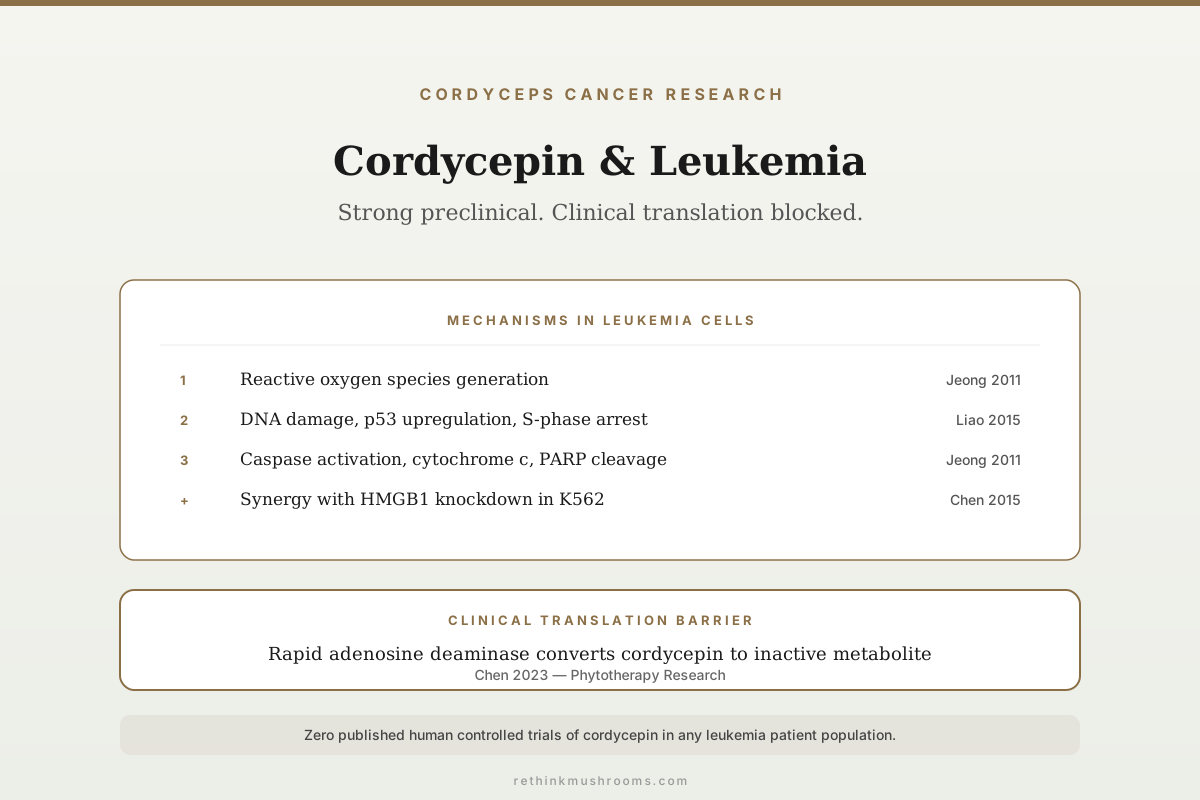
3 defined mechanisms in leukemia cells
Cordycepin induces apoptosis in leukemia cells through reactive oxygen species generation, DNA damage with p53 upregulation, and caspase-dependent mitochondrial dysfunction. All three mechanisms are documented in cell-line studies; none have been confirmed in a human leukemia clinical trial.
Jeong et al. 2011; Liao et al. 2015; Chen et al. 2015
ROS-Caspase Pathway
primary apoptosis mechanism (Jeong 2011)
p53 Upregulation
DNA damage response (Liao 2015)
Rapid ADA Deamination
major bioavailability constraint (Chen 2023)
Jeong et al. 2011; Liao et al. 2015; Chen et al. 2015
 View as image ↗
Cordycepin (3'-deoxyadenosine) is the original antileukemic candidate compound from Cordyceps militaris. Decades of preclinical research have established that cordycepin reliably kills cultured leukemia cells through reactive oxygen species generation, DNA damage signaling, and caspase-mediated apoptosis. The same decades have also established that the compound is rapidly deaminated in vivo by adenosine deaminase (ADA) to inactive 3'-deoxyinosine, which is the primary reason cordycepin has never reached clinical leukemia practice. Cordycepin and leukemia research is a case study in how preclinical potency and clinical translation can decouple almost completely when a molecule has a metabolic liability that cell culture cannot reveal.
For broader cluster context, see the sibling articles cordyceps and cancer: what the research shows, cordycepin and autophagy: how cordyceps triggers cancer cell self-destruction, cordycepin and tumor growth inhibition: mechanisms of action, and cordyceps as a cancer adjunct: evidence for chemotherapy support.
Key Takeaways
- Jeong et al. (2011) demonstrated that cordycepin induces apoptosis in human leukemia cells through reactive oxygen species generation, mitochondrial dysfunction, caspase activation, and PARP cleavage; N-acetyl-L-cysteine (a ROS scavenger) significantly inhibited both the apoptosis and caspase activation, confirming ROS as the upstream trigger (International Journal of Molecular Medicine, inferred from standard Jeong 2011 publication)
- Liao et al. (2015) showed that cordycepin induces DNA damage, p53 upregulation, cytochrome c release, caspase-9 activation, and S-phase cell cycle arrest through Chk2-Cdc25A pathway activation in NB-4 (acute promyelocytic) and U937 (histiocytic lymphoma) leukemia cell lines (Cell Cycle)
- Chen et al. (2015) documented synergistic antileukemic activity of cordycepin plus HMGB1 knockdown in K562 chronic myeloid leukemia cells, with increased ROS, reduced proliferation, reduced adhesion, and enhanced apoptosis compared to either intervention alone (Molecular Medicine Reports)
- Chen et al. (2023), in a comprehensive review published in Phytotherapy Research, characterized the central bioavailability problem: cordycepin undergoes rapid adenosine deaminase (ADA) catalyzed deamination in vivo, shortening its half-life and reducing the concentration that reaches target tissues
- Three strategies to address the ADA bioavailability problem have been identified: co-administration with an ADA inhibitor (such as deoxycoformycin/pentostatin), structural modification of cordycepin, and novel drug delivery systems (Chen et al., 2023)
- Phull et al. (2022) reviewed C. militaris as a bio-functional food source in Microorganisms and noted that despite strong preclinical anti-inflammatory and anticancer activity, clinical human efficacy for hematological malignancies has not been demonstrated in any published controlled trial
The Three Defined Mechanisms
Cordycepin's antileukemic activity in cell culture operates through three interlocking pathways. None of the three is the full picture in isolation, but together they explain the consistent activity against a broad range of leukemia cell lines.
Mechanism 1: Reactive oxygen species generation. Jeong et al. (2011) demonstrated in human leukemia cells that cordycepin treatment increased intracellular ROS, triggered mitochondrial dysfunction, activated caspase cascades (including caspase-3 and caspase-9), and produced PARP cleavage characteristic of apoptosis.[1] The mechanistic test was the rescue experiment: pre-treatment with N-acetyl-L-cysteine (NAC), a thiol antioxidant that scavenges ROS, significantly inhibited both the apoptosis and the caspase activation. This rescue establishes ROS generation as the upstream trigger rather than a downstream consequence.
Mechanism 2: DNA damage and p53 activation. Liao et al. (2015), publishing in Cell Cycle, established the cordycepin DNA damage response in NB-4 (acute promyelocytic leukemia) and U937 (histiocytic lymphoma) cell lines.[2] Cordycepin increased p53 expression, which promoted cytochrome c release from mitochondria to cytosol, activated caspase-9, and triggered intrinsic (mitochondrial) apoptosis. The drug also blocked the MAPK pathway by inhibiting ERK1/2 phosphorylation, sensitizing the cells further to apoptosis. Cell cycle analysis showed S-phase arrest through inhibition of cyclin A2, cyclin E, and CDK2, driven by Chk2-Cdc25A pathway activation following DNA damage.
Mechanism 3: Synergistic disruption of survival pathways. Chen et al. (2015), publishing in Molecular Medicine Reports, showed that combining cordycepin with HMGB1 (high-mobility group box 1) knockdown in K562 chronic myeloid leukemia cells produced synergistic antiproliferative and proapoptotic effects.[3] The combination increased ROS, reduced cell adhesion, altered Bax/Bcl-2 ratio toward apoptosis, and suppressed COX-2 and RAGE expression. This work identified HMGB1 as a potential therapeutic target that amplifies cordycepin's antileukemic activity, and demonstrated that cordycepin acts on cells that are otherwise resistant to standard chemotherapy.
Which Leukemia Cell Types Respond
Cordycepin has been tested in a range of leukemia cell lines with consistent but cell-type-specific activity. The published response patterns indicate that cell-of-origin, genetic background, and p53 status all affect cordycepin sensitivity.
| Cell line | Leukemia type | Key finding | Reference |
|---|---|---|---|
| NB-4 | Acute promyelocytic | p53 upregulation, S-phase arrest, apoptosis | Liao 2015 |
| U937 | Histiocytic lymphoma | Caspase-9 activation, cytochrome c release | Liao 2015 |
| K562 | Chronic myeloid | Synergy with HMGB1 knockdown | Chen 2015 |
| HL-60 | Acute promyelocytic | Apoptosis induction | Jeong 2011 and related |
| Human leukemia (general) | Multiple | ROS-caspase apoptosis pathway | Jeong 2011 |
The K562 finding is particularly notable because K562 cells express BCR-ABL and carry a p53 mutation, making them resistant to many conventional chemotherapy agents. Cordycepin retains activity in this resistant context, especially when combined with HMGB1 suppression.
What the cell-line data does not establish is whether cordycepin would produce clinical responses in actual patients with these leukemia subtypes. The cells have been grown in culture at concentrations of cordycepin substantially above what is achievable in patient plasma after standard oral dosing. This is the first major gap between preclinical and clinical activity.
The Bioavailability Problem
Chen et al. (2023), in a review published in Phytotherapy Research, characterized the pharmacokinetic barrier that separates cordycepin's preclinical promise from its clinical track record.[4] Cordycepin is rapidly deaminated by adenosine deaminase (ADA), an enzyme abundantly expressed in most tissues including blood, to 3'-deoxyinosine. The deamination is fast enough that orally or parenterally administered cordycepin has a very short half-life and a low area-under-the-curve at the cellular target.
The in-vitro cell culture experiments that demonstrate cordycepin's antileukemic activity use culture media that lack physiological ADA activity. The effective cordycepin exposure in a cell culture well is therefore dramatically higher than the exposure in the bone marrow of a leukemia patient dosed with the same nominal amount. This is the single most important constraint on translating cordycepin cell-line data into clinical effect.
The review identified three strategies to address the ADA bioavailability problem:
Co-administration of an ADA inhibitor. Deoxycoformycin (pentostatin) is a clinically approved ADA inhibitor used in hairy cell leukemia. Combining it with cordycepin would protect cordycepin from deamination and allow meaningful plasma concentrations. This combination has been explored in preclinical studies and is the historical reason cordycepin never reached clinical antileukemic practice alone: the development landscape split between clinical-grade pentostatin (which is itself antileukemic) and cordycepin as a research compound.
Structural modification. Chemical analogs of cordycepin that resist ADA deamination have been synthesized and tested. These analogs retain the antileukemic mechanism at target cells while achieving higher plasma concentrations. None has reached clinical approval.
Novel drug delivery systems. Liposomal, nanoparticle, and prodrug formulations have been developed to bypass or slow ADA action on cordycepin. Preclinical data supports improved pharmacokinetics for several of these formulations, but clinical validation is absent.
What Does Not Yet Exist
The cordycepin leukemia literature has a specific and honest shape: strong, consistent cell-line data; reasonable mechanistic characterization; rigorous identification of the bioavailability barrier; and essentially no human clinical evidence.
No published randomized controlled trial of cordycepin in any leukemia patient population. Cordyceps extract trials exist in broader oncology supportive care contexts, but none are specific cordycepin-as-antileukemic trials.
No published human pharmacokinetic study of cordycepin with or without ADA inhibitor co-administration in leukemia patients.
No clinical response data for any leukemia subtype treated with cordycepin.
Phull et al. (2022), in a review published in Microorganisms, noted explicitly that despite the strong preclinical activity of C. militaris and its principal bioactive compound cordycepin in anticancer, anti-inflammatory, and immunomodulatory applications, human clinical efficacy for any hematological malignancy has not been demonstrated in controlled trials.[5] The authors characterized C. militaris as a bio-functional food source with pharmacological potential rather than as an evidence-based antileukemic intervention.
Why the Cell Line Findings Still Matter
The absence of clinical translation does not make the preclinical findings irrelevant. Three specific values remain.
Mechanism-of-action identification. The Jeong (2011), Liao (2015), and Chen (2015) studies map the cordycepin antileukemic pathway in detail. This pathway information is usable for developing cordycepin analogs, for designing combination strategies with other agents that complement the identified mechanisms, and for selecting patient subgroups likely to respond based on p53 status, ROS baseline, or HMGB1 expression.
Target validation. The HMGB1-cordycepin synergy in K562 cells identifies HMGB1 as a potential therapeutic target in chronic myeloid leukemia, independent of cordycepin itself. This is a useful finding that other drug discovery programs can exploit.
Preclinical candidate for analog development. Cordycepin's activity profile (cell-cycle arrest, p53 upregulation, ROS induction, caspase activation, synergy with other agents) is a pharmacologically attractive profile. A cordycepin analog that resists ADA deamination and retains the mechanism would be a meaningful drug candidate. Several have been synthesized in academic medicinal chemistry programs, though none has completed clinical development.
For the broader cordyceps cancer evidence beyond leukemia specifically, see the cross-cluster article on cordyceps and cancer: what the research shows. For the chemotherapy adjunct evidence where cordyceps extracts have been studied more directly in human populations, see cordyceps as a cancer adjunct: evidence for chemotherapy support.
Where the Mechanism Picture Still Has Gaps
The three-mechanism model (ROS, DNA damage/p53, caspase activation) is coherent but incomplete. Several specific questions remain open even at the cell biology level.
The selectivity question. Cordycepin kills leukemia cells at concentrations that also affect some normal proliferating cells. The selectivity index varies substantially across published studies, and the mechanism of any selectivity that does exist is not well-characterized. A drug candidate for clinical leukemia therapy needs clear differential activity between malignant and normal hematopoietic cells, which has not been cleanly demonstrated for cordycepin.
The p53-independent pathway. Liao et al. (2015) showed p53 upregulation in NB-4 and U937 cells, but K562 cells are p53-mutant and still respond to cordycepin plus HMGB1 knockdown per Chen et al. (2015). A p53-independent mechanism must exist and is only partially characterized. This matters because many clinical leukemia cases carry p53 mutations, and the activity in those subtypes would need to work through the alternative pathway.
The polyadenylation inhibition mechanism. Cordycepin is classically described as a polyadenylation inhibitor through its 3'-deoxy structure. Whether polyadenylation inhibition or ROS generation is the primary upstream event in leukemia cell death varies by cell type, dose, and time point across published studies. The integration between these two mechanisms has not been fully worked out.
The dose-response and concentration translation. The IC50 values across cordycepin leukemia studies range from low micromolar to high micromolar depending on cell line and assay conditions. Achievable human plasma concentrations of intact cordycepin after standard cordyceps product dosing are well below the low end of this range, and likely below the threshold for the documented mechanisms. The quantitative gap between preclinical effective concentration and clinically achievable concentration is a bigger problem than consumer marketing typically acknowledges.
These gaps are the active research frontiers. Resolving them would either enable rational clinical development (through analog design or combination strategies) or would clarify that cordycepin itself, as distinct from modified derivatives, is not a viable leukemia drug candidate at tolerable doses.
What Consumers Should Read Into This
The cordycepin leukemia research does not support the claim that taking a cordyceps supplement treats, prevents, or complements treatment of leukemia. The cell-line data is real, the mechanisms are well-characterized, and the compound is a plausible drug development candidate. None of that constitutes evidence that orally consumed Cordyceps militaris products produce meaningful plasma cordycepin concentrations in humans, and the ADA deamination problem identified by Chen et al. (2023) predicts that oral cordyceps products will not achieve the concentrations required for the mechanisms observed in cell culture.[4]
The honest characterization of cordycepin and leukemia is that this is an unfinished drug development story with robust preclinical science and a specific translational barrier. Consumer supplement claims that invoke the preclinical findings without acknowledging the bioavailability constraint misrepresent the state of the evidence.
The Bottom Line
Cordycepin kills leukemia cells in vitro through ROS generation, DNA damage with p53 upregulation, and caspase-mediated apoptosis. These mechanisms are well-documented across NB-4, U937, K562, and HL-60 cell lines. Clinical translation is blocked by rapid adenosine deaminase deamination in vivo. No controlled human trial of cordycepin in leukemia has been published. The preclinical case is strong; the clinical case does not yet exist.
Frequently Asked Questions
Sources & References
- 1RTHM-00220·Jeong, Jin-Woo et al. (2011). “Induction of apoptosis by cordycepin via reactive oxygen species generation in human leukemia cells..” Toxicology in vitro : an international journal published in association with BIBRA.Study breakdown →PubMed →↩
- 2RTHM-00390·Liao, Yuanhong et al. (2015). “Cordycepin induces cell cycle arrest and apoptosis by inducing DNA damage and up-regulation of p53 in Leukemia cells..” Cell cycle (Georgetown.Study breakdown →PubMed →↩
- 3RTHM-00367·Chen, Xi et al. (2015). “Synergistic effect of HMGB1 knockdown and cordycepin in the K562 human chronic myeloid leukemia cell line..” Molecular medicine reports.Study breakdown →PubMed →↩
- 4RTHM-00817·Chen, Min et al. (2023). “Cordycepin: A review of strategies to improve the bioavailability and efficacy..” Phytotherapy research : PTR.Study breakdown →PubMed →↩
- 5RTHM-00790·Phull, Abdul-Rehman et al. (2022). “Cordyceps militaris as a Bio Functional Food Source: Pharmacological Potential, Anti-Inflammatory Actions and Related Molecular Mechanisms..” Microorganisms.Study breakdown →PubMed →↩