Cordyceps and Kidney Function
36.7% urinary protein reduction
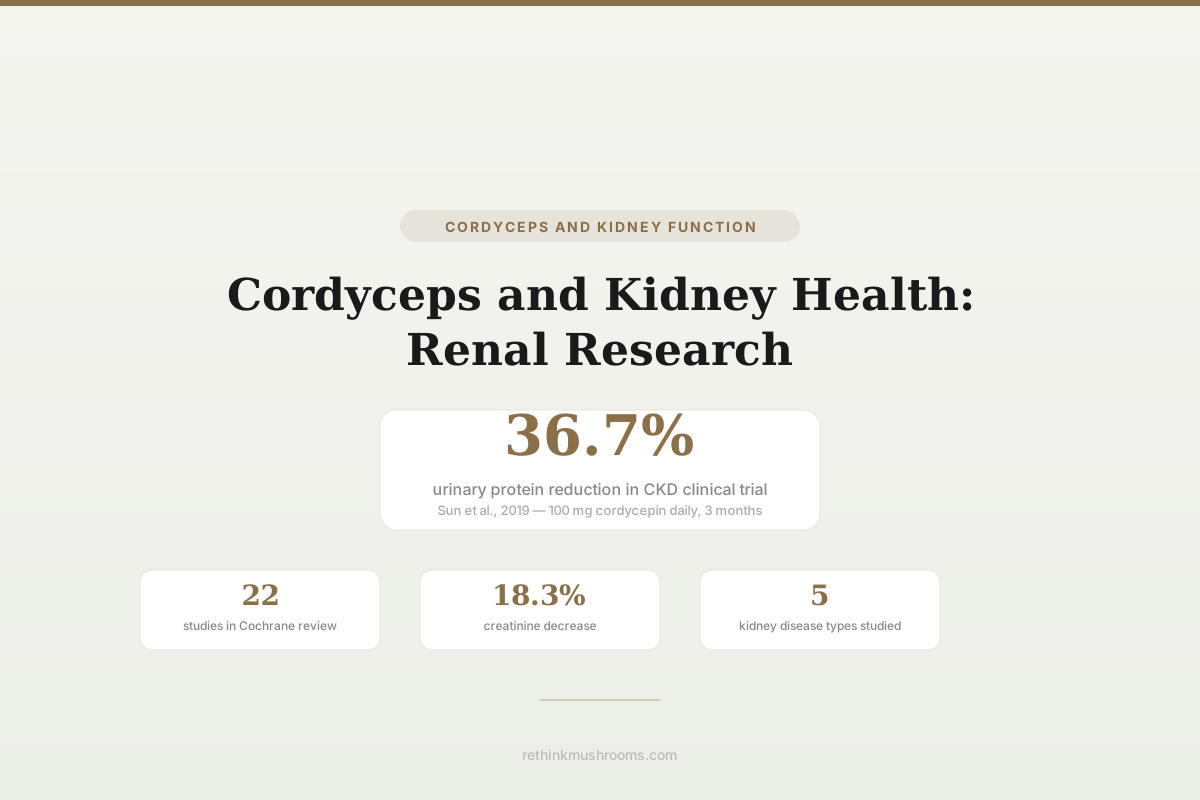
In a clinical study by Sun et al. (2019), CKD patients taking 100 mg cordycepin daily for three months showed a 36.7% reduction in urinary protein, 18.3% creatinine drop, and 12.5% BUN decrease.
Sun et al., Oxidative Medicine and Cellular Longevity, 2019
22 trials, 1,746 patients
in 2014 Cochrane CKD review
IgA nephropathy
mesangial proliferation inhibited
Ischemia-reperfusion
cordycepin reduced injury markers
Sun et al., Oxidative Medicine and Cellular Longevity, 2019
 View as image ↗
Cordyceps sinensis has been used in traditional Chinese medicine for kidney conditions for centuries, and over the past three decades, formal research has tested that tradition across multiple kidney diseases. The evidence spans chronic kidney disease (CKD), IgA nephropathy, kidney transplant outcomes, renal ischemia-reperfusion injury, contrast-induced nephropathy, and renal fibrosis. A 2022 review by Tan et al. in Frontiers in Pharmacology identified five therapeutic axes through which Cordyceps acts on kidney tissue: suppressing inflammation, reducing oxidative stress, modulating apoptosis, inducing autophagy, and reducing extracellular matrix deposition.[1]
The strongest clinical evidence comes from Chinese hospital use of Bailing capsules (a fermented Cordyceps preparation) as adjunctive therapy for CKD, and from one clinical trial testing cordycepin directly in CKD patients. The mechanistic evidence comes primarily from animal and cell culture models. This article covers the full kidney-health landscape: what has been tested, what the results show, and where the evidence remains thin. For cordyceps effects specific to diabetic kidney disease, see Cordyceps and diabetic kidney disease: renal protective research. For creatinine-specific data, see Cordyceps and creatinine levels: what the studies show.
Key Takeaways
- Sun et al. (2019) conducted a clinical trial in CKD patients: 100 mg cordycepin daily for three months reduced urinary protein by 36.7%, blood urea nitrogen by 12.5%, and serum creatinine by 18.3%, with improvements in lipid profile and oxidative stress markers
- A 2014 Cochrane review (Zhang et al.) analyzed 22 studies involving 1,746 CKD participants and found Cordyceps preparations decreased serum creatinine, increased creatinine clearance, and reduced proteinuria when added to conventional treatment, though evidence quality was rated poor
- Lin et al. (1999) isolated compound H1-A from Cordyceps sinensis that inhibited activated human mesangial cell proliferation and reduced hematuria and proteinuria in an IgA nephropathy mouse model
- Xiao et al. (2018) demonstrated that Cordyceps sinensis inhibited Th22 cell chemotaxis in IgA nephropathy patients, reducing urinary IL-22 and improving kidney function markers
- Han et al. (2020) showed cordycepin protected against renal ischemia-reperfusion injury in rats by reducing inflammatory cytokines, suppressing apoptosis, and lowering oxidative stress markers
- All positive clinical results come from trials with small sample sizes and methodological limitations; no large-scale, high-quality randomized controlled trial has been published
The Clinical Trial: Cordycepin in CKD Patients
The most direct clinical evidence for cordyceps in kidney health comes from Sun et al. (2019), who assigned CKD patients to either a Cordyceps militaris group (100 mg cordycepin daily) or placebo for three months. The results showed measurable improvements across multiple kidney function markers.[2]
Urinary protein dropped by 36.7% (plus or minus 8.6%), blood urea nitrogen decreased by 12.5% (plus or minus 3.2%), and serum creatinine fell by 18.3% (plus or minus 6.6%). Lipid profiles improved: serum triglycerides, total cholesterol, and LDL-cholesterol decreased while HDL-cholesterol increased. Oxidative stress markers (MDA, ROS) were reduced while antioxidant enzymes (SOD, CAT, GPx) increased.
The mechanistic investigation showed that cordycepin reduced levels of TLR4, NF-kB, COX2, TNF-alpha, and IL-1-beta in HEK293T kidney cells. When TLR4 was silenced, cordycepin could no longer affect these downstream targets, confirming TLR4 as the receptor through which cordycepin modulates the inflammatory cascade in kidney cells.
The limitation: sample size and blinding details were not well reported, and three months is a short window for a disease that progresses over years. Whether these biomarker improvements translate to slowed disease progression remains unknown.
The Cochrane Review: 22 Studies, 1,746 Patients
The most comprehensive evaluation of cordyceps for CKD is the 2014 Cochrane systematic review by Zhang et al., which analyzed 22 studies involving 1,746 participants. Among CKD patients not receiving dialysis, Cordyceps preparations as adjunctive therapy decreased serum creatinine (14 studies, 987 participants), increased creatinine clearance (6 studies, 362 participants), and reduced 24-hour proteinuria (4 studies, 211 participants).
The review also found evidence for alleviating CKD complications: increased hemoglobin levels (suggesting improvement in renal anemia) and increased serum albumin (suggesting improved nutritional status). These effects were observed when Cordyceps was added to conventional treatment, not as a replacement.
The critical caveat: risk of bias was assessed as high in four studies and unclear in eighteen. Suboptimal reporting and flawed methodological approaches meant no definitive conclusions could be drawn. The review explicitly called for adequately powered trials with rigorous methodology. More than a decade later, that call remains largely unanswered.
IgA Nephropathy: Inhibiting Mesangial Proliferation
IgA nephropathy (Berger's disease) is the most common primary glomerulonephritis worldwide. The disease involves IgA immune complex deposition in the mesangium, triggering mesangial cell proliferation, cytokine release, and progressive glomerular injury.
Lin et al. (1999) approached this with compound isolation. The team fractionated methanolic extracts from Cordyceps sinensis fruiting bodies using silica gel column chromatography and identified a compound designated H1-A. In their in vitro model, H1-A inhibited human mesangial cell activation by IL-1 plus IL-6. Acute toxicity testing in mice showed no liver toxicity or mutagenicity.[3]
The team then tested H1-A in an IgA nephropathy mouse model using R36A (pneumococcal C-polysaccharide) as antigen. Mice fed 1% H1-A in their diet showed reduced hematuria and proteinuria with histopathologic improvement and decreased IgA deposition in the mesangial area. This was one of the earliest demonstrations of a defined Cordyceps compound showing renal benefit in a disease-specific model.
Xiao et al. (2018) added an immunological layer. In IgA nephropathy patients, the team found elevated Th22 cells and their signature cytokine IL-22 in both peripheral blood and urine. Cordyceps sinensis treatment reduced urinary IL-22 levels and Th22 cell frequency, with corresponding improvements in renal function markers.[4]
The mechanism: Cordyceps appeared to inhibit Th22 cell chemotaxis to the kidney, reducing the inflammatory burden on the glomeruli. This is a distinct mechanism from the direct mesangial cell inhibition shown by Lin et al., suggesting multiple entry points for Cordyceps in IgA nephropathy.
Renal Ischemia-Reperfusion Injury
Kidneys are vulnerable to ischemia-reperfusion (I/R) injury during transplant surgery, after major cardiovascular events, and during any period of reduced renal blood flow followed by restoration. The reperfusion phase generates a burst of reactive oxygen species and activates inflammatory cascades that cause tubular cell death.
Han et al. (2020) tested cordycepin in a rat model of renal I/R injury. Pretreatment with cordycepin reduced serum creatinine and BUN levels compared to untreated I/R controls. Histological examination showed less tubular necrosis and cast formation in cordycepin-treated kidneys.[5]
The mechanistic data: cordycepin decreased pro-inflammatory cytokines TNF-alpha, IL-6, and IL-1-beta in renal tissue. TUNEL staining showed fewer apoptotic cells. Oxidative stress markers (MDA) were lower while antioxidant capacity (SOD) was higher. The study demonstrated that cordycepin modulated inflammation, apoptosis, and oxidative stress in parallel, consistent with the multi-pathway framework identified in the Tan et al. (2022) review.
For transplant contexts specifically, see Cordyceps and kidney transplant: immunosuppression research in renal patients.
Contrast-Induced Nephropathy in Diabetic Models
Contrast-induced nephropathy (CIN) is a clinical concern for patients with diabetes who need iodinated contrast for imaging. Zhao et al. (2018) tested Cordyceps sinensis pretreatment against probucol (an established antioxidant) in diabetic rats receiving iodixanol contrast agent.[6]
Both Cordyceps and probucol groups showed lower serum creatinine, BUN, urinary KIM-1, and NGAL compared to untreated diabetic controls (P<0.05), with no measurable difference between the two treatments. At the molecular level, Cordyceps suppressed Caspase-3 and Bax activation while increasing Bcl-2 expression, and modulated JNK and ERK protein expression through MAPK signaling. The comparable performance to a pharmaceutical antioxidant is noteworthy, though direct clinical extrapolation from these doses and routes of administration would be premature.
Anti-Fibrotic Mechanisms Across Kidney Diseases
Renal fibrosis is the common final pathway of progressive kidney disease regardless of the initial cause. Once established, it is largely irreversible. Tan et al. (2022) synthesized the evidence for Cordyceps against renal fibrosis across multiple disease models and identified five converging mechanisms.[1]
Dong et al. (2019) provided one of the cleaner mechanistic demonstrations. The team isolated a nucleoside/nucleobase-rich extract from Cordyceps sinensis (CS-N), characterized it via HPLC-DAD and LC-MS, and tested it in streptozotocin-induced diabetic mice. CS-N inhibited epithelial-mesenchymal transition (EMT) and extracellular matrix accumulation through p38 and ERK signaling pathway suppression.[7]
The EMT pathway is relevant across kidney diseases, not just diabetic nephropathy. When tubular epithelial cells transform into myofibroblasts and begin depositing collagen, the kidney's functional architecture is progressively replaced by scar tissue. The demonstration that a chemically characterized Cordyceps fraction blocks this transition at the signaling level is more informative than studies using undefined whole-fungus preparations.
Kidney Transplant: Adjunctive Evidence
Ong et al. (2017) conducted a systematic review and meta-analysis of Cordyceps sinensis as adjunctive treatment in kidney transplant patients. The pooled analysis found evidence for reduced acute rejection episodes and improved graft function when Cordyceps preparations were added to standard immunosuppressive regimens.[8]
The immunomodulatory properties of Cordyceps, well-documented in other contexts, may complement standard calcineurin inhibitor-based immunosuppression by reducing inflammatory damage to the graft while potentially allowing lower doses of conventional immunosuppressants (and therefore fewer side effects). The evidence quality parallels the CKD literature: promising direction, inadequate trial methodology.
Where the Evidence Stands
The cordyceps-kidney research has two consistent patterns. First, the preclinical mechanisms are plausible and converging: anti-inflammatory, anti-oxidant, anti-fibrotic, and anti-apoptotic effects have been demonstrated across multiple kidney disease models using both whole extracts and isolated compounds. Second, the clinical evidence is consistently limited by small sample sizes, short follow-up, and methodological concerns.
The Sun et al. (2019) clinical trial showed the most concrete results: measurable reductions in proteinuria, creatinine, and BUN with an identified molecular target (TLR4/NF-kB). But a single small trial, even with positive results, does not establish efficacy. The Cochrane review's conclusion from 2014 still holds: Cordyceps shows potential promise as adjunctive therapy, but definitive conclusions require trials that the field has not yet produced.
No published trial has compared Cordyceps preparations against SGLT2 inhibitors, finerenone, or other agents that have demonstrated kidney-protective effects in large randomized controlled trials. No trial has used hard endpoints like progression to dialysis or doubling of serum creatinine over multi-year follow-up. Until those studies exist, the preclinical promise and the limited clinical signals remain in separate categories. For CKD-specific clinical data, see Cordyceps for chronic kidney disease: clinical evidence.
The Bottom Line
Cordyceps research in kidney health spans chronic kidney disease, IgA nephropathy, ischemia-reperfusion injury, contrast-induced nephropathy, renal fibrosis, and transplant outcomes. One clinical trial showed cordycepin reduced proteinuria by 36.7% and creatinine by 18.3% in CKD patients over three months. A Cochrane review of 22 studies found consistent adjunctive benefits but rated evidence quality as poor. Preclinical studies have identified multiple converging mechanisms, including TLR4/NF-kB modulation, mesangial proliferation inhibition, EMT suppression, and oxidative stress reduction. The gap between these findings and rigorous, large-scale clinical validation remains the defining limitation of the field.
Frequently Asked Questions
Sources & References
- 1RTHM-00798·Tan, Wei et al. (2022). “Potential Therapeutic Strategies for Renal Fibrosis: Cordyceps and Related Products..” Frontiers in pharmacology.Study breakdown →PubMed →↩
- 2RTHM-00588·Sun, Tingli et al. (2019). “Cordyceps militaris Improves Chronic Kidney Disease by Affecting TLR4/NF-κB Redox Signaling Pathway..” Oxidative medicine and cellular longevity.Study breakdown →PubMed →↩
- 3RTHM-00029·Lin, C Y et al. (1999). “Inhibition of activated human mesangial cell proliferation by the natural product of Cordyceps sinensis (H1-A): an implication for treatment of IgA mesangial nephropathy..” The Journal of laboratory and clinical medicine.Study breakdown →PubMed →↩
- 4RTHM-00536·Xiao, Chenggen et al. (2018). “Cordyceps sinensis may inhibit Th22 cell chemotaxis to improve kidney function in lgA nephropathy..” American journal of translational research.Study breakdown →PubMed →↩
- 5RTHM-00617·Han, Feng et al. (2020). “Cordycepin protects renal ischemia/reperfusion injury through regulating inflammation, apoptosis, and oxidative stress..” Acta biochimica et biophysica Sinica.Study breakdown →PubMed →↩
- 6RTHM-00539·Zhao, Kai et al. (2018). “Cordyceps sinensis prevents contrast-induced nephropathy in diabetic rats: its underlying mechanism..” International journal of clinical and experimental pathology.Study breakdown →PubMed →↩
- 7RTHM-00552·Dong, Zhonghua et al. (2019). “A Nucleoside/Nucleobase-Rich Extract from Cordyceps Sinensis Inhibits the Epithelial-Mesenchymal Transition and Protects against Renal Fibrosis in Diabetic Nephropathy..” Molecules (Basel.Study breakdown →PubMed →↩
- 8RTHM-00486·Ong, Bee Yean et al. (2017). “Efficacy of Cordyceps sinensis as an adjunctive treatment in kidney transplant patients: A systematic-review and meta-analysis..” Complementary therapies in medicine.Study breakdown →PubMed →↩