Cordyceps Kidney Health
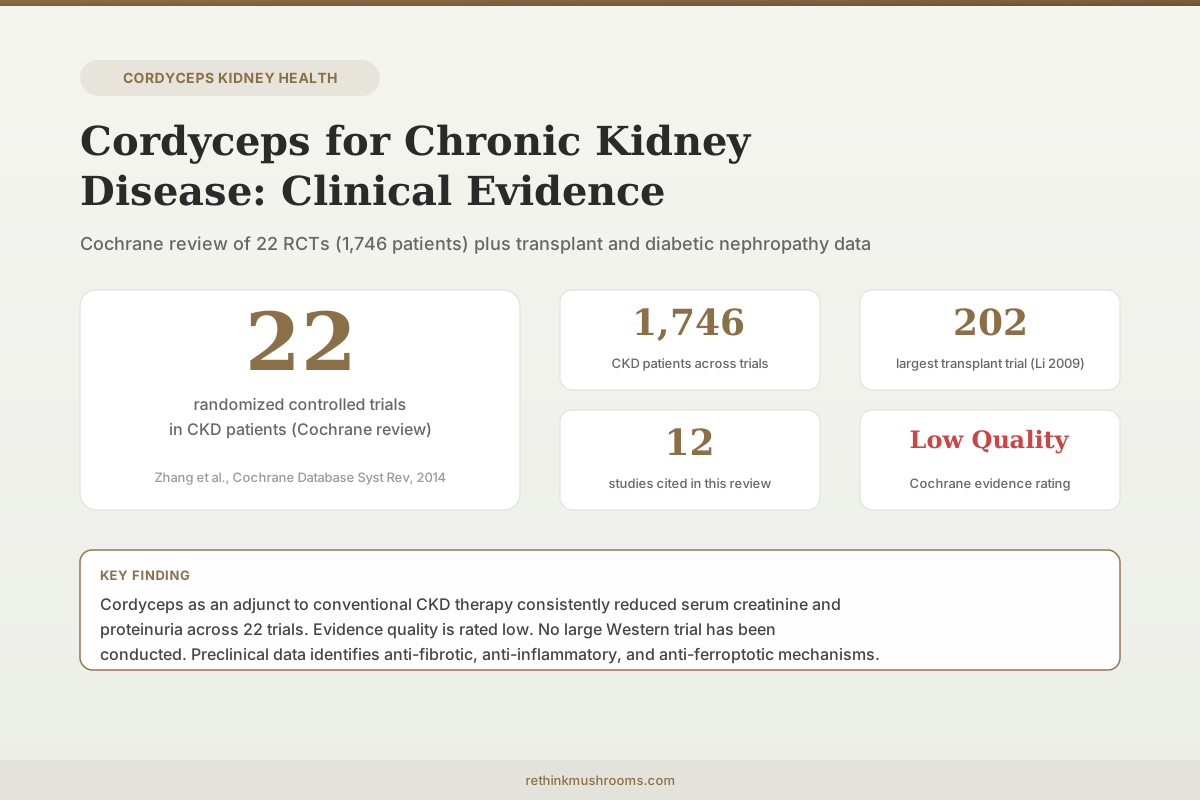
22 trials
A 2014 Cochrane systematic review analyzed 22 clinical trials (1,746 CKD patients) using cordyceps as an adjunct to conventional treatment. Most showed reduced serum creatinine and proteinuria.
Zhang et al., Cochrane Database Syst Rev, 2014
1,746
CKD patients across trials
Bailing Capsule
most-studied formulation
Low Quality
Cochrane evidence rating
Zhang et al., Cochrane Database Syst Rev, 2014
 View as image ↗
Chronic kidney disease is the one clinical condition where cordyceps has been most extensively tested in humans, primarily in Chinese clinical trials using Bailing Capsule (a fermented Cordyceps sinensis preparation). A 2014 Cochrane systematic review analyzed 22 randomized controlled trials enrolling 1,746 CKD patients. A separate 2015 Cochrane review covered cordyceps in kidney transplant recipients. A 2017 systematic review and meta-analysis added further evidence on transplant outcomes. The consistent finding across these reviews: cordyceps as an adjunct to conventional therapy reduced serum creatinine and proteinuria compared to conventional therapy alone. The consistent caveat: the evidence quality was rated low due to small sample sizes, poor blinding, and significant heterogeneity. This article examines both the promise and the limitations. For the broader view of cordyceps and kidney health, that article covers the full renal protection evidence.
Key Takeaways
- A 2014 Cochrane review of 22 RCTs (1,746 CKD patients) found cordyceps adjunct therapy reduced serum creatinine and 24-hour proteinuria compared to conventional treatment alone (Zhang et al., 2014)
- A 2017 meta-analysis of kidney transplant studies found cordyceps as an adjunct to immunosuppressants reduced acute rejection rates and improved renal function markers (Ong et al., 2017)
- In a 202-patient transplant trial, 3 g/day of C. sinensis alongside standard immunosuppression improved renal function and reduced complications over 3 months (Li et al., 2009)
- C. militaris improved CKD markers in animal models by suppressing TLR4/NF-kB signaling, reducing oxidative stress and inflammation in kidney tissue (Sun et al., 2019)
- All Cochrane reviews rated the evidence quality as low, citing small sample sizes, inadequate blinding, and inconsistent outcome reporting
- No large-scale, high-quality Western RCT has tested cordyceps for CKD as a primary intervention
The Cochrane Evidence: What 22 Trials Found
Zhang et al. (2014) published a Cochrane systematic review evaluating cordyceps for treating CKD. This is the gold standard of evidence synthesis, and the review's conclusions reflect both the promise and the problems with the current data.[1]
The review identified 22 randomized or quasi-randomized controlled trials enrolling 1,746 participants with CKD. All trials were conducted in China. Most used Bailing Capsule or similar fermented C. sinensis mycelium preparations as an adjunct to conventional CKD therapy (ACE inhibitors, ARBs, or other standard treatments).
The pooled results showed that cordyceps adjunct therapy, compared to conventional treatment alone, was associated with:
- Reduced serum creatinine levels
- Reduced 24-hour urine protein (proteinuria)
- Increased creatinine clearance
- No significant increase in adverse events
However, the Cochrane reviewers rated the evidence quality as low. The primary concerns were: most trials had fewer than 100 participants, blinding was inadequate or absent in many trials, outcome reporting was inconsistent across studies, and allocation concealment was unclear. The review concluded that cordyceps "may help decrease serum creatinine and increase creatinine clearance" but emphasized that large, well-designed trials were needed before definitive clinical recommendations could be made.
Kidney Transplant Evidence
Cochrane Review: Hong et al. (2015)
A separate Cochrane review by Hong et al. (2015) evaluated cordyceps specifically for kidney transplant recipients. This review examined trials where cordyceps was used alongside standard immunosuppressive therapy (typically cyclosporine, tacrolimus, or mycophenolate).[2]
The review found that cordyceps adjunct therapy was associated with reduced acute rejection episodes and improved graft function markers. As with the CKD review, evidence quality was rated low.
Meta-Analysis: Ong et al. (2017)
Ong et al. (2017) conducted a systematic review and meta-analysis specifically on cordyceps as an adjunctive treatment in kidney transplant patients, searching both English and Chinese databases. The meta-analysis found that natural and fermented cordyceps preparations, when added to standard immunosuppression, were associated with improved renal function outcomes and reduced adverse event profiles compared to immunosuppression alone.[3]
The transplant evidence is notable because immunosuppressed patients are a population where immune-modulating supplements carry theoretical risks. The finding that cordyceps improved outcomes without increasing rejection or infection rates suggests immunomodulation (balancing immune function) rather than immunostimulation, which could be harmful in this population.
Clinical Trial: Li et al. (2009)
The largest individual transplant trial came from Li et al. (2009), who randomized 202 kidney transplant patients. The treatment group received 1 g of C. sinensis three times daily (3 g/day) alongside standard immunosuppressive therapy for 3 months. The cordyceps group showed improved renal function markers and a lower incidence of complications compared to the control group.[4]
For the specific evidence on transplant applications, see Cordyceps and Kidney Transplant: Immunosuppression Research and traditional transplant use.
Diabetic Kidney Disease: The Preclinical Mechanisms
Diabetic nephropathy is the leading cause of CKD worldwide, and cordyceps has been studied extensively in diabetic kidney disease models.
TLR4/NF-kB Pathway
Sun et al. (2019) demonstrated that C. militaris improved CKD markers in an animal model by suppressing the TLR4/NF-kB redox signaling pathway. Cordycepin, the primary bioactive compound, reduced oxidative stress and inflammatory cytokines in kidney tissue. The treatment preserved renal function as measured by serum creatinine and blood urea nitrogen levels.[5]
This connects to the broader anti-inflammatory mechanisms of cordyceps, where NF-kB suppression is the convergent pathway across organ systems.
Autophagy Protection of Podocytes
Cao et al. (2019) investigated cordycepin's effect on diabetic nephropathy through autophagy induction. Podocytes, the specialized cells that form the kidney's filtration barrier, are particularly vulnerable to high glucose damage. Cordycepin induced protective autophagy in podocytes, helping them clear damaged cellular components and maintain their filtration function both in vitro and in diabetic mouse models.[6]
Preserving Renal Function in Type 2 Diabetes
Yu et al. (2016) tested CmNo1, a C. militaris preparation, in type 2 diabetic nephropathy mice. The treatment preserved renal function markers and reduced kidney histological damage compared to untreated diabetic controls.[7]
2025: Ferroptosis Protection
Wu et al. (2025) identified a new mechanism: cordycepin ameliorates diabetic nephropathy injury by activating the SLC7A11/GPX4 pathway, which protects against ferroptosis (iron-dependent cell death) in podocytes. This is the most recently published mechanism and adds to the growing list of protective pathways cordycepin engages in kidney tissue.[8]
For the comprehensive review of these mechanisms, see Cordyceps and Creatinine Levels: What the Studies Show.
Renal Fibrosis: The Anti-Scarring Evidence
CKD progression involves renal fibrosis, the scarring process that gradually replaces functional kidney tissue with non-functional connective tissue. Tan et al. (2022) reviewed the evidence for cordyceps and related products in renal fibrosis, concluding that cordyceps acts through multiple anti-fibrotic mechanisms: suppressing transforming growth factor-beta (TGF-β) signaling, reducing epithelial-to-mesenchymal transition (EMT), and inhibiting extracellular matrix accumulation.[9]
Liu et al. (2022) reviewed the specific mechanisms of C. sinensis in diabetic kidney disease, identifying anti-inflammatory, antioxidant, and anti-fibrotic pathways. The review noted that Bailing Capsule (the fermented C. sinensis preparation used in most Chinese clinical trials) is an approved adjunct therapy in Chinese hospital settings for CKD management.[10]
IgA Nephropathy: A Specific CKD Subtype
Xiao et al. (2018) investigated cordyceps in IgA nephropathy, the most common form of primary glomerulonephritis. The study found that C. sinensis may inhibit Th22 cell chemotaxis, reducing the inflammatory cell infiltration that drives kidney damage in IgA nephropathy. This immunomodulatory mechanism is distinct from the anti-fibrotic and antioxidant pathways identified in diabetic nephropathy research.[11]
Contrast-Induced Nephropathy
Zhao et al. (2018) tested C. sinensis in preventing contrast-induced nephropathy (CIN) in diabetic rats. CIN is acute kidney damage caused by iodinated contrast agents used in CT scans and angiography. Cordyceps pretreatment reduced contrast-induced renal damage by suppressing apoptosis in kidney tubular cells. This protective effect has particular clinical relevance because CKD patients frequently require contrast imaging and are at elevated risk for CIN.[12]
Why the Evidence Is Promising But Incomplete
The cordyceps-CKD evidence is the most extensive human dataset in all of cordyceps research. It is also the most frustrating for evidence-based analysis. The 22 Cochrane trials consistently show benefit, but consistently fail to meet modern standards for clinical trial quality.
The specific problems include: nearly all trials were conducted in China, limiting generalizability; most used Bailing Capsule, a specific product that may not represent other cordyceps supplements; blinding was often inadequate; follow-up periods were typically short (3-6 months); and long-term outcomes (progression to dialysis, mortality) were rarely measured.
The preclinical evidence provides strong mechanistic support: anti-inflammatory effects through NF-kB suppression, anti-fibrotic effects through TGF-β inhibition, podocyte protection through autophagy induction and ferroptosis prevention, and immunomodulation in transplant settings. But preclinical mechanisms do not guarantee clinical benefit, and the human trials that exist do not yet meet the evidentiary standards required for clinical practice guidelines in Western nephrology.
What the evidence does support is that cordyceps as an adjunct to standard CKD therapy (not as a replacement) appears safe and may improve some renal function markers. Whether this translates to clinically meaningful outcomes like delayed progression to dialysis remains unproven.
The Bottom Line
Cordyceps has more human clinical trial data in CKD than in any other condition. A Cochrane review of 22 trials (1,746 patients) found that cordyceps adjunct therapy reduced serum creatinine and proteinuria versus conventional treatment alone. Separate reviews confirmed benefits in kidney transplant recipients. Preclinical research identifies multiple protective mechanisms: NF-kB suppression, autophagy induction, anti-fibrotic activity, and ferroptosis prevention. However, all systematic reviews rate the evidence quality as low due to small sample sizes and methodological limitations. No large-scale, high-quality Western trial has tested cordyceps for CKD.
Frequently Asked Questions
Sources & References
- 1RTHM-00360·Zhang, Hong Wei et al. (2014). “Cordyceps sinensis (a traditional Chinese medicine) for treating chronic kidney disease..” The Cochrane database of systematic reviews.Study breakdown →PubMed →↩
- 2RTHM-00375·Hong, Tao et al. (2015). “Cordyceps sinensis (a traditional Chinese medicine) for kidney transplant recipients..” The Cochrane database of systematic reviews.Study breakdown →PubMed →↩
- 3RTHM-00486·Ong, Bee Yean et al. (2017). “Efficacy of Cordyceps sinensis as an adjunctive treatment in kidney transplant patients: A systematic-review and meta-analysis..” Complementary therapies in medicine.Study breakdown →PubMed →↩
- 4RTHM-00161·Li, Y et al. (2009). “Clinical application of Cordyceps sinensis on immunosuppressive therapy in renal transplantation..” Transplantation proceedings.Study breakdown →PubMed →↩
- 5RTHM-00588·Sun, Tingli et al. (2019). “Cordyceps militaris Improves Chronic Kidney Disease by Affecting TLR4/NF-κB Redox Signaling Pathway..” Oxidative medicine and cellular longevity.Study breakdown →PubMed →↩
- 6RTHM-00547·Cao, Tao et al. (2019). “The protective effect of Cordycepin on diabetic nephropathy through autophagy induction in vivo and in vitro..” International urology and nephrology.Study breakdown →PubMed →↩
- 7RTHM-00458·Yu, Sung-Hsun et al. (2016). “Cordyceps militaris Treatment Preserves Renal Function in Type 2 Diabetic Nephropathy Mice..” PloS one.Study breakdown →PubMed →↩
- 8RTHM-00954·Wu, Bing et al. (2025). “Cordycepin ameliorates diabetic nephropathy injury by activating the SLC7A11/GPX4 pathway..” Journal of diabetes investigation.Study breakdown →PubMed →↩
- 9RTHM-00798·Tan, Wei et al. (2022). “Potential Therapeutic Strategies for Renal Fibrosis: Cordyceps and Related Products..” Frontiers in pharmacology.Study breakdown →PubMed →↩
- 10RTHM-00783·Liu, Wu et al. (2022). “Mechanism of Cordyceps sinensis and its Extracts in the Treatment of Diabetic Kidney Disease: A Review..” Frontiers in pharmacology.Study breakdown →PubMed →↩
- 11RTHM-00536·Xiao, Chenggen et al. (2018). “Cordyceps sinensis may inhibit Th22 cell chemotaxis to improve kidney function in lgA nephropathy..” American journal of translational research.Study breakdown →PubMed →↩
- 12RTHM-00539·Zhao, Kai et al. (2018). “Cordyceps sinensis prevents contrast-induced nephropathy in diabetic rats: its underlying mechanism..” International journal of clinical and experimental pathology.Study breakdown →PubMed →↩