Cordyceps Kidney
-60.76 µmol/L serum creatinine
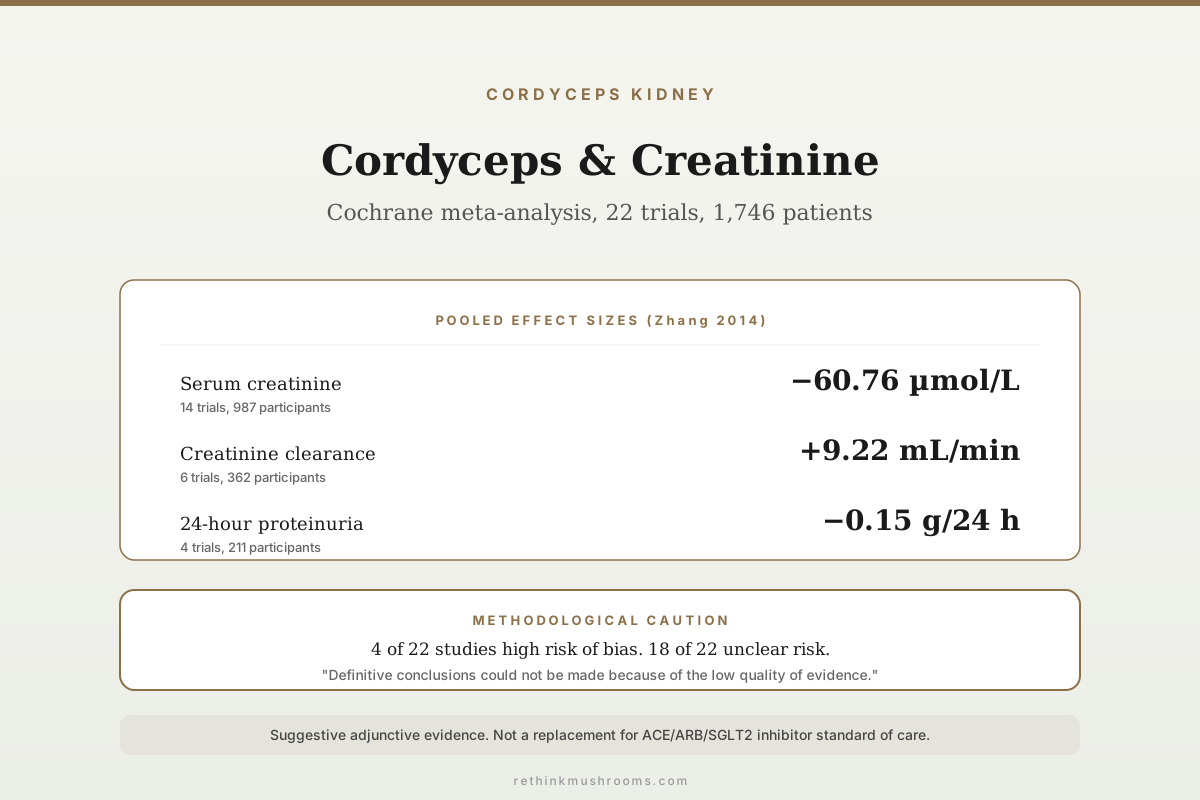
Zhang et al. (2014), in a Cochrane systematic review of 22 trials and 1,746 participants, reported that cordyceps preparations as adjuvant therapy to conventional CKD care significantly decreased serum creatinine, increased creatinine clearance by 9.22 mL/min, and reduced 24-hour proteinuria.
Zhang et al., Cochrane Database of Systematic Reviews, 2014
14 trials, 987 patients
serum creatinine meta-analysis
+9.22 mL/min
creatinine clearance improvement
High risk of bias
methodological quality limits interpretation
Zhang et al., Cochrane Database of Systematic Reviews, 2014
 View as image ↗
The cordyceps and creatinine question has a genuine evidence base, unusual for a functional mushroom. A 2014 Cochrane systematic review pooled 22 randomized or quasi-randomized trials with 1,746 chronic kidney disease (CKD) patients and found statistically significant reductions in serum creatinine, increases in creatinine clearance, and reductions in proteinuria when cordyceps preparations were added to conventional CKD care. The effect sizes are clinically meaningful. The methodological quality is not. Sixteen of the 22 studies had unclear or high risk of bias, and the review authors explicitly cautioned that definitive conclusions cannot be drawn from the current evidence base. This article examines what the pooled data shows, where the methodological weaknesses sit, and what the honest interpretation is for cordyceps supplementation in people with impaired kidney function.
For related cluster coverage, see the sibling articles cordyceps and kidney health: research on renal protection, cordyceps for chronic kidney disease: clinical evidence, cordyceps and kidney transplant: immunosuppression research in renal patients, and cordyceps sinensis and kidney transplant: traditional use.
Key Takeaways
- Zhang et al. (2014), in a Cochrane systematic review of 22 studies with 1,746 CKD participants, reported serum creatinine reduction of -60.76 µmol/L (95% CI -85.82 to -35.71) across 14 trials with 987 participants when cordyceps was used as adjuvant therapy (Cochrane Database of Systematic Reviews)
- The same review reported creatinine clearance increase of +9.22 mL/min (95% CI 3.10 to 15.34) across 6 trials with 362 participants, and 24-hour proteinuria reduction of -0.15 g/24 h (95% CI -0.24 to -0.05) across 4 trials with 211 participants
- Methodological quality was low: risk of bias was assessed as high in 4 studies and unclear in 18 of the 22 included studies, leading the Cochrane authors to caution that definitive conclusions cannot be drawn
- Liu et al. (2014), in a rat model of CKD using 5/6 nephrectomy, demonstrated that oral Cordyceps sinensis 4 mg/kg/day for 8 weeks produced statistically significant rescue effects on liver and heart metabolic profiles through 1H-NMR metabolomic analysis, supporting an extrarenal organ-protection mechanism (Acta Pharmacologica Sinica)
- Phull et al. (2022), in a comprehensive review of Cordyceps militaris in Microorganisms, characterized cordycepin and polysaccharide content as the proposed active fractions behind the kidney effects, with inflammation and oxidative stress reduction as the candidate mechanisms
- Chen et al. (2023), in a review in Phytotherapy Research, flagged that cordycepin specifically undergoes rapid adenosine deaminase deamination in vivo, limiting its bioavailability and arguing that the clinical kidney effects likely operate through polysaccharide-driven mechanisms rather than cordycepin itself
- Chou et al. (2016) documented a parallel nephroprotective mechanism for chaga (Inonotus obliquus) low-molecular-weight polysaccharide in diabetic nephropathy mice, with NF-κB/TGF-β1 pathway inhibition as the mechanism, suggesting that polysaccharide-driven renal protection is not unique to cordyceps (International Journal of Molecular Sciences)
The Cochrane Finding in Detail
Zhang et al. (2014), publishing in the Cochrane Database of Systematic Reviews, conducted the most rigorous existing meta-analysis of cordyceps for CKD.[1] The review followed Cochrane methodology: specialised register search, independent dual-author data extraction, random-effects statistical model, risk of bias assessment, and transparent reporting of heterogeneity.
The included studies were 22 randomized or quasi-randomized trials totaling 1,746 participants, all comparing cordyceps preparations (added to standard CKD care) against standard care alone, placebo, or conventional treatment. The primary analytical findings:
| Outcome | Trials | Participants | Effect size | 95% CI |
|---|---|---|---|---|
| Serum creatinine | 14 | 987 | -60.76 µmol/L | -85.82 to -35.71 |
| Creatinine clearance | 6 | 362 | +9.22 mL/min | 3.10 to 15.34 |
| 24-hour proteinuria | 4 | 211 | -0.15 g/24 h | -0.24 to -0.05 |
All three effects are statistically significant and in the direction favoring cordyceps. A 60 µmol/L reduction in serum creatinine is clinically meaningful; normal serum creatinine ranges roughly 60-110 µmol/L, and an improvement of that magnitude in impaired kidney function would translate to a measurable change in estimated glomerular filtration rate. A 9 mL/min increase in creatinine clearance is similarly clinically noticeable, roughly equivalent to regaining one CKD stage of function.
The review also reported improvements in hemoglobin and serum albumin, suggesting that the benefits extend beyond isolated creatinine markers to broader manifestations of CKD including anemia and protein metabolism.
Where the Methodology Fails
The same review that produced these effect sizes was explicit about the methodological weaknesses.
Risk of bias. Four of the 22 studies were assessed as high risk of bias. Eighteen were assessed as unclear risk of bias. Only zero to a small handful met low risk of bias criteria on all Cochrane domains (randomization, allocation concealment, blinding, outcome assessment, selective reporting).
Heterogeneity. The included studies varied in cordyceps preparation (cultured mycelium, fermented mycelium, fruiting body extract, Cs-4 Cordymax, Bailing capsules, Jinshuibao), dose (100 mg to several grams per day), duration (weeks to months), CKD etiology (diabetic, hypertensive, glomerulonephritis), and conventional treatment regimens. Pooling across such heterogeneity produces a summary effect but obscures whether the effect is consistent across preparations.
Reporting quality. The review characterized the included studies as having "suboptimal reporting and flawed methodological approaches." Most were published in Chinese-language journals without standardized CONSORT-compliant reporting.
Publication bias. Meta-analyses of traditional Chinese medicine interventions often show strong positive effects in regional literature that do not replicate in high-quality Western trials. The included studies were predominantly from Chinese regional databases (CBM, CMCC, TCMLARS, CMAC, Index to Chinese Periodical Literature), which limits generalizability.
The Cochrane authors' explicit conclusion: "definitive conclusions could not be made because of the low quality of evidence." This is the single most important framing of the evidence base.
What the Mechanism Data Supports
Liu et al. (2014), publishing in Acta Pharmacologica Sinica, produced preclinical mechanistic data for the CKD effect using a rat 5/6 nephrectomy model.[2] After 8 weeks of oral Cordyceps sinensis at 4 mg/kg/day, treated animals showed statistically significant rescue of liver and heart metabolite profiles via 1H-NMR metabolomic analysis. The disturbances documented in CKD rats (oxidative stress, altered energy metabolism, amino acid and protein metabolism changes, choline metabolism changes) were reversed by cordyceps treatment. The authors concluded that CKD-related extrarenal organ dysfunction occurs sequentially rather than simultaneously, with liver effects preceding heart effects, and that cordyceps protects both through a systemic metabolic normalization mechanism.
Phull et al. (2022), in their comprehensive Cordyceps militaris review published in Microorganisms, characterized cordycepin and polysaccharides as the proposed active fractions behind kidney effects.[3] Candidate mechanisms include reduction of inflammatory cytokines, oxidative stress reduction, and modulation of fibrotic pathways. The review did not claim that any specific mechanism is fully established but placed the kidney effect within the broader anti-inflammatory activity profile of the genus.
Chen et al. (2023), in a cordycepin review in Phytotherapy Research, flagged an important constraint.[4] Cordycepin undergoes rapid adenosine deaminase (ADA) deamination in vivo, sharply reducing the plasma concentration available after oral cordyceps administration. If the clinical CKD effects require intact cordycepin at target tissues, ADA metabolism predicts that achievable concentrations would be too low for significant effects. This suggests that the clinical kidney benefits observed in the Cochrane review, if real, are more likely driven by the polysaccharide fraction of cordyceps rather than by cordycepin specifically.
Chou et al. (2016), publishing in the International Journal of Molecular Sciences, provided parallel evidence that polysaccharide-driven nephroprotection is not unique to cordyceps.[5] Low-molecular-weight chaga (Inonotus obliquus) polysaccharide (LIOP) at 300 mg/kg for 8 weeks in high-fat-diet plus streptozotocin diabetic nephropathy mice produced decreased urinary albumin/creatinine ratio, restored glomerular capsule integrity, reduced TGF-β expression, and inhibited NF-κB/TGF-β1 signaling pathway activation. The mechanism (NF-κB and TGF-β suppression) is plausibly the same mechanism invoked for cordyceps renoprotection, suggesting that beta-glucan-containing mushroom polysaccharides have a class-level nephroprotective effect rather than a cordyceps-specific effect.
How to Read the Effect Sizes
The -60.76 µmol/L serum creatinine reduction looks large until it is placed in context. Three qualifications matter.
Most studies used cordyceps as adjunct to conventional CKD treatment. The comparator arm was conventional care alone. The reported effect is therefore the incremental benefit over standard care, not the full treatment effect. This is the appropriate clinical framing.
The effect size is comparable to angiotensin converting enzyme inhibitors and angiotensin receptor blockers. A 60 µmol/L reduction is not dramatically larger than what is achievable with standard pharmacological RAAS inhibition. Cordyceps would not be expected to replace ACE inhibitors; it would be a complementary intervention with potentially additive effects.
Methodological bias tends to inflate effect sizes. Meta-analyses of low-quality trials typically show effect sizes that shrink substantially when the same interventions are tested in higher-quality studies. The best prediction is that rigorous future trials would show smaller but non-zero effects, not that the observed effects are entirely artifactual.
What the Evidence Does Not Establish
Several specific claims that go beyond what the current data supports:
- Cordyceps cannot be presented as first-line CKD therapy on this evidence base
- The optimal cordyceps preparation, dose, and duration have not been established across standardized trials
- Long-term safety data in CKD patients taking cordyceps for years has not been systematically collected
- No head-to-head trials compare cordyceps to ACE inhibitors, ARBs, SGLT2 inhibitors, or other established CKD pharmacotherapy
- No rigorous trials in non-Chinese populations have replicated the Chinese-language literature findings
- No regulatory agency has approved cordyceps for CKD treatment in any jurisdiction
The honest characterization is that cordyceps has a suggestive evidence base of statistically significant pooled effects on creatinine-related outcomes, with methodological weaknesses that prevent definitive conclusions and with mechanistic plausibility that supports (but does not prove) the observed effects.
For the broader kidney protection context beyond cordyceps, see the cross-cluster article on chaga and diabetic complications: kidney and eye protection. For the underlying cordyceps pharmacology that explains the bioavailability constraints, see cordycepin and leukemia research: preclinical findings.
What Would Raise the Quality of This Evidence Base
The cordyceps kidney literature would move from suggestive to established if several specific studies were conducted.
A large multicenter randomized controlled trial in diabetic nephropathy patients, comparing a defined cordyceps preparation (single product, defined cordycepin and polysaccharide content, quality controlled) against placebo with both groups receiving best-practice conventional CKD care (ACE inhibitor or ARB, SGLT2 inhibitor where indicated, blood pressure and glycemic control). Primary endpoints would include serum creatinine, estimated glomerular filtration rate by CKD-EPI or MDRD formula, and 24-hour proteinuria at 12 months and 24 months, with hard clinical endpoints (progression to dialysis, cardiovascular events, mortality) as secondary outcomes.
A head-to-head comparison with established renoprotective pharmacotherapy, since cordyceps is typically promoted as adjunct to conventional therapy. Whether it adds meaningful effect on top of optimized ACE/ARB/SGLT2 inhibitor regimens or duplicates the same mechanisms is unknown.
A pharmacokinetic and tissue-distribution study in CKD patients to establish whether active cordyceps compounds reach kidney tissue at therapeutic concentrations after oral dosing. The rapid ADA deamination of cordycepin identified by Chen et al. (2023) makes this a meaningful open question.[4]
A dose-response trial across a defined range of the same cordyceps preparation to establish the minimum effective dose and ceiling effects.
Until these studies exist, cordyceps for CKD sits in the category of "suggestive-evidence adjunctive therapy with mechanistic plausibility, methodologically weak clinical data, and no established dose standardization." Readers in that category can reasonably consider it alongside conventional CKD care in consultation with their nephrology team. Marketing claims that present cordyceps as proven CKD therapy outrun the evidence that the Cochrane review itself characterized as inadequate for definitive conclusions.
The Bottom Line
A Cochrane meta-analysis of 22 trials and 1,746 CKD patients found cordyceps reduced serum creatinine by 60.76 µmol/L, increased creatinine clearance by 9.22 mL/min, and reduced proteinuria when used as adjunct to conventional care. Methodological quality was low (high or unclear risk of bias in 22 of 22 studies), and the Cochrane authors cautioned against definitive conclusions. The effect is suggestive but not established by rigorous trial standards.
Frequently Asked Questions
Sources & References
- 1RTHM-00360·Zhang, Hong Wei et al. (2014). “Cordyceps sinensis (a traditional Chinese medicine) for treating chronic kidney disease..” The Cochrane database of systematic reviews.Study breakdown →PubMed →↩
- 2RTHM-00337·Liu, Xia et al. (2014). “Cordyceps sinensis protects against liver and heart injuries in a rat model of chronic kidney disease: a metabolomic analysis..” Acta pharmacologica Sinica.Study breakdown →PubMed →↩
- 3RTHM-00790·Phull, Abdul-Rehman et al. (2022). “Cordyceps militaris as a Bio Functional Food Source: Pharmacological Potential, Anti-Inflammatory Actions and Related Molecular Mechanisms..” Microorganisms.Study breakdown →PubMed →↩
- 4RTHM-00817·Chen, Min et al. (2023). “Cordycepin: A review of strategies to improve the bioavailability and efficacy..” Phytotherapy research : PTR.Study breakdown →PubMed →↩
- 5RTHM-00423·Chou, Yen-Jung et al. (2016). “Renal Protective Effects of Low Molecular Weight of Inonotus obliquus Polysaccharide (LIOP) on HFD/STZ-Induced Nephropathy in Mice..” International journal of molecular sciences.Study breakdown →PubMed →↩