Cordyceps and Kidney Function
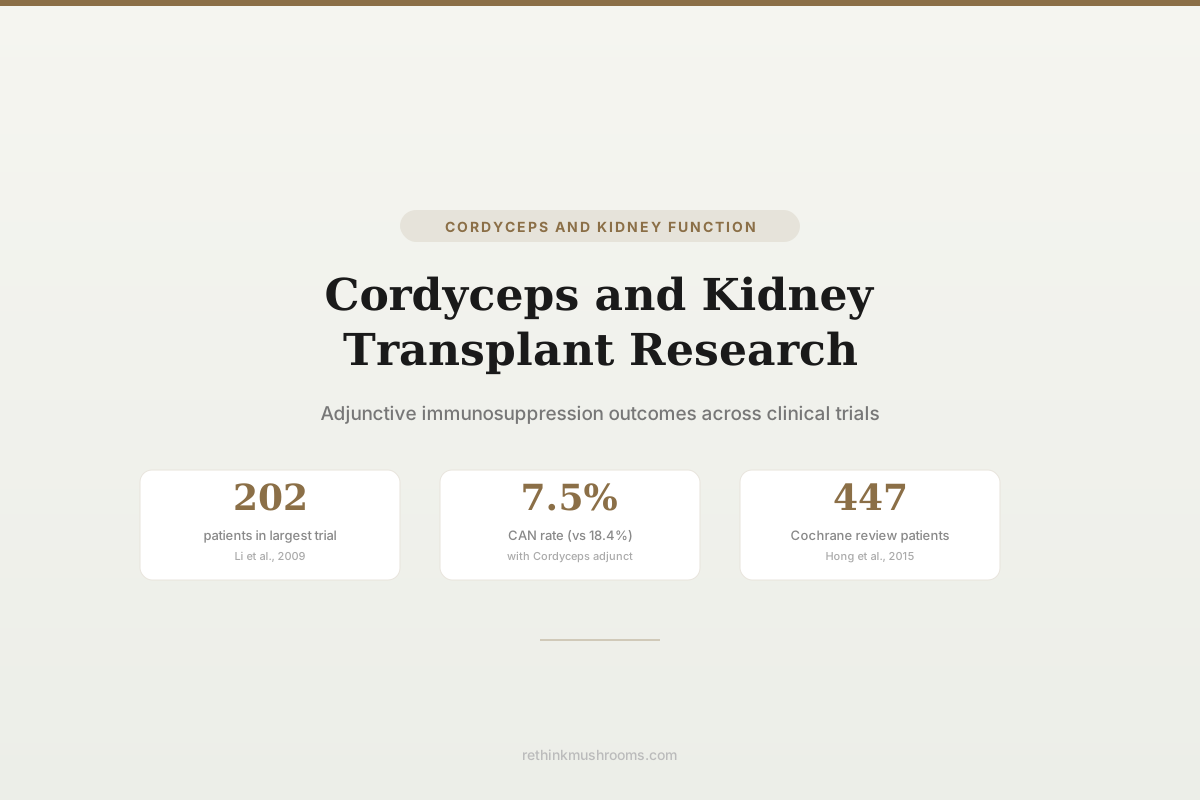
202 transplant patients in largest trial
Li et al. (2009) randomized 202 kidney transplant recipients to Cordyceps sinensis plus standard immunosuppression or standard immunosuppression alone, finding lower cyclosporine doses, reduced nephrotoxicity (19.35% vs. 33.94%), and less chronic allograft nephropathy.
Li et al., Transplantation Proceedings, 2009
447 patients
across 5 Cochrane-reviewed trials
12.9% vs 24.8%
hepatotoxicity with vs. without CS
7.5% vs 18.4%
chronic allograft nephropathy rate
Li et al., Transplantation Proceedings, 2009
 View as image ↗
Kidney transplant recipients take immunosuppressive drugs for life. The standard regimen, typically built around calcineurin inhibitors (cyclosporine or tacrolimus), prevents graft rejection but carries long-term costs: nephrotoxicity to the transplanted kidney itself, hepatotoxicity, increased infection risk, and metabolic side effects. Cordyceps sinensis has been studied in Chinese transplant centers as an adjunctive immunosuppressive agent, with the hypothesis that adding Cordyceps could allow lower calcineurin inhibitor doses while maintaining rejection suppression and reducing drug-related toxicity.[1]
The largest randomized trial enrolled 202 patients. Two systematic reviews have pooled the available data. The results show a consistent pattern: possible reductions in drug toxicity and infection with no increase in rejection risk. The consistent limitation is also familiar: small sample sizes, short follow-up, and methodological quality that prevents definitive conclusions. For the broader kidney-health evidence base, see Cordyceps and kidney health: research on renal protection. For related biomarker data, see Cordyceps and creatinine levels: what the studies show.
Key Takeaways
- Li et al. (2009) randomized 202 kidney transplant recipients and found that adding Cordyceps sinensis (1 g three times daily) allowed lower cyclosporine doses at 2-6 months post-transplant, with nephrotoxicity rates of 19.35% vs. 33.94% and hepatotoxicity of 12.90% vs. 24.77% compared to controls
- The same trial showed chronic allograft nephropathy incidence of 7.53% in the Cordyceps group vs. 18.35% in controls (P = 0.024), with lower 24-hour urinary protein in affected patients
- A 2015 Cochrane review (Hong et al.) analyzed 5 studies with 447 participants and found Cordyceps comparable to azathioprine for graft survival with possible improvements in acute rejection, anemia, and infection rates
- Ong et al. (2017) meta-analysis of 9 RCTs found Cordyceps as adjuvant reduced proteinuria after 6-12 months and showed less cyclosporine-induced nephrotoxicity compared to cyclosporine monotherapy
- Han et al. (2020) demonstrated cordycepin protected against renal ischemia-reperfusion injury in rats by reducing inflammatory cytokines TNF-alpha, IL-6, and IL-1-beta and suppressing apoptosis, relevant to the transplant ischemia window
- No studies have tested Cordyceps alongside tacrolimus, mycophenolate mofetil, or modern induction therapy; all trials used cyclosporine-based regimens
Why Transplant Immunosuppression Needs Adjunctive Options
Calcineurin inhibitors (CNIs) reduced acute rejection rates from over 50% to under 15%, transforming transplant medicine. But they did not solve long-term graft survival. Chronic allograft nephropathy (CAN), driven partly by CNI nephrotoxicity itself, remains a leading cause of graft loss beyond the first year. The transplanted kidney is damaged by the very drugs protecting it from rejection.
This creates a clinical dilemma: lower the CNI dose and risk rejection, or maintain the dose and accept ongoing nephrotoxicity. An adjunctive agent that provides immunosuppressive support while allowing CNI dose reduction could address both sides of this equation. Cordyceps sinensis has been explored in this role primarily in Chinese transplant centers.
The Li et al. Trial: 202 Patients
The largest individual trial was conducted by Li et al. (2009) at a Chinese transplant center. The team randomized 202 kidney transplant recipients by lottery into a treatment group (n = 93) receiving Cordyceps sinensis 1.0 g three times daily in addition to standard immunosuppression, and a control group (n = 109) receiving standard immunosuppression alone.[2]
Patient and graft survival rates were not different between groups. Serum creatinine and blood urea nitrogen were similar. The differences emerged in secondary outcomes:
Cyclosporine dose reduction: At 2-6 months post-transplant, cyclosporine dosages in the Cordyceps group were lower than controls. Whole blood trough cyclosporine concentrations were also lower at 3-6 months. The dose reduction followed a linear trajectory in the Cordyceps group versus a quadratic pattern in controls, suggesting a more stable dose-tapering profile.
Reduced toxicity: Hepatotoxicity occurred in 12.90% of the Cordyceps group vs. 24.77% of controls. Nephrotoxicity occurred in 19.35% vs. 33.94%. Both differences were statistically marked (P < 0.05).
Chronic allograft nephropathy: CAN incidence was 7.53% in the Cordyceps group vs. 18.35% in controls (P = 0.024). Among patients who did develop CAN, 24-hour urinary protein was lower in the Cordyceps group (P = 0.045).
Acute rejection: Only 3 patients in the Cordyceps group required thymoglobulin anti-rejection therapy compared to 13 in the control group (P = 0.014).
The interpretation: Cordyceps allowed lower cyclosporine exposure without increasing rejection risk, and the lower CNI exposure translated into less nephrotoxicity, hepatotoxicity, and chronic graft damage. The limitation: this was an open-label study at a single center with lottery-based randomization. Blinding was not reported.
Cochrane Review: 5 Studies, 447 Participants
Hong et al. (2015) conducted a Cochrane systematic review of Cordyceps for kidney transplant recipients, identifying 5 studies (6 reports) involving 447 participants.[3]
Four studies (265 participants) compared Cordyceps against azathioprine. One study (182 participants) compared Cordyceps plus low-dose cyclosporine against standard-dose cyclosporine.
Cordyceps vs. azathioprine: No difference in graft or patient survival. Graft function improved in the Cordyceps group. Acute rejection episodes may have been reduced. Anemia, leukopenia, liver function, and infection incidence all favored the Cordyceps group.
Cordyceps + low-dose CsA vs. standard CsA: No differences in patient survival, graft loss, acute rejection, or allograft function. Limited evidence suggested possible benefits in pulmonary infection rates, serum albumin, uric acid levels, and reduced CNI nephrotoxicity and hepatotoxicity.
All included studies were assessed as having unclear risk of bias due to limited reporting. Follow-up was short-term (three months to one year). The review concluded that while some favorable aspects were associated with Cordyceps, longer-term studies were needed, and future research should test Cordyceps alongside tacrolimus, mycophenolate mofetil, and modern induction therapy.
Ong et al. Meta-Analysis: 9 RCTs
Ong et al. (2017) expanded the evidence base by reviewing 9 RCTs examining Cordyceps as an adjuvant immunosuppressive agent in kidney transplant patients.[1]
The pooled analysis found Cordyceps combined with various immunosuppressant regimens produced reductions in proteinuria after 6-12 months. Compared to cyclosporine monotherapy, the combination of Cordyceps with cyclosporine showed less treatment-induced nephrotoxicity.
The meta-analysis noted the same limitation as the Cochrane review: no studies investigated combinations with tacrolimus or induction therapy. The immunosuppressive landscape has shifted toward tacrolimus-based regimens in most transplant centers worldwide, and the Cordyceps evidence remains entirely within the cyclosporine era.
Ischemia-Reperfusion: The Transplant Surgery Window
Every transplanted kidney undergoes a period of ischemia (cold storage during transport, warm ischemia during surgical connection) followed by reperfusion when blood flow is restored. This ischemia-reperfusion (I/R) window generates oxidative stress, inflammatory cytokine release, and tubular cell death that can impair early graft function and contribute to delayed graft function.
Han et al. (2020) tested cordycepin in a rat model of renal I/R injury. Pretreatment reduced serum creatinine and BUN levels. Histological analysis showed less tubular necrosis and fewer casts. Inflammatory cytokines TNF-alpha, IL-6, and IL-1-beta decreased in renal tissue. TUNEL staining confirmed fewer apoptotic cells, and oxidative stress markers (MDA) were lower while antioxidant capacity (SOD) was higher.[4]
This is preclinical data, not clinical transplant data. But the mechanism is directly relevant to the transplant I/R window, and the anti-inflammatory and anti-apoptotic effects demonstrated here are consistent with the reduced nephrotoxicity and better graft outcomes observed in the clinical trials.
Immunomodulatory Mechanisms
The immunosuppressive rationale for Cordyceps in transplantation rests on its immunomodulatory properties. Jung et al. (2019) conducted a randomized, double-blind clinical trial of a Cordyceps mycelium extract (Paecilomyces hepiali, CBG-CS-2) and confirmed immune-modulating effects in healthy adults, demonstrating that Cordyceps preparations can shift immune responses in humans, not just animal models.[5]
For kidney transplant specifically, the proposed mechanism is not straightforward immunosuppression. Cordyceps does not replace calcineurin inhibitors; its immunosuppressive effect alone is weaker than cyclosporine. The clinical hypothesis is synergy: Cordyceps provides enough additional immunomodulation to allow lower CNI doses while maintaining adequate rejection suppression. The Li et al. (2009) trial supported this model, showing lower cyclosporine concentrations in the Cordyceps group without increased rejection.
Tan et al. (2022) reviewed the broader anti-fibrotic mechanisms of Cordyceps in kidney tissue, including suppression of inflammation, oxidative stress, and extracellular matrix deposition.[6] These mechanisms may contribute to the reduced chronic allograft nephropathy observed in clinical trials, as CAN involves both immune-mediated and fibrotic components. For the specific diabetic kidney disease context, see Cordyceps and diabetic kidney disease: renal protective research.
Critical Gaps in the Evidence
The most important limitation is era mismatch. Every transplant trial used cyclosporine-based regimens. Modern transplant immunosuppression centers on tacrolimus (which largely replaced cyclosporine due to lower rejection rates), mycophenolate mofetil, and often induction therapy with basiliximab or thymoglobulin. Whether Cordyceps offers the same benefits alongside tacrolimus is unknown and cannot be inferred from cyclosporine-era data, since the two CNIs have different nephrotoxicity profiles and drug interaction potential.
Second, all trials came from Chinese transplant centers. Multi-center international trials have not been conducted. The patient populations, surgical techniques, baseline immunosuppression protocols, and outcome definitions may not generalize to other healthcare systems.
Third, follow-up was universally short. The longest follow-up was one year. Chronic allograft nephropathy develops over years, and the most relevant outcome, long-term graft survival, requires 5-10 year data that simply does not exist for Cordyceps in transplant recipients.
Fourth, none of the trials used hard endpoints like return to dialysis or graft loss as primary outcomes. Surrogate markers (creatinine, proteinuria, biopsy findings) were the primary measures. While these surrogates correlate with outcomes, they are not substitutes for long-term survival data. For information on cordyceps and CKD more broadly, see Cordyceps for chronic kidney disease: clinical evidence. For the traditional use context, see Cordyceps sinensis and kidney transplant: traditional use.
The Bottom Line
Clinical trials of Cordyceps sinensis in kidney transplant recipients show a consistent pattern: adjunctive use alongside cyclosporine-based immunosuppression allows lower CNI doses, reduces nephrotoxicity and hepatotoxicity, and may decrease chronic allograft nephropathy without increasing rejection risk. The largest trial (202 patients) found chronic allograft nephropathy rates of 7.53% vs. 18.35% and nephrotoxicity of 19.35% vs. 33.94%. Two systematic reviews confirm these trends across 5-9 RCTs. The evidence is limited by small sample sizes, short follow-up, single-country origin, and exclusive use of cyclosporine-era protocols that do not reflect current tacrolimus-based transplant immunosuppression.
Frequently Asked Questions
Sources & References
- 1RTHM-00486·Ong, Bee Yean et al. (2017). “Efficacy of Cordyceps sinensis as an adjunctive treatment in kidney transplant patients: A systematic-review and meta-analysis..” Complementary therapies in medicine.Study breakdown →PubMed →↩
- 2RTHM-00161·Li, Y et al. (2009). “Clinical application of Cordyceps sinensis on immunosuppressive therapy in renal transplantation..” Transplantation proceedings.Study breakdown →PubMed →↩
- 3RTHM-00375·Hong, Tao et al. (2015). “Cordyceps sinensis (a traditional Chinese medicine) for kidney transplant recipients..” The Cochrane database of systematic reviews.Study breakdown →PubMed →↩
- 4RTHM-00617·Han, Feng et al. (2020). “Cordycepin protects renal ischemia/reperfusion injury through regulating inflammation, apoptosis, and oxidative stress..” Acta biochimica et biophysica Sinica.Study breakdown →PubMed →↩
- 5RTHM-00563·Jung, Su-Jin et al. (2019). “Immunomodulatory effects of a mycelium extract of Cordyceps (Paecilomyces hepiali; CBG-CS-2): a randomized and double-blind clinical trial..” BMC complementary and alternative medicine.Study breakdown →PubMed →↩
- 6RTHM-00798·Tan, Wei et al. (2022). “Potential Therapeutic Strategies for Renal Fibrosis: Cordyceps and Related Products..” Frontiers in pharmacology.Study breakdown →PubMed →↩