Reishi and Blood Sugar
2 distinct insulin-sensitizing mechanisms
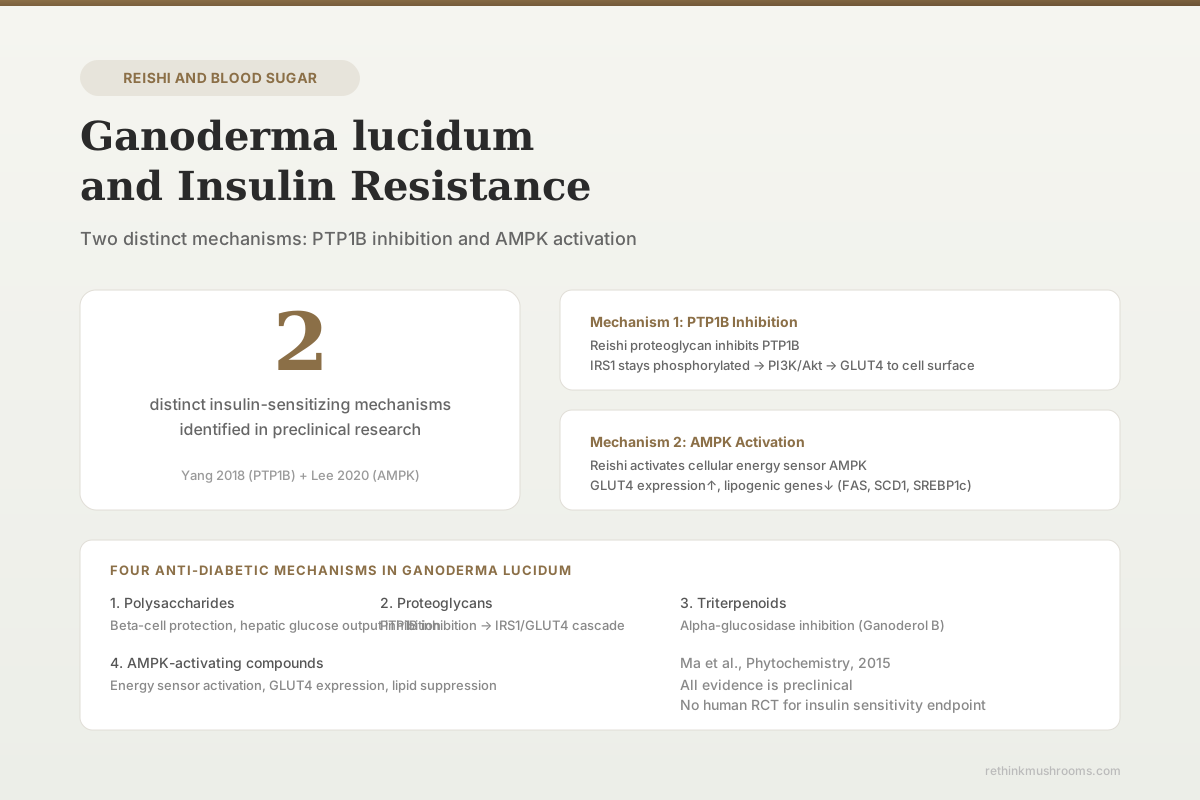
Ganoderma lucidum targets insulin resistance at two separate points in the glucose regulation system: PTP1B inhibition restores the insulin receptor's signaling capacity, and AMPK activation boosts cellular glucose uptake directly.
Yang et al., Food & Function, 2018; Lee et al., Nutrients, 2020
PTP1B
the enzyme that blocks insulin signaling when overactive; reishi inhibits it
AMPK
the metabolic master switch that reishi activates to restore glucose uptake
GLUT4
the glucose transporter both mechanisms ultimately mobilize to cell surfaces
Yang et al., Food & Function, 2018; Lee et al., Nutrients, 2020
 View as image ↗
Most articles about Ganoderma lucidum and insulin resistance say "reishi may improve insulin sensitivity" and cite animal studies. Few explain what actually happens inside the cell, which two pathways reishi compounds are targeting, or why those two pathways are the right ones to target for insulin resistance.
This article explains exactly that. The Ganoderma lucidum insulin resistance research has identified two distinct molecular mechanisms, both preclinical, both mechanistically well-defined, and both pointing at the same downstream problem: cells that cannot take up glucose efficiently even when insulin is present.
For background on reishi's full compound profile and the distinction between its triterpenoids and polysaccharides, see what is reishi mushroom: the science behind the mushroom of immortality.
Key Takeaways
- Reishi extract inhibits PTP1B, an enzyme that causes insulin resistance by blocking IRS1 phosphorylation; this inhibition allows the insulin cascade to proceed normally, activating PI3K/Akt and driving GLUT4 glucose transporters to cell surfaces (Yang et al., Food & Function, 2018)
- In high-fat diet obese mice, reishi extract activated AMPK (the metabolic energy sensor), increasing insulin receptor, IRS1, and Akt expression while reducing lipogenic genes (FAS, SCD1, SREBP1c), improving insulin sensitivity via a pathway separate from PTP1B (Lee et al., Nutrients, 2020)
- A 2015 review documented four distinct anti-diabetic mechanisms in Ganoderma lucidum: polysaccharides, proteoglycans (PTP1B inhibitors), triterpenoids, and AMPK-activating compounds, establishing the species as unusually multi-mechanistic among anti-diabetic mushrooms (Ma et al., Phytochemistry, 2015)
- Polysaccharides and triterpenoids act at different points in glucose metabolism: polysaccharides primarily protect beta cells and reduce hepatic glucose output, while triterpenoids and proteoglycans act on peripheral insulin signaling (Aramabasic et al., Journal of Fungi, 2021)
- Both key insulin resistance studies are animal models; no human RCT has tested Ganoderma lucidum specifically for insulin sensitivity as a primary endpoint. The mechanisms are biologically plausible but require clinical validation.
What Insulin Resistance Actually Is
Insulin resistance is the condition where cells respond poorly to insulin. Understanding why this matters for what reishi does requires a brief explanation of the normal insulin signaling process.
When blood glucose rises after eating, the pancreas releases insulin. Insulin binds to receptors on cell surfaces, triggering a chain of events inside the cell. The receptor activates IRS1 (insulin receptor substrate 1) by adding phosphate groups to it. Activated IRS1 then triggers PI3K (phosphoinositide 3-kinase), which activates Akt. Active Akt signals GLUT4 (glucose transporter type 4) to move from inside the cell to the cell surface. GLUT4 at the cell surface is what actually allows glucose to enter the cell from the bloodstream.
In insulin resistance, this chain breaks down. The cell surface still has insulin receptors. Insulin still binds. But the downstream signaling is blunted, and GLUT4 transporters don't make it to the cell surface in sufficient numbers. Glucose stays in the blood.
One of the primary culprits is PTP1B, a phosphatase enzyme that removes phosphate groups from IRS1. PTP1B is, in a sense, the off-switch for insulin signaling. In people with insulin resistance and type 2 diabetes, PTP1B activity is often elevated. It removes the activation signals from IRS1 faster than insulin can add them, preventing the downstream cascade from proceeding.
This is the enzymatic target that reishi compounds appear to address.
PTP1B: Reishi's Intervention in the Insulin Signaling Pathway
Yang and colleagues, in a 2018 study published in Food & Function, identified a specific PTP1B inhibitor in reishi extract and traced its effects through the insulin signaling cascade in animal and cell models.[1]
The mechanism they documented runs as follows. Reishi proteoglycan inhibits PTP1B activity. With PTP1B suppressed, IRS1 retains its phosphorylation after insulin stimulation. Phosphorylated IRS1 activates PI3K, which activates Akt. Activated Akt triggers GLUT4 translocation from intracellular storage to the cell surface. With GLUT4 present at the cell membrane, glucose enters the cell.
In plain terms: the reishi compound removes the specific molecular brake on insulin signaling. The signaling cascade, once unblocked, proceeds normally. Cells become more sensitive to insulin because the off-switch that was causing the resistance is being inhibited.
PTP1B inhibition is also the mechanism targeted by pharmaceutical insulin sensitizers under development. The fact that a compound from reishi inhibits it is not trivial. PTP1B is a validated drug target, and an effective inhibitor with preclinical evidence is at least mechanistically credible.
The study by Yang et al. did not test this in humans. It used cell culture and animal models. The question of whether reishi PTP1B inhibitors reach the tissues where insulin resistance occurs, at sufficient concentrations, following oral dosing in humans, remains open.
For context on the triterpenoid compounds in reishi, including the specific compound classes that may include PTP1B inhibitors, see ganoderic acid A, B, and beyond: individual compound research.
AMPK: The Second Mechanism and Why It's Different
AMPK is AMP-activated protein kinase, an enzyme that functions as the cell's energy sensor. When the ratio of AMP (low energy state) to ATP (high energy state) rises, AMPK activates. Active AMPK initiates a cascade of responses to improve cellular energy metabolism: it increases glucose transporter expression, promotes fatty acid oxidation, and inhibits energy-expensive biosynthetic processes.
Crucially, AMPK activation and PTP1B inhibition are different mechanisms that arrive at similar endpoints. PTP1B inhibition works by unblocking the insulin receptor's signaling chain. AMPK activation works by an entirely separate pathway that doesn't require insulin receptor signaling at all. This means that even in cells where insulin resistance is severe and PTP1B inhibition alone might be insufficient, AMPK activation could still improve glucose uptake.
Lee and colleagues demonstrated AMPK activation by reishi extract in high-fat diet obese mice, published in Nutrients in 2020.[2] These mice had diet-induced insulin resistance. After reishi extract treatment, AMPK activation increased. The researchers measured upstream markers (IR, IRS1, Akt expression, all increased) and GLUT1 and GLUT4 expression (both increased). They also found a reduction in lipogenic gene expression: FAS (fatty acid synthase), SCD1 (stearoyl-CoA desaturase 1), and SREBP1c (sterol regulatory element-binding protein 1c) all decreased.
This last finding is notable. AMPK activation doesn't just improve glucose metabolism. It also suppresses the lipid synthesis that drives obesity and fatty liver, two conditions closely linked to insulin resistance. The Lee 2020 study positions reishi extract as addressing the metabolic syndrome environment that creates insulin resistance, not just blocking one specific signaling enzyme.
For the broader context of how reishi's two main compound classes work through different mechanisms, see how reishi triterpenes differ from polysaccharides in mechanism.
Two Mechanisms, One Endpoint
How Reishi Reaches Glucose Uptake From Two Directions
Reishi's insulin-resistance story is two mechanisms that arrive at the same place. One route unblocks insulin signaling by inhibiting PTP1B; the other bypasses the receptor entirely by activating AMPK. Both end at the same bottleneck — GLUT4 transporters that insulin-resistant cells fail to move to the surface. Reading the two lanes side by side is the fastest way to see why the endpoint is shared even though the chemistry is not.
PTP1B inhibition restores the IRS1–GLUT4 cascade
A reishi proteoglycan (FYGL) competitively inhibits PTP1B, the phosphatase that switches insulin signaling off by stripping phosphate from IRS1. With PTP1B suppressed, IRS1 stays phosphorylated after insulin binds, PI3K activates Akt, and Akt drives GLUT4 to the cell surface. This route depends on the insulin receptor being engaged — it removes the brake rather than bypassing the pathway.
Yang 2018 [1] — FYGL proteoglycan, IRS1–GLUT4 cascade (cell + animal)
AMPK activation boosts glucose uptake without the receptor
Reishi extract activates AMPK, the cellular energy sensor, in high-fat-diet obese mice. AMPK raises insulin receptor, IRS1 and Akt expression alongside GLUT1 and GLUT4, while suppressing the lipogenic genes FAS, SCD1 and SREBP1c. Because AMPK moves glucose transporters through a pathway that does not require insulin-receptor signaling, it can still help where the PTP1B route alone would stall — and it addresses the lipid overload that drives the resistance in the first place.
Lee 2020 [2] — AMPK activation in HFD obese mice; ↓FAS ↓SCD1 ↓SREBP1c
Every molecular step shown is established in cell or animal models. No human randomized controlled trial has tested Ganoderma lucidum with insulin sensitivity as a primary endpoint, and the doses used preclinically cannot be mapped to a commercial supplement amount. This is a mechanism map, not an efficacy claim.
Mechanism synthesis; arms from refs [1][2][3] (see references)
How These Two Mechanisms Fit Into the Full Picture
The two mechanisms described above (PTP1B inhibition and AMPK activation) are two of four distinct anti-diabetic mechanisms identified in Ganoderma lucidum by the research literature.
Ma and colleagues, in a 2015 review in Phytochemistry, mapped the full range:[3]
- Polysaccharides protect pancreatic beta cells from oxidative damage and inhibit hepatic glucose output (via PEPCK and G6Pase enzyme inhibition).
- Proteoglycans inhibit PTP1B, restoring insulin receptor signaling.
- Triterpenoids inhibit alpha-glucosidase, slowing carbohydrate digestion and reducing postprandial glucose spikes.
- Additional compounds (possibly including polysaccharides and triterpenoids) activate AMPK.
Winska and colleagues reviewed the evidence across the full Ganoderma genus in 2019 and similarly identified polysaccharides and triterpenoids as the primary active classes, with the evidence base extending beyond just G. lucidum to related species.[4]
Aramabasic and colleagues provided a useful schematic in their 2021 Journal of Fungi review: mushroom polysaccharides act primarily on hepatic glucose production and beta-cell protection, while triterpenoids act primarily on gut carbohydrate absorption (alpha-glucosidase) and peripheral insulin signaling.[5] The PTP1B inhibitors and AMPK activators occupy the peripheral insulin signaling domain.
This four-mechanism profile makes Ganoderma lucidum unusual. Most natural compounds studied for anti-diabetic activity target one or two pathways. Reishi compounds address four distinct points in the glucose regulation system, from gut carbohydrate absorption all the way through to cellular glucose uptake.
For the insulin resistance article's cluster siblings, each mechanism has its own focused article: reishi and blood sugar: what the research shows covers the full landscape, reishi polysaccharides and glucose metabolism covers the beta-cell and hepatic mechanisms, and reishi and alpha-glucosidase inhibition: slowing carbohydrate digestion covers the gut-level mechanism. The clinical human evidence is reviewed in reishi for type 2 diabetes: clinical evidence.
For context on how Poria, another TCM mushroom, also shows insulin resistance-related mechanisms, see Poria and insulin resistance: mechanisms.
What the Evidence Does Not Yet Show
The mechanism research on Ganoderma lucidum and insulin resistance is the more developed side of the evidence base. What's missing is the clinical bridge.
Neither the Yang 2018 study on PTP1B inhibition nor the Lee 2020 study on AMPK activation involved human subjects. Both used animal models of insulin resistance, with interventions applied at doses and by administration routes that do not correspond to commercially available supplements. Whether the active compounds identified in these studies reach insulin-sensitive tissues at relevant concentrations following standard oral dosing in humans is unknown.
No human randomized controlled trial has tested Ganoderma lucidum with insulin sensitivity as the primary endpoint. Human trials that do exist have tested HbA1c and fasting plasma glucose in type 2 diabetes patients, with mixed results: some positive signals in trials using purified polysaccharide preparations, and null results in trials using whole mushroom powder. These are explained in the clinical evidence article. Neither type of trial isolates the insulin resistance endpoint.
The mechanistic evidence supports the biological plausibility of Ganoderma lucidum as an insulin sensitizer. The two pathways targeted (PTP1B and AMPK) are validated drug targets and genuinely relevant to insulin resistance biology. But plausibility is not clinical evidence, and the gap between mechanism research and proven human benefit is the honest assessment that distinguishes Rethink from both supplement marketing and excessively dismissive coverage.
This article is educational and not medical advice. Insulin resistance, prediabetes, and type 2 diabetes are conditions that should be managed with a qualified healthcare professional; anyone considering reishi alongside a diagnosis or medication (particularly glucose-lowering drugs, where an additive effect is theoretically possible) should discuss it with their clinician first.
The Bottom Line
Ganoderma lucidum targets insulin resistance through two distinct preclinical mechanisms. The first is PTP1B inhibition: a reishi proteoglycan suppresses the phosphatase enzyme that blocks insulin signaling, allowing IRS1 phosphorylation and GLUT4 translocation to proceed. The second is AMPK activation: reishi extract activates the cellular energy sensor that independently promotes glucose uptake and suppresses lipid synthesis in obese mice. Both mechanisms are animal model findings without human clinical validation. The compound also shows alpha-glucosidase inhibition and polysaccharide-mediated beta-cell protection, making it one of the more mechanistically diverse anti-diabetic mushrooms studied.
Frequently Asked Questions
Sources & References
- 1RTHM-01022·Yang, Zhou et al. (2018). “A novel PTP1B inhibitor extracted from Ganoderma lucidum ameliorates insulin resistance by regulating IRS1-GLUT4 cascades in the insulin signaling pathway..” Food & function.Study breakdown →PubMed →↩
- 2RTHM-01228·Lee, Hyeon A et al. (2020). “Ganoderma lucidum Extract Reduces Insulin Resistance by Enhancing AMPK Activation in High-Fat Diet-Induced Obese Mice..” Nutrients.Study breakdown →PubMed →↩
- 3RTHM-00724·Ma, Haou-Tzong et al. (2015). “Anti-diabetic effects of Ganoderma lucidum..” Phytochemistry.Study breakdown →PubMed →↩
- 4RTHM-01136·Wińska, Katarzyna et al. (2019). “Mushrooms of the Genus Ganoderma Used to Treat Diabetes and Insulin Resistance..” Molecules (Basel.Study breakdown →PubMed →↩
- 5RTHM-01322·Aramabašić Jovanović, Jelena et al. (2021). “The Effects of Major Mushroom Bioactive Compounds on Mechanisms That Control Blood Glucose Level..” Journal of fungi (Basel.Study breakdown →PubMed →↩