Reishi and Blood Sugar / Diabetes
−0.10% pooled HbA1c change (Cochrane, not significant)
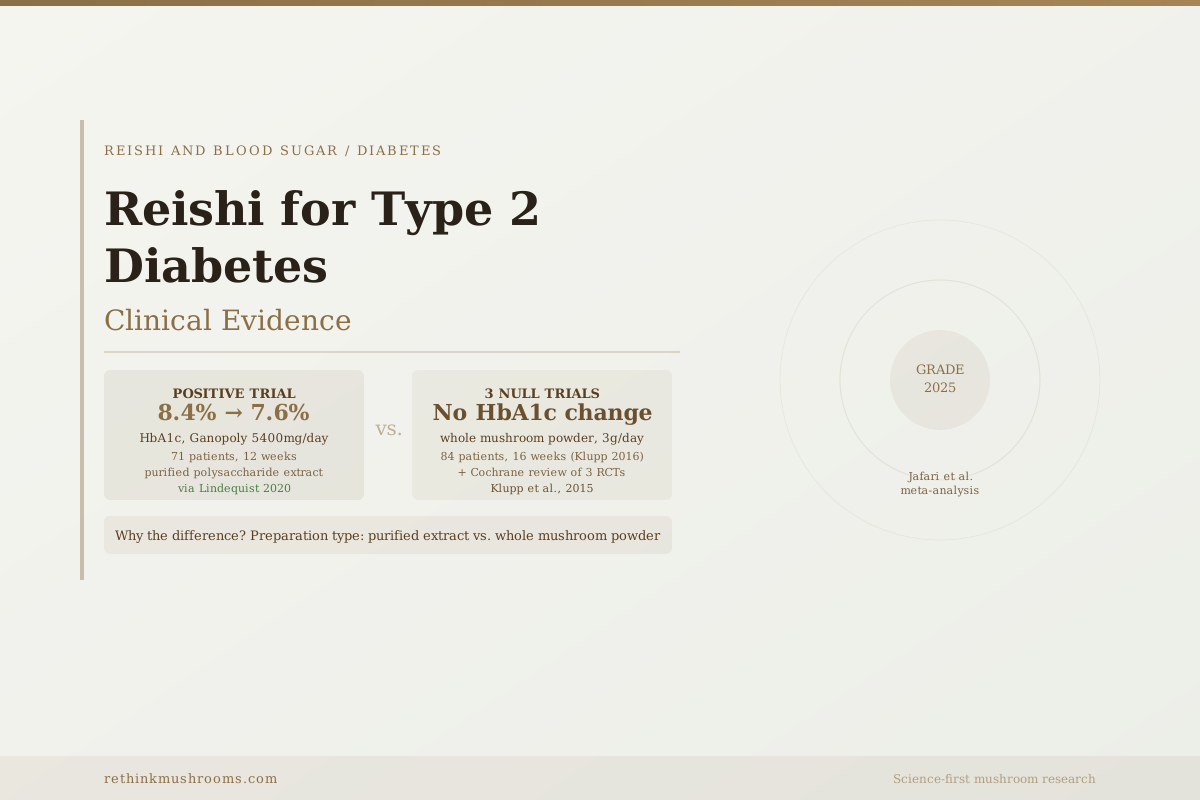
The Cochrane review (five trials, 398 participants) found no significant effect of reishi on HbA1c in type 2 diabetes patients, and the most rigorous single trial was also null. But a separate trial using a purified polysaccharide preparation showed a meaningful reduction. The preparation difference explains the contradiction.
Klupp et al., Cochrane Database of Systematic Reviews, 2015
84 patients
in the largest null RCT (Klupp 2016, 16 weeks, 3g/day whole mushroom)
8.4% to 7.6%
HbA1c change in the positive Ganopoly trial (71 patients, 12 weeks, Gao 2004 via Lindequist 2020)
Jafari 2025
the most current GRADE-assessed meta-analysis of Ganoderma clinical trials (17 RCTs, 971 participants)
Klupp et al., Cochrane Database of Systematic Reviews, 2015
 View as image ↗
Reishi has four distinct laboratory-demonstrated mechanisms for blood sugar regulation, a body of positive animal research, and a compelling in vitro compound that outperforms a pharmaceutical comparison. It also has a 2015 Cochrane review that found no significant HbA1c effect across the randomized controlled trials it pooled.
Both of those things are true, and understanding why requires looking at what was actually tested. The story of reishi and type 2 diabetes is not a simple positive or negative finding. It is a story about what happens when the same plant-based compound is tested in four different clinical preparations, and how preparation type may determine whether a trial produces a result or not.
This article covers only the clinical evidence: what happened in trials with actual human patients. For the mechanisms behind why reishi should affect blood sugar, reishi and blood sugar: what the research shows covers the preclinical story. For the specific compounds and pathways involved, how reishi triterpenes differ from polysaccharides in mechanism explains the compound-level distinction that underlies the clinical results. The broader reishi overview provides foundation context.
Key Takeaways
- The 2015 Cochrane review (five trials, 398 participants; pooled HbA1c estimate from two studies, WMD −0.10%, not significant) found no significant effect of reishi on HbA1c in type 2 diabetes patients; the 2016 Klupp RCT (n=84, 3g/day, 16 weeks) confirmed this null result (Klupp et al., Cochrane, 2015; Klupp et al., Scientific Reports, 2016)
- A separate trial using purified reishi polysaccharides (Ganopoly, 5,400 mg/day) in 71 patients showed HbA1c decrease from 8.4% to 7.6% over 12 weeks (Gao 2004, as reported in Lindequist & Haertel, 2020)
- The most likely explanation for the contradictory results is preparation type: Ryu et al. (2021) demonstrated that drying method dramatically affects ganoderic acid content and anti-diabetic activity; whole mushroom powder likely contained a fraction of the active compound concentration of purified polysaccharide extract
- The 2025 GRADE meta-analysis by Jafari et al. (17 randomized controlled trials, 971 participants) is the most current comprehensive clinical evidence synthesis for Ganoderma
- Reishi should not be used as a replacement for diabetes medication; no clinical evidence supports this role
- For type 2 diabetes patients on medication, the interaction profile with reishi is not well-characterized; the clinical question requires discussion with a prescribing physician
The Contrast That Defines This Research: One Positive Trial, Three Null Results
Before reviewing the trials individually, the structural summary helps frame what follows:
Trial producing a positive HbA1c result: Gao 2004 (Ganopoly preparation, 5,400 mg/day purified polysaccharide extract, 71 patients, 12 weeks, as reported in Lindequist & Haertel 2020).[4]
Trials producing null results: The Cochrane review synthesized five trials (398 participants) of whole-mushroom powder or standard extract preparations at lower doses (Klupp et al. 2015); its pooled HbA1c estimate, drawn from two of those trials, was −0.10% and not significant.[2] The most rigorous single trial, published by Klupp et al. in 2016 (n=84, 3g/day whole mushroom, 16 weeks, double-blind), was likewise null.[1]
The contrast between these trials is the heart of the clinical story for reishi and type 2 diabetes. Understanding why the results differ is what makes this topic genuinely interesting for anyone trying to evaluate the evidence.
The Positive Signal: The Ganopoly Trial
Ganopoly is a purified, standardized polysaccharide extract of Ganoderma lucidum. Unlike whole-mushroom powder or unspecified reishi supplements, it contains a defined and concentrated amount of active polysaccharide fraction.
A clinical trial reported by Lindequist and Haertel (2020) in their review of medicinal mushrooms for type 2 diabetes found that in 71 patients treated with Ganopoly at 5,400 mg/day over 12 weeks, HbA1c decreased from 8.4% to 7.6%.[4] A decrease from 8.4% to 7.6% represents meaningful glycemic improvement. An HbA1c of 8.4% indicates poor diabetes control; 7.6% is still above the typical treatment target of 7.0% but represents a clinically relevant improvement.
Lindequist and Haertel's review acknowledged this positive result while also noting the methodological limitations of the available clinical trial literature in the field, including concerns about blinding quality and standardization across trials. This reflects the honest picture: the Ganopoly result is real, but it is from a single trial with a non-standard high-dose preparation.
It is also worth noting what Ganopoly is: a preparation that concentrates polysaccharides to levels that may be 5-10 times higher per milligram than typical commercial reishi supplements. The clinical dose of 5,400 mg/day is substantially higher than standard supplement recommendations.
The Null Results: What the Cochrane Review Found
The Cochrane review published by Klupp et al. (2015) evaluated reishi for cardiovascular risk factors, including glycemic markers in type 2 diabetes or metabolic syndrome.[2] Five trials with a total of 398 participants met the inclusion criteria; three provided data suitable for statistical analysis, and the pooled HbA1c estimate (from two of those trials, 130 participants) was a weighted mean difference of −0.10% (95% CI −1.05% to 0.85%). The conclusion: no evidence of a significant effect on HbA1c in 12-16 week trials.
The Cochrane review process is the highest-quality systematic review methodology available. Its conclusion carries significant weight. The finding is not that reishi showed a small non-significant trend or that the effect was borderline. The review found no meaningful signal for HbA1c reduction across its included trials.
Klupp et al. subsequently conducted their own RCT, published in Scientific Reports in 2016, specifically designed to test the question more rigorously.[1] The design: 84 participants with type 2 diabetes and metabolic syndrome, double-blind, placebo-controlled, 3g/day of reishi preparation for 16 weeks. Outcome: no significant effect on HbA1c and no significant effect on fasting plasma glucose. Safety was confirmed; no serious adverse events occurred in either group.
This trial is the most rigorous single study in the clinical literature for reishi and type 2 diabetes, and its result was null. This is the finding that any honest review of the evidence must engage with directly.
Why Two Preparations of the Same Mushroom Produced Opposite Results
The gap between the positive Ganopoly result and the consistent null results in other trials is real and needs an explanation. The preparation difference is the most scientifically credible one.
Ryu et al. (2021) published a study measuring how drying method affects ganoderic acid content and anti-diabetic activity in Ganoderma lucidum preparations.[7] The finding: anti-diabetic activity and ganoderic acid content varied significantly across preparations produced from identical source material. Different processing methods shifted the bioactive profile substantially.
This has direct implications for the clinical trial discrepancy. Consider what was different between the Ganopoly trial and the null trials:
Active compound concentration. Ganopoly is a purified polysaccharide extract, not whole mushroom powder. The 5,400 mg/day Ganopoly dose contained a defined and concentrated amount of polysaccharide fraction. The 3g/day whole mushroom powder in the Klupp 2016 trial contained an unknown and likely much lower concentration of active polysaccharides, because polysaccharide extraction efficiency from whole powder is limited.
Dose. The polysaccharide dose in Ganopoly at 5,400 mg/day almost certainly exceeded the polysaccharide dose in 3g of whole mushroom powder by a substantial factor. The active compound comparison is not 5,400 mg vs. 3,000 mg; it is more likely something closer to the active fraction in 5,400 mg of purified extract vs. the active fraction in 3,000 mg of unpurified powder.
Population and duration differences. Different patient populations, baseline HbA1c, medication status, and trial duration also contribute to variability across trials.
Shamim et al. (2023) reviewed the broader landscape of edible mushrooms for diabetes and noted that inconsistent preparation standardization is the major limiting factor in interpreting the clinical mushroom literature for glycemic outcomes.[8] The honest summary: the positive result likely reflects what a concentrated, standardized polysaccharide extract can do; the null results likely reflect what an unstandardized whole mushroom supplement cannot.
Preparation, Not Mushroom
The Human Result Tracks the Preparation Tested
Every row is “reishi” in a type 2 diabetes trial — but the HbA1c outcome moves with how concentrated the active polysaccharide fraction was, not with the label on the bottle. Bar width reflects the relative concentration of active polysaccharide delivered, not effect size. The one preparation that shifted HbA1c was also the one furthest from a typical commercial supplement.
Purified polysaccharide extract
HbA1c 8.4% → 7.6%Gao 2004 (via Lindequist 2020)
Ganopoly, 5,400 mg/day · 12 wk · n=71 — A concentrated, standardised polysaccharide fraction — the only preparation that produced a clinically meaningful HbA1c drop. A single trial, high dose, non-standard product.
Cochrane pooled synthesis
HbA1c WMD −0.10% (NS)Klupp 2015 (Cochrane)
G. lucidum 1.4–3 g/day vs placebo — Five trials (398 participants) were included; three contributed usable data and the pooled HbA1c estimate came from two of them. No statistically or clinically significant effect (95% CI −1.05 to 0.85).
Whole-mushroom powder
HbA1c +0.13% (null)Klupp 2016
3 g/day · 16 wk · n=84 · double-blind — The single most rigorous trial — double-blind, placebo-controlled — used unstandardised whole-mushroom powder. No effect on HbA1c or fasting plasma glucose. Safe, but inert on glycaemia.
How to read it: the same species produced opposite results because the preparations were not the same intervention. Ryu et al. (2021) showed that drying and extraction method alone shift ganoderic acid content and anti-diabetic activity from identical source material — so a purified 5,400 mg/day polysaccharide extract and 3 g/day of whole-mushroom powder deliver very different amounts of active compound. The honest read is not “reishi works” or “reishi doesn’t” — it is that only a concentrated, standardised extract has shown a glycaemic signal, and only once.
Sources: Klupp 2016 [1]; Klupp 2015 Cochrane review [2]; Gao 2004 as reported in Lindequist & Haertel 2020 [4]; Ryu 2021 [7]. Bar widths are illustrative of relative active-polysaccharide concentration per preparation, not quantitative effect sizes.
The 2025 GRADE Meta-Analysis: Current State of Evidence
Jafari et al. (2025) published the most current comprehensive meta-analysis of Ganoderma clinical trials, pooling 17 randomized controlled trials with 971 participants and using GRADE methodology to assess both the magnitude and the certainty of the evidence.[5] GRADE (Grading of Recommendations Assessment, Development and Evaluation) is the gold-standard framework for evaluating the strength of clinical evidence. It rates evidence as high, moderate, low, or very low certainty.
The Jafari meta-analysis covered clinical trials testing Ganoderma at doses ranging from 200 to 11,200 mg/day for 1 to 24 weeks and assessed outcomes across body composition, blood glucose, lipids, blood pressure, and immune and metabolic markers. The glycemic outcomes section provides the most current synthesis of what the human clinical literature actually shows.
The GRADE framework applied to the existing reishi diabetes trials would be expected to rate the evidence as low to moderate certainty given the methodological heterogeneity, small sample sizes, and inconsistent preparations across trials. This rating does not mean reishi has no effect on blood sugar. It means the available evidence is not yet sufficient to draw confident clinical conclusions.
For readers interested in whether reishi affects other aspects of metabolic health, reishi and cholesterol covers the lipid side of metabolic syndrome, which the Klupp 2016 trial also evaluated.
Spore Preparations vs. Fruiting Body Preparations: One More Variable
Thuy et al. (2023) published a systematic review specifically examining the pharmacological activities of Ganoderma spore preparations, separate from fruiting body preparations.[6] Spore and fruiting body preparations differ in their bioactive compound profiles: spore preparations are typically higher in specific lipids and may have different polysaccharide compositions than fruiting body extracts.
Most clinical trials have used fruiting body preparations. The existing clinical evidence base is therefore primarily relevant to fruiting body extracts and not necessarily generalizable to spore preparations. This is a further source of heterogeneity in the trial literature that makes direct comparison across studies difficult.
The Chu et al. (2012) controlled human intervention trial assessed cardiovascular risk markers including metabolic parameters in Ganoderma supplementation, adding to the human data context that goes beyond pure HbA1c endpoints.[3] The broader metabolic picture that reishi may affect includes blood pressure, lipid levels, and inflammatory markers; these are outcomes that fall within the same metabolic syndrome framework that the Klupp 2016 RCT also examined.
The Honest Clinical Summary: What the Evidence Supports and What It Does Not
What the clinical evidence supports:
A purified, concentrated polysaccharide extract (Ganopoly at 5,400 mg/day) showed a clinically meaningful HbA1c reduction in 71 patients with type 2 diabetes over 12 weeks. This result exists and is reported in the clinical literature.
What the clinical evidence does not support:
Whole mushroom powder reishi supplements at standard doses have not shown significant HbA1c reduction in randomized controlled trials, including the most methodologically rigorous trial available (Klupp 2016, n=84, double-blind, 16 weeks, null result). The Cochrane review is consistent with this conclusion.
What the clinical evidence cannot yet answer:
Whether a properly standardized, high-dose polysaccharide extract of reishi would reliably produce HbA1c reductions in a broader population. No well-powered phase 3 trial exists. The Ganopoly result is promising but from a single trial with a specialized preparation.
What this means in practice: for a person with type 2 diabetes using standard medications, adding an unstandardized reishi supplement is unlikely to produce meaningful glycemic improvement based on current evidence. The preparation that showed clinical benefit in the positive trial is not a typical commercial supplement. Replacing or reducing diabetes medication based on the existing reishi evidence would be premature and potentially harmful. For maitake as a comparison, that species has a separate clinical evidence base for glycemic outcomes that is worth comparing.
The Bottom Line
The clinical evidence for reishi and type 2 diabetes contains a genuine contradiction: one positive trial using purified polysaccharide extract (Ganopoly) showed meaningful HbA1c reduction, while three other trials including a Cochrane review found no significant glycemic effect with whole mushroom preparations at standard doses. The preparation difference (concentrated purified extract vs. whole mushroom powder) is the most scientifically credible explanation. The 2025 GRADE meta-analysis by Jafari et al. provides the most current evidence synthesis. The honest conclusion is that standard reishi supplements have not been shown to reduce HbA1c in human trials, while a specialized high-concentration preparation showed promise in one trial. This is not a settled question, but it is a question that requires a better class of clinical evidence than currently exists.
Frequently Asked Questions
Sources & References
- 1RTHM-00429·Klupp, Nerida L et al. (2016). “A double-blind, randomised, placebo-controlled trial of Ganoderma lucidum for the treatment of cardiovascular risk factors of metabolic syndrome..” Scientific reports.Study breakdown →PubMed →↩
- 2RTHM-00380·Klupp, Nerida L et al. (2015). “Ganoderma lucidum mushroom for the treatment of cardiovascular risk factors..” The Cochrane database of systematic reviews.Study breakdown →PubMed →↩
- 3RTHM-00247·Chu, Tanya T W et al. (2012). “Study of potential cardioprotective effects of Ganoderma lucidum (Lingzhi): results of a controlled human intervention trial..” The British journal of nutrition.Study breakdown →PubMed →↩
- 4RTHM-00632·Lindequist, Ulrike et al. (2020). “Medicinal Mushrooms for Treatment of Type 2 Diabetes: An Update on Clinical Trials..” International journal of medicinal mushrooms.Study breakdown →PubMed →↩
- 5RTHM-02098·Jafari, Ali et al. (2025). “The Nutritional Significance of Ganoderma lucidum on Human Health: A GRADE-Assessed Systematic Review and Meta-Analysis of Clinical Trials..” Food science & nutrition.Study breakdown →PubMed →↩
- 6RTHM-01802·Thuy, Nguyen Huu Lac et al. (2023). “Pharmacological Activities and Safety of Ganoderma lucidum Spores: A Systematic Review..” Cureus.Study breakdown →PubMed →↩
- 7RTHM-01427·Ryu, Da Hye et al. (2021). “Optimization of antioxidant, anti-diabetic, and anti-inflammatory activities and ganoderic acid content of differentially dried Ganoderma lucidum using response surface methodology..” Food chemistry.Study breakdown →PubMed →↩
- 8RTHM-00850·Shamim, Mohammad Zaki et al. (2023). “Exploring Edible Mushrooms for Diabetes: Unveiling Their Role in Prevention and Treatment..” Molecules (Basel.Study breakdown →PubMed →↩