Reishi and Blood Sugar
~7× more potent than acarbose in vitro
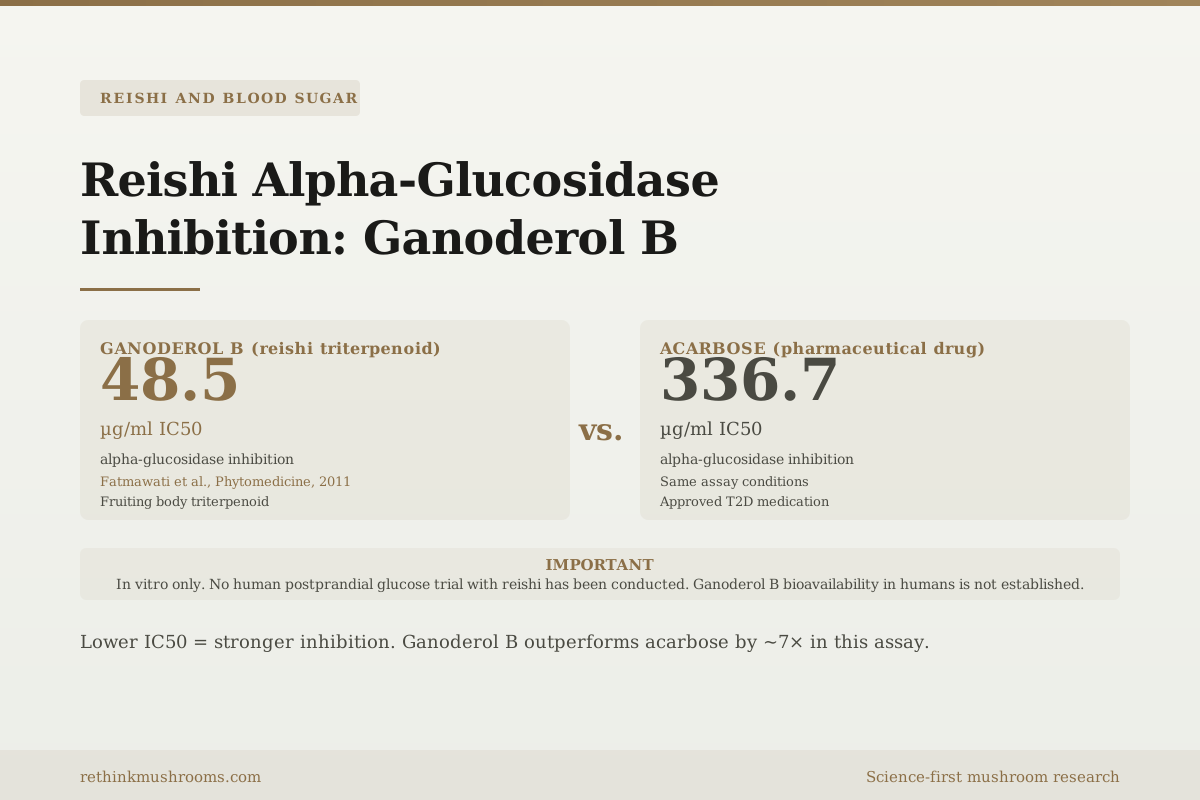
Ganoderol B, a triterpene isolated from Ganoderma lucidum's fruiting body, inhibits alpha-glucosidase with an IC50 of 48.5 µg/ml — compared to 336.7 µg/ml for the pharmaceutical drug acarbose in the same in vitro assay.
Fatmawati et al., Phytomedicine, 2011
48.5 µg/ml
Ganoderol B IC50 for alpha-glucosidase (Fatmawati 2011)
336.7 µg/ml
acarbose IC50 in the same assay
In vitro only
no human postprandial glucose trials with reishi have been conducted
Fatmawati et al., Phytomedicine, 2011
 View as image ↗
In 2011, a research team in Indonesia published a study identifying a specific compound in reishi's fruiting body that inhibits alpha-glucosidase, the digestive enzyme responsible for breaking complex carbohydrates into glucose in the small intestine. The compound, Ganoderol B, showed stronger inhibitory activity than acarbose, the pharmaceutical drug prescribed for this exact purpose in type 2 diabetes management. In vitro, in a test tube, under controlled enzyme kinetics conditions — but the comparison was not subtle.
This mechanism is almost entirely absent from consumer content about reishi and blood sugar. Every article covers the big picture. Almost none explain why reishi might affect post-meal glucose, or identify the specific compound responsible. For the broader overview of reishi's blood sugar research, see What Is Reishi Mushroom? The Science Behind the Mushroom of Immortality.
Key Takeaways
- Alpha-glucosidase is the intestinal enzyme that breaks complex carbohydrates into glucose for absorption — inhibiting it slows the post-meal glucose rise
- Ganoderol B, a triterpenoid isolated from Ganoderma lucidum fruiting body, inhibits alpha-glucosidase with an IC50 of 48.5 µg/ml
- Acarbose, the pharmaceutical alpha-glucosidase inhibitor drug, produced an IC50 of 336.7 µg/ml in the same assay — roughly 7× less potent
- Reishi triterpenoids act at a different site than polysaccharides, which work primarily on hepatic glucose output and beta-cell protection
- Ganoderic acid content in reishi preparations varies dramatically depending on drying method, meaning the active compound concentration in commercial products is highly variable
- No clinical trial has specifically measured reishi's effect on postprandial (after-meal) glucose in humans
What Alpha-Glucosidase Does and Why Blocking It Matters
Carbohydrates in food do not enter the bloodstream as glucose directly. Starch and complex carbohydrates must first be broken down into simple sugars, and the final step of this digestion happens at the lining of the small intestine. Specialized enzymes called alpha-glucosidases (including maltase, sucrase, and isomaltase) sit on the intestinal brush border and cleave the bonds holding carbohydrate chains together, releasing glucose that is then absorbed into the bloodstream.
When these enzymes work quickly, glucose floods into circulation rapidly. The result is the sharp post-meal blood sugar spike, technically called postprandial hyperglycemia, that is a major driver of diabetes progression and its associated complications. The spike itself damages blood vessels, promotes insulin resistance, and contributes to elevated HbA1c over time.
Alpha-glucosidase inhibitors slow this process by competing with carbohydrates for the enzyme's active site. The drugs bind to the enzyme, reducing its efficiency, which delays glucose absorption. The net effect is a slower, lower glucose rise after meals. Acarbose (brand name Precose), miglitol (Glyset), and voglibose are the three pharmaceutical alpha-glucosidase inhibitors approved for type 2 diabetes management. They are primarily prescribed in patients whose postprandial glucose peaks are disproportionately elevated relative to fasting glucose.
For readers interested in how reishi's mechanisms compare between its two major compound classes, see How Reishi Triterpenes Differ from Polysaccharides in Mechanism.
The Discovery: Alpha-Glucosidase Inhibitors in Reishi
Kim and Nho published the foundational study on Ganoderma lucidum's alpha-glucosidase inhibitory activity in 2004. The study isolated alpha-glucosidase inhibitory compounds from G. lucidum and characterized their enzyme inhibition kinetics, establishing for the first time that reishi contains compounds capable of blocking this digestive enzyme.[2]
This 2004 finding identified the mechanism category but did not characterize the active compound specifically. It was sufficient to establish that reishi had biologically meaningful alpha-glucosidase inhibitory activity and that the mechanism was worth investigating further. Subsequent work over the following decade aimed to identify exactly which compound or compounds were responsible.
The 2004 discovery placed reishi in a chemical category alongside several other plants and natural products already known to contain alpha-glucosidase inhibitors. What made the finding notable was that G. lucidum's inhibitory activity was substantially stronger than many plant-derived compounds, suggesting there was a potent compound waiting to be identified.[2]
Ganoderol B: The Active Compound and the Acarbose Comparison
The specific active compound was identified in Fatmawati and colleagues' 2011 study in Phytomedicine. The team isolated Ganoderol B, a triterpenoid, from the fruiting body of Ganoderma lucidum and measured its IC50 against alpha-glucosidase in a standard enzyme inhibition assay. IC50 is the concentration required to inhibit 50 percent of enzyme activity, a standard measure of inhibitory potency. Lower numbers mean stronger inhibition.[1]
Ganoderol B's IC50: 48.5 µg/ml.
The study ran acarbose as the positive control in the same assay, under identical conditions. Acarbose's IC50: 336.7 µg/ml.[1]
The ratio: Ganoderol B is approximately 7 times more potent than acarbose in this assay. This is not a marginal advantage. In enzyme inhibition terms, a 7-fold potency difference is substantial.
Several important caveats attach to this finding before it can be interpreted:
This is an in vitro result. Enzyme inhibition in a test tube does not automatically translate to equivalent inhibition in a human digestive system. The actual concentrations of Ganoderol B that would reach the intestinal brush border after oral consumption of a reishi preparation are unknown and likely far lower than the concentrations tested in the assay. The comparison is biologically meaningful but not clinically proven.
Acarbose is an imperfect comparator. Acarbose's clinical mechanism relies partly on reaching unabsorbed intestinal enzyme activity further down the gut, not just the brush border. The in vitro conditions may not capture this pharmacokinetic difference. The head-to-head comparison is informative for the inhibitory chemistry but does not establish clinical equivalence.
Bioavailability of Ganoderol B is not established. Triterpenoids from oral reishi preparations face absorption barriers, first-pass metabolism, and variable gut delivery depending on formulation. Whether Ganoderol B survives digestion and reaches the intestinal brush border in bioactive concentrations has not been tested.
For more on Ganoderol B within the broader context of reishi's triterpene chemistry, see Ganoderic Acids: The Unique Triterpenes in Reishi.
Triterpenoids vs. Polysaccharides: Two Different Blood Sugar Mechanisms
Reishi contains two major bioactive compound classes with anti-diabetic activity: polysaccharides and triterpenoids. Understanding that they act at different stages of glucose metabolism is important for interpreting the evidence.
Aramabasic Jovanovic and colleagues' 2021 review in the Journal of Fungi documented the distinctions clearly. Reishi polysaccharides act primarily at the hepatic and cellular level: they inhibit gluconeogenic enzymes in the liver (PEPCK and G6Pase, which control hepatic glucose output), protect pancreatic beta cells from oxidative damage, and enhance GLUT4 glucose transporter expression in skeletal muscle. These are mechanisms that affect fasting glucose and insulin sensitivity over time.[3]
Triterpenoids, by contrast, act in the digestive tract. Alpha-glucosidase inhibition at the intestinal brush border affects glucose absorption rate rather than insulin sensitivity or fasting glucose. The clinical target is postprandial glucose peaks, not baseline insulin resistance.[3]
This distinction has practical implications for interpreting clinical trials. The Klupp 2016 RCT that found no HbA1c effect from whole-mushroom reishi at 3g/day over 16 weeks used HbA1c as the primary endpoint, a measure of average glucose over 3 months. If reishi's primary glucose effect operates via postprandial alpha-glucosidase inhibition, HbA1c might change modestly or not at all, while postprandial glucose peaks could still be affected. No trial has specifically measured reishi's effect on postprandial glucose using meal challenge protocols. The clinical gap aligns with the specific mechanism.
Ma and colleagues' 2015 review in Phytochemistry confirmed that alpha-glucosidase inhibition is one of four distinct anti-diabetic mechanisms in G. lucidum, alongside PTP1B inhibition, AMPK activation, and polysaccharide-mediated beta-cell protection. Each mechanism acts at a different point in glucose metabolism, and testing reishi only on HbA1c misses the mechanistic diversity of the compound's potential effects.[4]
For the insulin resistance mechanisms specifically, see Ganoderma lucidum and Insulin Resistance. For polysaccharide mechanisms, see Reishi Polysaccharides and Glucose Metabolism.
Why Preparation Method Determines Whether the Mechanism Works
Ganoderic acid content in reishi, and therefore the alpha-glucosidase inhibitory activity that depends on triterpenoid concentration, is not fixed. A 2021 study by Ryu and colleagues in Food Chemistry tested how different drying methods affect anti-diabetic activity and ganoderic acid content in reishi preparations. The variation was dramatic. Hot-air drying, freeze-drying, and low-temperature drying produced statistically different ganoderic acid concentrations from the same source material, with corresponding differences in alpha-glucosidase inhibitory activity measured in vitro.[5]
This finding directly addresses why clinical trials on reishi and blood sugar have produced inconsistent results. If a trial uses a preparation with low ganoderic acid content (due to high-heat processing that degrades triterpenoids), it tests a reishi product without the active compound. The mechanism cannot operate if the active compound is absent or at sub-therapeutic concentration.[5]
For commercial reishi products, ganoderic acid content is not consistently reported or standardized. A supplement labeled "reishi extract" may contain anywhere from trace amounts to meaningful concentrations of Ganoderol B and related triterpenoids, depending on source material, extraction method, and processing temperature. Without standardization, no two products are necessarily equivalent for this mechanism.
This preparation variability is a systemic issue in reishi research and explains why the mechanism evidence (strong in vitro) and the clinical trial evidence (inconsistent) coexist without contradiction. They may be measuring different things, depending on what was in the capsule.
For the clinical trial evidence on reishi and type 2 diabetes, including the head-to-head comparison of positive and null results, see Reishi for Type 2 Diabetes: Clinical Evidence. For the full blood sugar research overview, see Reishi and Blood Sugar: What the Research Shows.
For other triterpene-containing mushrooms with alpha-glucosidase inhibitory activity, see Poria and Insulin Resistance: Mechanisms.
The Bottom Line
Ganoderol B, a triterpene from Ganoderma lucidum's fruiting body, inhibits alpha-glucosidase with approximately 7 times more potency than acarbose in vitro (IC50 48.5 vs. 336.7 µg/ml). Alpha-glucosidase breaks complex carbohydrates into absorbable glucose at the intestinal brush border, and its inhibition slows postprandial glucose peaks. This is one of four distinct anti-diabetic mechanisms in reishi, operating at a different site than the polysaccharide pathways that affect fasting glucose and insulin sensitivity. Ganoderic acid content varies dramatically by preparation and processing method, which likely explains inconsistent clinical trial results. No human trial has specifically measured reishi's effect on postprandial glucose.
Frequently Asked Questions
Sources & References
- 1. Source details for this reference are not yet available.
- 2. Source details for this reference are not yet available.
- 3. Source details for this reference are not yet available.
- 4RTHM-00724·Ma, Haou-Tzong et al. (2015). “Anti-diabetic effects of Ganoderma lucidum..” Phytochemistry.Study breakdown →PubMed →↩
- 5. Source details for this reference are not yet available.