Reishi and Blood Sugar
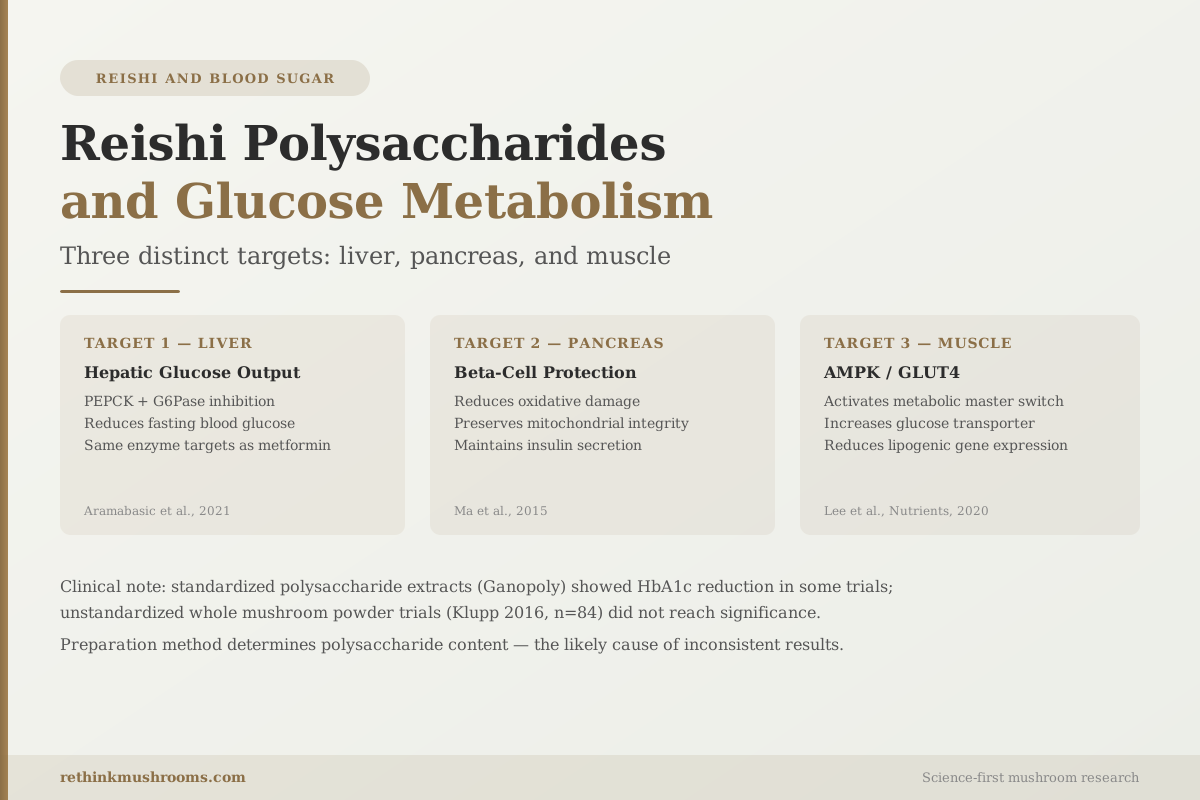
3 distinct glucose metabolism targets for reishi polysaccharides
Reishi polysaccharides reduce hepatic glucose output, protect pancreatic beta cells from oxidative damage, and enhance GLUT4 expression in skeletal muscle: three separate entry points in glucose metabolism from one compound class.
Aramabasic Jovanovic et al., Journal of Fungi, 2021
Hepatic glucose output
PEPCK and G6Pase inhibition reduces liver's glucose release
Beta-cell protection
polysaccharides preserve mitochondrial integrity in pancreatic islets
AMPK activation
GLUT4 upregulation improved insulin sensitivity in obese mice (Lee 2020)
Aramabasic Jovanovic et al., Journal of Fungi, 2021
 View as image ↗
Consumer health content on reishi and blood sugar tends to treat reishi polysaccharides as a single category with a single effect ("supports blood sugar"). The research is considerably more specific. Reishi polysaccharides, primarily its beta-glucan and glycoprotein fractions, affect glucose metabolism through at least three distinct molecular targets in different organs. Understanding those three targets separately is more useful than the generic "supports insulin function" framing that most supplement content offers.
This article covers the polysaccharide mechanisms specifically. The broader cluster covering reishi and blood sugar: what the research shows provides the overview including clinical trial data, and reishi for type 2 diabetes: clinical evidence covers the human trials. For the contrast between what polysaccharides and triterpenes each do, the article on how reishi triterpenes differ from polysaccharides in mechanism covers that distinction. This article sits within the broader reishi mushroom science overview.
Key Takeaways
- Reishi polysaccharides act on glucose metabolism through at least three distinct targets: inhibiting hepatic glucose output enzymes (PEPCK and G6Pase), protecting pancreatic beta cells from oxidative damage, and enhancing GLUT4 expression in peripheral tissue
- The hepatic glucose target is pharmacologically significant: PEPCK and G6Pase are the same liver enzymes targeted by metformin through a different binding mechanism; reducing their activity lowers the liver's contribution to fasting blood glucose
- Beta-cell protection preserves the organ responsible for insulin production; in type 2 diabetes beta-cell dysfunction progresses over time and reduces the body's ability to compensate for insulin resistance
- Lee and colleagues (2020) found reishi extract in obese mice activated AMPK, the "metabolic master switch," increasing GLUT4 and GLUT1 expression while reducing lipogenic gene expression (FAS, SCD1, SREBP1c)
- A 2025 GRADE-assessed meta-analysis by Jafari and colleagues is the most current comprehensive synthesis of reishi clinical trials, essential context for translating these mechanisms to clinical expectations
- Polysaccharide content in reishi products varies substantially by preparation method, which likely explains inconsistent clinical results across trials using different formulations
Three Glucose Targets: How Reishi Polysaccharides Act at the Liver, Pancreas, and Muscle
The specificity of reishi polysaccharide activity is one of its pharmacologically interesting features. Rather than a single mechanism, the evidence points to three separate sites of action, each addressing a different component of glucose dysregulation in type 2 diabetes.[1]
The liver is where fasting blood glucose largely originates. When hepatic glucose production is dysregulated, as it is in insulin resistance, the liver continues releasing glucose into the bloodstream even when blood sugar is already elevated. Reishi polysaccharides appear to reduce this through inhibition of two key hepatic enzymes: phosphoenolpyruvate carboxykinase (PEPCK) and glucose-6-phosphatase (G6Pase). These enzymes are rate-limiting in gluconeogenesis and glycogenolysis respectively. When they are inhibited, the liver produces less glucose.
The pancreas is where insulin is produced and where type 2 diabetes progressively impairs function. Beta cells (the insulin-producing cells in the pancreatic islets) are highly vulnerable to oxidative stress, and their gradual failure is a central feature of type 2 diabetes progression. Reishi polysaccharides appear to protect beta cells from oxidative damage, preserving mitochondrial integrity in pancreatic islets and maintaining insulin secretion capacity.
Skeletal muscle is the primary site of post-meal glucose disposal. Insulin signals muscle cells to move GLUT4 (glucose transporter type 4) to the cell surface, allowing glucose to enter and be used or stored. In insulin resistance, this signaling breaks down. Reishi polysaccharides appear to enhance GLUT4 expression and translocation, improving the muscle's ability to take up glucose even when insulin signaling is impaired.
These three targets together address the three main failure points of glucose metabolism in type 2 diabetes: too much glucose from the liver, too little insulin from the pancreas, and insufficient uptake by peripheral tissue.
How Reishi Polysaccharides Suppress Hepatic Glucose Output at Its Source
The liver's role in type 2 diabetes is often underappreciated in patient-facing content. In a healthy state, the liver produces glucose primarily during fasting (overnight) through gluconeogenesis (making glucose from non-carbohydrate precursors) and glycogenolysis (releasing stored glycogen). After eating, insulin signals the liver to stop.
In insulin-resistant individuals, the liver becomes insulin-resistant too: it continues releasing glucose even when circulating insulin levels are elevated. This hepatic glucose overproduction is the primary cause of elevated fasting blood glucose and a major contributor to elevated HbA1c over time.
PEPCK and G6Pase are the two key enzymes in the hepatic glucose output pathway. PEPCK is the rate-limiting enzyme in gluconeogenesis. G6Pase dephosphorylates glucose-6-phosphate, allowing glucose to exit the liver cell into the bloodstream. Metformin reduces hepatic glucose output in part by suppressing PEPCK expression through AMPK activation; reishi polysaccharides appear to target similar enzyme activity through polysaccharide-receptor signaling at the hepatocyte level.[1]
The result is the same: less glucose released from the liver during fasting, which translates to lower fasting blood glucose readings and over time to improved glycemic control markers like HbA1c.
This does not mean reishi polysaccharides work the same way as metformin or are interchangeable with it. The binding sites and signaling cascades are different. But the downstream target, reducing hepatic PEPCK and G6Pase activity, overlaps with the most widely prescribed diabetes medication. That pharmacological specificity is what makes the preclinical data mechanistically credible rather than generic.
Beta-Cell Protection: Preserving the Organ That Makes Insulin
The progression of type 2 diabetes is often described as a two-stage process: first, insulin resistance develops in peripheral tissues (muscle, liver, fat); second, the pancreas compensates by producing more insulin until the beta cells become exhausted or damaged and insulin production declines. The decline in beta-cell function is what separates well-controlled from poorly-controlled type 2 diabetes over years.
Reishi polysaccharides appear to offer some protection at this second stage. The evidence comes primarily from animal and cell models showing that polysaccharide fractions reduce oxidative damage in pancreatic islets, preserve mitochondrial integrity in beta cells, and maintain insulin secretion capacity under conditions of metabolic stress.[3]
The mechanism at the cell level involves polysaccharides enhancing the expression of antioxidant enzymes (superoxide dismutase and glutathione peroxidase) within beta cells, reducing reactive oxygen species accumulation that damages mitochondrial DNA and cell structure. Beta cells are particularly vulnerable to oxidative damage because they have relatively low intrinsic antioxidant capacity compared to other cell types.
Why does this matter for glucose metabolism specifically? Because declining beta-cell mass and function is the reason type 2 diabetes eventually requires insulin injections in many patients. If polysaccharides protect beta-cell function under metabolic stress, they would theoretically help the pancreas maintain adequate insulin production longer. That is a different biological target from reducing glucose production or improving uptake: it is preserving the insulin production infrastructure itself.
This mechanism is important to distinguish from simply "supporting insulin function." The specific target is beta-cell survival and mitochondrial integrity under oxidative challenge, not insulin receptor sensitivity or insulin signal transduction.
The AMPK Connection: Why Reishi Polysaccharides Improve Peripheral Glucose Uptake
The third target is AMPK, sometimes called the "metabolic master switch" because of its central role in regulating cellular energy balance. When a cell's energy supply is low relative to demand, AMPK is activated. Activated AMPK triggers a cascade of metabolic adaptations: increasing glucose uptake, reducing fat synthesis, and enhancing mitochondrial function.
Lee and colleagues tested reishi extract in high-fat diet obese mice, an established animal model for insulin resistance and metabolic syndrome.[2] Reishi extract activated AMPK and its downstream effectors. The results included increased expression of insulin receptor (IR), insulin receptor substrate 1 (IRS1), and Akt, all components of the insulin signaling cascade. GLUT4 and GLUT1 expression increased in muscle tissue, facilitating more glucose uptake. Lipogenic gene expression was reduced: fatty acid synthase (FAS), stearoyl-CoA desaturase 1 (SCD1), and sterol regulatory element-binding protein 1c (SREBP1c) all decreased, reducing the liver's production of new fatty acids that contribute to insulin resistance.
This was an animal model study, not a human trial. The dose and reishi preparation used in the Lee 2020 study would not map directly to off-the-shelf reishi supplements at typical doses. But the mechanistic picture is consistent with what would be expected from an AMPK activator: improved glucose uptake, reduced de novo lipogenesis, better insulin signaling.
The AMPK target is also relevant because it explains why reishi polysaccharides and exercise may share a mechanistic pathway. Exercise activates AMPK through energy depletion; reishi polysaccharides appear to activate AMPK through a different trigger. Both produce some overlapping downstream effects on glucose metabolism. This does not make reishi a substitute for exercise, but it gives a mechanistic account of why the compound class might have metabolic effects in metabolically compromised animals and (possibly) humans.
What Clinical Trials Show About Polysaccharide Preparations
The mechanistic case for reishi polysaccharides in glucose metabolism is substantial at the preclinical level. The clinical evidence is more complicated.
A 2019 comprehensive review of the Ganoderma genus for diabetes noted that polysaccharides and triterpenoids are the primary active classes but concluded that while preclinical evidence is promising across multiple mechanisms, clinical trials have produced inconsistent results.[4]
A 2020 clinical trial update covering medicinal mushrooms for type 2 diabetes found positive results for specific Ganoderma preparations, including the Ganopoly polysaccharide extract, with some trials showing HbA1c reduction over 12 weeks.[6] However, trials using whole mushroom powder at standard doses did not produce the same results. The Klupp 2016 RCT (3g whole mushroom per day, 84 participants, 16 weeks) found no significant effect on HbA1c or fasting plasma glucose.
The most current evidence synthesis is the 2025 Jafari GRADE-assessed meta-analysis of all Ganoderma clinical trials, covering doses from 200 to 11,200 mg per day and durations from 1 to 24 weeks.[5] The GRADE methodology explicitly assesses evidence quality rather than simply pooling results, making it the most methodologically rigorous clinical summary available. The detailed findings of that meta-analysis are covered in reishi for type 2 diabetes: clinical evidence.
What the clinical data tells us about polysaccharides specifically: the trials that have shown positive glucose effects used concentrated, standardized polysaccharide extracts rather than whole mushroom powder. This pattern is consistent with the mechanistic research, which shows dose-dependent effects at polysaccharide concentrations that may not be reliably present in unstandardized whole mushroom products.
Why Preparation Method Changes Everything
The inconsistency of clinical trial results across different reishi preparations is not random. Reishi's polysaccharide content varies significantly based on how the mushroom is processed.
Extraction method matters: hot water extraction pulls polysaccharides into solution; ethanol extraction does not. Fruiting body versus mycelium matters: the beta-glucan profiles differ. Drying method matters: the anti-diabetic activity of dried reishi varies measurably with temperature and duration.[3]
A standardized polysaccharide extract like Ganopoly (used in the positive clinical trials) may contain 10 times the relevant polysaccharide concentration per gram than an unstandardized whole mushroom powder at the same gram dose. A consumer buying "reishi" without polysaccharide content stated on the label is taking a product where the active compound concentration is entirely unknown.
This is why the mechanistic and clinical evidence do not contradict each other. The mechanisms are real and well-documented. The clinical inconsistency reflects preparation heterogeneity, not an absence of pharmacological activity. For people interested in the anti-diabetic mechanisms specifically, polysaccharide content and standardization matter far more than gram dose of whole mushroom.
For a patient-focused perspective on reishi polysaccharides and blood glucose in diabetic patients specifically, the article on reishi polysaccharides and blood glucose in diabetic patients covers that application in more detail.
The Bottom Line
Reishi polysaccharides affect glucose metabolism through three mechanistically distinct targets: inhibiting hepatic PEPCK and G6Pase enzymes to reduce the liver's glucose output, protecting pancreatic beta cells from oxidative damage to preserve insulin production capacity, and activating AMPK to increase GLUT4 expression and peripheral glucose uptake. Animal model evidence for all three mechanisms is consistent. Clinical trials have produced mixed results, with positive outcomes largely in standardized polysaccharide extracts and negative results in unstandardized whole mushroom powder trials. Preparation method determines polysaccharide content, which may account for the clinical inconsistency. The 2025 Jafari GRADE meta-analysis provides the most rigorous current clinical synthesis.
Frequently Asked Questions
Sources & References
- 1. Source details for this reference are not yet available.
- 2. Source details for this reference are not yet available.
- 3RTHM-00724·Ma, Haou-Tzong et al. (2015). “Anti-diabetic effects of Ganoderma lucidum..” Phytochemistry.Study breakdown →PubMed →↩
- 4. Source details for this reference are not yet available.
- 5. Source details for this reference are not yet available.
- 6. Source details for this reference are not yet available.