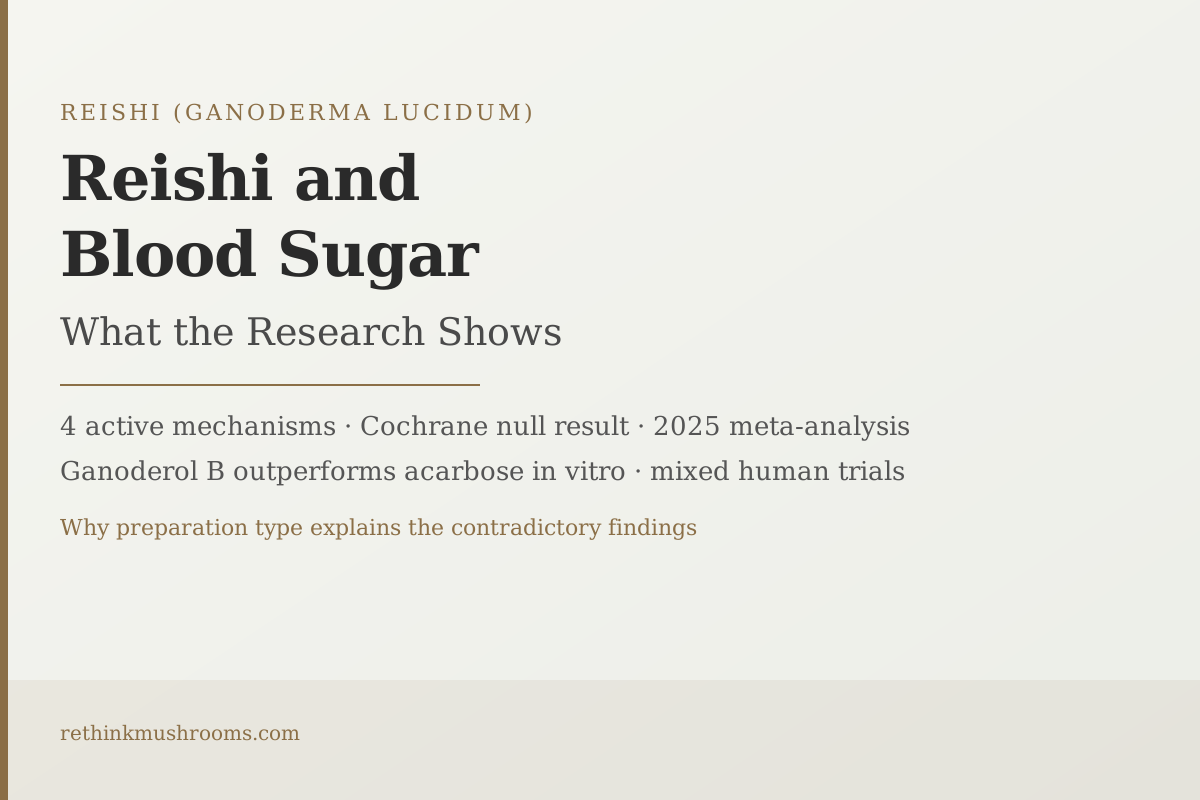
Reishi (Ganoderma lucidum)
4 active mechanisms
A 2015 systematic review mapped four distinct anti-diabetic pathways in Ganoderma lucidum: beta-cell protection, PTP1B inhibition, AMPK activation, and alpha-glucosidase inhibition. Human trials have not yet reliably translated this preclinical activity.
Ma et al., Phytochemistry, 2015
n=84
participants in the 2016 null RCT: 3g/day reishi for 16 weeks produced no change in HbA1c or fasting plasma glucose (Klupp 2016)
48.5 vs. 336.7 µg/ml
Ganoderol B vs. acarbose IC50 for alpha-glucosidase inhibition in vitro: reishi triterpenoid was more potent in a test tube (Fatmawati 2011)
200-11,200 mg/day
dose range tested across Ganoderma clinical trials, representing a 56-fold variation that may explain inconsistent results (Jafari 2025)
Ma et al., Phytochemistry, 2015
 View as image ↗
Reishi contains compounds that, in laboratory and animal studies, affect blood sugar through four distinct biological mechanisms. That part is well-established. The harder question is whether those mechanisms translate into meaningful blood sugar changes in people with diabetes. That is where the evidence gets genuinely complicated.
The honest answer is that well-designed human trials have mostly found no significant effect on HbA1c, the standard long-term blood sugar measure. A Cochrane systematic review examined the three best available RCTs and concluded there was no evidence of benefit for type 2 diabetes management.[7] But the preclinical evidence explains why researchers keep studying this mushroom, and understanding what the lab work shows is useful context for interpreting why different preparations have produced different results.
This article covers both sides: what the preclinical evidence tells us about the mechanisms, and what the clinical trials have actually found. For the broader story of what reishi is and what it does across its various studied effects, the complete guide to reishi mushroom provides that context.
Key Takeaways
- A 2015 systematic review identified four distinct anti-diabetic mechanisms in Ganoderma lucidum: polysaccharide-mediated beta-cell protection and GLUT4 enhancement, proteoglycan-mediated PTP1B inhibition, AMPK activation, and triterpenoid-mediated alpha-glucosidase inhibition (Ma 2015)
- A reishi triterpenoid called Ganoderol B inhibits alpha-glucosidase (the enzyme that converts starch to glucose) with an IC50 of 48.5 µg/ml, stronger than the pharmaceutical acarbose (336.7 µg/ml) in vitro (Fatmawati 2011)
- A 2015 Cochrane systematic review of 3 RCTs found no evidence that reishi reduces HbA1c in people with type 2 diabetes treated for 12-16 weeks (Klupp 2015)
- A 2016 double-blind RCT (n=84) confirmed the null result: 3g/day of reishi for 16 weeks produced no significant change in HbA1c or fasting plasma glucose (Klupp 2016)
- A 2025 GRADE-assessed meta-analysis by Jafari and colleagues covering the full clinical trial database (200-11,200 mg/day, 1-24 weeks) is the most current and methodologically rigorous synthesis of Ganoderma's human evidence
- The 56-fold variation in doses tested across clinical trials, combined with differences between polysaccharide extracts and whole mushroom preparations, likely explains why some trials have shown signals while others have found no effect
Four Mechanisms, One Mushroom: What the Lab Evidence Shows
A 2015 review by Ma and colleagues mapped the known anti-diabetic mechanisms across all Ganoderma lucidum compound classes.[1] Four distinct pathways emerged:
Polysaccharides: beta-cell protection and glucose transport. Reishi's complex carbohydrate compounds (beta-glucans and proteoglycans) appear to protect the insulin-producing cells in the pancreas from oxidative damage, and to increase the expression of GLUT4, the protein that moves glucose from blood into muscle cells.
Proteoglycans: PTP1B inhibition. A specific class of reishi glycoproteins inhibits an enzyme called PTP1B. PTP1B is a key driver of insulin resistance: when it's overactive, it blocks the insulin receptor from staying in its active state. Yang and colleagues (2018) confirmed this mechanism in a study showing reishi extract reduced insulin resistance by inhibiting PTP1B and restoring the downstream signaling cascade that puts glucose transporters into cell membranes.[2]
AMPK activation: metabolic signaling. Lee and colleagues (2020) showed that reishi extract activates AMPK, an enzyme often called the "metabolic master switch" because it coordinates cellular energy management across muscle, liver, and fat tissue.[3] In high-fat diet obese mice, reishi activation of AMPK increased glucose transporter expression and reduced the activity of genes driving fat synthesis, improving insulin sensitivity.
Triterpenoids: alpha-glucosidase inhibition. Reishi's triterpene compounds, particularly one called Ganoderol B, inhibit alpha-glucosidase, the intestinal enzyme that breaks down complex carbohydrates into glucose for absorption. This is the same enzyme targeted by the pharmaceutical drug acarbose. In vitro, Ganoderol B shows stronger inhibition than acarbose by a substantial margin.[4]
These four mechanisms operate at different points in the blood sugar system: the pancreas, the insulin receptor, cellular energy signaling, and carbohydrate digestion. Their specificity explains why researchers consider reishi genuinely interesting as a metabolic compound, not just generally bioactive. For a deeper look at each mechanism, reishi and insulin resistance, reishi polysaccharides and glucose metabolism, and reishi and alpha-glucosidase inhibition each cover one pathway in depth.
The Ganoderol B Story: Stronger Than Acarbose in a Test Tube
The alpha-glucosidase finding deserves specific attention because it is both the most surprising data point in reishi's blood sugar literature and the most honest illustration of the gap between lab and clinic.
Kim and Nho (2004) first isolated alpha-glucosidase inhibitory compounds from Ganoderma lucidum, establishing that the species contains at least one compound class capable of acting on this enzyme target.[5]
Fatmawati and colleagues (2011) identified the specific active compound: Ganoderol B, a triterpenoid from the fruiting body. They measured its inhibitory potency directly against alpha-glucosidase and compared it to acarbose.[4] The IC50 (the concentration needed to inhibit 50% of enzyme activity) was 48.5 µg/ml for Ganoderol B versus 336.7 µg/ml for acarbose. Lower IC50 means more potent. Ganoderol B was approximately seven times more potent than acarbose in the test tube.
This is a striking number. Acarbose is a well-established, prescribed medication for type 2 diabetes. A natural compound outperforming it in vitro would be clinically significant if the effect translated to human trials. The important caveat is that no human trial has measured postprandial glucose response to reishi specifically targeting this mechanism. The compound shows activity; whether it reaches the intestinal brush border at sufficient concentrations from a supplement is untested.
For the full context of reishi's triterpene compounds and what Ganoderol B belongs to, ganoderic acids: the unique triterpenes in reishi provides that overview.
What Human Clinical Trials Have Found: The Honest Picture
The preclinical evidence described above is mechanistically specific and plausible. The human trial results are less encouraging.
Klupp and colleagues published a Cochrane systematic review in 2015 examining the three highest-quality available RCTs of reishi for cardiovascular risk factors, including blood glucose in people with type 2 diabetes.[7] The Cochrane conclusion: no evidence of significant effect on HbA1c across trials lasting 12-16 weeks. This is the gold standard of evidence synthesis, and the null result is direct.
The following year, the same research group published a double-blind, randomized, placebo-controlled trial directly testing reishi for metabolic syndrome (which includes elevated blood glucose).[8] 84 participants received 3g per day of reishi extract for 16 weeks. The result: no significant change in HbA1c or fasting plasma glucose compared to placebo.
Winska and colleagues' 2019 review of the Ganoderma genus for diabetes treatment notes that across the available evidence, polysaccharide and triterpenoid compounds show anti-diabetic activity in preclinical systems, but the translation to consistent clinical outcomes has been limited.[6]
Jafari and colleagues published the most current synthesis in 2025: a GRADE-assessed systematic review and meta-analysis covering all published Ganoderma clinical trials.[9] Their analysis covered doses from 200 to 11,200 mg per day across trials lasting 1 to 24 weeks. The GRADE methodology provides quality ratings for each outcome, allowing a more nuanced view than simple pooled effect sizes. Readers wanting the most current and complete clinical evidence synthesis should look to this 2025 analysis.
For a dedicated deep-dive on every clinical trial that has tested reishi specifically for type 2 diabetes, reishi for type 2 diabetes: the full clinical evidence covers the trial record in detail.
Why Different Preparations Produce Different Results
The most clinically important insight to emerge from comparing positive and negative reishi studies is that the trials are not testing the same thing. They test different preparations.
The 56-fold dose range in Jafari 2025's meta-analysis (200-11,200 mg/day) is a signal that the clinical literature is not evaluating a standardized intervention. But dose variation is only part of the story.
Reishi's four anti-diabetic mechanisms depend on different compound classes. Alpha-glucosidase inhibition requires triterpenoids (specifically Ganoderol B) from the fruiting body. Beta-cell protection and GLUT4 enhancement require polysaccharides. PTP1B inhibition requires proteoglycans. A whole-mushroom powder, a polysaccharide extract, a spore-based product, and a hot-water extract of the fruiting body will contain different relative concentrations of these compound classes.
Ma and colleagues note that the major bioactive fractions of Ganoderma lucidum vary significantly by preparation method, solvent extraction conditions, and mushroom maturity.[1] A whole-mushroom powder at 3g/day may not contain the polysaccharide concentration needed to demonstrate the beta-cell protective effects shown in animal studies. A hot-water polysaccharide extract at a fraction of that dose may contain considerably more.
The null result in Klupp 2016 (3g/day whole mushroom, 16 weeks) does not prove that reishi cannot affect blood glucose in humans. It proves that a specific preparation at a specific dose over a specific duration, in a specific population (metabolic syndrome with T2DM), did not produce a measurable HbA1c change. That is a different and more limited claim.
Understanding this distinction requires knowing what the active compounds are and where they come from, which is precisely the kind of information that most supplement marketing omits. For the conceptual framework distinguishing triterpene and polysaccharide mechanisms, how reishi triterpenes differ from polysaccharides in mechanism covers that directly.
Reishi Among Mushrooms: A Species Comparison for Blood Sugar
Shamim and colleagues' 2023 review of edible mushrooms in diabetes prevention and treatment positions reishi within the broader landscape of evidence for glycemic effects from fungi.[10]
Reishi is not the only species with anti-diabetic preclinical evidence. Maitake (Grifola frondosa), oyster mushroom (Pleurotus ostreatus), and Poria cocos all appear in the glycemic evidence base. The comparative picture is similar across species: robust preclinical activity, preliminary positive signals in some clinical preparations, inconsistent or null results in others.
Reishi's specific distinction is the breadth of its mechanism diversity: four distinct pathways covering both glucose production (hepatic output), glucose disposal (muscle uptake), insulin receptor signaling, and carbohydrate digestion. No other single mushroom species has been shown to act on all four. Whether that mechanistic breadth translates to superior clinical outcomes remains untested.
For blood sugar-focused reishi polysaccharide data specifically in diabetic patient contexts, reishi polysaccharides and blood glucose control covers that evidence base.
The Bottom Line
Reishi contains four compound classes with distinct anti-diabetic mechanisms in preclinical studies: beta-cell protection, PTP1B inhibition, AMPK activation, and alpha-glucosidase inhibition. The alpha-glucosidase inhibitor Ganoderol B outperforms acarbose in vitro. Despite this mechanistic breadth, a Cochrane review of three RCTs and a 2016 double-blind trial (n=84) both found no significant HbA1c change from whole-mushroom reishi. The likely explanation is preparation and dose variation: different compound classes require different extraction conditions, and clinical trials have not used standardized preparations targeting the specific active fractions. The 2025 Jafari GRADE meta-analysis is the most current clinical synthesis.
Frequently Asked Questions
Sources & References
- 1RTHM-00724·Ma, Haou-Tzong et al. (2015). “Anti-diabetic effects of Ganoderma lucidum..” Phytochemistry.Study breakdown →PubMed →↩
- 2. Source details for this reference are not yet available.
- 3. Source details for this reference are not yet available.
- 4. Source details for this reference are not yet available.
- 5. Source details for this reference are not yet available.
- 6. Source details for this reference are not yet available.
- 7. Source details for this reference are not yet available.
- 8. Source details for this reference are not yet available.
- 9. Source details for this reference are not yet available.
- 10. Source details for this reference are not yet available.