Agaricus blazei and Liver Health
ALT: 151→46 IU/L
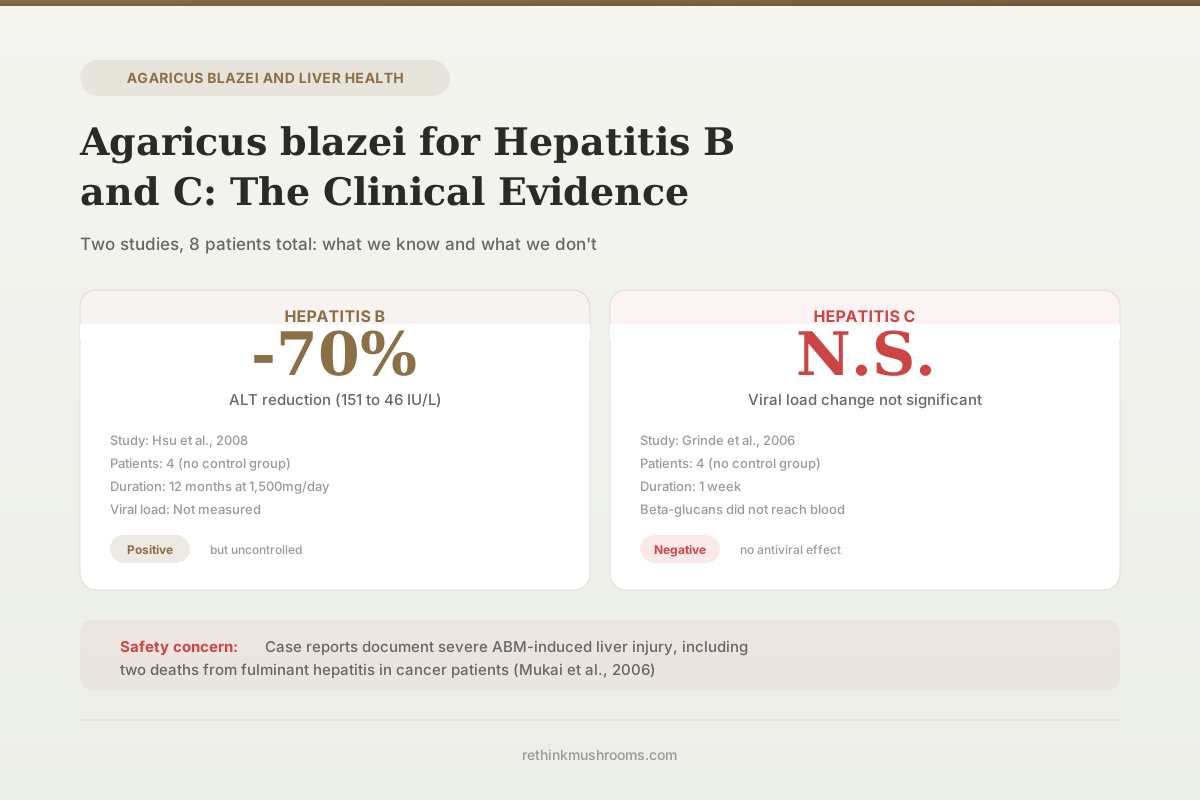
In a pilot study of 4 chronic hepatitis B patients, Agaricus blazei extract at 1,500mg/day for 12 months reduced ALT from 151 to 46 IU/L (normal range). No controlled trial has replicated this.
Hsu et al., Journal of Alternative and Complementary Medicine, 2008
4 HBV Patients
the only hepatitis B clinical study
4 HCV Patients
viral load not significantly reduced
Hepatotoxicity Risk
severe liver injury reported in case studies
Hsu et al., Journal of Alternative and Complementary Medicine, 2008
 View as image ↗
Agaricus blazei Murill (ABM) has been used traditionally in Brazil and Japan for liver conditions, and hepatitis B patients in Asia have been among the most common consumers of the mushroom supplement. The clinical evidence, however, is remarkably thin: one uncontrolled pilot study in 4 hepatitis B patients and one small study in 4 hepatitis C patients. These are the only human trials directly examining ABM in viral hepatitis. The hepatitis B results were positive but the study design was too weak to draw conclusions. The hepatitis C results were negative. Complicating matters, case reports describe severe liver injury from ABM itself, creating a paradox where the same mushroom that shows hepatoprotective effects in some contexts causes hepatotoxicity in others.
For the broader picture of ABM's liver protection research, liver enzyme normalization data, and chemical hepatotoxicity protection, those topics have their own articles. This one focuses specifically on what the hepatitis research shows and what it leaves unanswered.
Key Takeaways
- In 4 chronic hepatitis B patients, 1,500mg/day ABM extract for 12 months reduced AST from 246 to 61 IU/L and ALT from 151 to 46 IU/L, normalizing liver function (Hsu et al., Journal of Alternative and Complementary Medicine, 2008)
- In 4 chronic hepatitis C patients, 1 week of ABM treatment slightly but not significantly decreased viral load, and the beta-glucans responsible for in vitro cytokine induction did not appear to enter the blood at effective levels (Grinde et al., International Immunopharmacology, 2006)
- ABM extract co-administered with hepatitis B virus core DNA vaccine enhanced both antibody responses and T cell proliferation in mice, suggesting adjuvant potential for HBV vaccination (Chen et al., International Immunopharmacology, 2004)
- Three cancer patients developed severe hepatic dysfunction while taking ABM extract, with two deaths from fulminant hepatitis, and one patient showed liver function recovery on cessation and deterioration on rechallenge (Mukai et al., Japanese Journal of Clinical Oncology, 2006)
- A second case series identified ABM-associated drug-induced liver injury that histologically mimicked autoimmune hepatitis, with rising immunoglobulin G levels suggesting the immunostimulatory action of ABM triggered the injury (Hisamochi et al., Clinical Journal of Gastroenterology, 2013)
- A 2017 review found only 17 clinical studies across all ABM research, with the hepatitis evidence representing some of the weakest data due to sample sizes of 4 patients (da Silva de Souza et al., Current Pharmaceutical Design, 2017)
Three streams, three verdicts
What the Hepatitis Evidence Actually Shows
The entire human evidence base is two studies of 4 patients each, set against case reports of serious liver injury. The three streams do not point the same way.
Hepatitis B
Promising, uncontrolledALT 151 → 46 IU/L
Evidence
1 open-label pilot, 4 patients
Regimen
1,500 mg/day for 12 months
Result
AST 246 → 61, ALT 151 → 46 IU/L (normalized)
No control group, no blinding, no viral-load data. ALT flares and remits on its own in chronic HBV.
Hepatitis C
No effectViral load not reduced
Evidence
1 study, 4 patients
Regimen
AndoSan extract for 1 week
Result
Slight, non-significant viral-load change
Beta-glucans that drive the in-vitro immune effect did not readily enter the blood after oral dosing.
Liver safety
Documented harm2 deaths from fulminant hepatitis
Evidence
Case reports, rechallenge-positive
Injury
Fulminant hepatitis; autoimmune-like DILI
Tolerability
Phase I (n=78, remission): AEs in ~12%, mostly mild GI
The same immunostimulation studied as a benefit is the proposed trigger for the liver injury.
Sources: Hsu et al., 2008; Grinde et al., 2006; Mukai et al., 2006; Hisamochi et al., 2013; Ohno et al. (Phase I), 2011 (RTHM-00427, PMID 21584278)
Hepatitis B: The Pilot Study
Hsu et al. (2008) conducted the only clinical study of ABM in hepatitis B patients.[1] This was an open-label pilot study (no control group, no blinding) with 4 patients who met specific criteria: chronic hepatitis B carrier status for more than 3 years, ALT above 100 IU/L, and not taking lamivudine, alpha-interferon, or other hepatitis medications.
The patients took 1,500mg of ABM extract daily for 12 months. Results:
- AST: Decreased from 246 (+/- SD 138.9) to 61.3 (+/- SD 32.6) IU/L
- ALT: Decreased from 151 (+/- SD 86.9) to 46.1 (+/- SD 22.5) IU/L
Both enzymes moved from markedly elevated to near-normal range. The magnitude of improvement is striking. ALT dropped by approximately 70%.
Why this study cannot support conclusions: Four patients, no control group, no blinding, no viral load measurement. ALT fluctuates naturally in chronic hepatitis B, with spontaneous flares and remissions. Without a control group, the improvement cannot be attributed to ABM versus natural disease course. The study authors themselves framed this as an "initial observation" requiring controlled follow-up. More than 18 years later, that controlled study has not been conducted.
Hepatitis B Vaccine Adjuvant
A separate line of evidence comes from Chen et al. (2004), who tested ABM extract as an immune adjuvant for hepatitis B DNA vaccination in mice.[2]
Mice co-immunized with hepatitis B virus core antigen (HBcAg) DNA vaccine plus ABM extract showed significantly increased HBcAg-specific antibody responses and T cell proliferation compared to mice receiving the vaccine alone. This suggests ABM's polysaccharides, particularly beta-glucans, can enhance the immune response to HBV antigens when delivered together.
This is mechanistically interesting because it connects ABM's known immunostimulatory properties to a hepatitis-specific context. Beta-glucans activate innate immune cells (macrophages, dendritic cells) that process and present antigens, potentially improving vaccine efficacy. However, this was an animal study using a DNA vaccine platform that is not currently standard for human HBV vaccination. The translational gap to human clinical use is wide.
Hepatitis C: A Negative Result
Grinde et al. (2006) from Hetland's Norwegian group studied ABM in 4 chronic hepatitis C patients.[3] Patients received ABM extract (the AndoSan preparation) for 1 week.
Viral load: Slightly decreased after 1 week of treatment, but the change was not statistically significant. This is a negative result for antiviral activity.
Gene expression: Using genome-wide microarrays on peripheral blood cells, the researchers found that the cytokine genes most strongly induced by ABM in vitro (in laboratory cell cultures) were not induced in vivo (in the patients' blood). The more notable gene expression changes involved G-protein coupled receptor signaling, cell cycling, and transcriptional regulation.
The beta-glucan absorption problem: The authors concluded that ABM's beta-glucans, which drive cytokine induction in vitro, "did not readily enter the blood" after oral consumption. This is a fundamental pharmacokinetic limitation. Large polysaccharide molecules have limited absorption across the intestinal mucosa. Other ABM components (potentially ergosterol or small molecules) were active in the blood, but these were not sufficient to significantly affect HCV viral load.
This absorption barrier is consistent with findings from Johnson et al. (2009), who showed that ABM extract caused massive cytokine increases when applied directly to blood cells ex vivo but produced anti-inflammatory effects in vivo after oral consumption.[4] The in vitro immune activation that makes ABM attractive for viral infections may not translate to oral dosing.
The Hepatotoxicity Paradox
While some researchers studied ABM for liver disease, others documented ABM causing liver disease. This contradiction is the most important consideration for hepatitis patients.
Liver Safety
CriticalAgaricus blazei has caused severe liver injury
Concern
Case reports document fulminant hepatitis with two deaths and autoimmune-like drug-induced liver injury in patients taking ABM extract. In one patient, liver injury resolved on stopping ABM and returned on rechallenge, which points to a causal link rather than coincidence.
What the research says
No controlled trial shows ABM treats viral hepatitis, and its immunostimulatory action is the proposed mechanism for the liver injury. In people who already have chronic liver inflammation, that same immune activation could plausibly worsen the disease.
Particularly relevant for: Anyone with hepatitis B, hepatitis C, or other active liver disease
What to do
Do not use ABM to treat hepatitis. Talk to your hepatologist before taking any mushroom supplement, and stop immediately if liver enzymes rise.
Mukai et al., 2006; Hisamochi et al., 2013
Case Report 1: Fulminant Hepatitis (Mukai 2006)
Mukai et al. reported three cancer patients who developed severe hepatic damage while taking ABM extract.[5] Two patients died of fulminant hepatitis. In the third patient, liver function recovered after stopping ABM, but deteriorated again when she restarted it. This rechallenge-positive pattern strongly suggests a causal relationship between ABM and the liver damage.
The patients were cancer patients with other potential causes of liver injury (chemotherapy, disease progression), so confounders cannot be completely excluded. But the rechallenge case provides particularly strong circumstantial evidence.
Case Report 2: Autoimmune-Like DILI (Hisamochi 2013)
Hisamochi et al. described two patients who developed drug-induced liver injury (DILI) while taking ABM extract for cancer.[6] Both cases were scored as compatible with DILI using the Roussel Uclaf Causality Assessment Method (an international diagnostic scale). The liver biopsies in both cases showed histological features very similar to autoimmune hepatitis (AIH).
Serum immunoglobulin G and zinc sulfate turbidity tests gradually increased from the start of ABM supplementation to the onset of liver injury. The authors concluded that ABM's immunostimulatory action triggered an autoimmune-like liver injury. This mechanism is biologically plausible: if ABM stimulates immune cells that then attack liver tissue, the very immunomodulation that makes ABM interesting for hepatitis could cause liver damage in susceptible individuals.
Implications for Hepatitis Patients
This creates a direct conflict. Hepatitis B and C patients have chronic liver inflammation. ABM's immunostimulatory effects could theoretically help clear the virus by boosting immune responses. But they could also worsen liver inflammation by activating immune cells that attack hepatocytes. The case reports suggest the second scenario occurs in a subset of patients.
The hepatoprotective animal data provides some counterweight. Al-Dbass et al. (2012) showed ABM protected rat livers against CCl4-induced injury through antioxidant mechanisms.[7] But chemical hepatoprotection in rats involves different pathways than viral hepatitis in humans, and the DILI case reports demonstrate that animal protection data does not guarantee human safety.
The largest formal safety assessment offers partial reassurance but does not settle the question. A Phase I dose-escalation study by Ohno et al. (2011) gave 78 cancer survivors in remission 1.8 to 5.4g/day of ABM powder for 6 months; adverse events occurred in 9 patients (12%), mostly mild nausea and diarrhea.[8] That trial found ABM generally tolerable at these doses, but it studied people in remission, not anyone with active liver disease, which is precisely the population the hepatotoxicity reports warn about.
What the Reviews Say
Da Silva de Souza et al. (2017) identified the hepatoprotective effects of ABM as one of at least nine bioactivities "supported by experimental evidence," but classified the hepatitis clinical data among the weakest evidence in the ABM literature due to the minimal sample sizes.[9]
Hetland et al. (2020) acknowledged ABM's immunomodulatory properties in the context of infection but noted the limited and mixed clinical evidence for hepatitis specifically.[10] The comprehensive review's discussion of anti-infection properties focused more on bacterial infections (where ABM has stronger preclinical support) than viral hepatitis.
Neither review recommended ABM for hepatitis treatment. The evidence base, consisting of two studies with 4 patients each, is too small to inform clinical decisions. The dosage guide for ABM covers what the Hsu hepatitis B study used (1,500mg/day), but this dose has not been validated in a controlled trial.
Why No Follow-Up Studies Exist
The Hsu 2008 hepatitis B pilot was published 18 years ago. The Grinde 2006 hepatitis C study is nearly 20 years old. Neither has been followed by a controlled trial. Several factors explain this:
Direct-acting antivirals changed hepatitis C treatment. Since 2013, drugs like sofosbuvir achieve HCV cure rates above 95%. There is little clinical motivation to study mushroom extracts for a disease with a highly effective pharmaceutical cure.
Hepatitis B treatment has improved. Tenofovir and entecavir suppress HBV replication effectively. While HBV cure remains elusive, viral suppression is achievable, reducing interest in unproven adjuncts.
The hepatotoxicity reports raised safety concerns. Funding agencies and ethics committees are less likely to approve hepatitis trials for a substance with documented liver injury reports. The risk-benefit calculus for studying ABM in patients with pre-existing liver disease is unfavorable.
ABM research groups focused elsewhere. Hetland's group in Norway, the most active ABM clinical research team, pursued allergy, IBD, and cancer studies rather than returning to hepatitis. The cancer research and allergy research have broader patient populations and stronger preclinical foundations.
The Bottom Line
The clinical evidence for Agaricus blazei in hepatitis consists of two studies totaling 8 patients. A hepatitis B pilot study showed impressive liver enzyme normalization in 4 patients over 12 months, but had no control group. A hepatitis C study found no significant viral load reduction in 4 patients after 1 week, with evidence that ABM's key immunostimulatory compounds (beta-glucans) are poorly absorbed orally. Case reports of severe ABM-induced liver injury, including fulminant hepatitis and autoimmune-like DILI, complicate any potential use in patients with pre-existing liver disease. No controlled hepatitis trial has been conducted, and advances in antiviral therapy have reduced the clinical motivation to study ABM for these conditions.
This article is for education only and is not medical advice. Hepatitis B and C are serious medical conditions with effective, proven treatments; do not substitute or delay them for a supplement. Talk to your doctor before taking Agaricus blazei or any mushroom extract, especially if you have liver disease.
Frequently Asked Questions
Sources & References
- 1RTHM-00137·Hsu, Chung-Hua et al. (2008). “The mushroom Agaricus blazei Murill extract normalizes liver function in patients with chronic hepatitis B..” Journal of alternative and complementary medicine (New York.Study breakdown →PubMed →↩
- 2RTHM-00068·Chen, L et al. (2004). “Coimmunization of Agaricus blazei Murill extract with hepatitis B virus core protein through DNA vaccine enhances cellular and humoral immune responses..” International immunopharmacology.Study breakdown →PubMed →↩
- 3RTHM-00097·Grinde, B et al. (2006). “Effects on gene expression and viral load of a medicinal extract from Agaricus blazei in patients with chronic hepatitis C infection..” International immunopharmacology.Study breakdown →PubMed →↩
- 4RTHM-00157·Johnson, E et al. (2009). “Effect of an extract based on the medicinal mushroom Agaricus blazei murill on release of cytokines, chemokines and leukocyte growth factors in human blood ex vivo and in vivo..” Scandinavian journal of immunology.Study breakdown →PubMed →↩
- 5RTHM-00105·Mukai, Hirofumi et al. (2006). “An alternative medicine, Agaricus blazei, may have induced severe hepatic dysfunction in cancer patients..” Japanese journal of clinical oncology.Study breakdown →PubMed →↩
- 6RTHM-00287·Hisamochi, Akiko et al. (2013). “Drug-induced liver injury associated with Agaricus blazei Murill which is very similar to autoimmune hepatitis..” Clinical journal of gastroenterology.Study breakdown →PubMed →↩
- 7RTHM-00243·Al-Dbass, Abeer M et al. (2012). “Agaricus blazei Murill as an efficient hepatoprotective and antioxidant agent against CCl4-induced liver injury in rats..” Saudi journal of biological sciences.Study breakdown →PubMed →↩
- 8RTHM-00229·Ohno, Satoshi et al. (2011). “Phase I Clinical Study of the Dietary Supplement, Agaricus blazei Murill, in Cancer Patients in Remission..” Evidence-based complementary and alternative medicine : eCAM.Study breakdown →PubMed →↩
- 9RTHM-00468·da Silva de Souza, Aline Cristine et al. (2017). “Agaricus blazei Bioactive Compounds and their Effects on Human Health: Benefits and Controversies..” Current pharmaceutical design.Study breakdown →PubMed →↩
- 10RTHM-00620·Hetland, Geir et al. (2020). “Antitumor, Anti-Inflammatory and Antiallergic Effects of Agaricus blazei Mushroom Extract and the Related Medicinal Basidiomycetes Mushrooms, Hericium erinaceus and Grifola frondosa: A Review of Preclinical and Clinical Studies..” Nutrients.Study breakdown →PubMed →↩