Agaricus blazei and Allergies
Dose-Dependent Histamine Inhibition
Agaricus blazei water extract dose-dependently inhibited histamine release from rat peritoneal mast cells and blocked systemic anaphylaxis-like reactions in mice.
Choi et al., Biological & Pharmaceutical Bulletin, 2006
cAMP Elevated
mast cell stabilization via intracellular signaling
IgE Reduced
in both mouse models and a human RCT
Eosinophils Down
in bronchial lavage of asthma-induced mice
Choi et al., Biological & Pharmaceutical Bulletin, 2006
 View as image ↗
Mast cells are the trigger cells of allergic asthma. When an allergen binds to IgE antibodies on their surface, mast cells degranulate, releasing histamine, prostaglandins, leukotrienes, and cytokines that cause bronchoconstriction, mucus production, and airway inflammation. Standard treatments like antihistamines and mast cell stabilizers (cromolyn sodium) target this cascade at different points. The question researchers have been asking since the mid-2000s: can Agaricus blazei Murill (ABM) do something similar through its beta-glucans and other bioactive compounds?
Nine studies spanning 2006 to 2020 have examined ABM's effects on mast cells, allergic sensitization, and asthma-specific endpoints. The evidence runs from direct mast cell inhibition in isolated cells to a randomized human trial in birch pollen allergy. For the broader picture of how ABM shifts immune balance from allergic to protective responses, and the full Th1/Th2 balance research, those topics get their own articles.
Key Takeaways
- ABM water extract dose-dependently inhibited histamine release from rat peritoneal mast cells and increased intracellular cAMP, a key mechanism shared with established mast cell stabilizers (Choi et al., Biological & Pharmaceutical Bulletin, 2006)
- ABM chloroform extract inhibited degranulation of bone marrow-derived mast cells, reducing beta-hexosaminidase release and blocking production of prostaglandin D2, leukotriene C4, and IL-6 via Akt phosphorylation (Song et al., American Journal of Chinese Medicine, 2012)
- In asthma-induced mice, oral ABM extract significantly reduced OVA-specific IgE, IgG1, IL-5 levels, and bronchial eosinophil counts while increasing IFN-gamma production (Takimoto et al., Immunopharmacology and Immunotoxicology, 2008)
- A randomized, double-blind, placebo-controlled trial in 60 birch-allergic blood donors found ABM extract significantly reduced allergy symptoms, asthma symptoms, medication use, and specific IgE levels during pollen season (Mahmood et al., Nutrients, 2019)
- ABM given before OR after allergen sensitization reduced anti-OVA IgE in mice, suggesting both preventive and therapeutic potential (Ellertsen & Hetland, Clinical and Molecular Allergy, 2009)
- In 8 healthy volunteers who consumed ABM extract daily for 12 days, pro-inflammatory cytokines IL-1beta and TNF-alpha were reduced by 97% and 84% respectively in vivo (Johnson et al., Scandinavian Journal of Immunology, 2009)
How ABM Directly Stabilizes Mast Cells
The foundational mast cell study came from Choi and colleagues in 2006.[1] They tested ABM water extract (ABWE) on rat peritoneal mast cells using compound 48/80, a synthetic mast cell activator, and anti-DNP IgE, which mimics allergic activation.
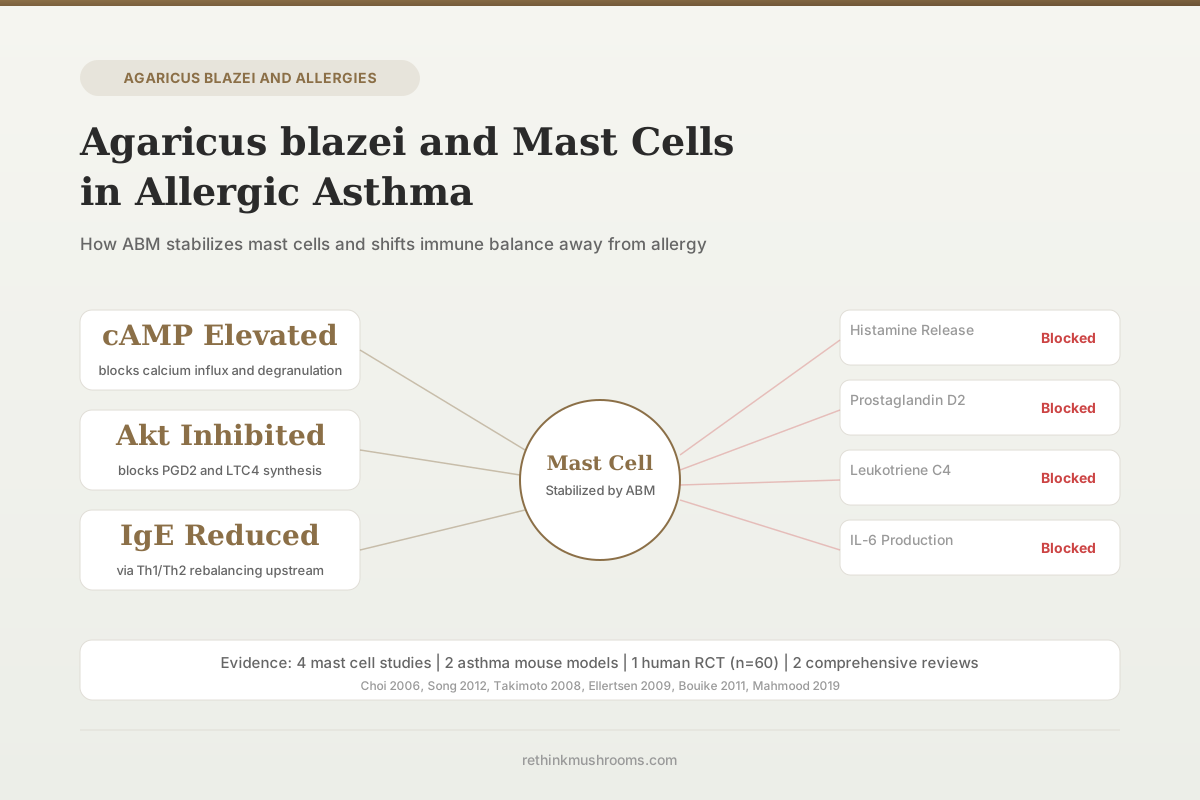
ABWE inhibited histamine release through both pathways in a dose-dependent manner. The mechanism: ABWE increased intracellular cyclic AMP (cAMP) levels and prevented compound 48/80-induced cAMP reduction. This is the same stabilization mechanism used by pharmaceutical mast cell stabilizers. Elevated cAMP prevents the calcium influx that triggers degranulation. Pretreatment with ABWE also reduced calcium uptake into mast cells.
In whole-animal tests, ABWE inhibited systemic anaphylaxis-like reactions, ear swelling, and passive cutaneous anaphylaxis in mice. The extract worked against both compound 48/80-induced (non-IgE) and anti-DNP IgE-mediated reactions, indicating it affects mast cell responses regardless of the activation trigger.
Song et al. (2012) extended this work using bone marrow-derived mast cells (BMMCs) and a chloroform-soluble ABM extract.[2] They found the extract inhibited degranulation (measured by beta-hexosaminidase release) and blocked production of three key allergic mediators: IL-6, prostaglandin D2 (PGD2), and leukotriene C4 (LTC4). The mechanism involved downregulation of Akt phosphorylation, placing ABM's effects upstream in the signaling cascade that leads to mediator synthesis.
PGD2 and LTC4 are particularly relevant to asthma. PGD2 causes bronchoconstriction and recruits eosinophils, Th2 cells, and basophils to the airways. LTC4 is converted to LTD4 and LTE4, the slow-reacting substances of anaphylaxis that cause sustained airway narrowing. Blocking their production at the mast cell level would be expected to reduce both acute bronchoconstriction and the late-phase inflammatory response.
The Asthma Mouse Model: Airway-Specific Evidence
Takimoto et al. (2008) produced the most directly relevant asthma study.[3] Using OVA-sensitized BALB/c mice (a standard allergic asthma model), they gave oral ABM hot-water extract daily and measured airway-specific outcomes.
The results were broad:
- OVA-specific IgE: Significantly decreased (the antibody that arms mast cells for allergic responses)
- OVA-specific IgG1: Significantly decreased (a Th2-associated antibody class)
- OVA-specific IgG2a: Not decreased (a Th1-associated antibody, confirming selective Th2 suppression)
- IL-5 in bronchial lavage: Significantly decreased (the cytokine that recruits and activates eosinophils)
- Eosinophil numbers in bronchial lavage: Significantly decreased
- Total cell numbers in bronchial lavage: Significantly decreased
- IFN-gamma from spleen cells: Significantly increased (confirming Th1 upregulation)
This pattern, reduced Th2 markers with preserved or enhanced Th1 markers, is exactly what you would want from an asthma intervention that works through immune rebalancing rather than broad immunosuppression. The IgG2a preservation is an important detail: ABM did not suppress the immune system globally; it selectively dampened the allergic arm.
Th1/Th2 Rebalancing: The Upstream Mechanism
The mast cell effects described above are downstream consequences of a larger immune shift that ABM appears to drive.
Ellertsen and Hetland (2009) demonstrated this in an OVA allergy mouse model using the ABM-based extract AndoSan (82% ABM).[4] Critically, they tested the extract both prophylactically (given before allergen sensitization) and therapeutically (given 19 days after sensitization). Both timing approaches reduced anti-OVA IgE without affecting IgG2a. There was a trend toward reduced Th2 cytokines relative to Th1 cytokines. The therapeutic timing result matters because it suggests ABM could modify established allergic sensitization, not just prevent initial sensitization.
Bouike et al. (2011) went deeper into the mechanism.[5] During OVA sensitization, oral ABM extract significantly reduced serum IgE. IL-4 and IL-5 from OVA-restimulated splenocytes were significantly decreased. Using a co-culture system of Caco-2 intestinal epithelial cells with splenocytes, they showed that ABM's immune effects were mediated through intestinal epithelial cells activating macrophages, which then promoted differentiation of naive T cells toward Th1. This gut-mediated pathway explains how oral ABM extract can affect systemic immune responses and airway inflammation.
Hetland's 2011 review synthesized these mechanisms: ABM's beta-glucans stimulate innate immune cells (monocytes, NK cells, dendritic cells), which drives Th1 polarization and reduces the Th2 skewing that underlies allergic disease.[6]
The Cytokine Paradox: Ex Vivo vs. In Vivo
Johnson et al. (2009) revealed a counterintuitive finding that is important for understanding ABM's anti-inflammatory potential.[7]
When ABM extract (AndoSan) was added to human whole blood in a test tube, it caused massive, dose-dependent increases in all cytokines tested. TNF-alpha increased up to 399-fold. This looks pro-inflammatory and potentially dangerous.
But when 8 healthy volunteers drank the same extract daily for 12 days, the opposite happened in vivo: IL-1beta dropped by 97%, TNF-alpha by 84%, IL-17 by 50%, and IL-2 by 46%. The authors attributed the discrepancy to two factors: the antioxidant activity of ABM in living systems and the limited absorption of large beta-glucan molecules across the intestinal mucosa.
This paradox has practical implications for asthma research. The in vitro inflammatory activation could theoretically worsen asthma, but the in vivo anti-inflammatory effect aligns with the mast cell stabilization and Th2 suppression seen in animal models. The route of administration and the body's processing of ABM compounds appear to determine whether the net effect is pro-inflammatory or anti-inflammatory.
Human Evidence: The Birch Allergy RCT
The strongest evidence comes from Mahmood et al. (2019), a randomized, double-blind, placebo-controlled trial.[8] Sixty blood donors with self-reported, IgE-confirmed birch pollen allergy were randomized to 7 weeks of pre-seasonal oral supplementation with AndoSan or placebo.
During the subsequent pollen season:
- General allergy symptoms: Significantly reduced in ABM vs. placebo
- Asthma symptoms: Significantly reduced in ABM vs. placebo
- Medication use: Significantly reduced in ABM vs. placebo
- Specific IgE (anti-Bet v 1 and anti-t3): Significantly reduced in ABM vs. placebo
- Basophil sensitivity: In the placebo group, the allergen concentration needed to activate basophils dropped after the season (enhanced sensitization). In the ABM group, basophil sensitivity remained stable.
The basophil finding is mechanistically important. Basophils, like mast cells, are IgE-armed effector cells. The fact that ABM prevented the seasonal increase in basophil sensitivity aligns with the mast cell stabilization data from the animal studies. The connection between allergic dermatitis and this respiratory allergy data suggests a systemic rather than organ-specific effect.
This is one trial with 60 participants. The results are promising but the sample is small, the study used self-reported symptoms, and the extract contains other mushroom species besides ABM (15% Hericium erinaceus, 3% Grifola frondosa).
Limitations and Open Questions
The mast cell stabilization evidence has meaningful gaps.
Extract variability: Different studies used different ABM preparations. Choi used water extract. Song used chloroform-soluble extract. The clinical trial used AndoSan, which is not pure ABM. The active compounds responsible for mast cell effects have not been definitively identified. Beta-glucans are the leading candidates, but the Song study's chloroform fraction would contain lipophilic compounds, not polysaccharides.
No direct asthma clinical trials: The Mahmood RCT studied birch pollen allergy with asthma as a secondary outcome. No trial has enrolled diagnosed asthmatic patients as the primary population. The mouse asthma model (Takimoto 2008) uses OVA sensitization, which models allergic asthma but not all asthma phenotypes.
Dose and timing uncertainty: The mouse studies used various doses and schedules. The human trial used a specific commercial product (AndoSan, 60mL/day for 7 weeks pre-seasonally). Optimal dosing for mast cell stabilization in humans is unknown. Whether continuous long-term supplementation produces sustained mast cell effects or whether tolerance develops has not been studied.
Mechanism specificity: The Th1/Th2 rebalancing hypothesis explains Th2-driven allergic asthma but would not be expected to help non-allergic (Th2-low) asthma, which accounts for roughly 50% of adult asthma cases. Neutrophilic asthma, steroid-resistant asthma, and exercise-induced bronchoconstriction operate through different immune pathways that ABM's documented mechanisms do not address.
The 2020 review by Hetland et al. concluded that ABM's anti-allergic and anti-asthmatic properties are supported by consistent animal evidence and one positive clinical trial, but acknowledged that the field needs larger, asthma-specific human trials to move beyond preliminary status.[9] The cancer research from Brazil and Japan faces the same evidence gap: strong preclinical signals with limited clinical follow-up.
The Bottom Line
Agaricus blazei directly stabilizes mast cells through cAMP elevation and Akt inhibition, blocking histamine release, prostaglandin D2, and leukotriene C4 production. In asthma-induced mice, oral ABM extract reduced IgE, eosinophils, and IL-5 in bronchial lavage while preserving Th1 responses. A single randomized human trial in birch pollen allergy found significant reductions in allergy symptoms, asthma symptoms, medication use, and specific IgE. The mast cell stabilization and Th1/Th2 rebalancing mechanisms are consistent across studies, but no asthma-specific clinical trial exists and the optimal human dose remains unknown.
Frequently Asked Questions
Sources & References
- 1RTHM-00095·Choi, Yun Ho et al. (2006). “Inhibitory effects of Agaricus blazei on mast cell-mediated anaphylaxis-like reactions..” Biological & pharmaceutical bulletin.Study breakdown →PubMed →↩
- 2RTHM-00263·Song, Hyuk-Hwan et al. (2012). “Anti-inflammatory and anti-allergic effect of Agaricus blazei extract in bone marrow-derived mast cells..” The American journal of Chinese medicine.Study breakdown →PubMed →↩
- 3RTHM-00146·Takimoto, Hiroaki et al. (2008). “Amelioration of skewed Th1/Th2 balance in tumor-bearing and asthma-induced mice by oral administration of Agaricus blazei extracts..” Immunopharmacology and immunotoxicology.Study breakdown →PubMed →↩
- 4RTHM-00153·Ellertsen, Linda K et al. (2009). “An extract of the medicinal mushroom Agaricus blazei Murill can protect against allergy..” Clinical and molecular allergy : CMA.Study breakdown →PubMed →↩
- 5RTHM-00205·Bouike, Go et al. (2011). “Oral Treatment with Extract of Agaricus blazei Murill Enhanced Th1 Response through Intestinal Epithelial Cells and Suppressed OVA-Sensitized Allergy in Mice..” Evidence-based complementary and alternative medicine : eCAM.Study breakdown →PubMed →↩
- 6RTHM-00215·Hetland, Geir et al. (2011). “The Mushroom Agaricus blazei Murill Elicits Medicinal Effects on Tumor, Infection, Allergy, and Inflammation through Its Modulation of Innate Immunity and Amelioration of Th1/Th2 Imbalance and Inflammation..” Advances in pharmacological sciences.Study breakdown →PubMed →↩
- 7RTHM-00157·Johnson, E et al. (2009). “Effect of an extract based on the medicinal mushroom Agaricus blazei murill on release of cytokines, chemokines and leukocyte growth factors in human blood ex vivo and in vivo..” Scandinavian journal of immunology.Study breakdown →PubMed →↩
- 8RTHM-00579·Mahmood, Faiza et al. (2019). “Agaricus blazei-Based Mushroom Extract Supplementation to Birch Allergic Blood Donors: A Randomized Clinical Trial..” Nutrients.Study breakdown →PubMed →↩
- 9RTHM-00620·Hetland, Geir et al. (2020). “Antitumor, Anti-Inflammatory and Antiallergic Effects of Agaricus blazei Mushroom Extract and the Related Medicinal Basidiomycetes Mushrooms, Hericium erinaceus and Grifola frondosa: A Review of Preclinical and Clinical Studies..” Nutrients.Study breakdown →PubMed →↩