Agaricus blazei and Allergies
IgE Reduced
In a randomized, placebo-controlled trial of 60 birch-allergic blood donors, 7 weeks of pre-seasonal ABM extract supplementation significantly reduced specific IgE levels and allergy symptoms during pollen season.
Mahmood et al., Nutrients, 2019
60 Subjects
randomized, double-blind, placebo-controlled
Th1 Shift
IFN-gamma up, IL-4/IL-5 down in mouse models
Mast Cell
inhibited degranulation and leukotriene C4 release
Mahmood et al., Nutrients, 2019
 View as image ↗
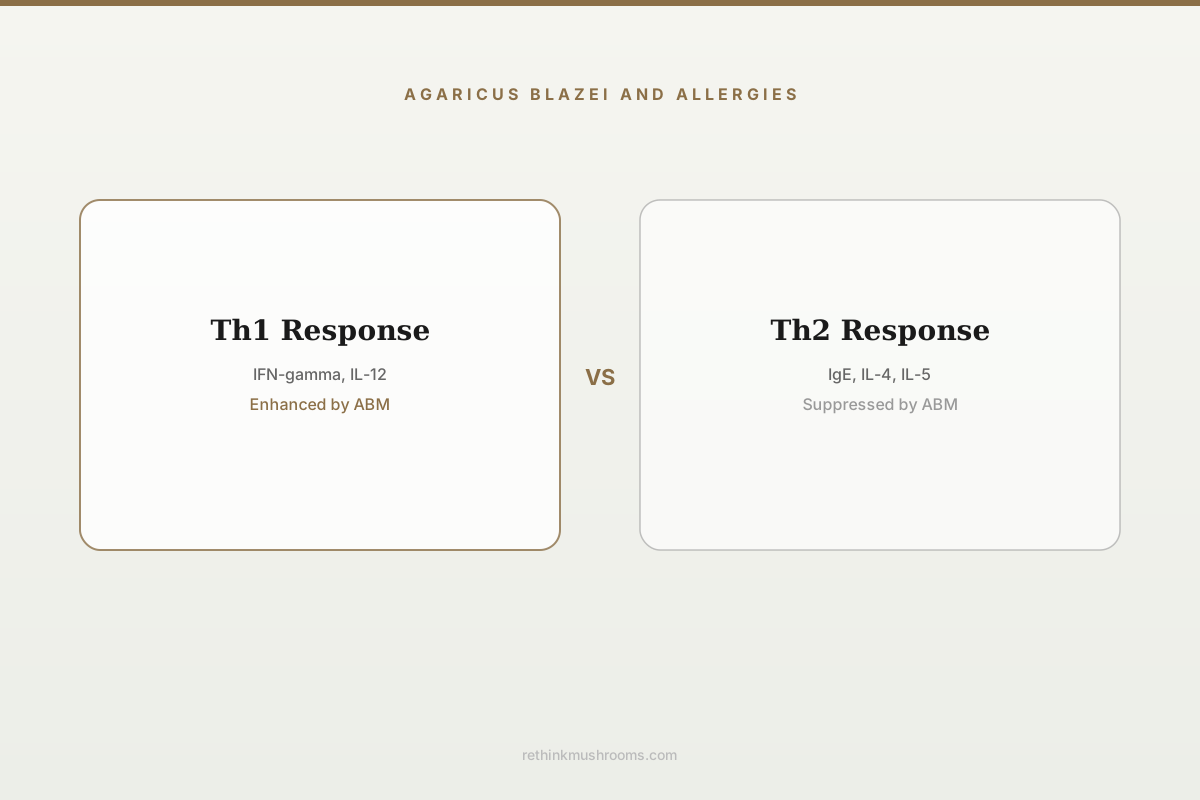
The immune system runs two parallel programs for fighting different threats. Type 1 T helper (Th1) cells drive cellular immunity against intracellular pathogens like viruses and bacteria inside cells. Type 2 T helper (Th2) cells drive humoral immunity against extracellular parasites, producing antibodies, notably IgE. In allergic disease, Th2 activity dominates. The immune system overproduces IgE against harmless substances like pollen, dust mites, or food proteins. IgE binds to mast cells. When the allergen returns, mast cells degranulate, releasing histamine and inflammatory mediators that cause sneezing, itching, wheezing, and swelling.
Agaricus blazei Murill (ABM) has been studied for its ability to shift this balance. The hypothesis is straightforward: if ABM's beta-glucans stimulate Th1 responses through dendritic cell activation, the resulting Th1 dominance should suppress Th2 activity and reduce allergic responses. Mouse studies from 2008 to 2011 confirmed this mechanism. A 2019 randomized human trial showed reduced allergy symptoms and IgE levels. For the specific application to allergic dermatitis and asthma, those conditions have their own dedicated articles.
Key Takeaways
- In a randomized, double-blind trial of 60 birch-allergic blood donors, 7 weeks of pre-seasonal ABM extract (AndoSan) significantly reduced allergy symptoms, medication use, and specific IgE anti-Bet v 1 levels compared to placebo (Mahmood et al., Nutrients, 2019)
- Oral ABM extract ameliorated skewed Th1/Th2 balance in both asthma-induced and tumor-bearing mice, significantly increasing IFN-gamma (Th1) while decreasing IgE and IL-5 (Th2) (Takimoto et al., Immunopharmacology and Immunotoxicology, 2008)
- ABM extract reduced serum IgE in OVA-allergic mice whether given before or after allergen sensitization, functioning as both preventive and therapeutic (Ellertsen and Hetland, Clinical and Molecular Allergy, 2009)
- The anti-allergic mechanism operates through intestinal epithelial cells: ABM beta-glucans activate gut macrophages, which promote Th1 differentiation of naive T cells (Bouike et al., Evidence-Based CAM, 2011)
- ABM chloroform extract inhibited mast cell degranulation and blocked production of prostaglandin D2 and leukotriene C4, two key allergic mediators (Song et al., American Journal of Chinese Medicine, 2012)
- A 2020 review confirmed ABM's antiallergic effects across preclinical and clinical studies, mediated through innate immunity modulation and Th1/Th2 rebalancing (Hetland et al., Nutrients, 2020)
The Th1/Th2 Paradigm: Why Balance Matters
The Th1/Th2 model, first proposed by Mosmann and Coffman in 1986, describes how naive CD4+ T cells differentiate into functionally distinct subsets. The two subsets cross-regulate each other: Th1 cytokines (IFN-gamma, IL-2) suppress Th2 differentiation, and Th2 cytokines (IL-4, IL-10) suppress Th1 differentiation. In healthy individuals, these two programs maintain a dynamic equilibrium.
In allergic disease, the balance is skewed toward Th2:
- IL-4 drives B cell class switching to IgE production
- IL-5 recruits and activates eosinophils
- IL-13 promotes mucus hypersecretion and airway remodeling
- IgE binds to FcepsilonRI receptors on mast cells and basophils, priming them for degranulation upon re-exposure to allergen
Conventional allergy treatments suppress the downstream effects (antihistamines block histamine receptors, corticosteroids suppress inflammation broadly). A Th1-boosting approach would instead address the upstream imbalance, reducing Th2 dominance at the source. This is the theoretical basis for ABM's anti-allergy research.
The immune rebalancing
How Agaricus blazei Shifts Th1/Th2 Balance
Allergy is a Th2-dominant state. Beta-glucans in ABM extract promote a Th1 response, and enhanced Th1 activity cross-suppresses the Th2 markers that drive allergic reactions.
Th2-dominant
Allergic baseline
IgE
High — binds mast cells, primes them to degranulate
IL-4 / IL-5
Elevated — drive IgE class-switching and eosinophils
IFN-gamma (Th1)
Low — Th1 cross-regulation is weak
Result
Sneezing, itching, wheezing on allergen re-exposure
Th1-shifted
After ABM extract
IgE
↓ Reduced
IL-4 / IL-5
↓ Reduced
IFN-gamma (Th1)
↑ Increased
Result
→ Fewer symptoms; basophils stay less sensitive across the season
The direction of each marker is consistent across mouse models and the single human trial. The magnitude in humans comes from one 60-person RCT using a combined mushroom extract, so effect size is not yet well quantified.
Sources: Takimoto et al., Immunopharmacol Immunotoxicol, 2008 (RTHM-00275); Bouike et al., Evid Based Complement Alternat Med, 2011 (RTHM-00380); Mahmood et al., Nutrients, 2019 (RTHM-01104)
Mouse Evidence: The Asthma and Tumor Model
Takimoto and colleagues published the most comprehensive Th1/Th2 rebalancing study in 2008.[1] They used two distinct mouse models representing opposite ends of the immune spectrum: tumor-bearing mice (Th1 suppressed) and OVA-induced asthma mice (Th2 dominant).
In asthma-induced mice, oral ABM extract caused:
- Significant downregulation of OVA-specific IgG1 and IgE (Th2 markers) but not IgG2a (Th1 marker)
- Decreased total cell numbers, IL-5 levels, and eosinophil counts in bronchoalveolar lavage fluid
- Increased IFN-gamma production by anti-CD3-stimulated spleen cells (Th1 activation)
In tumor-bearing mice, oral ABM extract caused:
- Significantly higher IFN-gamma production by spleen T cells restimulated with anti-CD3
- Increased IFN-gamma-inducing protein 10 mRNA expression and elevated CD69+ and CD49d+ activated T cells infiltrating tumors
The dual-model approach is elegant. ABM corrected the Th1/Th2 imbalance in both directions: it boosted Th1 in Th2-skewed (allergic) mice and boosted Th1 in Th1-suppressed (tumor) mice. This suggests ABM acts as a Th1 promoter rather than a direct Th2 suppressor, and that the Th2 reduction is an indirect consequence of enhanced Th1 cross-regulation.
The Prevention vs. Treatment Question
Ellertsen and Hetland addressed a practical question in 2009: does ABM work only as prevention (before allergen exposure) or also as treatment (after sensitization has occurred)?[2]
Using an OVA-sensitized mouse model, they administered AndoSan (82% ABM, 15% Hericium erinaceus, 3% Grifola frondosa) either one day before or 19 days after OVA immunization. Mice were sacrificed on day 26.
Both timing protocols worked. AndoSan reduced anti-OVA IgE levels whether given before or after sensitization. Anti-OVA IgG2a (a Th1 marker) was not reduced, confirming selective suppression of Th2 responses. Cytokine analysis showed a tendency toward reduced Th2 relative to Th1 cytokine levels in both AndoSan groups.
This finding is practically relevant. If ABM only worked pre-exposure, its utility would be limited to prophylaxis. The fact that it reduced IgE even when administered after allergic sensitization was established suggests potential for managing existing allergies, not just preventing new ones. The mechanisms of how this immune shift works from allergic to protective are explored in a companion article.
The Gut Immune Connection
Bouike and colleagues mapped the cellular pathway by which oral ABM reaches the immune system in 2011.[3] The question was specific: how does a compound taken orally end up shifting systemic Th1/Th2 balance?
Using both in vivo OVA-sensitized mice and in vitro co-culture systems with Caco-2 intestinal epithelial cells, they demonstrated:
- Serum IgE decreased significantly in ABME-treated groups
- IL-4 and IL-5 from OVA-restimulated splenocytes decreased significantly (Th2 suppression)
- IFN-gamma production increased significantly (Th1 enhancement)
- In the Caco-2 co-culture system, ABM extract activated macrophages through epithelial cells, which then promoted naive T cell differentiation toward Th1
The pathway: ABM beta-glucans interact with intestinal epithelial cells in the gut lining. These epithelial cells signal to underlying macrophages in gut-associated lymphoid tissue (GALT). Activated macrophages produce cytokines that drive Th1 differentiation of naive T cells in Peyer's patches and mesenteric lymph nodes. These Th1-primed T cells then enter systemic circulation, shifting the overall Th1/Th2 balance.
The active components are specific beta-glucan fractions rather than the whole mushroom, and their structure depends on strain, growing conditions, and extraction method. This means anti-allergic potency varies between ABM preparations; not all products would be expected to have the same effect.
Mast Cell Stabilization
Song and colleagues demonstrated in 2012 that ABM has direct effects on mast cells independent of the Th1/Th2 pathway.[4] Using bone marrow-derived mast cells (BMMCs), they tested ABM chloroform-soluble extract.
The extract:
- Inhibited IL-6 production in stimulated mast cells
- Downregulated Akt phosphorylation, a key signaling node in mast cell activation
- Inhibited beta-hexosaminidase release (a marker of mast cell degranulation)
- Blocked prostaglandin D2 and leukotriene C4 production, two lipid mediators that cause bronchoconstriction, vasodilation, and eosinophil recruitment
This direct mast cell effect is mechanistically distinct from the Th1/Th2 rebalancing. ABM appears to work through at least two parallel pathways: (1) shifting upstream immune programming away from Th2 and (2) directly stabilizing mast cells to reduce their response even when triggered. For a deeper look at mast cell stabilization in allergic asthma, that mechanism has its own article.
The Human Trial: Birch Pollen Allergy
The strongest evidence comes from Mahmood and colleagues' 2019 randomized, double-blind, placebo-controlled trial.[5] Sixty blood donors with self-reported, IgE-confirmed birch pollen allergy and/or asthma were randomized to receive oral AndoSan (ABM-based extract) or placebo for 7 weeks before pollen season.
Mahmood et al. (2019) · Nutrients
- Population
- 60 blood donors with IgE-positive, self-reported birch pollen allergy and/or asthma
- Intervention
- Oral AndoSan (AbM-based extract) for 7 weeks before pollen season
- Comparator
- Placebo, double-blind randomization
- Finding
- During the pollen season, the ABM group had significantly reduced allergy and asthma symptoms and medication use, significantly lower specific IgE (anti-Bet v 1 and anti-t3), and no seasonal worsening of basophil sensitization, unlike placebo.
positive A single 60-person trial using a combined mushroom extract (82% AbM, plus Hericium erinaceus and Grifola frondosa) — promising but not yet replicated, no dose-response, one season.
Mahmood F et al., Nutrients, 2019;11(10):2339
Results during the subsequent pollen season:
- General allergy and asthma symptoms were significantly reduced in the ABM group versus placebo
- Medication use was significantly reduced in the ABM group
- Specific IgE anti-Bet v 1 and anti-t3 (birch pollen extract) levels decreased significantly in the ABM group compared to placebo
- Basophil activation test: The allergen concentration needed to trigger basophil activation shifted to lower concentrations in the placebo group (enhanced sensitization over the season) but remained stable in the ABM group, meaning ABM prevented the seasonal worsening of sensitization
This is the only randomized controlled trial of ABM for allergic disease. The sample size (60) is modest. The study used a combined mushroom extract (AndoSan: 82% ABM, 15% Hericium erinaceus, 3% Grifola frondosa), making it impossible to attribute effects solely to ABM. The 7-week pre-seasonal supplementation protocol means results may not apply to year-round allergen exposure or acute allergic reactions.
The IgE reduction confirmed in humans what mouse studies had demonstrated: ABM shifts the immune response away from Th2-driven IgE production. The basophil activation data adds a novel finding: ABM did not just reduce IgE levels, it prevented basophils from becoming more sensitive over the allergy season.
Comprehensive Review: Where Things Stand
Hetland and colleagues published a comprehensive review in 2020 covering all preclinical and clinical studies of ABM's antitumor, anti-inflammatory, and antiallergic effects.[6] For allergy specifically, the review confirmed that ABM's effects are mediated through innate immunity modulation (beta-glucan activation of dendritic cells and macrophages) that cascades to adaptive immune rebalancing (Th1 enhancement, Th2 suppression).
The review noted that ABM's immunomodulatory effects depend heavily on extract composition. AndoSan, the extract used in most published studies, contains multiple mushroom species. The beta-glucan profile differs between ABM strains, growing conditions, and extraction methods. This variability complicates comparison across studies and raises questions about commercial product standardization.[7]
The Dectin-1 receptor pathway provides the mechanistic foundation: fungal beta-glucans bind Dectin-1 on dendritic cells and macrophages, activating innate immunity that drives Th1 polarization.[8] This pathway is conserved across mammalian species, providing biological plausibility for translating mouse findings to humans. The Mahmood 2019 trial validated the clinical relevance of this pathway.
What Remains Unknown
The evidence for ABM's anti-allergic effects is stronger than for most medicinal mushroom claims, but significant gaps remain:
- Only one RCT exists, with 60 subjects and a combined mushroom extract
- No head-to-head comparison with standard allergy treatments (antihistamines, nasal corticosteroids, allergen immunotherapy)
- No dose-response data in humans
- No long-term follow-up beyond a single pollen season
- No pediatric data, despite allergic disease being most prevalent in children
- No food allergy studies, only aeroallergen (pollen) data in humans
- Cell & mechanistic studiescompleted
Chloroform extract stabilizes mast cells (Song 2012); Caco-2 gut co-culture maps macrophage-driven Th1 differentiation (Bouike 2011)
- Animal modelscompleted
Consistent IgE and Th2-cytokine reduction with IFN-gamma rise across asthma, tumor, and OVA-sensitized mice (Takimoto 2008; Ellertsen 2009; Bouike 2011)
- Small human trialcurrent
One 60-person double-blind RCT in birch-allergic adults using a combined extract (Mahmood 2019)
- Large / replicated RCTmissing
No large or independently replicated trial, no dose-response, no pediatric or food-allergy data
- Meta-analysismissing
Too few human trials to pool
The mechanism is unusually well mapped in preclinical models and points consistently in one direction, but human evidence rests on a single small trial of a combined mushroom extract. That makes the anti-allergic case stronger than for most medicinal mushroom claims yet still short of clinical confirmation.
Synthesis of references [1]–[6] cited in this article
The Bottom Line
Agaricus blazei shifts immune balance from Th2-dominant (allergic) toward Th1-dominant (protective) through beta-glucan activation of gut-associated macrophages and dendritic cells. Mouse studies show consistent IgE reduction, Th2 cytokine suppression, and IFN-gamma elevation. A randomized trial in 60 birch-allergic adults confirmed reduced allergy symptoms, lower specific IgE, and prevented seasonal basophil sensitization. ABM also directly stabilizes mast cells through Akt pathway inhibition. One human trial exists; the mechanism is well-mapped in preclinical models.
Safety & Allergy
ModerateAgaricus blazei is itself a mushroom — it can trigger allergy in sensitive people
Concern
ABM is generally well tolerated: in a Phase I safety study, 78 cancer patients took it for 6 months and adverse events (mostly mild digestive symptoms) occurred in only 12%. However, one participant developed a liver-dysfunction-related food allergy, and mushroom-allergic individuals can react to ABM. Published studies also used a specific combined extract (AndoSan), not generic mushroom powder, and effects vary by preparation.
What the research says
The trial evidence describes a defined extract taken as a supplement, not a substitute for prescribed allergy or asthma medication. People with known mushroom allergies should avoid ABM, and anyone on allergy or asthma treatment should not stop or change it based on this research.
Particularly relevant for: People with allergies or asthma considering ABM supplements
What to do
This article is educational and is not medical advice. Talk to a qualified clinician before adding ABM, especially if you have a mushroom allergy, liver concerns, or take prescription allergy or asthma medication.
Ohno et al., Evid Based Complement Alternat Med, 2011 (RTHM-00427); Mahmood et al., Nutrients, 2019
Frequently Asked Questions
Sources & References
- 1RTHM-00146·Takimoto, Hiroaki et al. (2008). “Amelioration of skewed Th1/Th2 balance in tumor-bearing and asthma-induced mice by oral administration of Agaricus blazei extracts..” Immunopharmacology and immunotoxicology.Study breakdown →PubMed →↩
- 2RTHM-00153·Ellertsen, Linda K et al. (2009). “An extract of the medicinal mushroom Agaricus blazei Murill can protect against allergy..” Clinical and molecular allergy : CMA.Study breakdown →PubMed →↩
- 3RTHM-00205·Bouike, Go et al. (2011). “Oral Treatment with Extract of Agaricus blazei Murill Enhanced Th1 Response through Intestinal Epithelial Cells and Suppressed OVA-Sensitized Allergy in Mice..” Evidence-based complementary and alternative medicine : eCAM.Study breakdown →PubMed →↩
- 4RTHM-00263·Song, Hyuk-Hwan et al. (2012). “Anti-inflammatory and anti-allergic effect of Agaricus blazei extract in bone marrow-derived mast cells..” The American journal of Chinese medicine.Study breakdown →PubMed →↩
- 5RTHM-00579·Mahmood, Faiza et al. (2019). “Agaricus blazei-Based Mushroom Extract Supplementation to Birch Allergic Blood Donors: A Randomized Clinical Trial..” Nutrients.Study breakdown →PubMed →↩
- 6RTHM-00620·Hetland, Geir et al. (2020). “Antitumor, Anti-Inflammatory and Antiallergic Effects of Agaricus blazei Mushroom Extract and the Related Medicinal Basidiomycetes Mushrooms, Hericium erinaceus and Grifola frondosa: A Review of Preclinical and Clinical Studies..” Nutrients.Study breakdown →PubMed →↩
- 7RTHM-00215·Hetland, Geir et al. (2011). “The Mushroom Agaricus blazei Murill Elicits Medicinal Effects on Tumor, Infection, Allergy, and Inflammation through Its Modulation of Innate Immunity and Amelioration of Th1/Th2 Imbalance and Inflammation..” Advances in pharmacological sciences.Study breakdown →PubMed →↩
- 8RTHM-00333·Lee, Dong Hee et al. (2014). “Innate immunity induced by fungal β-glucans via dectin-1 signaling pathway..” International journal of medicinal mushrooms.Study breakdown →PubMed →↩
- 9RTHM-00229·Ohno, Satoshi et al. (2011). “Phase I Clinical Study of the Dietary Supplement, Agaricus blazei Murill, in Cancer Patients in Remission..” Evidence-based complementary and alternative medicine : eCAM.Study breakdown →PubMed →↩