Agaricus blazei and Allergies
Th1/Th2 Balance Shift
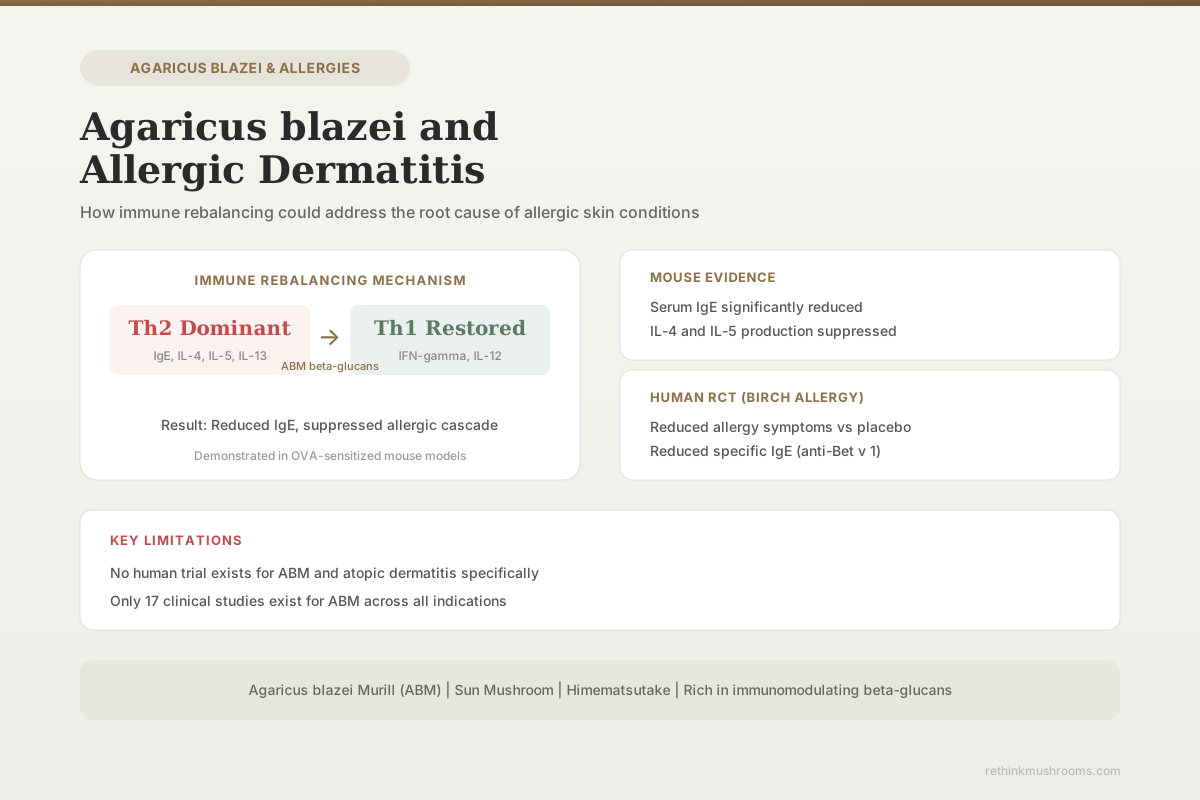
Agaricus blazei Murill contains beta-glucans that shift immune balance from a Th2-dominant (allergic) response toward a Th1-dominant (protective) response. Mouse studies show reduced IgE antibodies and suppressed allergic reactions. A randomized human trial found reduced allergy symptoms during pollen season.
Hetland et al., Advances in Pharmacological Sciences, 2011
Reduced IgE
in OVA-sensitized mouse models
Human RCT
birch allergy, reduced symptoms vs placebo
Beta-Glucan Driven
immunomodulating polysaccharides
Hetland et al., Advances in Pharmacological Sciences, 2011
 View as image ↗
Allergic dermatitis, including atopic dermatitis (eczema), is driven by an immune system skewed toward Th2 (T helper type 2) dominance. Th2 cells produce cytokines like IL-4, IL-5, and IL-13 that promote IgE antibody production, mast cell activation, and the inflammatory cascade that causes itching, redness, and skin barrier disruption. The standard approach is to suppress this overactive immune response with topical steroids or biologics like dupilumab.
Agaricus blazei Murill (ABM), also known as the sun mushroom or himematsutake, takes a different approach in preclinical research. Rather than suppressing immune function broadly, ABM extracts appear to rebalance the immune response by boosting Th1 activity while dampening Th2 dominance. The evidence is primarily from mouse models, with one randomized human trial in allergic rhinitis, not dermatitis specifically. But the mechanism is directly relevant to allergic skin conditions. For the broader picture of how Agaricus blazei shifts immune response from allergic to protective, that pathway is explored in depth separately. And the Th1/Th2 balance research has its own dedicated review.
Key Takeaways
- Oral Agaricus blazei Murill extract significantly reduced serum IgE levels and IL-4/IL-5 production from splenocytes in OVA-sensitized mice, indicating suppressed Th2-mediated allergy (Bouike et al., Evidence-Based Complementary and Alternative Medicine, 2011)
- ABM enhanced Th1 response through intestinal epithelial cells, suggesting the gut immune system mediates its anti-allergic effects (Bouike et al., 2011)
- A randomized, double-blind, placebo-controlled 7-week pre-seasonal trial in 60 birch pollen-allergic blood donors (Mahmood et al., Nutrients, 2019) using the AbM-dominant AndoSan blend (82% Agaricus blazei + 15% Hericium erinaceus + 3% Grifola frondosa) found reduced general allergy and asthma symptoms, reduced medication use, and reduced specific IgE anti-Bet v 1 and anti-t3 in the AndoSan group versus placebo
- ABM's anti-allergic mechanism involves innate immune cell stimulation (monocytes, NK cells, dendritic cells) that shifts adaptive immunity from Th2 toward Th1 (Hetland et al., Advances in Pharmacological Sciences, 2011)
- A 2020 narrative review in Nutrients (Hetland et al.) groups Agaricus blazei with Hericium erinaceus and Grifola frondosa and concludes their antiallergic activity is mediated by innate immune stimulation and Th1/Th2 rebalancing — much of the human evidence comes from the AbM-dominant AndoSan blend rather than single-species ABM
- Only 17 clinical studies exist for ABM across all indications; dermatitis-specific human data is absent
The Th1/Th2 Balance Problem in Allergic Dermatitis
The immune system uses two main T helper cell programs. Th1 cells fight intracellular pathogens (viruses, bacteria inside cells) through cell-mediated immunity. Th2 cells fight extracellular parasites through antibody-mediated immunity, primarily IgE production.
In allergic conditions, the balance tips too far toward Th2. The immune system produces IgE antibodies against harmless substances (pollen, dust mites, food proteins, skin bacteria). These IgE antibodies bind to mast cells. When the allergen is encountered again, mast cells degranulate, releasing histamine and inflammatory mediators that cause allergic symptoms: itching, swelling, redness, and in the case of dermatitis, chronic skin inflammation and barrier damage.
Atopic dermatitis affects approximately 15-20% of children and 1-3% of adults globally. Standard treatments suppress the inflammatory response (corticosteroids) or block specific Th2 cytokines (dupilumab blocks IL-4/IL-13). These treatments manage symptoms but do not address the underlying Th1/Th2 imbalance.
How Agaricus blazei Modulates the Immune Balance
Hetland and colleagues published a comprehensive review in 2011 describing ABM's immunomodulatory mechanisms.[1] ABM is rich in beta-glucans and other immunomodulating polysaccharides. These compounds are recognized by pattern recognition receptors on innate immune cells, specifically Dectin-1 and complement receptor 3 on monocytes, macrophages, NK cells, and dendritic cells.
When ABM beta-glucans activate these innate immune cells, the downstream effect is a shift in adaptive immunity. Dendritic cells primed by ABM promote Th1 differentiation over Th2 differentiation. The net result: increased production of Th1 cytokines (IFN-gamma, IL-12) and decreased production of Th2 cytokines (IL-4, IL-5, IL-13). This rebalancing reduces IgE production and suppresses the allergic cascade.
The mechanism is not immunosuppressive. ABM does not shut down the immune system. It redirects it. Th1 function actually increases, which means antimicrobial defense is maintained or enhanced while allergic responses are dampened. This is fundamentally different from corticosteroids, which suppress both Th1 and Th2 responses indiscriminately. For a closer look at ABM and mast cell stabilization in allergic asthma, that mechanism gets its own article.
The Mouse Studies: Suppressing Allergic Sensitization
Bouike and colleagues published the most detailed mechanistic study in 2011.[2] They used an ovalbumin (OVA)-sensitized mouse model, a standard model for studying allergic responses. Mice were sensitized to OVA (egg white protein) to induce Th2-dominant allergy, then treated orally with Agaricus blazei Murill extract (ABME).
The results:
- Serum IgE levels decreased significantly in the ABME-treated group compared to untreated sensitized controls
- IL-4 and IL-5 production from splenocytes restimulated with OVA was significantly reduced, indicating suppressed Th2 cytokine output
- Th1 response was enhanced through intestinal epithelial cells, suggesting the gut immune system (gut-associated lymphoid tissue, GALT) mediates the anti-allergic effect
The gut-immune connection is significant. ABM is taken orally, and its beta-glucans interact with immune cells in the intestinal mucosa. Peyer's patches and other gut immune structures are where oral antigens are first processed. By priming Th1 responses at the gut level, ABM may redirect the entire systemic immune balance away from Th2 dominance.
Ellertsen and Hetland (2009) confirmed in an OVA-sensitized mouse model that the ABM-dominant blend AndoSan (82% Agaricus blazei, 15% Hericium erinaceus, 3% Grifola frondosa) reduced anti-OVA IgE levels whether given before or after OVA immunization, with a trend toward reduced Th2 relative to Th1 cytokine output.[3] The intervention is therefore an ABM-dominant multi-mushroom extract rather than pure ABM, and the same product (AndoSan) is the one used in the Mahmood 2019 human trial discussed below — a useful continuity but also a reminder that the human evidence rests on a specific commercial blend, not on a single-species ABM preparation.
The Human Trial: Birch Pollen Allergy
Mahmood and colleagues published the only randomized, double-blind, placebo-controlled human trial of an ABM-based extract for allergic conditions in 2019.[4] Sixty self-reported birch pollen-allergic blood donors were randomized to receive AndoSan (the same 82% AbM / 15% Hericium / 3% Grifola blend used in the Ellertsen 2009 mouse study) or matched placebo for 7 weeks pre-seasonally, with symptom questionnaires, serum IgE, and Bet v 1-induced basophil activation measured before and after the pollen season.
The results:
- General allergy and asthma symptoms were significantly reduced in the ABM group compared to placebo during pollen season
- Medication use was significantly reduced in the ABM group
- Specific IgE levels (anti-Bet v 1, the major birch pollen allergen, and anti-t3 birch pollen extract) were significantly reduced in the ABM group compared to placebo
This is the closest human evidence to supporting ABM for allergic dermatitis. The study tested allergic rhinitis (hay fever), not dermatitis. Both conditions share the same underlying Th2-dominant immune imbalance and IgE-mediated pathology, so the mechanism is transferable in principle. But atopic dermatitis involves additional factors (skin barrier dysfunction, Staphylococcus aureus colonization, epidermal nerve sensitization) that rhinitis does not.
No randomized human trial has tested ABM specifically for atopic dermatitis. The dermatitis application remains theoretical, extrapolated from the Th1/Th2 mechanism demonstrated in mice and the IgE reduction demonstrated in human allergy patients.
Broader Evidence Base for ABM
Da Silva de Souza and colleagues published a comprehensive review of ABM bioactive compounds in 2017.[5] They identified the key bioactive fractions: beta-glucans (particularly (1,6)- and (1,3)-linked glucans), proteoglycans, ergosterol (a vitamin D precursor), and agaritine (a hydrazine compound with debated safety profile at high doses).
The review noted a discrepancy between the extensive preclinical literature and the limited clinical evidence. Only 17 clinical studies existed for ABM across all indications. Most were small, open-label, or focused on cancer patients. The dermatitis data was entirely preclinical.
Hetland and colleagues updated the evidence in a 2020 review in Nutrients covering Agaricus blazei alongside the related basidiomycete mushrooms Hericium erinaceus and Grifola frondosa.[6] The review concluded that ABM's immunomodulatory effects are mediated through innate immune activation leading to Th1/Th2 rebalancing, and that the anti-allergic potential is well-supported in preclinical models but requires more clinical validation. Because the review groups three mushrooms together — and because the AndoSan product the authors' clinical work relies on is itself a three-mushroom blend — separating ABM-only effects from blend-level effects in the human evidence remains difficult. The parallel research on ABM and asthma covers the respiratory side of the same Th1/Th2 mechanism.
What This Means for Allergic Dermatitis
The research supports a plausible mechanism by which ABM could benefit allergic dermatitis:
- Oral ABM beta-glucans activate innate immune cells through Dectin-1 and complement receptors
- Activated dendritic cells shift adaptive immunity toward Th1 dominance
- Th2 cytokine production (IL-4, IL-5, IL-13) decreases
- IgE production falls
- Mast cell activation decreases
- Allergic inflammation subsides
Steps 1-4 are demonstrated in mouse models. Step 4 is partially demonstrated in the human birch allergy trial (IgE reduction). Steps 5-6 for dermatitis specifically are extrapolated, not directly tested.
Limitations
No human dermatitis trial exists. The mouse data is promising, but animal immune systems differ from human immune systems in ways that matter for translational relevance.
Dose and standardization are undefined. The mouse studies used ABM extracts at varying concentrations. The human trial used a proprietary mushroom blend. There is no consensus on the optimal dose, extract type, or beta-glucan content for anti-allergic effects.
The agaritine concern. ABM contains agaritine, a hydrazine compound. Some in vitro studies have raised mutagenicity concerns. The 2017 review noted this controversy but concluded that oral bioavailability of agaritine metabolites is low and that normal dietary consumption appears safe. Hot water extraction (the standard process for mushroom supplements) significantly reduces agaritine content.
Atopic dermatitis is multifactorial. Even if ABM corrects Th1/Th2 imbalance, it does not address filaggrin gene mutations (affecting skin barrier), Staphylococcus aureus colonization, or nerve sensitization. A Th1/Th2-rebalancing agent would target one component of a multi-component disease.
The Bottom Line
Agaricus blazei Murill demonstrates anti-allergic effects through immune rebalancing: shifting Th2-dominant (allergic) immunity toward Th1-dominant (protective) immunity. Mouse studies show reduced IgE, IL-4, and IL-5 production after oral ABM treatment. A single human RCT found reduced allergy symptoms and specific IgE in birch pollen-allergic individuals. No human trial has tested ABM for atopic dermatitis directly. The mechanism is plausible for dermatitis (same Th2/IgE pathway), but the translation from mouse allergy models and human rhinitis data to dermatitis outcomes remains unconfirmed.
Frequently Asked Questions
Sources & References
- 1RTHM-00215·Hetland, Geir et al. (2011). “The Mushroom Agaricus blazei Murill Elicits Medicinal Effects on Tumor, Infection, Allergy, and Inflammation through Its Modulation of Innate Immunity and Amelioration of Th1/Th2 Imbalance and Inflammation..” Advances in pharmacological sciences.Study breakdown →PubMed →↩
- 2RTHM-00205·Bouike, Go et al. (2011). “Oral Treatment with Extract of Agaricus blazei Murill Enhanced Th1 Response through Intestinal Epithelial Cells and Suppressed OVA-Sensitized Allergy in Mice..” Evidence-based complementary and alternative medicine : eCAM.Study breakdown →PubMed →↩
- 3RTHM-00153·Ellertsen, Linda K et al. (2009). “An extract of the medicinal mushroom Agaricus blazei Murill can protect against allergy..” Clinical and molecular allergy : CMA.Study breakdown →PubMed →↩
- 4RTHM-00579·Mahmood, Faiza et al. (2019). “Agaricus blazei-Based Mushroom Extract Supplementation to Birch Allergic Blood Donors: A Randomized Clinical Trial..” Nutrients.Study breakdown →PubMed →↩
- 5RTHM-00468·da Silva de Souza, Aline Cristine et al. (2017). “Agaricus blazei Bioactive Compounds and their Effects on Human Health: Benefits and Controversies..” Current pharmaceutical design.Study breakdown →PubMed →↩
- 6RTHM-00620·Hetland, Geir et al. (2020). “Antitumor, Anti-Inflammatory and Antiallergic Effects of Agaricus blazei Mushroom Extract and the Related Medicinal Basidiomycetes Mushrooms, Hericium erinaceus and Grifola frondosa: A Review of Preclinical and Clinical Studies..” Nutrients.Study breakdown →PubMed →↩