Agaricus blazei and Allergies
3 Mechanisms Identified
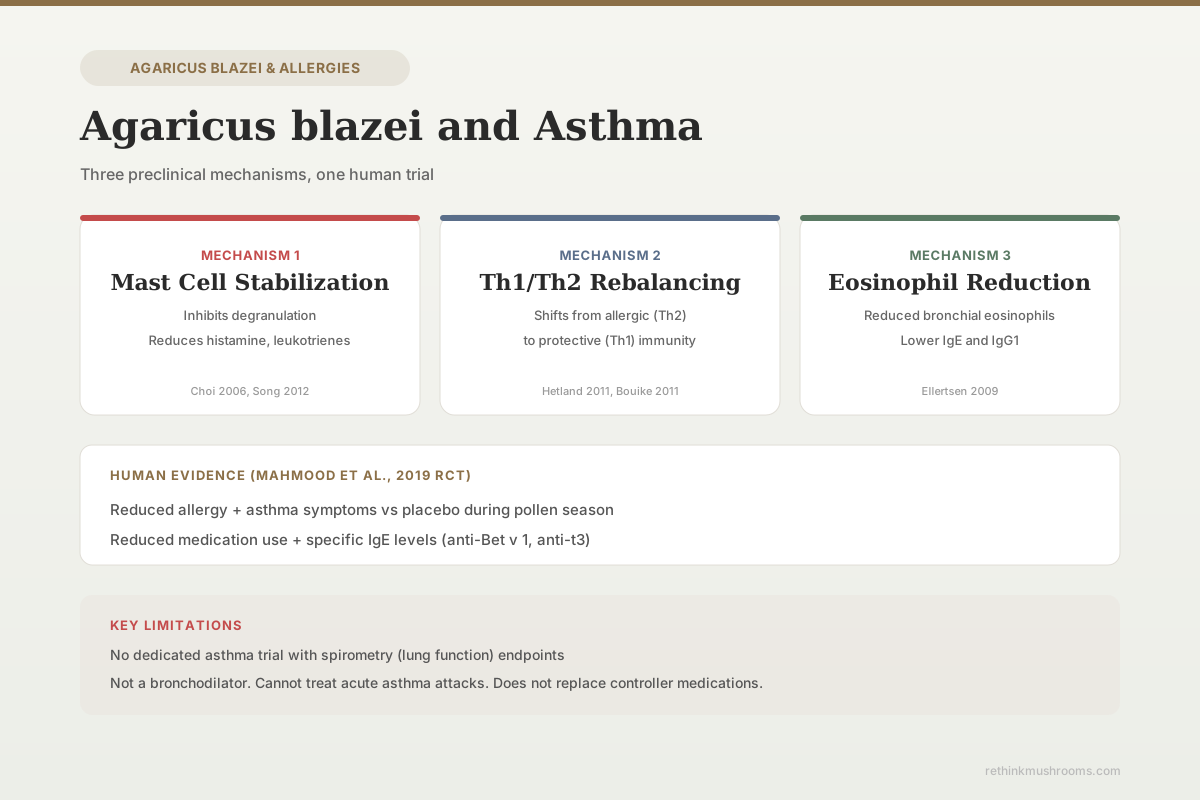
Agaricus blazei Murill targets allergic asthma through three documented mechanisms: mast cell stabilization (preventing histamine release), Th1/Th2 immune rebalancing (reducing IgE production), and bronchial eosinophil reduction (decreasing airway inflammation).
Hetland et al., Nutrients, 2020
Mast Cell Inhibition
reduced degranulation and histamine release in mice
Lower IgE + IgG1
in an OVA-induced mouse asthma model (Takimoto, 2008)
Human RCT
lower birch-specific IgE vs placebo (mixed symptom signal)
Hetland et al., Nutrients, 2020
 View as image ↗
Allergic asthma affects approximately 300 million people worldwide. The condition involves three interconnected processes: airway inflammation driven by eosinophils, bronchial hyperresponsiveness mediated by mast cells, and an underlying immune imbalance skewed toward Th2 dominance with excessive IgE production. Standard treatments target symptoms (bronchodilators) or suppress inflammation broadly (inhaled corticosteroids, biologics).
Agaricus blazei Murill (ABM), a medicinal mushroom studied primarily for immune modulation and cancer research, has shown activity against all three asthma-related pathways in preclinical studies. A single randomized human trial also reported reduced asthma symptoms. The evidence is preliminary but mechanistically consistent. For background on how ABM shifts immune response from allergic to protective, that mechanism is explored in detail separately. The closely related allergic dermatitis research covers the skin side of the same Th1/Th2 pathway.
Key Takeaways
- ABM extract inhibited mast cell degranulation and reduced production of IL-6, prostaglandin D2, and leukotriene C4 in bone marrow-derived mast cells (Song et al., Bioscience, Biotechnology, and Biochemistry, 2012)
- ABM water extract inhibited compound 48/80-induced systemic anaphylaxis and passive cutaneous anaphylaxis in mice (Choi et al., Biological and Pharmaceutical Bulletin, 2006)
- In an asthma-induced mouse model, oral Agaricus blazei extract significantly reduced OVA-specific IgG1 and IgE and decreased eosinophil counts and IL-5 in bronchoalveolar lavage fluid (Takimoto et al., Immunopharmacology and Immunotoxicology, 2008)
- A randomized, double-blind, placebo-controlled trial of an Agaricus blazei-based multi-mushroom extract (Andosan: 82% A. blazei, 15% Hericium erinaceus, 3% Grifola frondosa) in birch pollen-allergic blood donors found a significantly improved general allergy change score and lower birch-specific IgE during pollen season, but no separation on the detailed specific symptom score (Mahmood et al., Nutrients, 2019)
- ABM's mechanisms span innate immunity (mast cell stabilization), adaptive immunity (Th1/Th2 rebalancing), and end-organ effects (reduced airway eosinophilia)
- No dedicated asthma clinical trial has been conducted; the human evidence comes from a mixed allergy/asthma population
Mechanism 1: Mast Cell Stabilization
Mast cells are the first responders in allergic asthma. They sit in airway tissue, coated with IgE antibodies. When an allergen cross-links those IgE molecules, mast cells degranulate, releasing histamine, prostaglandins, leukotrienes, and cytokines. This triggers immediate bronchoconstriction, mucus production, and the inflammatory cascade that defines an asthma attack.
Choi and colleagues demonstrated in 2006 that ABM water extract (ABWE) directly inhibited mast cell-mediated allergic reactions in mice.[1] The study tested three models:
- Systemic anaphylaxis: ABWE inhibited compound 48/80-induced anaphylaxis (a chemical that directly triggers mast cell degranulation)
- Ear swelling response: ABWE reduced passive cutaneous anaphylaxis (a measure of local allergic inflammation)
- Histamine release: ABWE decreased histamine release from rat peritoneal mast cells in a dose-dependent manner
The mechanism appears to be direct mast cell stabilization, meaning ABM prevents mast cells from releasing their inflammatory contents even when triggered. This is similar to how cromolyn sodium (a pharmaceutical mast cell stabilizer) works, though through a different molecular pathway.
Song and colleagues expanded on this in 2012, testing a chloroform-soluble extract of ABM in mouse bone marrow-derived mast cells (BMMCs).[2] They found that ABM extract:
- Inhibited beta-hexosaminidase release (a marker of mast cell degranulation)
- Reduced IL-6 production (a pro-inflammatory cytokine)
- Reduced prostaglandin D2 production (a lipid mediator that causes bronchoconstriction)
- Reduced leukotriene C4 production (a potent bronchoconstrictor 1,000 times more potent than histamine)
The leukotriene finding is particularly relevant for asthma. Leukotrienes are the target of montelukast (Singulair), one of the most widely prescribed asthma medications. ABM extract reduced leukotriene production from mast cells in vitro, suggesting overlap with this established therapeutic mechanism. For a detailed analysis of ABM and mast cell stabilization in allergic asthma, that mechanism is explored more deeply.
Mechanism 2: Th1/Th2 Immune Rebalancing
Allergic asthma is characterized by Th2-dominant adaptive immunity. Th2 cells drive IgE production, eosinophil recruitment, and mucus hypersecretion. Shifting the immune balance toward Th1 can reduce all three.
Hetland and colleagues described ABM's immunomodulatory profile in a 2011 review.[3] ABM beta-glucans activate innate immune cells (monocytes, NK cells, dendritic cells) through pattern recognition receptors. These activated dendritic cells then promote Th1 differentiation over Th2, increasing IFN-gamma and IL-12 while decreasing IL-4, IL-5, and IL-13.
Bouike and colleagues extended this picture in an OVA-sensitized mouse model in 2011.[4] Oral ABM extract dose-dependently reduced day-14 serum total IgE and sharply lowered IL-4 and IL-5 from OVA-restimulated splenocytes. Caco-2 transwell cocultures showed the macrophage and T-cell signal depended on intestinal epithelial cells being in the loop, suggesting oral ABM activates gut-associated immune tissue before producing systemic effects rather than acting on macrophages directly.
For asthma specifically, Takimoto and colleagues reported in 2008 that oral Agaricus blazei extract changed all three hallmarks of allergic airway disease in an asthma-induced mouse model.[5] In OVA-induced asthma mice given the extract orally:
- Specific IgE decreased (less allergic antibody production)
- OVA-specific IgG1 decreased (another Th2-associated antibody class), while IgG2a was unchanged
- Bronchoalveolar lavage eosinophils, total cell counts, and IL-5 decreased (less airway inflammation)
- IFN-gamma production from anti-CD3-stimulated spleen cells increased (Th1 shift)
The reduction in airway eosinophils is directly relevant to asthma. Eosinophilic inflammation causes tissue damage, mucus plugging, and airway remodeling. It is the target of biologics like mepolizumab (anti-IL-5) and benralizumab (anti-IL-5R), which cost roughly $30,000 per year. ABM achieved eosinophil and IL-5 reduction in mice, but this is preclinical evidence in a single asthma model and does not establish that an oral mushroom product produces the same effect in human airways. The Th1/Th2 balance research for ABM and allergies covers this pathway comprehensively.
The Human Evidence: Allergy and Asthma Symptoms
Mahmood and colleagues published the only randomized, double-blind, placebo-controlled trial of an Agaricus blazei-based product in allergic patients in 2019.[6] The intervention was Andosan, a multi-mushroom liquid extract that is 82% Agaricus blazei but also contains 15% Hericium erinaceus and 3% Grifola frondosa. The study enrolled 60 birch pollen-allergic blood donors with self-reported IgE-positive allergy and/or asthma; the main published tables describe 27 analyzed participants per arm. Participants drank 60 mL once daily for 7 weeks before and through birch pollen season.
The results were genuinely mixed:
- General allergy change from the prior season favored Andosan (median -1 vs 0, p = 0.02), and participants used a narrower range of medication types during the season (p = 0.03). Medication frequency did not separate from placebo (p = 0.11).
- The 12-point specific symptom score (rhino-conjunctivitis plus asthma) was not significantly different between groups during the season (p = 0.97), and the change-from-prior-season comparison was also null (p = 0.51).
- Specific IgE against Bet v 1 (major birch allergen) and t3 (birch pollen extract) ratios were significantly lower with Andosan (p = 0.007 and p = 0.01).
- Basophil activation stayed broadly stable in the Andosan arm across the season while the placebo arm became markedly more sensitive (between-group p = 0.028).
- The cytokine panel (TNF-α, IFN-γ, IL-2, IL-4, IL-5, IL-10, IL-12p70, IL-13, GM-CSF) did not show a useful between-group signal — the authors explicitly note this.
Two limitations matter for asthma readers. The trial included participants with allergic rhinitis and asthma but did not isolate asthma outcomes; only 7 of 27 analyzed participants in the Andosan arm reported asthma comorbidity. No pulmonary function testing (FEV1, peak flow, BAL) was performed. The clearest positives are objective IgE and basophil endpoints, not the detailed symptom score.
A funding caveat is also relevant: Andosan was supplied free of charge by Immunopharma, which was listed as the trial sponsor, and one author (Hetland) is a cofounder and shareholder of that company. This does not invalidate the IgE and BAT findings, but it should be visible.
The Updated Evidence Landscape
Hetland and colleagues published an updated narrative review in Nutrients in 2020 covering preclinical and clinical evidence for ABM, Hericium erinaceus, and Grifola frondosa.[7] For ABM and allergic conditions specifically, the authors argue that the anti-allergic mechanism (innate immune activation leading to Th1/Th2 rebalancing and mast cell stabilization) is supported in preclinical models, while the human evidence remains small and concentrated around the same Andosan multi-mushroom product rather than evenly distributed across the three named species.
This review is useful for context but is not an independent synthesis. The lead author is a cofounder and shareholder of Immunopharma, the company behind Andosan, and the article repeatedly centers that product. Readers should weight the mechanistic narrative accordingly: the underlying mouse and cell findings are real, but the framing of Andosan as a therapeutic candidate comes from a research line with a direct commercial tie.
What ABM Cannot Do for Asthma
The evidence supports ABM as a potential preventive or adjunctive agent for allergic asthma, not as a treatment for acute attacks.
ABM does not act as a bronchodilator. During an asthma attack, the immediate need is to open constricted airways. ABM has no demonstrated ability to relax bronchial smooth muscle acutely. Rescue inhalers (albuterol) remain essential for acute episodes.
ABM does not replace controller medications. Inhaled corticosteroids reduce airway inflammation through potent immunosuppression. ABM's immunomodulatory effects are mild by comparison. The 2019 human trial showed reduced symptoms and medication use, but the participants were not on maximum asthma therapy.
ABM's onset is gradual. The Mahmood trial used 7 weeks of pre-seasonal supplementation. The mouse studies showed effects after repeated dosing. This is consistent with immune rebalancing, which takes weeks to shift the Th1/Th2 ratio. ABM is not useful for rapid symptom control.
The dose is undefined. The human trial used a proprietary extract. The mouse studies used varying preparations. There is no standardized asthma dose for ABM, and the optimal beta-glucan concentration for anti-allergic effects has not been determined.
Limitations of Current Research
The evidence has clear gaps:
- No dedicated asthma clinical trial exists. The Mahmood 2019 trial included asthma patients but did not isolate asthma-specific outcomes or measure lung function
- All mast cell data is preclinical (mouse and in vitro studies). Whether ABM stabilizes human airway mast cells at achievable oral doses is unknown
- The sample size was small. The human trial had modest enrollment. Larger trials with spirometry endpoints are needed
- Long-term safety in asthma patients is not characterized. Asthma patients often have concurrent conditions and take multiple medications; drug interactions have not been studied
- Comparison to existing treatments has not been conducted. Without head-to-head data against inhaled corticosteroids or biologics, ABM's relative efficacy is unknown
The Bottom Line
Agaricus blazei Murill shows anti-asthmatic potential in preclinical work through three mechanisms: direct mast cell stabilization (reduced degranulation, leukotriene C4 in mouse and rat assays), Th1/Th2 immune rebalancing (lower OVA-specific IgE and IgG1 in mouse models), and reduced bronchoalveolar eosinophilia and IL-5 in an asthma-induced mouse model (Takimoto 2008). The single human RCT used Andosan, a multi-mushroom formula (82% A. blazei, 15% H. erinaceus, 3% G. frondosa), in birch-allergic blood donors and produced mixed results — clearer signals on specific IgE and basophil activation than on the detailed symptom score. No dedicated asthma trial with lung function endpoints exists. The evidence supports further study of ABM as a potential adjunctive agent, not as a replacement for standard asthma treatments.
Frequently Asked Questions
Sources & References
- 1RTHM-00095·Choi, Yun Ho et al. (2006). “Inhibitory effects of Agaricus blazei on mast cell-mediated anaphylaxis-like reactions..” Biological & pharmaceutical bulletin.Study breakdown →PubMed →↩
- 2RTHM-00263·Song, Hyuk-Hwan et al. (2012). “Anti-inflammatory and anti-allergic effect of Agaricus blazei extract in bone marrow-derived mast cells..” The American journal of Chinese medicine.Study breakdown →PubMed →↩
- 3RTHM-00215·Hetland, Geir et al. (2011). “The Mushroom Agaricus blazei Murill Elicits Medicinal Effects on Tumor, Infection, Allergy, and Inflammation through Its Modulation of Innate Immunity and Amelioration of Th1/Th2 Imbalance and Inflammation..” Advances in pharmacological sciences.Study breakdown →PubMed →↩
- 4RTHM-00205·Bouike, Go et al. (2011). “Oral Treatment with Extract of Agaricus blazei Murill Enhanced Th1 Response through Intestinal Epithelial Cells and Suppressed OVA-Sensitized Allergy in Mice..” Evidence-based complementary and alternative medicine : eCAM.Study breakdown →PubMed →↩
- 5RTHM-00146·Takimoto, Hiroaki et al. (2008). “Amelioration of skewed Th1/Th2 balance in tumor-bearing and asthma-induced mice by oral administration of Agaricus blazei extracts..” Immunopharmacology and immunotoxicology.Study breakdown →PubMed →↩
- 6RTHM-00579·Mahmood, Faiza et al. (2019). “Agaricus blazei-Based Mushroom Extract Supplementation to Birch Allergic Blood Donors: A Randomized Clinical Trial..” Nutrients.Study breakdown →PubMed →↩
- 7RTHM-00620·Hetland, Geir et al. (2020). “Antitumor, Anti-Inflammatory and Antiallergic Effects of Agaricus blazei Mushroom Extract and the Related Medicinal Basidiomycetes Mushrooms, Hericium erinaceus and Grifola frondosa: A Review of Preclinical and Clinical Studies..” Nutrients.Study breakdown →PubMed →↩