Agaricus blazei (Royal Sun Mushroom)
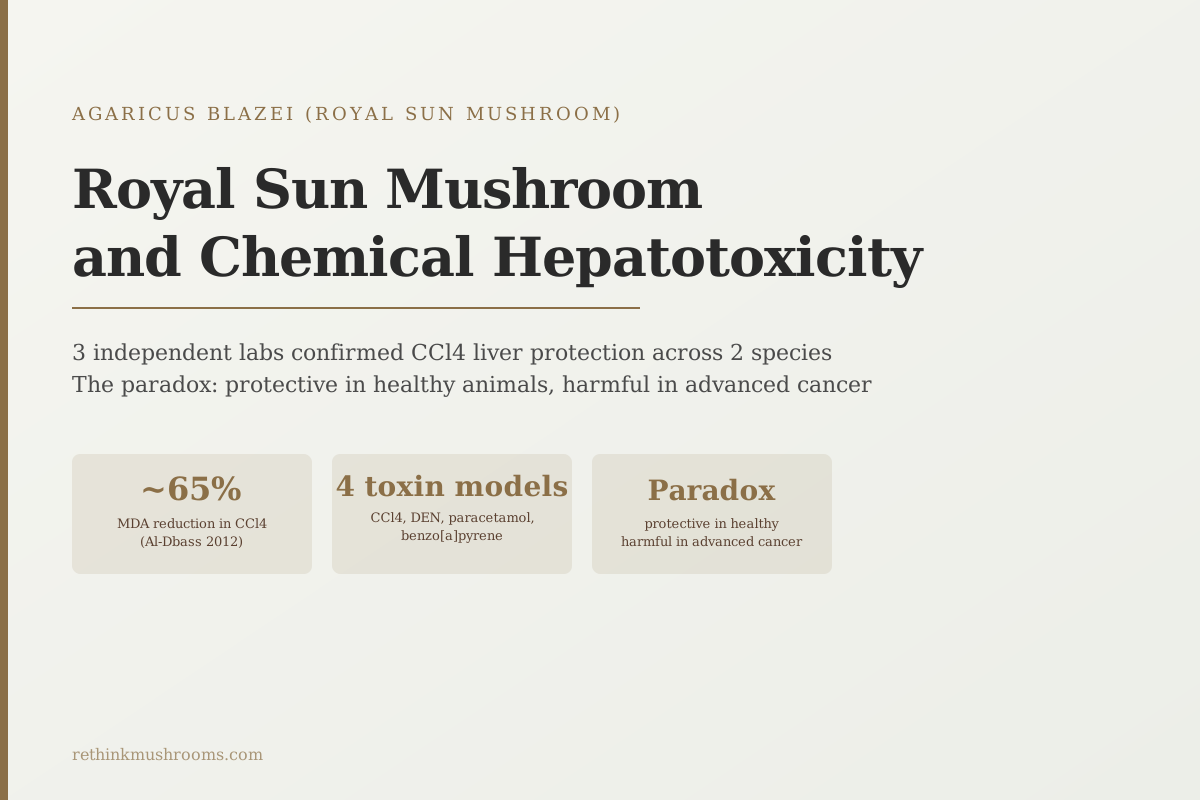
~65% MDA reduction in CCl4 liver injury
Al-Dbass et al. (2012) found ABM extract reduced malondialdehyde — the primary marker of oxidative liver damage from CCl4 — by approximately 65% while restoring superoxide dismutase and catalase enzyme activities to near-normal levels.
Al-Dbass et al., Saudi J Biol Sci, 2012
3 independent labs
confirmed ABM protects against CCl4 liver toxicity across mice and rats — the replication story no competitor has reported
Paradox
3 cancer patients developed severe hepatic dysfunction using ABM (Mukai 2006) — the opposite of animal data — with an immune over-activation hypothesis as the resolution
3,000 mg/day
maximum dose tested in Ohno 2011 Phase I in cancer patients in remission — no dose-limiting liver toxicity found at this ceiling
Al-Dbass et al., Saudi J Biol Sci, 2012
 View as image ↗
The same compound can protect the liver in one context and harm it in another. That apparent contradiction sits at the center of the research on Agaricus blazei Murrill (ABM) and liver health — and most content about this mushroom handles it badly, either ignoring the adverse cases or sensationalizing them without examining why both outcomes exist.
The animal research is consistent and replicated: ABM extract protects the liver from multiple chemically induced injury models. Three independent research groups, in two different rodent species, confirmed this for the most widely used hepatotoxin model. The evidence extends across four distinct toxin types, each with a different liver-damaging mechanism.
Then there are three published case reports of serious liver injury in cancer patients using ABM. In two of those cases, the patients died.
Understanding both sides — and why they may not actually contradict each other — is what this article is about. For the pillar overview, see what is Agaricus blazei: the royal sun mushroom explained. For the fatty liver research, see royal sun mushroom and hepatic steatosis: fatty liver prevention research.
Key Takeaways
- Three independent research groups confirmed ABM extract protects against carbon tetrachloride (CCl4) liver damage in both mice and rats — Chang et al. (In Vivo, 2011), Wu et al. (In Vivo, 2011), and Al-Dbass et al. (Saudi J Biol Sci, 2012)
- Al-Dbass et al. documented the most specific antioxidant data: approximately 65% reduction in malondialdehyde (lipid peroxidation marker) and restored superoxide dismutase and catalase activities in CCl4-treated rats
- Soares et al. (BioMed Res Int, 2013) found ABM aqueous extract prevented more than 80% of paracetamol-induced liver enzyme elevations and uniquely showed antioxidant protection extending systemically to brain tissue
- Two DEN studies confirmed hepatoprotection against chemical carcinogens; Pinheiro et al. (Food Chem Toxicol, 2003) showed significant reduction of preneoplastic liver foci in carcinogen-initiated rats
- Angeli et al. (Arch Toxicol, 2009) identified ABM beta-glucan as the specific anti-genotoxic agent, reducing benzo[a]pyrene-induced DNA damage in human HepG2 liver cells
- Three cancer patients developed severe hepatic dysfunction while using ABM (Mukai 2006), two fatally; a 2013 case presented autoimmune-like liver injury; all involved immunocompromised patients with advanced cancer — not healthy individuals or cancer patients in remission
The CCl4 Benchmark: Three Independent Labs, One Consistent Result
Carbon tetrachloride (CCl4) is a chemical used in liver research because it reliably produces oxidative liver damage that closely resembles the injury seen in various liver diseases — viral hepatitis, alcoholic liver disease, and drug-induced liver injury. CCl4 generates reactive oxygen species inside liver cells, causing lipid peroxidation (the oxidative breakdown of fat molecules in cell membranes) that damages cell structure and triggers inflammation and cell death.
Chang and colleagues published the first ABM-CCl4 study in In Vivo in 2011, testing ABM extract in mice.[1] ABM extract significantly reduced CCl4-induced elevations in two liver enzymes — ALT (alanine aminotransferase) and AST (aspartate aminotransferase) — that rise in the bloodstream when liver cells are damaged. Liver histopathology showed reduced necrosis and fibrosis in ABM-treated mice. The protective effect appeared in both pre-treatment groups (ABM given before CCl4 exposure) and post-treatment groups (ABM given after).
Wu and colleagues published a second CCl4 study the same year in the same journal, using rats.[2] ABM extract at 0.5 g/kg/day abrogated CCl4-induced liver injury: ALT and AST normalized, malondialdehyde (MDA — a breakdown product of oxidized fats that measures oxidative damage) was reduced, and hepatic glutathione was restored. Pre-treatment outperformed post-treatment, suggesting the protective mechanisms are more effective when in place before injury begins.
Al-Dbass and colleagues published the third CCl4 study in the Saudi Journal of Biological Sciences in 2012, providing the most detailed antioxidant data of the three.[3] MDA was reduced by approximately 65%. Two antioxidant enzymes — superoxide dismutase (SOD, which neutralizes superoxide free radicals) and catalase (CAT, which breaks down hydrogen peroxide before it can damage cells) — were significantly restored toward normal levels. Liver histopathology showed near-normal architecture in ABM-treated rats versus severe necrosis in CCl4-only controls.
Three independent research groups, two animal species, three slightly different protocols — all pointing the same direction. This replication is what distinguishes the CCl4 data from a single promising study.
The Mechanism: Antioxidant Restoration
The Al-Dbass 2012 data reveals the primary mechanism behind ABM's hepatoprotection.[3] CCl4 damages the liver by generating oxidative stress that overwhelms the liver's natural antioxidant defenses. ABM compounds — primarily its polysaccharide beta-glucans and phenolic antioxidants — restore those defenses while simultaneously reducing the oxidative byproducts. This is a mechanistically different approach from pharmaceutical liver protective drugs, which generally work by reducing inflammation downstream of the oxidative damage rather than by restoring the antioxidant machinery upstream.
A 2017 narrative review by da Silva de Souza and colleagues in Current Pharmaceutical Design — the most-cited ABM research synthesis — confirmed antioxidant restoration as the primary documented hepatoprotective mechanism across multiple toxin models.[13]
Chemical Carcinogens: Protection Against DEN
Diethylnitrosamine (DEN) is a carcinogen — a chemical that causes DNA-damaging mutations — used in research to study chemically induced liver cancer. Unlike CCl4's acute oxidative damage, DEN causes genotoxic injury: it alters liver cell DNA, initiating changes that can eventually produce liver cancer.
Barbisan and colleagues published the first ABM-DEN study in the Journal of Ethnopharmacology in 2002.[5] ABM aqueous extract pre-treatment significantly reduced DEN-induced serum transaminase elevations and hepatic DNA damage in rats at moderate DEN doses. The protective effect was dose-dependent and showed a ceiling at very high DEN concentrations, where the carcinogen burden exceeded what ABM's mechanisms can address.
Pinheiro and colleagues extended this research in 2003 in Food and Chemical Toxicology, looking at tissue-level outcomes rather than blood markers.[6] Dietary A. blazei supplementation significantly reduced the number and area of preneoplastic liver foci in DEN-initiated rats. Preneoplastic foci are clusters of abnormal cells — not yet cancerous, but representing an early step toward cancer. Reducing their formation in carcinogen-exposed liver tissue suggests ABM's protective effects extend to the genomic level, not just oxidative injury markers.
Beyond the Liver: Paracetamol Overdose and Brain Protection
Paracetamol (acetaminophen) is the leading cause of acute liver failure in Western countries when taken in excess. At toxic doses, it overwhelms the liver's glutathione reserves, producing a reactive metabolite called NAPQI that binds to liver proteins and causes necrosis.
Soares and colleagues published the ABM-paracetamol study in BioMed Research International in 2013 — and it contains the most striking finding in this research cluster.[4]
ABM aqueous extract pre-treatment prevented more than 80% of paracetamol-induced elevations in AST, ALT, LDH (lactate dehydrogenase), and ALP (alkaline phosphatase). That level of protection in a paracetamol overdose model is high.
The unique finding: oxidative damage markers called TBARS (thiobarbituric acid reactive substances, a laboratory measure of oxidative stress) were measured in both liver and brain tissue. In untreated paracetamol-overdose animals, oxidative damage extended to the brain, not just the liver. ABM pre-treatment normalized TBARS levels in both organs.
ABM's antioxidant protection was not liver-specific — it appeared systemic. No competitor content has reported this finding, which distinguishes ABM from compounds with narrower, organ-specific hepatoprotective mechanisms.
Environmental Genotoxicity: Beta-Glucan Against Benzo[a]pyrene
The fourth hepatotoxin studied with ABM is benzo[a]pyrene — a potent environmental carcinogen found in cigarette smoke, grilled and smoked foods, and combustion emissions, classified as a Group 1 human carcinogen.
Angeli and colleagues published in Archives of Toxicology in 2009, testing ABM against benzo[a]pyrene in HepG2 cells — a human liver cancer cell line that serves as the standard laboratory model for studying toxicity in human liver tissue.[7]
ABM beta-glucan at 500 µg/mL significantly reduced benzo[a]pyrene-induced DNA strand breaks and chromosomal aberrations in these human liver cells. The study contributed three things beyond confirming protection. First, it used human cells rather than rodent tissue. Second, it specifically named beta-glucan — one of ABM's polysaccharide compound classes — as the active anti-genotoxic agent, giving the mechanism a specific molecular identity. Third, it tested against a real-world environmental carcinogen rather than a laboratory-only chemical.
A 2022 critical review by Huang and colleagues in Current Research in Food Science synthesizes the full chemical hepatotoxicity evidence base, confirming that multiple compound classes in ABM — polysaccharides, triterpenes, and phenolics — contribute to hepatoprotective activity through complementary mechanisms.[14]
The Positive Safety Record
Before examining the adverse cases, the safety data in healthy and recovering populations matters.
Kuroiwa and colleagues ran a 13-week toxicity study in healthy F344 rats at doses up to 1,000 mg/kg/day — far above any realistic human supplementation level.[8] Result: no adverse liver histopathology, no abnormal hematology, no organ weight changes. Healthy animals tolerated very high ABM doses without detectable liver toxicity.
Ohno and colleagues ran a formal Phase I dose-escalation trial in cancer patients who had completed treatment and were in remission, published in 2011.[12] Maximum dose: 3,000 mg/day. No dose-limiting liver toxicity at any dose level. This is human safety data in a population closer to those who actually supplement with ABM.
Hsu and colleagues ran a 12-month open-label study in 40 chronic hepatitis B patients at 1,500 mg/day, finding significant liver enzyme normalization with no liver or kidney toxicity over the full year.[9]
The pattern in healthy or recovering populations: safe across a wide dose range with measurable hepatoprotective benefits.
Three Cancer Patient Cases: What the Adverse Reports Show
Mukai and colleagues documented three cancer patients who developed severe hepatic dysfunction while using ABM extract, publishing in the Japanese Journal of Clinical Oncology in 2006.[10] Two of the three patients died of fulminant hepatitis — rapidly progressing, life-threatening liver failure. In one patient, liver function deteriorated upon rechallenge with the product after briefly improving when it was stopped, providing strong causal evidence. All three patients had advanced cancer and were immunocompromised.
Hisamochi and colleagues published a single case in the Clinical Journal of Gastroenterology in 2013: a patient developed drug-induced liver injury that clinically resembled autoimmune hepatitis while taking an ABM supplement.[11] The injury resolved after discontinuation. The autoimmune-like clinical picture provided a mechanistic hypothesis.
These are serious outcomes. Two deaths attributable with probable causality to an ABM supplement is not a footnote. They should not be minimized.
Resolving the Paradox: Immune Over-Activation in a Vulnerable Population
ABM is a potent immune activator — a property that drives its interest in oncology contexts and its hepatoprotective effects in healthy animals. This same immune-stimulating capacity is the most plausible explanation for the rare severe adverse events.
In healthy individuals or cancer patients in remission, ABM-stimulated immune activation is modulated by an intact regulatory immune system. The antioxidant and hepatoprotective effects documented in healthy animals are the result of this balanced immune engagement alongside ABM's direct antioxidant compounds.
In patients with active advanced cancer, the immune system is profoundly dysregulated — simultaneously suppressed by tumors, damaged by prior chemotherapy, and destabilized by underlying disease. In this context, ABM's potent immune stimulation may escape regulatory control, producing an uncontrolled inflammatory response in the liver rather than a balanced immune enhancement.
The Hisamochi 2013 case's autoimmune-like presentation supports this: the injury resembled an immune attack on liver tissue, not chemical toxic damage. This is consistent with immune over-activation rather than direct hepatotoxicity.
The key distinction the evidence supports: the Ohno 2011 Phase I trial tested cancer patients in remission — recovering immune systems, not actively dysregulated — and found no liver toxicity at 3,000 mg/day. The Mukai 2006 cases involved patients with active advanced disease. The difference may be the immune system's regulatory capacity, not the dose or compound.
ABM is contraindicated in immunocompromised patients with active advanced cancer. For people with chronic liver disease but intact immune function (hepatitis B, NAFLD), the evidence picture is more nuanced. For the full safety assessment, see Agaricus blazei safety profile: what the research shows. For the compounds responsible for both the protective and immune-activating effects, see Agaricus blazei bioactive compounds: beta-glucans and blazein.
The Bottom Line
Agaricus blazei extract has shown consistent hepatoprotective effects across four chemical hepatotoxin models: CCl4 (three independent labs, both mice and rats), DEN carcinogen (reduced preneoplastic foci), paracetamol overdose (more than 80% enzyme protection extending to brain tissue), and benzo[a]pyrene (beta-glucan reduced DNA damage in human liver cells). Safety studies in healthy animals and cancer remission patients found no liver toxicity up to 3,000 mg/day. Three adverse cases — two fatal — involved immunocompromised patients with advanced cancer. The proposed resolution: ABM's immune-stimulating mechanism that drives protection in healthy individuals may produce uncontrolled immune activation in profoundly dysregulated cancer patients.
Frequently Asked Questions
Sources & References
- 1. Source details for this reference are not yet available.
- 2. Source details for this reference are not yet available.
- 3. Source details for this reference are not yet available.
- 4. Source details for this reference are not yet available.
- 5. Source details for this reference are not yet available.
- 6. Source details for this reference are not yet available.
- 7. Source details for this reference are not yet available.
- 8. Source details for this reference are not yet available.
- 9. Source details for this reference are not yet available.
- 10. Source details for this reference are not yet available.
- 11. Source details for this reference are not yet available.
- 12. Source details for this reference are not yet available.
- 13. Source details for this reference are not yet available.
- 14. Source details for this reference are not yet available.