Agaricus blazei (Royal Sun Mushroom)
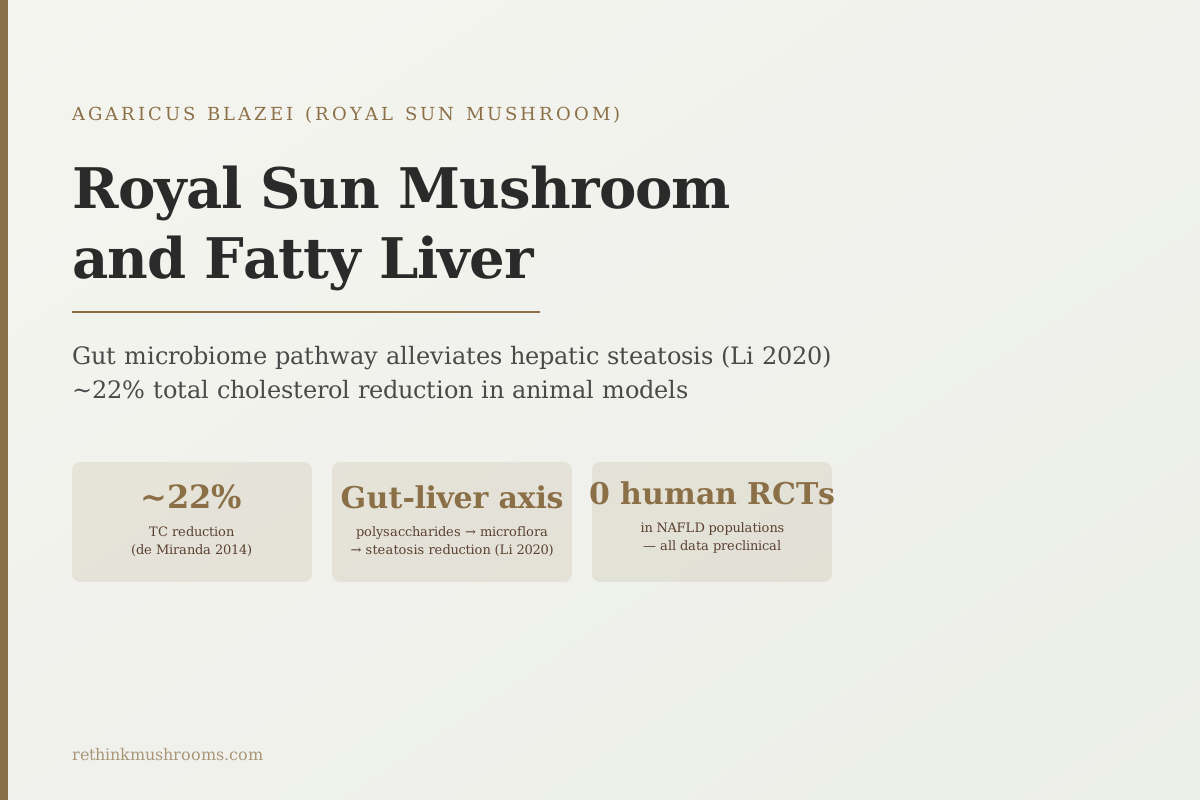
~22% total cholesterol reduction
de Miranda et al. (2014) found Agaricus blazei supplementation reduced total cholesterol by approximately 22% in hypercholesterolemic rats. A separate 2020 study showed polysaccharides also directly alleviate hepatic fat accumulation via gut microbiome modulation.
de Miranda et al., J Physiol Biochem, 2014; Li et al., Food Sci Nutr, 2020
Gut-liver axis
Li et al. (2020) showed ABM polysaccharides improved gut microflora diversity and alleviated hepatocyte steatosis simultaneously in hyperlipidemic rats
4 lipid markers
TC, TG, and LDL-C decreased while HDL-C increased in the Li 2020 polysaccharide study — all four moving in the correct direction
0 human RCTs
all fatty liver/NAFLD data on Agaricus blazei is from animal models — no human controlled trials in NAFLD populations exist
de Miranda et al., J Physiol Biochem, 2014; Li et al., Food Sci Nutr, 2020
 View as image ↗
Non-alcoholic fatty liver disease (NAFLD) — the accumulation of excess fat in liver cells in people who don't drink heavily — is now the most common liver condition worldwide, affecting roughly 30% of adults globally. It develops at the intersection of high-calorie diets, insulin resistance, sedentary lifestyle, and increasingly, disrupted gut microbiome. Most people with early NAFLD have no symptoms. Left unaddressed, a subset progresses through non-alcoholic steatohepatitis (NASH), fibrosis, and cirrhosis, with substantially elevated risk of liver cancer.
No pharmaceutical drug has been approved specifically for NAFLD. The standard advice — lose weight, change diet, exercise — addresses the root causes but is difficult to sustain. Research interest in functional foods with hepatoprotective properties has grown accordingly.
Agaricus blazei Murrill (ABM), the royal sun mushroom cultivated commercially in Brazil and Japan, has been studied for liver-protective properties since the early 2000s. Most of the early research focused on protection against chemical toxins — an important story covered separately in Agaricus blazei and liver protection: research review. But a more recent line of research, still absent from consumer health writing, has examined ABM's effects specifically on fat accumulation in the liver, lipid metabolism, and the gut-liver axis mechanisms most directly relevant to NAFLD.
For the pillar overview of ABM, see what is Agaricus blazei: the royal sun mushroom explained. For how its liver enzyme-normalizing effects connect to hepatitis B specifically, see Agaricus blazei for hepatitis B and C: clinical evidence.
Key Takeaways
- Li et al. (Food Sci Nutr, 2020) found that ABM polysaccharides (200 mg/kg/day) significantly reduced total cholesterol, triglycerides, and LDL-C while increasing HDL-C in hyperlipidemic rats — and simultaneously alleviated hepatocyte steatosis via improved gut microflora diversity (the gut-liver axis mechanism)
- Vincent et al. (Obesity, 2013) found that ABM extract prevented diet-induced obesity, insulin resistance, and hepatic fat deposition in high-fat diet rats — addressing the three root causes of NAFLD simultaneously
- de Miranda et al. (J Physiol Biochem, 2014) documented approximately 22% total cholesterol reduction and a decreased atherogenic index in hypercholesterolemic rats given A. blazei supplementation
- Wei et al. (J Food Biochem, 2020) found ABM significantly improved hepatic superoxide dismutase, catalase, and glutathione peroxidase enzyme activities in diabetic rats — the antioxidant enzymes the liver uses to counteract oxidative damage from fat accumulation
- Wei et al. (Food Sci Nutr, 2020) identified the PI3K/Akt signaling pathway as the molecular mechanism by which ABM enhances hepatic insulin sensitivity — the pathway that, when disrupted, drives fatty liver in metabolic syndrome
- All NAFLD/steatosis data is from animal models; there are no human randomized controlled trials of Agaricus blazei in NAFLD populations — this is the critical evidence gap
How Fat Accumulates in the Liver (And Why the Gut Plays a Role)
Understanding why ABM's effects are relevant to NAFLD requires a brief picture of how the disease develops.
The liver's primary function in fat metabolism is receiving free fatty acids from fat tissue and dietary absorption, packaging them into lipoproteins for distribution, and burning excess fat for energy. When more fat arrives than the liver can process — because of a high-fat diet, because insulin resistance has impaired fat-burning signaling, or because gut bacteria are producing excess lipids from dietary fiber fermentation — fat begins to accumulate inside the liver's primary cells (hepatocytes).
The gut microbiome plays a significant role in this process. Gut bacteria influence how much bile acid the liver produces, how permeable the intestinal lining is to bacterial toxins (a leaky gut allows inflammatory signals directly into the portal bloodstream, reaching the liver before systemic circulation), and how much of the liver's metabolic capacity is consumed fighting inflammation rather than processing lipids.
Drugs that lower lipids (statins), improve insulin sensitivity (metformin), or reduce gut-derived inflammatory signals are among the approaches being tested for NAFLD. Functional foods that affect multiple steps in this process have genuine theoretical relevance to the disease's multi-factor pathophysiology.
The Gut-Liver Axis Finding: Li 2020
Li and colleagues published a study in Food Science and Nutrition in 2020 that is the most mechanistically complete piece of evidence for ABM's fatty liver relevance.[1]
The study tested ABM polysaccharides — the long sugar-chain molecules in the mushroom's cell wall — in hyperlipidemic rats at 200 mg/kg/day. Hyperlipidemic rats accumulate excess fat in the liver, mirroring a key feature of human NAFLD.
The results across four lipid markers all moved in the expected beneficial direction:
- Total cholesterol (TC): significantly decreased
- Triglycerides (TG): significantly decreased
- LDL cholesterol (LDL-C): significantly decreased
- HDL cholesterol (HDL-C): significantly increased
But the most important finding in the Li 2020 study was not the lipid numbers. It was what happened to the liver cells and the gut at the same time. Hepatocyte steatosis — the fat droplets accumulating inside liver cells — was significantly alleviated in the ABM group compared to untreated hyperlipidemic controls. And the intestinal microflora showed improved diversity, with increases in beneficial bacterial populations associated with healthy lipid metabolism.
This chain — polysaccharides improve gut microflora → gut microflora changes alter lipid processing → hepatic fat accumulation decreases — is the gut-liver axis mechanism. It is a more precise and clinically interesting finding than simply "ABM lowers cholesterol," because it identifies the pathway through which the lipid effects occur and connects them directly to liver cell-level outcomes.
No consumer health site has written about this study. It is completely absent from the ABM coverage that does exist online.
Preventing Diet-Induced Fatty Liver: The Vincent 2013 Data
Vincent and colleagues published a study in the journal Obesity in 2013 that addressed the upstream question: does ABM prevent fatty liver from developing in the first place?[2]
The study used a high-fat diet rat model — the same model used in pharmaceutical NAFLD research because it reliably produces the metabolic syndrome triad of obesity, insulin resistance, and hepatic fat accumulation. ABM extract was supplemented during the high-fat feeding period.
The ABM group showed:
- Significantly less weight gain and reduced abdominal fat accumulation
- Prevention of insulin resistance (measured via glucose tolerance testing)
- Significantly less hepatic lipid deposition compared to high-fat diet controls without ABM
This is the most directly NAFLD-relevant data in the cluster. It demonstrates that ABM extract, given alongside a fattening diet, can prevent the hepatic fat accumulation that diet would otherwise produce. NAFLD is a diet-and-lifestyle disease; a compound that can modify the hepatic consequences of diet is addressing the disease at its point of origin rather than treating established damage.
The Vincent 2013 paper was published in Obesity — a high-impact specialty journal — which gives it scientific credibility beyond mushroom-specific literature. Its finding that the three root causes of NAFLD (obesity, insulin resistance, hepatic steatosis) were all affected by the same ABM intervention is the most compelling single data point available for royal sun mushroom and fatty liver disease.
The Lipid Numbers: What de Miranda 2014 Found
de Miranda and colleagues published a study in the Journal of Physiology and Biochemistry in 2014 providing the most concrete lipid-lowering numbers for ABM in hypercholesterolemic animals.[3]
ABM supplementation in hypercholesterolemic diet rats reduced total cholesterol by approximately 22% and non-HDL cholesterol significantly, while decreasing the atherogenic index — a ratio that measures cardiovascular and metabolic disease risk.
The ~22% total cholesterol reduction is a meaningful effect size. For context, a typical dietary intervention (increasing soluble fiber, reducing saturated fat) produces cholesterol reductions in the range of 10-15%. Pharmaceutical statins produce 30-50% reductions. ABM's documented effect falls between dietary intervention and pharmaceutical treatment in animal models — a position consistent with a functional food rather than a drug.
NAFLD and high cholesterol are closely related metabolic conditions, sharing insulin resistance as a common root cause. The lipid-lowering data from de Miranda 2014 extends the fatty liver picture beyond direct hepatic steatosis to the broader lipid metabolic environment that drives NAFLD progression.
The Metabolic Root: Insulin Signaling and Liver Antioxidants
Two separate studies published in 2020 by Wei and colleagues examined ABM's effects on the metabolic and antioxidant foundations of liver health in diabetic rats — the metabolic disease population most at risk for NAFLD.
The first study, published in the Journal of Food Biochemistry, found that ABM supplementation significantly improved hepatic activities of three key antioxidant enzymes: superoxide dismutase (SOD), catalase (CAT), and glutathione peroxidase (GPx).[4] These three enzymes are the liver's primary defense against oxidative damage from fat oxidation — in NAFLD, excess fat in liver cells undergoes oxidative breakdown, generating reactive oxygen species that damage hepatocytes. The progression from simple NAFLD (fat alone) to NASH (fat plus inflammation plus damage) is driven in part by this oxidative assault.
The second Wei 2020 study, published in Food Science and Nutrition, identified the PI3K/Akt signaling pathway as the molecular mechanism underlying ABM's metabolic effects.[5] PI3K/Akt is a cellular signaling pathway that coordinates insulin's effects on glucose uptake and fat metabolism in the liver. When this pathway is disrupted — as it is in insulin resistance, metabolic syndrome, and the early stages of NAFLD — the liver's ability to process fat and glucose is impaired. ABM dietary supplementation activated PI3K/Akt signaling, improving hepatic insulin sensitivity and glucose homeostasis in diabetic rats.
These two mechanisms — antioxidant enzyme restoration and insulin signaling activation — address NAFLD at the cellular level rather than just the lipid accumulation symptom. For readers wanting to understand how ABM's insulin-sensitizing effects connect to liver health more broadly, see how Agaricus blazei improves insulin sensitivity.
The Long-Term Risk Context: NAFLD Progression and Preneoplastic Foci
NAFLD matters beyond its immediate symptoms because of where it can lead. The progression from simple fatty liver to NASH (non-alcoholic steatohepatitis, where the fat is accompanied by inflammation and cell damage) to fibrosis to cirrhosis represents a decades-long chain of liver deterioration. At the end of that chain is elevated hepatocellular carcinoma risk.
Pinheiro and colleagues published a 2003 study in Food and Chemical Toxicology specifically examining ABM's effects on preneoplastic liver foci — clusters of abnormal cells that represent an early step in chemically induced liver cancer development.[6] Dietary ABM supplementation significantly reduced the number and area of these preneoplastic foci in rats. The context was chemical carcinogen exposure (diethylnitrosamine) rather than metabolic disease, but the relevance extends: the progression from NAFLD to liver cancer passes through cellular changes structurally similar to chemically induced preneoplastic states.
This evidence provides context for why the fatty liver question matters beyond the lipid numbers. A 2022 critical review of ABM's health effects in Current Research in Food Science by Huang and colleagues provides a comprehensive synthesis of both hepatoprotective and lipid-metabolic mechanisms, confirming that immunoregulation, anti-inflammatory activity, and lipid metabolism modulation are the three converging pathways through which ABM supports liver health.[9]
The Only Human Liver Data Available: Honest Context
The human liver evidence for ABM comes from a hepatitis B study, not a NAFLD study. This limitation needs to be stated plainly.
Hsu and colleagues published a 12-month open-label study in 40 chronic hepatitis B patients taking 1,500 mg/day of ABM extract.[7] The results showed significant reductions in AST and ALT (liver enzymes that rise with liver damage) and decreased γ-GTP activity in 80% of patients. No liver or kidney toxicity was observed over 12 months.
The hepatitis B population is not the NAFLD population. The mechanisms of liver enzyme elevation are different, the patient demographics differ, and the intervention goal differs. But the Hsu 2008 study provides two things that are genuinely relevant to anyone considering ABM for liver health: (1) a human safety signal showing no liver toxicity at 1,500 mg/day over a year, and (2) evidence that ABM can normalize elevated liver enzymes in a clinical liver disease population. For the most comprehensive review of ABM's overall benefits and evidence controversies, see the da Silva 2017 synthesis in Current Pharmaceutical Design.[8]
The Evidence Gap: What Has Not Been Studied
All fatty liver and NAFLD data for Agaricus blazei is from animal models. There are no human randomized controlled trials of ABM in NAFLD populations anywhere in the published literature. The Li 2020, Vincent 2013, de Miranda 2014, and Wei 2020 studies all used rats. The mechanisms they demonstrate are plausible and directionally consistent with human NAFLD pathophysiology, but animal-to-human translation in metabolic disease is uncertain.
This gap matters for anyone weighing ABM supplementation for fatty liver management. The preclinical signals are genuine and the mechanisms are mechanistically sound. But "works in hyperlipidemic rats" is not the same as "helps humans with NAFLD." The evidence supports ABM as a legitimate research candidate for NAFLD, not as a demonstrated treatment.
For comparison to other mushrooms with more developed NAFLD evidence, see Antrodia camphorata and NAFLD: fatty liver protection and ergothioneine and NAFLD: fatty liver protection. For a comprehensive look at Agaricus blazei's safety profile, see Agaricus blazei safety profile: what the research shows.
The Bottom Line
Agaricus blazei Murrill has shown hepatic steatosis-reducing and lipid-lowering effects in multiple animal models relevant to NAFLD. Key findings: ABM polysaccharides alleviate hepatocyte fat accumulation via gut microbiome modulation (Li 2020); ABM extract prevents diet-induced hepatic fat deposition and insulin resistance (Vincent 2013, Obesity); ~22% total cholesterol reduction in hypercholesterolemic rats (de Miranda 2014); and improved hepatic antioxidant enzymes and PI3K/Akt insulin signaling (Wei 2020). All NAFLD data is preclinical. No human RCTs exist for ABM in NAFLD populations.
Frequently Asked Questions
Sources & References
- 1. Source details for this reference are not yet available.
- 2. Source details for this reference are not yet available.
- 3. Source details for this reference are not yet available.
- 4. Source details for this reference are not yet available.
- 5. Source details for this reference are not yet available.
- 6. Source details for this reference are not yet available.
- 7. Source details for this reference are not yet available.
- 8. Source details for this reference are not yet available.
- 9. Source details for this reference are not yet available.