Agaricus blazei and Liver Health
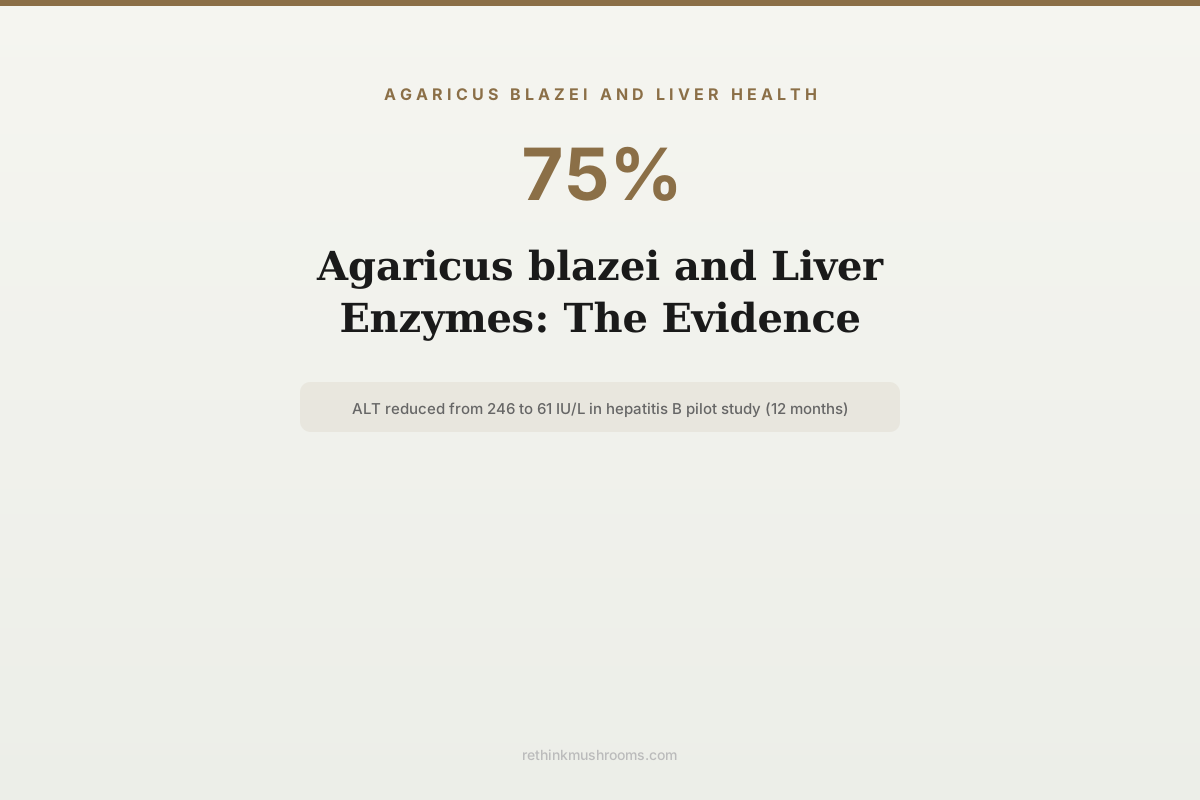
75% AST Reduction
In a 12-month open-label pilot study of four chronic hepatitis B patients, Agaricus blazei Murill extract (1,500 mg/day) reduced mean AST from 246.0 to 61.3 IU/L and mean ALT from 151.0 to 46.1 IU/L. Only ALT finished inside its normal reference range.
Hsu et al., Journal of Alternative and Complementary Medicine, 2008
4 Patients
open-label pilot, no placebo control
12 Months
duration of ABM extract treatment
ALT Fell 69%
from 151.0 to 46.1 IU/L, inside the normal band
Hsu et al., Journal of Alternative and Complementary Medicine, 2008
 View as image ↗
When liver cells are damaged, they leak enzymes into the bloodstream. Two of the most commonly measured are alanine aminotransferase (ALT) and aspartate aminotransferase (AST). Elevated ALT and AST are the first signal that something is going wrong in the liver, whether from viral hepatitis, chemical toxins, alcohol, or drug reactions. Bringing those numbers back down, "normalizing" liver enzymes, is a primary goal of liver treatment.
Agaricus blazei Murill (ABM), the Brazilian mushroom also called himematsutake or royal sun mushroom, has been studied for its effects on liver enzymes in both human hepatitis patients and animal models of chemical liver injury. The results are mixed in an unusual way: the same mushroom that reduced liver enzymes in a hepatitis B pilot study has also been linked to rare but severe liver injury in cancer patients. Understanding this paradox requires looking at the full evidence. For the broader picture of Agaricus blazei and liver protection research, the entire landscape of hepatoprotective data is reviewed separately.
Key Takeaways
- In 4 chronic hepatitis B patients, ABM extract (1,500 mg/day for 12 months) reduced mean AST from 246.0 to 61.3 IU/L and mean ALT from 151.0 to 46.1 IU/L; ALT was the study's stated major outcome measure (Hsu et al., Journal of Alternative and Complementary Medicine, 2008)
- Only ALT finished inside its conventional reference band (7-56 IU/L); the endpoint AST of 61.3 IU/L remained above the commonly cited 8-48 IU/L range, so "normalization" was partial
- ABM pretreatment largely prevented paracetamol-induced elevation of ALT, AST, LDH, and ALP in rats, but gave little or no protection for gluconeogenesis or histological signs of inflammation (Soares et al., BioMed Research International, 2013)
- In a rat CCl4 model, ABM raised non-enzymatic antioxidants and lowered malondialdehyde, and the authors concluded hepatoprotection; the abstract's enzyme comparisons are drawn against normal controls rather than against the CCl4 group (Al-Dbass et al., Saudi Journal of Biological Sciences, 2012)
- Three cancer patients developed severe hepatic dysfunction while taking ABM extract, with two dying of fulminant hepatitis (Mukai et al., Japanese Journal of Clinical Oncology, 2006)
- ABM's immunostimulating action may paradoxically cause autoimmune-like hepatitis in susceptible individuals; two case reports showed liver histology mimicking autoimmune hepatitis (Hisamochi et al., Clinical Journal of Gastroenterology, 2013)
- In diabetic rats, an ABM ethyl acetate extract outperformed an ethanol extract on a hepatic antioxidant panel that included SOD, catalase, glutathione, AST, and ALT, though per-marker directions are not reported (Wei et al., Journal of Food Biochemistry, 2020)
The Hepatitis B Pilot Study: Dramatic Numbers, Tiny Sample
The only human study directly measuring ABM's effect on liver enzymes was published by Hsu and colleagues in 2008.[1] It was a 12-month, open-label pilot study involving four patients with chronic hepatitis B who met specific criteria: they had been HBsAg-positive carriers for more than three years, had ALT levels above 100 IU/L (indicating active liver damage), and were not taking any antiviral medications (lamivudine, interferon, or others).
Each patient received 1,500 mg of ABM extract daily for 12 months. The study named ALT as its major outcome measurement. The results were striking:
- AST decreased from 246.0 (+/- 138.9) to 61.3 (+/- 32.6) IU/L, a 75% reduction
- ALT decreased from 151.0 (+/- 86.9) to 46.1 (+/- 22.5) IU/L, a 69% reduction
The order matters here, and it is the most frequently misread detail in secondary write-ups of this study. The published abstract reports "aspartate aminotransferase and alanine aminotransferase decreased from 246.0 ... and 151.0 ..., respectively," which assigns the larger 246 baseline to AST, not ALT.
That correction changes the interpretation. Measured against the conventional reference bands, the endpoint ALT of 46.1 IU/L sits inside the normal range, while the endpoint AST of 61.3 IU/L is still above it. The study's title claims ABM "normalizes liver function." On its own numbers, one enzyme normalized and one did not.
The only human enzyme data · Hsu 2008
Both Enzymes Fell Sharply. Only One Reached Normal.
Four chronic hepatitis B patients, 1,500 mg/day of Agaricus blazei extract, 12 months, open-label and uncontrolled. Shaded bands are the commonly cited clinical reference ranges. Whiskers are ±1 standard deviation as published.
n = 4
The entire human evidence base for ABM and liver enzymes, in one uncontrolled open-label pilot
±138.9
Baseline AST standard deviation — wider than the 184.7-point drop it brackets
0
Control patients, blinded assessments, and viral-load measurements in the study
Source: Hsu et al., 2008 (RTHM-00255). Means and standard deviations as published; the abstract reports aspartate aminotransferase first and alanine aminotransferase second, and names ALT as the major outcome measure. Reference ranges are the conventional clinical bands and vary by laboratory. With four patients and no control arm, these trajectories cannot be separated from the spontaneous fluctuation of chronic hepatitis B.
These numbers are impressive, but the study has critical limitations that make them difficult to interpret. Four patients is extraordinarily small, too small to rule out spontaneous remission, which occurs in a fraction of chronic hepatitis B patients even without treatment. There was no placebo control group. The study was open-label, so both patients and researchers knew what was being given. The reported standard deviations are wider than the changes they bracket. And chronic hepatitis B enzyme levels fluctuate naturally, with some patients experiencing periods of lower ALT without any intervention. No viral load outcome was reported, so the study cannot say whether anything happened to the underlying infection.
The authors acknowledged these limitations, concluding that their "initial observation seems to indicate the potential benefit" and calling for controlled studies with larger samples. Those controlled studies have not been published as of 2026. For a deeper look at ABM's role in hepatitis B and C, the viral hepatitis data is explored separately.
Animal Models: Protection Against Chemical Liver Damage
Carbon Tetrachloride (CCl4) Model
Al-Dbass and colleagues tested ABM's hepatoprotective capacity in rats using carbon tetrachloride (CCl4), a standard experimental liver toxin, in 2012.[2] CCl4 generates free radicals that damage liver cell membranes, causing enzyme leakage and lipid peroxidation.
Rats were divided into five groups: normal control, ABM extract alone, CCl4 alone, ABM pretreatment followed by CCl4 (preventive group), and CCl4 followed by ABM treatment (therapeutic group). The ABM extract was prepared from wet fruiting bodies, crushed and suspended in distilled water, administered orally.
What the abstract actually reports is worth stating precisely, because it is narrower than the way this study is usually cited. The measured panel covered aspartate and alanine transaminase, lactate dehydrogenase, glutathione reductase, the non-enzymatic antioxidants (glutathione, vitamin C, vitamin E), and malondialdehyde. Against normal controls, the CCl4-treated animals showed decreases in the measured enzymes and non-enzymatic antioxidants alongside a rise in malondialdehyde. Against normal controls, the ABM-treated animals showed increased non-enzymatic antioxidants and decreased malondialdehyde. The authors concluded that ABM extract "can protect the liver against carbon tetrachloride induced oxidative damage" and called it an efficient hepatoprotective and antioxidant agent.
What the abstract does not supply is a clean ABM-versus-CCl4 transaminase comparison. The antioxidant result is the reported result; a specific AST and ALT reduction attributable to ABM in this model is an inference the published summary does not state.
The proposed mechanism is antioxidant-driven. ABM compounds scavenge free radicals generated by CCl4 metabolism, limiting the chain reaction of lipid peroxidation that destroys liver cell membranes. When membranes stay intact, enzymes stay inside the cells rather than leaking into the bloodstream. The full scope of ABM's protection against chemical hepatotoxins extends beyond the CCl4 model.
Paracetamol (Acetaminophen) Model
Soares and colleagues tested ABM aqueous extract pretreatment against paracetamol-induced liver injury in rats in 2013.[3] Paracetamol overdose is the most common cause of acute liver failure in the developed world, making this a clinically relevant model. It is also the single cleanest test of the enzyme claim anywhere in this literature.
Soares et al. (2013) · BioMed Research International
- Population
- Rats given a paracetamol (acetaminophen) overdose
- Intervention
- Agaricus blazei aqueous extract, administered as pretreatment
- Comparator
- Paracetamol without ABM pretreatment
- Finding
- ABM pretreatment largely prevented the rise in plasma hepatic enzymes (AST, ALT, LDH, ALP) and practically normalized TBARS in liver and brain tissue. On functional and metabolic parameters, the extract provided little or no protection: gluconeogenesis remained impaired and morphological signs of inflammation persisted.
mixed The clearest support for the enzyme claim, and simultaneously the clearest demonstration of why enzyme levels alone are not sufficient evidence of hepatoprotection.
Soares et al., BioMed Research International, 2013 (RTHM-00555)
This study introduced a nuance that challenges simple claims of hepatoprotection. When the researchers looked beyond enzyme levels at functional and metabolic parameters, ABM provided little or no protection. Gluconeogenesis, the liver's ability to produce glucose, remained impaired. Histological examination still showed signs of liver inflammation. The enzymes went down, but the liver was not fully protected.
The authors made a broader methodological point, and it is the most useful sentence in the entire ABM liver literature: many natural products are claimed to be hepatoprotective based solely on enzyme normalization, but enzyme levels are only one indicator of liver health. Functional parameters like gluconeogenesis and structural parameters like histological inflammation tell a more complete story. By that fuller measure, ABM's protection against paracetamol injury was partial, not complete.
Diabetic Liver Model
Wei and colleagues reported in 2020 on ABM extracts and hepatic antioxidant activity in streptozotocin-induced diabetic rats.[4] Diabetes damages the liver through chronic oxidative stress, and this study compared two extract types.
The hepatic antioxidant panel analysed comprised superoxide dismutase, catalase activity, glutathione, aspartate transaminase, and alanine transaminase, alongside histopathological assessment of pancreatic tissue. The reported result was comparative: the ethyl acetate extract "showed a better protective effect on hepatic antioxidant activity and recovery of the impaired pancreatic tissues" than the ethanol extract. The abstract does not give the direction of change for individual markers, so this study is best read as evidence that extract preparation matters rather than as a specific AST and ALT result.
That distinction matters more than it might seem. Solvent choice changes which compounds end up in the final product, which means two supplements both labelled "Agaricus blazei extract" are not necessarily comparable. Research on fatty liver prevention explores another metabolic liver condition where ABM data exists.
The Other Side: ABM-Induced Liver Injury
Any honest assessment of ABM and liver enzymes must address the case reports where ABM itself caused liver damage.
Documented Harm
CriticalSevere hepatic dysfunction reported in cancer patients taking ABM extract
Concern
Five cases across two published reports describe serious liver injury during ABM use. Two patients died of fulminant hepatitis. In one patient, liver function recovered after stopping ABM and deteriorated again on restarting it — a positive rechallenge, which is the strongest causality signal available outside a controlled trial.
What the research says
Both Hisamochi cases were graded as compatible with drug-induced liver injury on the Roussel Uclaf Causality Assessment Method, with liver histology resembling autoimmune hepatitis and serum IgG rising from the start of supplementation. Every documented case occurred in a patient with cancer.
Particularly relevant for: Cancer patients, including those on concurrent treatment or under observation for stable malignancies
What to do
This article is not medical advice. Anyone with liver disease, an active cancer diagnosis, or ongoing treatment should discuss ABM with their physician before use, and should disclose supplement use — in both published case series, patients had not told their doctors they were taking ABM.
Mukai et al., Japanese Journal of Clinical Oncology, 2006 (RTHM-00196); Hisamochi et al., Clinical Journal of Gastroenterology, 2013 (RTHM-00522)
Three Cancer Patients: Two Deaths
Mukai and colleagues reported in 2006 that three cancer patients developed severe hepatic dysfunction while taking ABM extract.[5] Two of the three died of fulminant hepatitis. In one patient, liver function recovered after stopping ABM, then deteriorated again when she restarted it, establishing a clear temporal relationship between ABM consumption and liver damage.
All three patients had advanced cancer and were receiving other treatments, and the authors noted that several other factors could not be completely ruled out as causes. But the rechallenge response in one patient is the strongest evidence available for a causal connection, and the authors concluded that a strong causal relationship was suggested.
Autoimmune-Like Hepatitis
Hisamochi and colleagues published two additional cases in 2013: a 60-year-old woman and a 75-year-old man who developed liver injury while taking ABM extract alongside other supplements.[6] Both were cancer patients under observation for stable malignancies. Neither had disclosed their supplement use to their physicians.
Both cases scored as "compatible with drug-induced liver injury" on the Roussel Uclaf Causality Assessment Method (an international diagnostic scale). The liver biopsies in both cases showed histological patterns strikingly similar to autoimmune hepatitis. Serum immunoglobulin G levels had been gradually rising from the start of ABM supplementation until liver injury onset.
The authors proposed a mechanism: ABM's immunostimulating properties, which are the same effects that researchers study for antitumor and anti-infection applications, may have triggered autoimmune-like liver damage in susceptible individuals. The immune system, ramped up by ABM, attacked the patient's own liver tissue.
The hypothesis is biologically coherent, though the receptor detail is less settled than popular accounts suggest. Hetland and colleagues reviewed ABM's immunological properties in 2008 and reported strong immunomodulating activity, while also flagging highly different biological potency between ABM extracts of different source and manufacturing.[7] Work by Yamanaka and colleagues on a cold water extract of the fruiting body found that its 1,3-beta-glucan segment was too small to interact with dectin-1, the classic beta-glucan receptor; instead the extract bound directly to Toll-like receptor 2, and only an anti-TLR2 antibody suppressed the resulting IL-6 production from splenocytes.[8] In other words, the immune activation is real and measurable, but which receptor carries it depends on how the mushroom was extracted.
In most people, this enhanced immune activity does not cause autoimmune problems. But in patients with pre-existing immune dysregulation, which cancer, chemotherapy, and advanced age can all contribute to, the same immune stimulation could plausibly become destructive.
Reconciling the Paradox
How can the same mushroom both protect and damage the liver? The Phase I safety trial by Ohno and colleagues provides context.[9] Seventy-eight cancer patients in remission took 1.8, 3.6, or 5.4 g of ABM granulated powder daily for six months. Adverse events occurred in 9 patients (12%), most of them digestive in nature such as nausea and diarrhoea, and one patient developed a liver dysfunction-related food allergy. None of the adverse events occurred in a dose-dependent manner, and the authors concluded that ABM does not cause problems in most patients within the laboratory parameters tested.
This suggests that ABM is generally tolerated by most people's livers, with rare idiosyncratic reactions rather than predictable dose-dependent toxicity.
It would be satisfying to resolve the paradox by pointing to two separate mechanisms, one antioxidant and hepatoprotective, the other immunostimulatory and occasionally harmful. The honest position is that the literature does not yet support that resolution. Firenzuoli and colleagues, reviewing ABM in 2008, concluded that the biological pathways and chemical substances involved in its pharmacological activities "are still not clear," attributed the immunostimulant and antitumor properties provisionally to the polysaccharide phytocomplex, and raised a separate toxicological concern about the mushroom's agaritine content that they argued must be fully evaluated.[10] The two-pathway story is a reasonable hypothesis. It is not an established finding.
What can be said with more confidence is that population context tracks the split in the data. The case reports of liver injury all occurred in cancer patients, often with concurrent treatment and other supplements. The hepatoprotective studies used either healthy animals or patients with viral hepatitis, a very different immune state. Extract preparation varies substantially between products, as both Hetland and Wei observed from different angles. The same label may not describe the same compound, and the same compound may not behave the same way in a different immunological context.
What This Means for the Evidence
What each study actually measured
The Enzyme Claim, Traced Back to Its Sources
“Agaricus blazei normalizes liver enzymes” is a sentence assembled from five studies, only one of which measured enzyme normalization in humans and only one of which tested enzyme protection against a control injury. Reading the reported endpoint next to the claim it can carry is the whole exercise.
Hsu 2008
Thin supportHuman — 4 patients, chronic hepatitis B, 12 months
Endpoint measured
Serum AST and ALT (ALT = major outcome)
What the source reports
AST 246.0 → 61.3 IU/L; ALT 151.0 → 46.1 IU/L
The only human enzyme data that exists. Uncontrolled and open-label, so it cannot separate the drug from the natural course of hepatitis B.
Soares 2013
Direct supportRat — paracetamol overdose
Endpoint measured
Plasma AST, ALT, LDH, ALP; TBARS; gluconeogenesis; histology
What the source reports
Enzyme rises largely prevented; TBARS practically normalized; gluconeogenesis and inflammation not protected
The most direct support for the enzyme claim anywhere in the file — and the paper that shows why enzymes alone are not enough.
Al-Dbass 2012
Indirect supportRat — carbon tetrachloride
Endpoint measured
Serum enzymes; glutathione, vitamin C, vitamin E; malondialdehyde
What the source reports
ABM raised non-enzymatic antioxidants and lowered malondialdehyde; the abstract reports enzymes falling in CCl4 rats, not rising
Supports antioxidant hepatoprotection. It does not supply a clean ABM-versus-CCl4 enzyme reduction.
Wei 2020
Indirect supportRat — streptozotocin diabetes
Endpoint measured
Hepatic SOD, catalase, glutathione, AST, ALT; pancreatic histology
What the source reports
Ethyl acetate extract outperformed ethanol extract on hepatic antioxidant activity and pancreatic tissue recovery
Supports extract type mattering. The abstract gives no per-marker direction, so it cannot be read as an AST/ALT result.
Mukai 2006 · Hisamochi 2013
Opposite supportHuman — 5 case reports, cancer patients
Endpoint measured
Clinical course, liver histology, RUCAM causality, serum IgG
What the source reports
Severe hepatic dysfunction, 2 deaths, 1 positive rechallenge; autoimmune-hepatitis-like histology
Enzymes moved in the opposite direction, and ABM was the proposed cause.
Four of the five rows are rodent work, and the one human row has four patients and no control arm. Nothing in this file is a randomized trial with a liver enzyme endpoint.
Sources: Hsu et al., 2008 (RTHM-00255); Soares et al., 2013 (RTHM-00555); Al-Dbass et al., 2012 (RTHM-00450); Wei et al., 2020 (RTHM-01298); Mukai et al., 2006 (RTHM-00196); Hisamochi et al., 2013 (RTHM-00522). Endpoints and directions are quoted from the published abstracts; where an abstract does not state a per-marker direction, none is asserted here.
The liver enzyme data for ABM shows:
What is best supported: In a rat paracetamol model, ABM pretreatment largely prevented the rise in plasma AST, ALT, LDH, and ALP. This is the one study that tested enzyme protection against a control injury and reported the enzyme result directly.
What is preliminary: One pilot study in 4 hepatitis B patients showed large enzyme reductions over 12 months, with ALT finishing inside its normal range and AST finishing above its own. The study was open-label and uncontrolled, and the finding has not been replicated or tested in a controlled trial.
What is supportive but indirect: The CCl4 and streptozotocin-diabetes models report antioxidant outcomes, and their authors concluded hepatoprotection. Neither abstract supplies a per-marker AST and ALT reduction attributable to ABM, so they support an antioxidant mechanism rather than an enzyme claim.
What is cautionary: Five cases across two published reports describe liver injury in cancer patients taking ABM, including two fatalities. The proposed mechanism involves immune-mediated hepatotoxicity in susceptible individuals.
What is missing: A randomized, placebo-controlled trial measuring liver enzymes as a primary endpoint in any human liver condition. The gap between the animal data and the single tiny pilot study is where the evidence stands.
This article is for information only and is not medical advice. Liver enzyme abnormalities require evaluation by a qualified clinician, and no supplement should replace that assessment.
The Bottom Line
Agaricus blazei Murill extract reduced AST by 75% and ALT by 69% in a single 12-month pilot study of 4 hepatitis B patients, though only ALT finished inside its normal reference range and the study had no control arm. In animal models, ABM pretreatment largely prevented paracetamol-induced enzyme rises while failing to protect liver function or histology, and CCl4 and diabetic-rat studies support an antioxidant mechanism without reporting a clean ABM-driven transaminase reduction. The same immunostimulatory properties that make ABM biologically interesting have also been implicated in rare liver injury in cancer patients, with two fatalities reported. No controlled clinical trial has measured liver enzymes as a primary endpoint.
Frequently Asked Questions
Sources & References
- 1RTHM-00137·Hsu, Chung-Hua et al. (2008). “The mushroom Agaricus blazei Murill extract normalizes liver function in patients with chronic hepatitis B..” Journal of alternative and complementary medicine (New York.Study breakdown →PubMed →↩
- 2RTHM-00243·Al-Dbass, Abeer M et al. (2012). “Agaricus blazei Murill as an efficient hepatoprotective and antioxidant agent against CCl4-induced liver injury in rats..” Saudi journal of biological sciences.Study breakdown →PubMed →↩
- 3RTHM-00306·Soares, Andréia A et al. (2013). “Effects of an Agaricus blazei aqueous extract pretreatment on paracetamol-induced brain and liver injury in rats..” BioMed research international.Study breakdown →PubMed →↩
- 4RTHM-00661·Wei, Qi et al. (2020). “The beneficial effects of Agaricus blazei Murrill on hepatic antioxidant enzymes and the pancreatic tissue recovery in streptozotocin-induced diabetic rats..” Journal of food biochemistry.Study breakdown →PubMed →↩
- 5RTHM-00105·Mukai, Hirofumi et al. (2006). “An alternative medicine, Agaricus blazei, may have induced severe hepatic dysfunction in cancer patients..” Japanese journal of clinical oncology.Study breakdown →PubMed →↩
- 6RTHM-00287·Hisamochi, Akiko et al. (2013). “Drug-induced liver injury associated with Agaricus blazei Murill which is very similar to autoimmune hepatitis..” Clinical journal of gastroenterology.Study breakdown →PubMed →↩
- 7RTHM-00133·Hetland, G et al. (2008). “Effects of the medicinal mushroom Agaricus blazei Murill on immunity, infection and cancer..” Scandinavian journal of immunology.Study breakdown →PubMed →↩
- 8RTHM-00273·Yamanaka, Daisuke et al. (2012). “Effect of Agaricus brasiliensis-derived cold water extract on Toll-like receptor 2-dependent cytokine production in vitro..” Immunopharmacology and immunotoxicology.Study breakdown →PubMed →↩
- 9RTHM-00229·Ohno, Satoshi et al. (2011). “Phase I Clinical Study of the Dietary Supplement, Agaricus blazei Murill, in Cancer Patients in Remission..” Evidence-based complementary and alternative medicine : eCAM.Study breakdown →PubMed →↩
- 10RTHM-00131·Firenzuoli, F et al. (2008). “The Medicinal Mushroom Agaricus blazei Murrill: Review of Literature and Pharmaco-Toxicological Problems..” Evidence-based complementary and alternative medicine : eCAM.Study breakdown →PubMed →↩