Antcins in Antrodia camphorata
50 mg/kg
Antcin K produced hepatoprotective effects comparable to silymarin at half the dose in a controlled liver injury model. Silymarin required 100 mg/kg to match the same protection.
Lin et al. Journal of Ethnopharmacology. 2017
28
participants in the only human RCT of Antrodia in liver disease (NASH)
4
distinct hepatoprotective mechanisms documented for antcins (NF-κB, Nrf2, NLRP3, JNK)
6 months
duration of the NASH trial showing sustained steatosis reduction
Lin et al. Journal of Ethnopharmacology. 2017
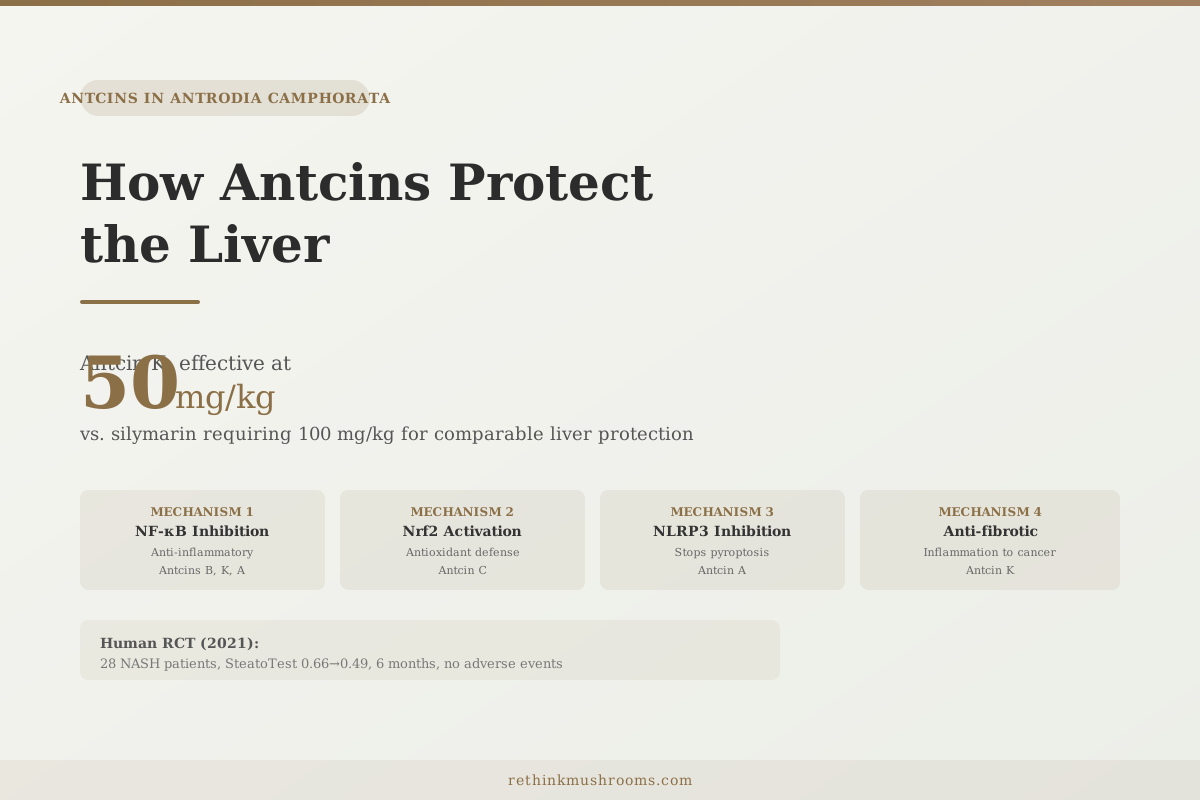 View as image ↗
Most compounds described as "hepatoprotective" have one mechanism: they reduce oxidative stress. Antcins, the group of triterpenoids concentrated in the Taiwan-endemic mushroom Antrodia cinnamomea, operate across four distinct pathways simultaneously. Different antcin variants address different stages of liver damage, from early inflammatory signaling to cell death to fibrosis.
More unusually for a compound discussed primarily in preclinical research: there is a human clinical trial. A 2021 double-blind, randomized, placebo-controlled study tested Antrodia cinnamomea mycelium in patients with nonalcoholic steatohepatitis, and it produced measurable improvements in liver fat and inflammatory markers. That trial, and what it found, is where this article starts.
For the background on what antcins are as a compound class, see Antcins: The Unique Triterpenoids in Antrodia camphorata. For how antcins fit into the broader category of triterpenes in mushrooms, including how they differ from reishi's ganoderic acids, see Mushroom Triterpenes: The Bitter Compounds with Powerful Effects. For the broader context of bioactive compounds in medicinal mushrooms, see the overview at What Are Beta-Glucans?.
Key Takeaways
- A 2021 double-blind RCT in 28 NASH patients found Antrodia cinnamomea mycelium (420 mg/day) significantly reduced liver fat (SteatoTest: 0.66 to 0.49) and TNF-α over 6 months with no adverse events. This is the only human RCT of Antrodia in liver disease
- Antcin K showed comparable hepatoprotective effect to silymarin (milk thistle) at half the dose (50 vs 100 mg/kg) against CCl4-induced liver injury in animals
- Antcins protect the liver via four distinct mechanisms: NF-κB anti-inflammatory pathway, Nrf2 antioxidant activation, NLRP3 inflammasome inhibition, and mitochondrial protection
- Different antcin variants activate different pathways: antcin B and K target NF-κB; antcin C activates Nrf2; antcin A inhibits NLRP3 and also mimics anti-inflammatory glucocorticoids
- A second clinical study found antroquinonol-containing Antrodia extract provided liver protection and reduced liver fat in alcoholic hepatitis patients
- All mechanistic data comes from preclinical studies; the clinical trials are small and preliminary
The Only Human Trial: What 28 NAFLD Patients Showed
Searching for human clinical evidence on Antrodia cinnamomea for liver disease produces exactly one randomized controlled trial.
Chen and colleagues published this trial in the Journal of Functional Foods in 2021.[1] They recruited 28 patients with nonalcoholic steatohepatitis (NASH), which is liver inflammation driven by fat accumulation, one of the most prevalent liver conditions worldwide. The trial design was rigorous: double-blind, placebo-controlled, with patients receiving either Antrodia cinnamomea mycelium (420 mg/day, three capsules) or placebo.
The primary measure was the SteatoTest, a validated blood-marker score that estimates liver fat content. At baseline, both groups had similar SteatoTest values around 0.66. After three months and again at six months, the treatment group showed a significant reduction: the score dropped from 0.66 to 0.49, a change that was statistically significant (p less than 0.029).
The second key finding was a reduction in TNF-alpha, which is a protein that coordinates the body's inflammatory response and is a primary driver of liver inflammation in NAFLD. The TNF-alpha reduction tracked alongside the steatosis improvement.
No adverse events were reported in either group across the six-month study period.
One trial of 28 people is preliminary evidence. It is not sufficient to establish Antrodia as a proven NASH treatment. But it is the first human signal, it used a rigorous design, and the results are consistent with the animal and cell data on mechanism. For a compound that most websites discuss using only preclinical sources, it is the most important data point in the hepatoprotection literature.[1]
A Second Human Data Point: Alcoholic Hepatitis
A 2022 cohort study by Tsai and colleagues, published in Nutrients, examined a different Antrodia product in a different liver condition.[2]
The study followed patients with alcoholic hepatitis given Golden-Antrodia, a commercial extract containing antroquinonol, one of the other bioactive compounds in Antrodia alongside the antcins. The outcome showed liver protection and reduction in liver fat in patients with alcohol-related liver damage.
This is a cohort study rather than a controlled trial, which limits what can be inferred about causation. The active compound in that product is also antroquinonol rather than a pure antcin preparation, so it does not isolate antcin effects specifically. The value of Tsai 2022 alongside the Chen 2021 RCT is that it provides a second piece of human data, in a different population (alcohol-related vs. metabolic liver disease), pointing in the same direction.
With those two human data points established, the rest of this article examines the preclinical evidence that explains how antcins produce these effects mechanistically.
Mechanism 1: Turning Off the Inflammation Master Switch (NF-κB)
The most extensively documented mechanism for antcin hepatoprotection runs through NF-kappa-B, which functions as the cell's master switch for inflammatory signaling. When liver cells detect damage (from toxins, fat accumulation, alcohol, or viral infection), they activate NF-kappa-B, which then turns on a cascade of inflammatory proteins: TNF-alpha (inflammation coordinator), IL-1-beta (immune cell recruiter), iNOS (a nitric oxide-producing enzyme), and COX-2 (a prostaglandin-producing enzyme). The combined effect of these proteins is liver inflammation, which over time damages tissue and can progress to fibrosis and failure.
Antcins B and K both inhibit this pathway.
Lin and colleagues tested antcins B and K against CCl4-induced liver injury in mice, published in the Journal of Ethnopharmacology in 2017.[3] CCl4 (carbon tetrachloride) is a toxic chemical used in research to produce reliable, reproducible liver damage. The researchers compared antcins B and K against silymarin, the active compound in milk thistle and the most widely studied natural liver protectant.
The result: antcin K and antcin B at 50 mg/kg produced hepatoprotective effects comparable to silymarin at 100 mg/kg. Half the dose, equivalent protection. Both antcins suppressed the NF-kappa-B activation pathway, reducing TNF-alpha, IL-1-beta, iNOS, and COX-2, the same downstream inflammation markers that the Chen 2021 NASH trial showed reduced in humans.[3]
Antcin A also operates on the NF-kappa-B pathway, but through a different upstream mechanism. Deng and colleagues demonstrated in 2011 that antcin A mimics the anti-inflammatory action of glucocorticoids, the class of steroid hormones (like cortisol) that the body uses to suppress inflammation.[7] Glucocorticoid-mimicking compounds suppress NF-kappa-B by promoting the synthesis of proteins that block its activation. Antcin A appears to work through this steroid-mimicking route, distinguishing it mechanistically from antcins B and K. The 2020 mechanistic review by Karunakar and colleagues, covering all 12 antcin variants, confirmed that this glucocorticoid-mimicking mechanism is specific to antcin A among the group.[8]
Mechanism 2: Activating the Liver's Own Antioxidant Defense System (Nrf2)
When liver cells are under oxidative stress (the condition where chemically unstable oxygen molecules accumulate faster than the cell can neutralize them), they can activate Nrf2, a protein that acts as a master controller for the cell's antioxidant defenses. Once activated, Nrf2 moves into the cell nucleus and switches on genes that produce protective antioxidant enzymes.
The key enzymes in this system are heme oxygenase-1 (HO-1, which breaks down a harmful blood component called heme into protective byproducts), NQO-1 (a detoxifying enzyme), gamma-GCLC (which produces glutathione, a major antioxidant), and SOD (superoxide dismutase, which neutralizes a particularly reactive oxygen molecule).
Antcin C is the antcin variant with the best-characterized Nrf2 mechanism.
Li and colleagues published a PLoS ONE study in 2013 testing antcin C against free-radical-induced liver cell damage, both in cell culture and in living mice.[4] They used AAPH, a compound that generates free radicals reliably, to induce liver damage. Two standard liver injury markers were measured: ALT and AST, which are enzymes that leak into the bloodstream when liver cells are damaged. Elevated ALT and AST are what physicians measure on a standard liver function test to assess liver health.
Antcin C prevented the AAPH-induced rise in ALT and AST. Mechanistically, it activated the full Nrf2 response: HO-1, NQO-1, gamma-GCLC, and SOD all increased. Glutathione, which AAPH depletes, was preserved. The effect was dose-dependent.[4]
The Nrf2 pathway is distinct from the NF-kappa-B pathway. NF-kappa-B suppression primarily reduces inflammatory signaling. Nrf2 activation primarily boosts antioxidant capacity. Both are involved in liver protection, but they address different stages of the damage process. This mechanistic separation is part of why different antcin variants may have complementary effects.
Mechanism 3: Stopping Cell Explosion via the NLRP3 Inflammasome
A third, more recently characterized mechanism involves a protein complex called the NLRP3 inflammasome, which is expressed in Kupffer cells (the immune cells that reside in the liver and monitor for damage signals).
When the NLRP3 inflammasome is activated, it triggers a form of inflammatory cell death called pyroptosis. In pyroptosis, the cell membrane is torn open by a protein called gasdermin-D, causing the cell to release its entire contents into the surrounding tissue. This content includes large amounts of IL-1-beta and other inflammatory signals, which then spread inflammation to adjacent liver cells. Pyroptosis is more damaging to surrounding tissue than ordinary cell death because of this inflammatory release. In NAFLD, where fat accumulation creates chronic low-grade stress in Kupffer cells, persistent NLRP3 activation and Kupffer cell pyroptosis contribute substantially to the progression of liver inflammation.
Ruan and colleagues published a 2021 study in International Immunopharmacology demonstrating that antcin A inhibits NLRP3 inflammasome assembly and activation in Kupffer cells.[5] Antcin A suppressed the NLRP3 complex, reduced gasdermin-D cleavage (the step that tears the cell membrane), and lowered Caspase-1 activation. In NAFLD mice, antcin A reduced lipid deposition in the liver and lowered ALT and AST levels.
This mechanism is entirely separate from antcin A's glucocorticoid-mimicking NF-kappa-B suppression. A single compound addressing two independent pathways is mechanistically unusual and helps explain why antcin A appears in the hepatoprotection literature across multiple research groups studying different disease models.[5]
Antcin K and the Full Progression: Inflammation to Fibrosis to Cancer
Most hepatoprotection research focuses on preventing acute liver injury. Chen and colleagues addressed a longer arc in their 2017 Scientific Reports study: what happens when liver inflammation progresses over time toward fibrosis and early carcinoma?[6]
They used a diethylnitrosamine (DEN) model, a chemical that induces progressive liver damage in rats, with inflammation first, fibrosis developing over weeks, and early tumor formation following. This models the natural history of liver disease more closely than the acute CCl4 model. Into this progression, they administered antcin K and a water extract of Antrodia cinnamomea fruiting bodies.
Both antcin K and the extract suppressed hepatic inflammation, reduced fibrotic tissue deposition, and inhibited early carcinoma development. The mechanism was NF-kappa-B inhibition combined with reduction of oxidative stress markers. Antcin K's effect extended from the acute inflammatory phase all the way through to the carcinoma prevention endpoint, suggesting the compound may be relevant not just for early-stage liver protection but for the longer-term disease progression that makes liver disease so dangerous.[6]
For the full data on antcin's anticancer activity specifically, including the comparative cytotoxicity work across 11 antcin variants, see Antcin Anti-Cancer Activity: Preclinical Research.
The Antcin K vs Silymarin Comparison in Context
Silymarin, extracted from milk thistle (Silybum marianum), is the most studied natural compound for liver protection and is used clinically in parts of Europe for various liver conditions. It is the standard comparator in natural liver protection research. Its primary mechanism is antioxidant protection and some anti-inflammatory activity through NF-kappa-B.
The Lin 2017 comparison (antcin K effective at 50 mg/kg where silymarin required 100 mg/kg) needs context to interpret properly. Animal model comparisons have well-known limitations: dose equivalence in mice does not translate directly to human dosing, the CCl4 model is acute injury rather than chronic disease, and "comparable protection" reflects specific markers rather than comprehensive liver function.
What the comparison does establish, within its limitations, is that antcin K operates through overlapping mechanisms to silymarin, and that the in vivo potency is in the same range. The NASH RCT used a whole-mycelium extract (420 mg/day), not purified antcins, so the precise contribution of antcins versus other Antrodia bioactive compounds to the clinical effect is not separable from that trial.
The 2023 review by Liu and colleagues provides the broadest current synthesis of Antrodia active compounds for liver protection, mapping mechanisms for triterpenoids (including antcins), polysaccharides, and benzenoids across multiple disease models.[9]
The Evidence Landscape: What Is and Isn't Established
The hepatoprotection case for antcins rests on several well-documented findings and some significant gaps.
What is established: multiple animal studies demonstrating antcin B, K, and C protection against chemically induced liver injury; cell studies showing three distinct mechanistic pathways (NF-kappa-B, Nrf2, NLRP3); and a randomized controlled trial showing measurable improvements in liver fat and inflammatory markers in human NASH patients.
The foundational observation that Antrodia camphorata extracts have antioxidant and hepatoprotective properties was documented as early as 2003, when Chen and colleagues published the initial characterization.[10] The two decades since have built mechanistic depth on that foundation.
What is not yet established: the clinical efficacy of antcins specifically (as opposed to whole Antrodia extracts) in human liver disease; optimal dosing for any specific condition; comparative efficacy against standard therapies in properly powered trials; and long-term safety data. The 2021 RCT had 28 participants over six months: a meaningful first signal, not a definitive answer.
For the individual compound profiles of antcins A, B, C, and K, see Antcin A, B, C, and K: Individual Compound Research. For the full context of antcins within Antrodia's bioactive compound profile, see Antcins in Antrodia: Taiwan's Most Valuable Bioactive Compound Class. For how ganoderic acids from reishi compare as a class of mushroom triterpenes, see Ganoderic Acids from Reishi: A Complete Guide.
The Bottom Line
Antcins protect the liver through four documented mechanisms: NF-kappa-B inflammatory pathway suppression (antcins B, K, and A), Nrf2 antioxidant gene activation (antcin C), NLRP3 inflammasome inhibition preventing Kupffer cell pyroptosis (antcin A), and protection against the inflammatory progression toward fibrosis and carcinoma (antcin K). The benchmark comparison shows antcin K effective at half the dose of silymarin against CCl4-induced liver injury. The only human trial (a 28-person NASH RCT in 2021) found significant steatosis reduction and TNF-alpha improvement over six months with 420 mg/day of Antrodia cinnamomea mycelium. The clinical evidence is preliminary but structurally consistent with the preclinical mechanism data.
Frequently Asked Questions
Sources & References
- 1. Source details for this reference are not yet available.
- 2. Source details for this reference are not yet available.
- 3. Source details for this reference are not yet available.
- 4. Source details for this reference are not yet available.
- 5. Source details for this reference are not yet available.
- 6. Source details for this reference are not yet available.
- 7. Source details for this reference are not yet available.
- 8. Source details for this reference are not yet available.
- 9. Source details for this reference are not yet available.
- 10. Source details for this reference are not yet available.