Antrodia Safety and Dosage
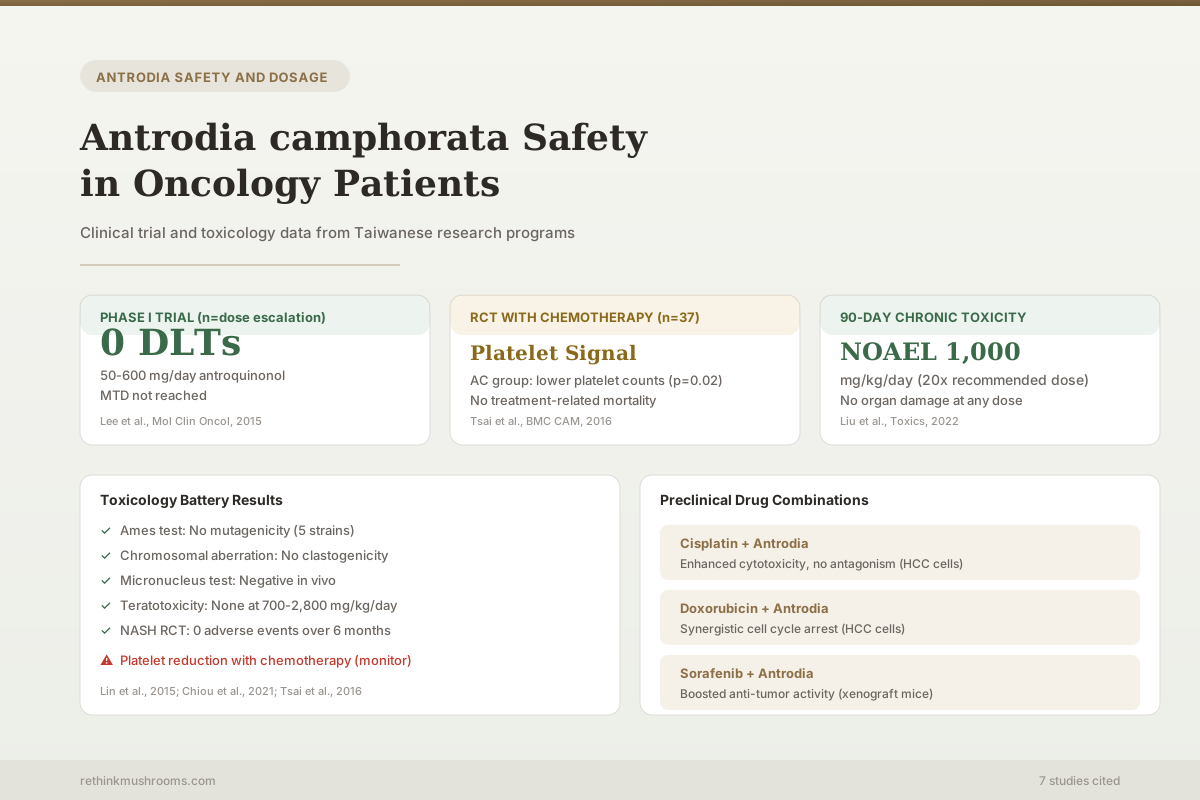
0 DLTs
Zero dose-limiting toxicities were observed in the phase I trial of antroquinonol at doses up to 600 mg/day in metastatic NSCLC patients.
Lee et al., Molecular and Clinical Oncology, 2015
37 Patients
in the only RCT with chemotherapy
NOAEL
1,000 mg/kg/day in 90-day rat study
Platelets
one safety signal requiring monitoring
Lee et al., Molecular and Clinical Oncology, 2015
 View as image ↗
Safety questions about Antrodia camphorata in cancer care are legitimate and answerable with data. Unlike most medicinal mushrooms, Antrodia has an actual clinical trial record in oncology patients: a phase I dose-escalation study of antroquinonol in metastatic NSCLC, a randomized controlled trial of Antrodia extract combined with chemotherapy in advanced cancer, and formal toxicology assessments including 90-day chronic toxicity, genotoxicity, and teratotoxicity studies. The evidence base is small but structured, covering both the isolated compound (antroquinonol) and whole-organism preparations. The safety profile is generally favorable, with one notable signal (lowered platelet counts) requiring attention. For broader context on Antrodia side effects and safety profile, see the general safety review.
Key Takeaways
- Antroquinonol produced zero dose-limiting toxicities at doses up to 600 mg/day in metastatic NSCLC patients; the maximum tolerated dose was not reached (Lee et al., 2015)
- In a 37-patient RCT combining Antrodia with chemotherapy, no treatment-related mortality occurred, but platelet counts were lower in the Antrodia group (p = 0.02) (Tsai et al., 2016)
- 90-day chronic toxicity testing in rats established a NOAEL of 1,000 mg/kg/day, approximately 20 times the recommended human daily intake (Liu et al., 2022)
- No genotoxicity in the Ames test, no chromosomal aberrations in CHO cells, no teratotoxicity at doses up to 2,800 mg/kg/day in pregnant rats (Lin et al., 2015)
- Antrodia ethanolic extract enhanced cisplatin and doxorubicin cytotoxicity against hepatocellular carcinoma cells in vitro with no antagonistic effects (Lin et al., 2015)
- The only human RCT for a non-cancer endpoint (NASH, n=28) reported zero adverse events over 6 months of supplementation (Chiou et al., 2021)
Phase I Clinical Trial: Antroquinonol in Metastatic NSCLC
Lee et al. (2015) conducted the first-in-human phase I study of antroquinonol, the ubiquinone derivative from Antrodia that has progressed furthest in clinical development. The open-label, dose-escalation trial enrolled patients with metastatic non-small-cell lung cancer who had failed at least two prior systemic regimens, including one platinum-based chemotherapy.
Doses escalated from 50 mg to 600 mg daily over 4-week treatment cycles. The primary objective was determining the maximum tolerated dose (MTD) and dose-limiting toxicities (DLTs).[1]
Key safety findings:
- Zero dose-limiting toxicities at any dose level tested
- The MTD was not reached, meaning even the highest dose (600 mg/day) was tolerated
- Adverse events were predominantly gastrointestinal: diarrhea, nausea, and vomiting
- No treatment-related mortality
- The recommended phase II dose was set at 600 mg/day or higher
Efficacy signals (preliminary): The best tumor response was stable disease in 3 patients. Among 5 patients at the 600 mg dose level, 2 of 3 evaluable patients achieved stable disease for more than 3 months.[1]
This trial establishes a basic safety floor for antroquinonol as a single agent. The gastrointestinal side effects are consistent with other oral anticancer agents and were manageable. The absence of DLTs even at the highest dose suggests a wide therapeutic window, though this could also reflect limited bioavailability at higher doses.
The population context matters for interpretation. These were heavily pretreated patients with metastatic disease who had failed multiple prior therapies. This is a population with inherently poor baseline health and multiple competing causes of symptoms. That antroquinonol did not add measurable toxicity to an already burdened system is a meaningful finding, even though it comes from a small, uncontrolled dose-escalation study. Antroquinonol has since been granted FDA orphan drug designation for pancreatic cancer and acute myeloid leukemia, indicating regulatory recognition of its development potential.
Randomized Controlled Trial: Antrodia Combined with Chemotherapy
Tsai et al. (2016) conducted the only published RCT of Antrodia in cancer patients receiving active chemotherapy. This double-blind study randomized 37 patients with advanced and/or metastatic adenocarcinoma (gastric, lung, liver, breast, and colorectal cancers) to receive their routine chemotherapy regimens plus either Antrodia cinnamomea extract (20 mL twice daily) or placebo for 30 days.[2]
Safety findings:
- No treatment-related mortality in either group
- Most hematologic, liver, and kidney function tests did not differ between groups
- Platelet counts were lower in the Antrodia group than placebo (p = 0.02), the single most important safety signal in the Antrodia oncology literature
- Quality of life assessments were similar between groups, except the Antrodia group reported improved sleep quality (p = 0.04)
Efficacy findings:
- Mean overall survival: 5.4 months (Antrodia) vs. 5.0 months (placebo), p = 0.340 (not statistically different)
- Disease control rate: 41.2% (Antrodia) vs. 55% (placebo), p = 0.33
- Mortality rate: 33.3% (Antrodia) vs. 66.7% (placebo), though the study was underpowered to detect survival differences
The platelet finding is the most clinically relevant safety concern. Thrombocytopenia (low platelet count) is already a common complication of chemotherapy, and any supplement that further reduces platelets in this population poses a bleeding risk. The authors noted this as a potential concern requiring monitoring in future studies. Whether the platelet reduction was caused by Antrodia directly, by an interaction with chemotherapy drugs, or by chance in a small sample cannot be determined from this single study.
For a complete analysis of Antrodia and drug interactions, including the platelet implications, see the interaction review.
Preclinical Chemotherapy Combinations
Two preclinical studies tested Antrodia in combination with standard chemotherapy agents:
Lin et al. (2015) showed that the ethanolic extract of Taiwanofungus camphoratus enhanced the cytotoxicity of cisplatin and doxorubicin against human hepatocellular carcinoma cells (Hep3B and HepG2). The extract induced cell cycle arrest at G0/G1 phase and showed additive or synergistic effects with both chemotherapy drugs. No antagonistic interactions were observed.[3]
Wu et al. (2018) tested Antrodia cinnamomea extract in combination with sorafenib, a tyrosine kinase inhibitor used in hepatocellular carcinoma. In xenograft mouse models, the combination boosted anti-tumor activity compared to either agent alone. The extract appeared to sensitize tumor cells to sorafenib through effects on apoptosis and cell proliferation pathways.[4]
Both studies suggest compatibility rather than interference between Antrodia compounds and standard chemotherapy. This is reassuring from a safety perspective but does not replace human combination data. The in vitro synergy with cisplatin and the in vivo boost with sorafenib are preliminary signals that warrant clinical investigation.
The synergy finding is mechanistically plausible: Antrodia compounds affect different cellular targets (cell cycle, apoptosis, AMPK) than the chemotherapy drugs they were paired with (DNA damage for cisplatin, topoisomerase inhibition for doxorubicin, kinase inhibition for sorafenib). Non-overlapping mechanisms of action are a standard rationale for combination therapy in oncology. The absence of antagonism is as important as the presence of synergy, because some herbal products actively interfere with drug metabolism through CYP450 enzyme induction or inhibition. No CYP450 interaction data specific to Antrodia triterpenoids has been published, which represents a gap in the safety characterization.
Formal Toxicology: Genotoxicity and Teratotoxicity
Lin et al. (2015) conducted comprehensive toxicological assessments of a commercial Antrodia product (Leader Deluxe Antrodia cinnamomea) using standard regulatory-grade testing protocols:[5]
Ames test (bacterial reverse mutation): Five strains of Salmonella typhimurium showed no increased reverse mutation at concentrations up to 5 mg/plate, with and without metabolic activation. This indicates no mutagenic potential.
Chromosomal aberration assay: Chinese Hamster Ovary (CHO-K1) cells exposed to the product showed no increase in chromosomal aberrations. This rules out clastogenic activity.
Micronucleus test (in vivo): Treatment did not increase the number of micronuclei in immature erythrocytes of ICR mice or affect the ratio of immature to total erythrocytes.
Acute toxicity: A 14-day single-dose study in rats showed no observable adverse effects.
90-day repeated dose toxicity: No adverse effects at any dose tested.
Reproductive/developmental toxicity: At doses of 700-2,800 mg/kg/day (far exceeding any anticipated human dose), no reproductive or developmental toxic effects were observed in pregnant rats or their fetuses.
These results satisfy the standard battery of toxicology tests required for food safety assessment in many regulatory jurisdictions.
90-Day Chronic Toxicity: NOAEL Established
Liu et al. (2022) conducted a separate 90-day chronic toxicity study of disc-cultured Antrodia cinnamomea fruiting body powder (ACP) in Sprague-Dawley rats at doses of 200, 600, and 1,000 mg/kg/day. The study confirmed the presence of seven key bioactive triterpenoids (antcins A, B, C, K, H, dehydrosulphurenic acid, and dehydroeburicoic acid) in the test material.[6]
At all doses, no mortality, adverse effects on general health, body weight, organ weights, or food intake were observed. Hematological and biochemical parameters remained normal. Histopathological examination of vital organs showed no structural changes even at the highest dose.
The established NOAEL of 1,000 mg/kg/day represents approximately 20 times the recommended daily intake for humans. This wide safety margin is comparable to many approved dietary supplements and exceeds the margins typically required for regulatory approval of food-grade ingredients. The presence of all seven key triterpenoids in the tested material confirms that the safety data applies to a product containing the same bioactive compounds found in wild Antrodia, not a biologically inert preparation.
Non-Oncology Human Safety Data
Chiou et al. (2021) conducted a 6-month randomized, double-blind, placebo-controlled trial of Antrodia mycelium in 28 NASH patients. While this study primarily assessed efficacy, the safety data is relevant: zero adverse events were reported in either the treatment or placebo group over the 6-month intervention period at 420 mg/day.[7]
This is the longest published human safety exposure to Antrodia (6 months), though in non-cancer patients. The absence of any reported adverse events at a moderate dose provides additional reassurance about the general safety profile, even if the population and context differ from oncology use.
What the Safety Data Does Not Address
Long-term oncology use. The longest cancer-specific exposure in published data is 30 days (Tsai et al., 2016). Cancer patients often take supplements for months or years. The safety of prolonged Antrodia use during ongoing cancer treatment is unknown.
Specific drug interactions. The platelet signal from the Tsai RCT could be drug-specific. Whether Antrodia interacts differently with different chemotherapy regimens (platinum-based, taxane-based, immunotherapy) has not been studied systematically. For known interaction concerns, see Antrodia and drug interactions.
Immunotherapy combinations. No data exists on Antrodia use during immune checkpoint inhibitor therapy (pembrolizumab, nivolumab, atezolizumab). Given Antrodia's documented immunomodulatory effects, the possibility of interaction with immunotherapy warrants investigation before any assumptions about safety are made.
Hepatic and renal impairment. Cancer patients frequently have compromised liver or kidney function. No pharmacokinetic data exists for Antrodia compounds in these populations.
Dose-finding in humans. The antroquinonol phase I established 600 mg/day as safe for the isolated compound. The appropriate dose of whole Antrodia extract in cancer patients has not been formally determined. For dosage guidance based on available data, see Antrodia Dosage Guide.
Quality control. Commercial Antrodia products vary widely in triterpenoid content depending on cultivation method and source. Safety data from standardized research materials may not apply to all commercial products. For product quality concerns, see Antrodia Supplement Quality: Avoiding Counterfeits.
The Bottom Line
The safety profile of Antrodia camphorata in oncology patients is supported by a phase I trial of antroquinonol (no dose-limiting toxicities at 600 mg/day), one 37-patient RCT with chemotherapy (no mortality, but a platelet reduction signal), formal genotoxicity/teratotoxicity testing (all negative), and a 90-day chronic toxicity study establishing a NOAEL of 1,000 mg/kg/day. The platelet count reduction observed when Antrodia was combined with chemotherapy is the primary safety concern requiring monitoring. Long-term safety in cancer patients, interactions with immunotherapy, and pharmacokinetics in organ impairment remain uncharacterized.
Frequently Asked Questions
Sources & References
- 1RTHM-00387·Lee, Yu-Chin et al. (2015). “A phase I multicenter study of antroquinonol in patients with metastatic non-small-cell lung cancer who have received at least two prior systemic treatment regimens, including one platinum-based chemotherapy regimen..” Molecular and clinical oncology.Study breakdown →PubMed →↩
- 2RTHM-00453·Tsai, Ming-Yen et al. (2016). “A preliminary randomised controlled study of short-term Antrodia cinnamomea treatment combined with chemotherapy for patients with advanced cancer..” BMC complementary and alternative medicine.Study breakdown →PubMed →↩
- 3RTHM-00393·Lin, Liang-Tzung et al. (2015). “The Ethanolic Extract of Taiwanofungus camphoratus (Antrodia camphorata) Induces Cell Cycle Arrest and Enhances Cytotoxicity of Cisplatin and Doxorubicin on Human Hepatocellular Carcinoma Cells..” BioMed research international.Study breakdown →PubMed →↩
- 4RTHM-00535·Wu, Wei-De et al. (2018). “Antrodia cinnamomea boosts the anti-tumor activity of sorafenib in xenograft models of human hepatocellular carcinoma..” Scientific reports.Study breakdown →PubMed →↩
- 5RTHM-00392·Lin, Chin-Chung et al. (2015). “Genotoxic, teratotoxic and oral toxic assessments of Antrodia cinnamomea health food product (Leader Deluxe Antrodia cinnamomea®)..” Toxicology reports.Study breakdown →PubMed →↩
- 6RTHM-00782·Liu, Shou-Chou et al. (2022). “Chemical Composition and Chronic Toxicity of Disc-Cultured Antrodia cinnamomea Fruiting Bodies..” Toxics.Study breakdown →PubMed →↩
- 7RTHM-00681·Chiou, Ya-Ling et al. (2021). “Hepatoprotective Effect of Antrodia cinnamomea Mycelium in Patients with Nonalcoholic Steatohepatitis: A Randomized, Double-Blind, Placebo-Controlled Trial..” Journal of the American College of Nutrition.Study breakdown →PubMed →↩