Antrodia Safety and Practical Use
Varies dramatically
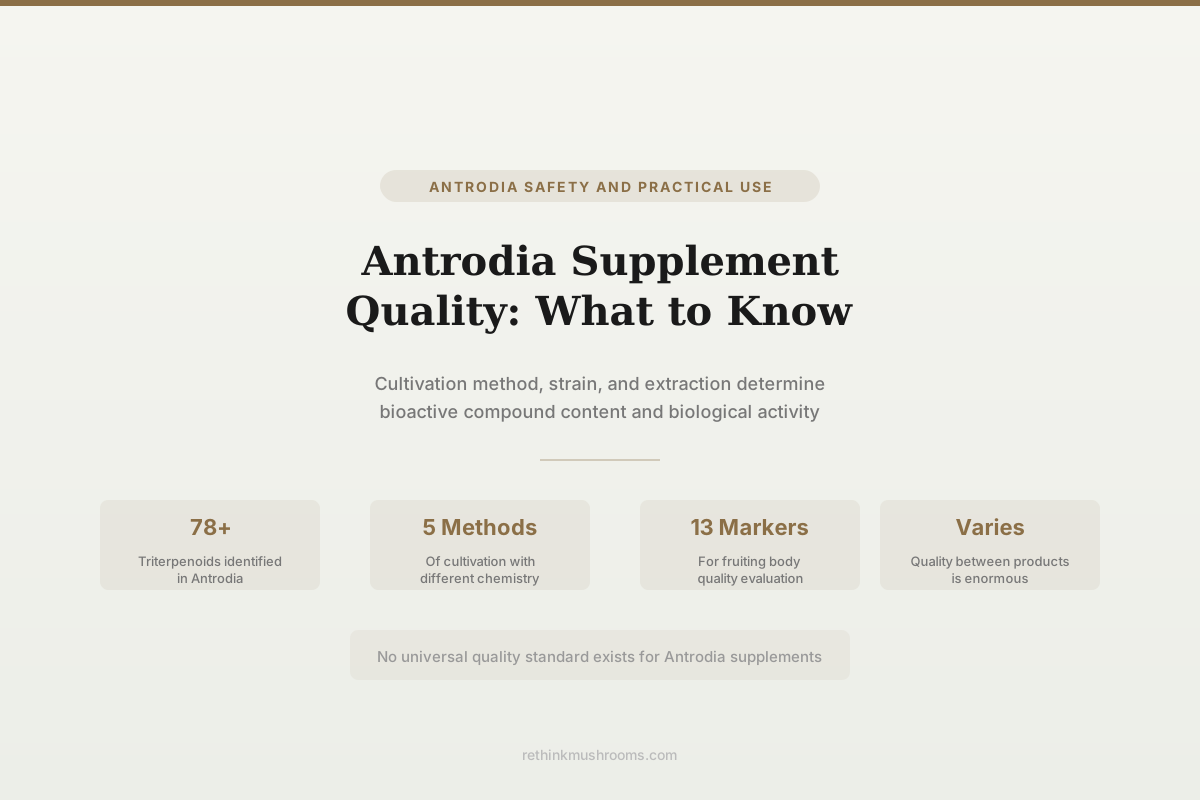
When researchers tested commercially available Antrodia supplements, bioactive triterpenoid content varied enormously between products, with many containing little to no active compounds.
Li et al., J. Ethnopharmacology, 2017
5 Methods
of cultivation produce different chemistry
13 Markers
used to authenticate fruiting body quality
7 Studies
on Antrodia quality and standardization
Li et al., J. Ethnopharmacology, 2017
 View as image ↗
Antrodia camphorata is among the most expensive medicinal mushrooms in the world. Wild fruiting bodies harvested from the endangered Cinnamomum kanehirae tree can cost thousands of dollars per kilogram. This price premium, combined with growing global demand, creates powerful economic incentives for adulteration, substitution, and mislabeling. Published research has documented that commercial Antrodia products vary enormously in their bioactive compound content, and some contain chemical profiles that do not match authentic Antrodia at all. For context on what active compounds to look for, see the overview of Antrodia's bioactive triterpenoids.
This article examines what published research reveals about the factors that determine Antrodia supplement quality: cultivation method, strain selection, extraction technique, wood substrate, culture age, and authentication testing. The goal is not to recommend specific products (this site does not make product recommendations) but to explain the scientific basis for quality variation so readers can evaluate claims critically. For related practical information, see the guides on Antrodia dosage and Antrodia drug interactions.
Key Takeaways
- Wild fruiting bodies, wood-cultured fruiting bodies, and dish cultures showed stronger hepatoprotective activity than mycelial preparations in head-to-head comparisons, with wild fruiting body being most potent (Li et al., 2017)
- An index of 13 representative metabolites was established for quality evaluation of Antrodia fruiting bodies, with profiles varying by culture age and wood substrate species (Lin et al., 2011)
- Triterpenoid content varies between "regular" and "white" Antrodia phenotypes, with regular (orange-red) fruiting bodies containing different compound ratios than white variants (Chen et al., 2016)
- Eighteen triterpenoids were detected in rat plasma after oral Antrodia administration, but their bioavailability and pharmacokinetics varied widely between individual compounds (Qiao et al., 2015)
- The Taiwanese government's official authentication method provides only a qualitative HPLC fingerprint, which cannot quantify the actual amount of active compounds in a product
- Over 78 distinct triterpenoids have been identified in Antrodia, but most commercial products do not specify which compounds they contain or at what concentration (Kuang et al., 2021)
Why Cultivation Method Is the Most Important Quality Factor
Antrodia camphorata grows naturally only on the inner heartwood of Cinnamomum kanehirae, a tree endemic to Taiwan that is now protected as a national treasure. Because wild harvesting is illegal and the natural supply is negligible, essentially all commercial Antrodia comes from artificial cultivation. Five methods exist, and they produce dramatically different chemical profiles.
Li et al. (2017) directly compared five cultivation methods for hepatoprotective activity: wild fruiting bodies, wood-cultured (cutting wood) fruiting bodies, dish cultures, wood-cultured mycelia, and submerged fermentation mycelia.[1] The results showed a clear hierarchy. Wild-growing and wood-cultured fruiting bodies, plus dish cultures, were more potent than either mycelial preparation. Among 29 triterpenoid compounds screened, antcin K and antcin B from fruiting body preparations were the primary hepatoprotective agents, with 50 mg/kg matching the effects of 100 mg/kg silymarin.
This hierarchy exists because fruiting bodies contain far higher concentrations of triterpenoids than mycelia. Submerged fermentation mycelia, the cheapest and fastest production method, contain the lowest triterpenoid levels. The price difference between fruiting body and mycelial products reflects a genuine quality difference, not just marketing. However, mycelial products contain different bioactive compounds (polysaccharides, adenosine) that may have their own therapeutic relevance, particularly for immune function.[1]
Culture Age and Wood Substrate Affect Chemistry
Even within fruiting body cultivation, the chemical profile changes based on how long the fungus grows and what wood it grows on. Lin et al. (2011) established an index of 13 representative metabolites from ethanol extracts of Antrodia fruiting bodies and measured how these metabolites varied with culture age and wood substrate.[2]
The metabolite profiles differed between fruiting bodies harvested at different ages and from different wood substrates. This means two "authentic" Antrodia fruiting body products could have meaningfully different chemical compositions simply because one was harvested earlier or grown on a different wood species. The 13-metabolite index provides a quality evaluation framework, but it requires HPLC analysis that is not available to consumers and rarely disclosed by manufacturers.
Chen et al. (2016) added another variable: phenotype. Antrodia cinnamomea produces both "regular" (orange-red) and "white" fruiting body phenotypes.[3] The major triterpenoid composition differs between these variants, with regular fruiting bodies showing a different compound ratio than white ones. Products made from different phenotypes would have different biological activities even if both are "authentic" Antrodia from the same cultivation facility.
The Triterpenoid Authentication Challenge
Kuang et al. (2021) published a comprehensive review identifying over 78 distinct triterpenoids from Antrodia, spanning multiple structural classes including ergostane-type, lanostane-type, and unique antcin-class compounds.[4] This chemical diversity creates both the medicinal potential and the quality control problem: which of these 78+ compounds should a product contain, and at what concentrations?
The Taiwanese government's official authentication method uses a qualitative HPLC fingerprint of terpenoids. This approach confirms that a product contains some Antrodia-derived compounds but cannot quantify how much of each active compound is present. A product could pass qualitative authentication while containing only trace amounts of the most pharmacologically active triterpenoids (antcin K, antcin B, eburicoic acid, dehydroeburicoic acid).
Ganesan et al. (2019) highlighted that the bioactive component profile varies between different cultivation conditions and product forms, making standardization across the industry difficult.[5] Without quantitative standards specifying minimum concentrations of specific active compounds, the "Antrodia camphorata" label conveys species identity but not therapeutic potency.
Bioavailability: What Actually Reaches the Body
Even if a product contains the right compounds, the body must absorb them for any biological effect to occur. Qiao et al. (2015) performed the first multi-component pharmacokinetic study of Antrodia triterpenoids, detecting 18 triterpenoids in rat plasma after oral administration of an ethanol extract.[6]
The pharmacokinetic profiles varied widely between individual compounds. Some triterpenoids achieved peak plasma concentrations rapidly, while others showed delayed absorption. Some had long half-lives (suggesting sustained activity), while others were cleared quickly. Two metabolites were also detected, indicating hepatic metabolism of the parent compounds.
This pharmacokinetic variability means that the "most abundant" triterpenoid in a product is not necessarily the "most bioavailable" or "most active" one. A product optimized for total triterpenoid content might not deliver the same biological activity as one optimized for bioavailable triterpenoids. This level of pharmaceutical analysis has not been applied to any commercial Antrodia product.
How Strain Selection Affects Immune Activity
Quality variation extends beyond triterpenoid content to functional immune activity. Kuo et al. (2008) tested hot water extracts from five different Antrodia strains on vascular tension and immune cell activation.[7] The results varied dramatically between strains. Strain B85 showed potent vasorelaxation through the endothelial Ca2+-NO-cGMP pathway, while strains 35398, 35396, and B71 had only mild effects. Strain B86 showed intermediate activity.
This strain-dependent variation in a measurable biological outcome (vasorelaxation) demonstrates that "Antrodia camphorata" is not a single standardized material. Two products from different strains, both genuinely containing authentic Antrodia, could produce meaningfully different health effects. Commercial products almost never specify the fungal strain used.
Red Flags and Quality Indicators
Based on the published research, several factors can help evaluate Antrodia product claims:
Product form matters. Fruiting body products contain higher triterpenoid levels than mycelial products. Products that specify "fruiting body" or "solid-state culture" generally contain more triterpenoids than "submerged fermentation" or "mycelium" products. However, mycelial products may be suitable for immune-focused applications due to their polysaccharide and adenosine content.
Extraction method matters. Ethanol extracts concentrate triterpenoids. Hot water extracts concentrate polysaccharides and adenosine. Products claiming both triterpenoid and polysaccharide content should specify dual extraction or full-spectrum processing.
Quantified active compounds are the gold standard. Products that specify milligrams of identified compounds (antcin K, eburicoic acid, antroquinonol, total triterpenoids) provide verifiable quality claims. Products that list only vague terms ("proprietary blend," "full spectrum," "potent extract") without quantification cannot be evaluated against published research.
Third-party testing adds credibility. Certificates of analysis (COAs) from independent labs that identify specific compounds by HPLC or LC-MS provide evidence that the product contains what it claims. COAs that test only for heavy metals and microbial contamination confirm safety but not potency.
Price correlates roughly with quality. Authentic Antrodia fruiting body products are expensive to produce. Products priced far below market norms may use cheaper mycelial cultivation, diluted extracts, or substitute species. This is not a reliable rule, as expensive products can also be low quality, but unusually cheap Antrodia products warrant skepticism.
Species verification is not always present. Antrodia/Taiwanofungus camphoratus is the species with published pharmacological evidence. Other Antrodia species exist but lack the same evidence base. Products should specify the species, not just the genus.
The Taxonomy Confusion Factor
Adding to quality concerns is the taxonomic naming confusion. The mushroom has been called Antrodia camphorata, Antrodia cinnamomea, Taiwanofungus camphoratus, and Ganoderma camphoratum in different publications and product labels. These names all refer to the same species, but the inconsistency creates opportunities for confusion. A product labeled with any of these names could be authentic, but a product labeled simply "Antrodia" without a species epithet is ambiguous, as the genus Antrodia contains dozens of species with different bioactivities.
The International Mycological Association recognizes Taiwanofungus camphoratus as the current accepted name, though Antrodia cinnamomea remains widely used in both scientific literature and commercial products. For regulatory purposes (such as the EU novel food application), the species name and cultivation method must be specified. In markets without such requirements, species identification relies entirely on manufacturer integrity.
The lack of a single standardized name also complicates literature searches and product comparisons. A product claiming to be backed by "Antrodia research" might cite studies using a different preparation method, strain, or even a different taxonomic name than what the product actually contains. Cross-referencing product claims against the specific study preparations is essential for accurate evaluation.
What the Research Cannot Resolve
No universal quality standard exists. Unlike pharmaceutical drugs, Antrodia supplements are not required to meet specific potency standards in most markets. The EU novel food application process requires identity and safety documentation but does not mandate minimum active compound concentrations.
Consumer testing options are limited. Unlike vitamins or minerals, Antrodia triterpenoids cannot be measured by consumer-accessible test kits. HPLC analysis requires specialized laboratory equipment. Consumers must rely on manufacturer claims and third-party certifications.
The authentication literature is primarily Taiwanese. Most quality control research comes from Taiwanese labs with deep expertise in Antrodia chemistry. Quality assessment capabilities outside Taiwan are limited, which creates challenges for products manufactured or distributed in other countries.
Counterfeit detection requires expertise. Simple visual inspection cannot distinguish authentic Antrodia from substitute species or diluted products. Chemical fingerprinting (HPLC, LC-MS) is the only reliable method, and it requires reference standards that are not widely available outside specialized research laboratories.
The Bottom Line
Antrodia camphorata supplement quality varies dramatically based on cultivation method (fruiting body vs. mycelium), strain, wood substrate, culture age, phenotype, and extraction technique. Published research documents that wild and wood-cultured fruiting bodies contain the highest triterpenoid concentrations and strongest biological activity, while submerged fermentation mycelia contain the least. Over 78 triterpenoids have been identified, but most commercial products do not specify which compounds they contain or their concentrations. The Taiwanese government's qualitative HPLC method confirms species identity but not potency. Consumers should prioritize products that specify product form, quantify active compounds, and provide third-party testing documentation.
Frequently Asked Questions
Sources & References
- 1RTHM-00479·Li, Zi-Wei et al. (2017). “Hepatoprotective activities of Antrodia camphorata and its triterpenoid compounds against CCl4-induced liver injury in mice..” Journal of ethnopharmacology.Study breakdown →PubMed →↩
- 2RTHM-00225·Lin, Ting-Yu et al. (2011). “Metabolite profiles for Antrodia cinnamomea fruiting bodies harvested at different culture ages and from different wood substrates..” Journal of agricultural and food chemistry.Study breakdown →PubMed →↩
- 3RTHM-00422·Chen, Wei-Lun et al. (2016). “Phenologic variation of major triterpenoids in regular and white Antrodia cinnamomea..” Botanical studies.Study breakdown →PubMed →↩
- 4RTHM-00695·Kuang, Yi et al. (2021). “Terpenoids from the medicinal mushroom Antrodia camphorata: chemistry and medicinal potential..” Natural product reports.Study breakdown →PubMed →↩
- 5RTHM-00555·Ganesan, Nagarajan et al. (2019). “Antrodia cinnamomea-An updated minireview of its bioactive components and biological activity..” Journal of food biochemistry.Study breakdown →PubMed →↩
- 6RTHM-00398·Qiao, Xue et al. (2015). “Metabolites identification and multi-component pharmacokinetics of ergostane and lanostane triterpenoids in the anticancer mushroom Antrodia cinnamomea..” Journal of pharmaceutical and biomedical analysis.Study breakdown →PubMed →↩
- 7RTHM-00140·Kuo, Mei-Chun et al. (2008). “Immunomodulatory effect of Antrodia camphorata mycelia and culture filtrate..” Journal of ethnopharmacology.Study breakdown →PubMed →↩