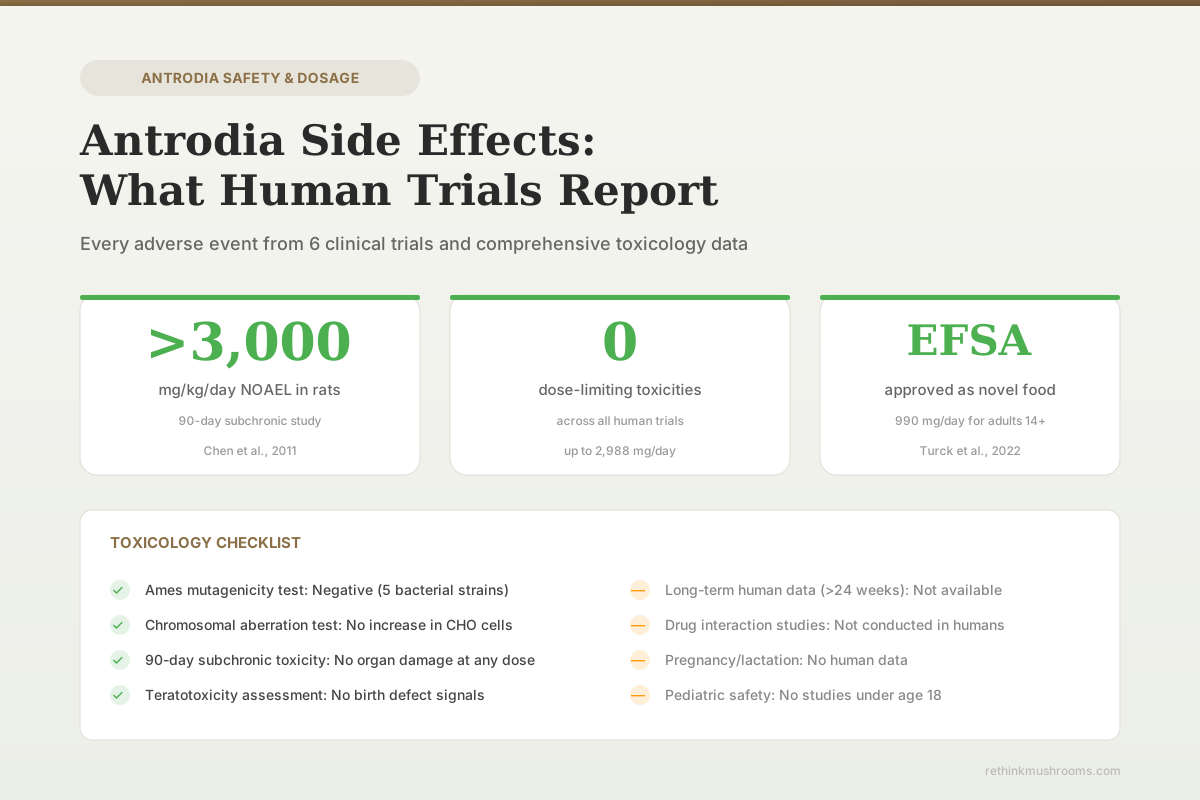
Antrodia Safety and Dosage
>3,000 mg/kg/day
The no-observed-adverse-effect level (NOAEL) for Antrodia cinnamomea in a 90-day subchronic toxicity study in Sprague-Dawley rats.
Chen et al., Food and Chemical Toxicology, 2011
No DLTs
at any human dose tested
EFSA Approved
as novel food in EU
Ames Negative
no mutagenic activity
Chen et al., Food and Chemical Toxicology, 2011
 View as image ↗
Antrodia camphorata has been tested in six human clinical trials with doses ranging from 300 mg to nearly 3,000 mg per day, and no dose-limiting toxicities have been reported in any of them.[1] That is a notable finding for a compound class with limited clinical history. But "no dose-limiting toxicities" is not the same as "no side effects," and understanding what was actually observed in each trial matters more than a blanket safety claim. For specific dose ranges tested in each trial, see Antrodia Dosage: Tested Doses in Human Trials.
This article catalogs every reported adverse event from human trials, every preclinical toxicology finding, and the regulatory conclusions the European Food Safety Authority drew from this evidence. Where the data has gaps, those gaps are named.
Key Takeaways
- The most common adverse events in human Antrodia trials were gastrointestinal: diarrhea, vomiting, and nausea, reported in the phase I cancer study at doses up to 600 mg/day (Lee et al., 2015)
- A first-in-human phase I study in 18 healthy volunteers found no serious adverse events at doses up to 2,988 mg/day over 5 weeks (Liao et al., 2023)
- The NOAEL for Antrodia cinnamomea in 90-day rat studies exceeds 3,000 mg/kg body weight per day, with no organ damage detected (Chen et al., 2011)
- Antrodia tested negative in the Ames mutagenicity assay and showed no chromosomal aberrations in Chinese Hamster Ovary cells (Wu et al., 2011)
- The EFSA approved freeze-dried Antrodia camphorata mycelia as a novel food with a derived safe level of 16.5 mg/kg body weight per day (Turck et al., 2022)
- No human trial has exceeded 24 weeks in duration, leaving long-term safety uncharacterized
Adverse Events Reported in Human Clinical Trials
Six human studies provide direct adverse event data for Antrodia camphorata or its isolated compounds. The following is a trial-by-trial accounting.
Human Trials at a Glance
Every Antrodia Human Trial and What It Reported for Safety
Six human studies span 300 mg to nearly 3,000 mg per day, and none reported a dose-limiting toxicity. The rows are ordered by how cleanly an adverse event can be blamed on Antrodia itself — healthy-volunteer trials at the top, chemotherapy-confounded oncology trials at the bottom, where the reported symptoms have an obvious alternative cause.
Liao 2023 · LEAC-102
Population
18 healthy volunteers
Dose
597.6–2,988 mg/day
Duration
1 month/level
Reported adverse events
No serious adverse events. One participant developed urticaria, which set the maximum tolerated dose at the top dose of 2,988 mg/day.
Chen 2020 · cholesterol pilot
Population
Healthy adults
Dose
Solid-state mycelium
Duration
Pilot
Reported adverse events
No adverse events reported.
Yen 2022 · Golden-Antrodia
Population
80 adults, elevated GGT
Dose
300 mg/day
Duration
12 weeks
Reported adverse events
No severe reactions. Mild events occurred at similar rates in the Antrodia and placebo groups.
Chiou 2021 · NASH
Population
Biopsy-confirmed NASH
Dose
420 mg/day
Duration
24 weeks (longest)
Reported adverse events
Double-blind, placebo-controlled; longest observation window in any Antrodia human study.
Lee 2015 · antroquinonol
Population
13 metastatic NSCLC patients
Dose
50–600 mg/day
Duration
4-week cycles
Reported adverse events
No dose-limiting toxicities. Most common events were diarrhea, vomiting, and nausea — but every patient had prior platinum chemotherapy, which causes the same symptoms.
Tsai 2016 · cancer adjuvant
Population
Advanced cancer + chemo
Dose
Combined with chemo
Duration
30 days
Reported adverse events
Reduction in platelet counts in the first month — not replicated elsewhere and plausibly a chemotherapy effect.
How to read it: the two trials with the strongest safety signal are the healthy-volunteer studies (Liao 2023, Chen 2020), because there is no underlying disease or chemotherapy to explain away an adverse event. The oncology trials sit at the bottom not because Antrodia looked unsafe, but because their adverse events — GI upset, low platelets — are also textbook chemotherapy effects, so they cannot be pinned on Antrodia with confidence. “No dose-limiting toxicity” held across all six.
Sources: Lee 2015 [1]; Liao 2023 [2]; Yen 2022 [3]; Chiou 2021 [4]; Chen 2020 [5]; Tsai 2016 [6]. Attribution labels reflect how cleanly a reported event can be assigned to Antrodia, not a ranking of study quality.
Phase I Antroquinonol Trial: GI Symptoms at 50 to 600 mg/day
Lee et al. (2015) enrolled 13 patients with metastatic non-small-cell lung cancer in a dose-escalation study of pure antroquinonol. Doses ranged from 50 to 600 mg daily over 4-week cycles. No dose-limiting toxicities occurred at any level. The most common treatment-related adverse events were diarrhea, vomiting, and nausea. No treatment-related mortality was reported.[1]
These gastrointestinal symptoms are the most frequently cited adverse events across all Antrodia human research. A critical detail: all 13 patients had metastatic cancer and had received at least two prior systemic treatment regimens including platinum-based chemotherapy. Gastrointestinal disturbance is among the most common side effects of platinum chemotherapy agents, so whether the diarrhea, vomiting, and nausea were caused by antroquinonol itself, by residual chemotherapy effects, or by the advanced cancer remains impossible to determine from this trial design alone. The study was published in Molecular and Clinical Oncology.
First-in-Human LEAC-102: No Serious Adverse Events Up to 2,988 mg/day
Liao et al. (2023) tested LEAC-102, a standardized Antrodia cinnamomea botanical drug, in 18 healthy volunteers using a 3+3 dose-escalation design. Five dose levels were tested from 597.6 to 2,988 mg per day, each for one month plus 7 days of follow-up. No serious adverse events were reported at any dose level. One participant developed urticaria (hives), and on that basis the investigators set the maximum tolerated dose at the top dose of 2,988 mg/day.[2]
This study carries particular weight because it tested healthy volunteers rather than patients with underlying conditions. Adverse events in healthy volunteers are more likely attributable to the study compound itself, which makes the single urticaria case worth noting even though it was not classified as serious. The upper dose of nearly 3 grams per day is the highest Antrodia dose tested in humans, and the overall safety signal at that level is informative. Published in the Journal of the American Nutrition Association.
Golden-Antrodia Liver Protection Trial: Mild Events at 300 mg/day
Yen et al. (2022) randomized 80 participants with elevated GGT levels to receive 300 mg/day of Golden-Antrodia camphorata tablets or placebo for 12 weeks. The published adverse event profile showed no severe adverse reactions. Some mild adverse events were documented in both the treatment and placebo groups, which is expected in any controlled trial of this duration.[3]
The similar adverse event rates between treatment and placebo groups suggest that the mild events were not caused by the Antrodia preparation itself. This study appeared in Frontiers in Pharmacology.
NASH Trial: 420 mg/day for 24 Weeks
Chiou et al. (2021) administered 420 mg/day of Antrodia cinnamomea mycelium to patients with biopsy-confirmed NASH for 6 months. This is the longest-duration human Antrodia trial published to date. The study was designed as a double-blind, placebo-controlled trial, which provides the most reliable framework for attributing adverse events to the treatment.[4]
The 24-week duration is valuable because it provides the longest window of observation for adverse events in any Antrodia human study. If cumulative toxicity or delayed adverse effects were to emerge, a 6-month trial would be more likely to detect them than the typical 4 to 12-week study. Published in the Journal of the American College of Nutrition.
Cholesterol Pilot Study: Safety in Healthy Adults
Chen et al. (2020) assessed food safety and potential cholesterol-lowering efficacy of Antrodia cinnamomea solid-state cultivated mycelium in healthy adults. No adverse events were reported during the trial. This is one of only two studies testing Antrodia in people without a pre-existing condition.[5]
Published in Evidence-Based Complementary and Alternative Medicine.
Cancer Adjuvant Trial: Short-Term Combined With Chemotherapy
Tsai et al. (2016) combined Antrodia cinnamomea treatment with chemotherapy in patients with advanced cancer over 30 days in a randomized controlled design. Any adverse events in this population are confounded by the chemotherapy itself, making it difficult to attribute specific effects to the Antrodia component.[6] One observation of interest was a reduction in platelet counts within the first month, though this finding was not consistent across other Antrodia studies and may reflect chemotherapy effects.
Published in BMC Complementary and Alternative Medicine. For a deeper look at oncology-specific data, see Antrodia and Cancer: Comprehensive Research Review.
Safety
ModeratePossible additive effect on platelet counts during chemotherapy
Concern
The only trial that combined Antrodia with chemotherapy observed a reduction in platelet counts within the first month. Chemotherapy already lowers platelets (thrombocytopenia), so an additive effect could theoretically raise bleeding risk in people already receiving cancer treatment.
What the research says
The signal comes from one small, short (30-day) oncology trial and was not reproduced in any other Antrodia study, including the healthy-volunteer trials that tested doses up to 2,988 mg/day. Whether the drop reflects Antrodia, the chemotherapy, or the underlying cancer cannot be separated from this trial design, so its magnitude and clinical significance remain uncertain.
Particularly relevant for: People undergoing chemotherapy or otherwise at risk of low platelet counts
What to do
This article is educational information, not medical advice. Anyone in active cancer treatment should consult their oncologist before adding Antrodia or any supplement.
Tsai et al., BMC Complement Altern Med, 2016
What Preclinical Toxicology Studies Show
Animal toxicology studies test doses that cannot be used in initial human trials, providing a broader safety margin assessment.
90-Day Subchronic Toxicity: NOAEL Above 3,000 mg/kg/day
Chen et al. (2011) conducted a 90-day subchronic toxicological assessment of Antrodia cinnamomea in Sprague-Dawley rats following standard regulatory protocols. The study identified the no-observed-adverse-effect level (NOAEL) as greater than 3,000 mg/kg body weight per day. No mortality, no significant changes in body weight, food consumption, hematology, clinical chemistry, urinalysis, organ weights, or gross or microscopic pathology were observed at any dose level.[7]
For context, a NOAEL of 3,000 mg/kg/day in rats translates (using standard allometric scaling with an interspecies safety factor of 10 and an interindividual safety factor of 10) to a human equivalent well above any dose currently tested in clinical trials. The EFSA used a similar dataset to derive its 16.5 mg/kg/day human safe level, applying appropriate uncertainty factors to bridge from animal to human safety margins. Published in Food and Chemical Toxicology.
Beta-Glucan Preparation: Subchronic and Genotoxicity Combined
Chen et al. (2018) tested an Antrodia mushroom beta-glucan preparation at doses up to 2,000 mg/kg body weight per day in rats for 90 days following OECD guidelines. No toxicologically significant treatment-related changes were observed in clinical observations, ophthalmic examinations, body weights, feed consumption, or organ weights.[8]
This study is useful because beta-glucans are a primary bioactive compound class in Antrodia supplements, and isolating their safety profile from the whole-mushroom matrix helps characterize which components carry risk. Published in Regulatory Toxicology and Pharmacology.
Chronic Toxicity of Disc-Cultured Fruiting Bodies
Liu et al. (2022) evaluated the chemical composition and chronic toxicity of disc-cultured Antrodia cinnamomea fruiting body powder administered to rats over 90 days. Oral administration at tested doses caused no mortality, adverse effects on general health, body and organ weights, or food intake.[9]
This study matters because disc-cultured fruiting bodies represent a different preparation method than the solid-state cultivated mycelium tested in most other studies. The clean safety profile across preparation methods suggests the safety is inherent to the species rather than an artifact of one cultivation technique. Published in Toxics. For more on how different preparation methods affect Antrodia compounds, see Antrodia Bioactive Compounds: Antcins, Triterpenoids, and Polysaccharides.
Genotoxicity and Mutagenicity Testing
Genotoxicity testing determines whether a substance damages DNA or causes mutations, which is a prerequisite for regulatory approval of any novel food.
Ames Test and Chromosomal Aberration: Negative
Wu et al. (2011) evaluated the genotoxicity of Antrodia cinnamomea using the Ames test with five strains of Salmonella typhimurium and the in vitro chromosomal aberration test in Chinese Hamster Ovary (CHO) cells. The results showed that Antrodia cinnamomea was not mutagenic in any bacterial strain and did not increase the frequency of chromosomal aberrations in mammalian cells.[10]
These are standard regulatory genotoxicity assays required by both the OECD and EFSA frameworks. Negative results in both assays provide strong evidence against mutagenic risk. The Ames test uses bacterial strains engineered to detect different mutation types (frameshift, base-pair substitution), while the chromosomal aberration test detects larger-scale DNA damage in mammalian cells. Together, they cover the two primary mechanisms of genotoxicity. Published in In Vivo.
Comprehensive Genotoxic, Teratotoxic, and Oral Toxic Assessment
Lin et al. (2015) conducted a broader safety assessment of a commercial Antrodia cinnamomea health food product (Leader Deluxe Antrodia cinnamomea), testing for genotoxicity, teratotoxicity (birth defect risk), and oral toxicity. No signs of increased reverse mutation were observed in the Ames test up to 5 mg/plate. No increase in chromosomal aberration was detected in CHO cells. The product did not affect blood cell levels in toxicological assessments.[11]
The inclusion of teratotoxicity testing is rare in mushroom supplement research and adds an additional safety dimension. Published in Toxicology Reports. For context on how this compares to drug interaction risks, see Antrodia and Drug Interactions: What to Know.
The EFSA Regulatory Safety Assessment
In 2022, the EFSA Panel on Nutrition, Novel Foods and Food Allergens published a formal safety evaluation of freeze-dried Antrodia camphorata mycelia.[12]
The Panel reviewed the full body of evidence, including:
- Compositional analysis (carbohydrates, proteins, fats, beta-glucans, antroquinonol, triterpenoids)
- A 90-day repeated-dose toxicity study
- A prenatal developmental toxicity study
- Genotoxicity battery results
From this evidence, the Panel derived a safe intake level of 16.5 mg/kg body weight per day, corresponding to 990 mg/day for a 60 kg adult. The authorization covers individuals aged 14 years and older. The Panel stated there were no concerns regarding genotoxicity of the novel food.[12]
This remains the only regulatory body globally to have formally evaluated and approved Antrodia camphorata for human consumption as of 2026. The approval applies specifically to freeze-dried mycelia, not to fruiting body extracts or purified compounds like antroquinonol.
Gaps in the Safety Evidence
Despite the favorable profile, several evidence gaps exist.
Duration: No human trial has exceeded 24 weeks. Chronic use over years is common with mushroom supplements, but no long-term safety data supports this pattern. The 90-day animal studies provide a partial bridge, but rodent lifespans and human lifespans are not comparable for chronic exposure assessment.
Population diversity: Nearly all human Antrodia trials were conducted in Taiwanese or East Asian populations. Genetic polymorphisms in drug-metabolizing enzymes (particularly CYP450 variants) differ across populations, and whether safety findings generalize globally is unknown.
Pregnancy and lactation: The Lin et al. (2015) teratotoxicity study was conducted in animals, not humans.[11] No human data exists for Antrodia use during pregnancy or breastfeeding.
Drug interactions: The phase I antroquinonol trial noted a short elimination half-life (1.3 to 4.3 hours), but formal drug-drug interaction studies have not been conducted.[1] Whether Antrodia compounds induce or inhibit CYP450 enzymes at clinically relevant concentrations is uncharacterized in humans.
Product variability: Safety data from one standardized product (LEAC-102, Golden-Antrodia tablets, EFSA-approved mycelium) cannot be transferred to a different manufacturer's product with an unknown compound profile. A supplement labeled "Antrodia camphorata 500 mg" could contain primarily starch filler from the grain substrate, concentrated triterpenoids from fruiting body extraction, or something in between. The safety of each depends on what bioactive compounds are actually present and at what concentrations. For more on this issue, see Antrodia Supplement Quality: Avoiding Counterfeits.
Pediatric data: The EFSA approval covers ages 14 and older. No clinical trial has included participants under 18. Pediatric metabolism, organ maturation, and body composition differ from adults, and adult safety data cannot be extrapolated to children without dedicated studies. The safety profile for oncology patients specifically is covered in Antrodia camphorata Safety in Oncology Patients.
The Bottom Line
Across six human clinical trials, Antrodia camphorata has shown a consistently mild adverse event profile dominated by gastrointestinal symptoms. Preclinical studies confirm no mutagenicity, no organ toxicity at high doses, and a NOAEL exceeding 3,000 mg/kg/day in rats. The EFSA has formally approved freeze-dried mycelia for human consumption. Gaps remain in long-term data, population diversity, pregnancy safety, and drug interaction characterization.
Frequently Asked Questions
Sources & References
- 1RTHM-00387·Lee, Yu-Chin et al. (2015). “A phase I multicenter study of antroquinonol in patients with metastatic non-small-cell lung cancer who have received at least two prior systemic treatment regimens, including one platinum-based chemotherapy regimen..” Molecular and clinical oncology.Study breakdown →PubMed →↩
- 2RTHM-00839·Liao, Yu-Tso et al. (2023). “A Botanical Drug Extracted From Antrodia cinnamomea: A First-in-human Phase I Study in Healthy Volunteers..” Journal of the American Nutrition Association.Study breakdown →PubMed →↩
- 3RTHM-00805·Yen, Yu-Ting et al. (2022). “Clinical Benefits of Golden-Antrodia Camphorata Containing Antroquinonol in Liver Protection and Liver Fat Reduction After Alcoholic Hepatitis..” Frontiers in pharmacology.Study breakdown →PubMed →↩
- 4RTHM-00681·Chiou, Ya-Ling et al. (2021). “Hepatoprotective Effect of Antrodia cinnamomea Mycelium in Patients with Nonalcoholic Steatohepatitis: A Randomized, Double-Blind, Placebo-Controlled Trial..” Journal of the American College of Nutrition.Study breakdown →PubMed →↩
- 5RTHM-00612·Chen, Wan-Jing et al. (2020). “A Pilot Study to Assess Food Safety and Potential Cholesterol-Lowering Efficacy of Antrodia cinnamomea Solid-State Cultivated Mycelium in Healthy Adults..” Evidence-based complementary and alternative medicine : eCAM.Study breakdown →PubMed →↩
- 6RTHM-00453·Tsai, Ming-Yen et al. (2016). “A preliminary randomised controlled study of short-term Antrodia cinnamomea treatment combined with chemotherapy for patients with advanced cancer..” BMC complementary and alternative medicine.Study breakdown →PubMed →↩
- 7RTHM-00209·Chen, Tai-I et al. (2011). “A 90-day subchronic toxicological assessment of Antrodia cinnamomea in Sprague-Dawley rats..” Food and chemical toxicology : an international journal published for the British Industrial Biological Research Association.Study breakdown →PubMed →↩
- 8RTHM-00503·Chen, S N et al. (2018). “Subchronic toxicity and genotoxicity studies of Antrodia mushroom β-glucan preparation..” Regulatory toxicology and pharmacology : RTP.Study breakdown →PubMed →↩
- 9RTHM-00782·Liu, Shou-Chou et al. (2022). “Chemical Composition and Chronic Toxicity of Disc-Cultured Antrodia cinnamomea Fruiting Bodies..” Toxics.Study breakdown →PubMed →↩
- 10RTHM-00240·Wu, Ming-Fang et al. (2011). “Evaluation of genotoxicity of Antrodia cinnamomea in the Ames test and the in vitro chromosomal aberration test..” In vivo (Athens.Study breakdown →PubMed →↩
- 11RTHM-00392·Lin, Chin-Chung et al. (2015). “Genotoxic, teratotoxic and oral toxic assessments of Antrodia cinnamomea health food product (Leader Deluxe Antrodia cinnamomea®)..” Toxicology reports.Study breakdown →PubMed →↩
- 12RTHM-00799·Turck, Dominique et al. (2022). “Safety of freeze-dried mycelia of Antrodia camphorata as a novel food pursuant to regulation (EU) 2015/2283..” EFSA journal. European Food Safety Authority.Study breakdown →PubMed →↩