Mushroom Supplement Adulteration
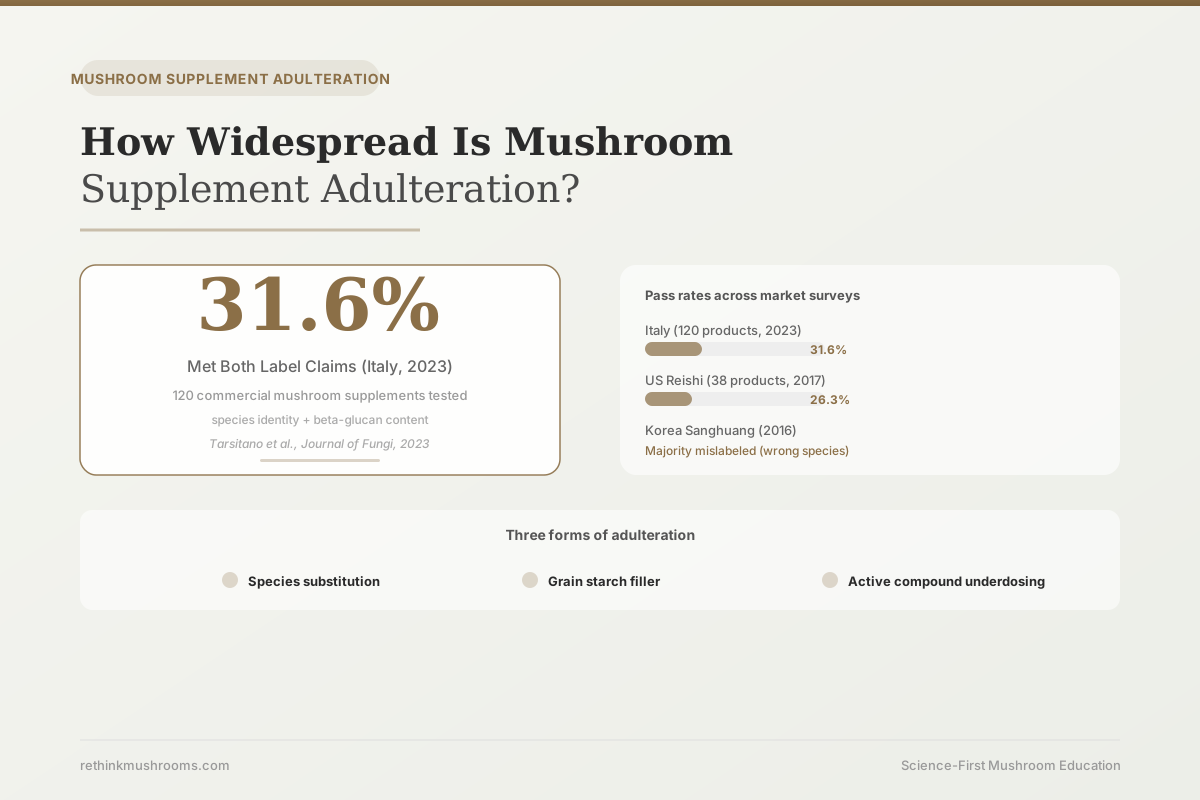
31.6% met label claims
Of 120 commercially available mushroom supplements tested across the Italian market, only 31.6% met label claims for both species identity and beta-glucan content, the most comprehensive quality survey of the mushroom supplement industry published to date.
Tarsitano et al., Journal of Fungi, 2023
26.3%
of 38 US reishi supplements met acceptable quality standards (Wu et al., 2017)
Species substitution
wrong mushroom species detected in commercial reishi and sanghuang products across multiple countries
2 types
species mislabeling and active compound underdosing are the two main adulteration forms
Tarsitano et al., Journal of Fungi, 2023
 View as image ↗
In 2023, a team of Italian researchers bought 120 mushroom supplements from the commercial market and tested each one against its own label. They checked two things: whether the species listed on the bottle was actually present, and whether the beta-glucan content matched the claimed amount. Only 31.6%, roughly 1 in 3, passed both tests.[1]
This was not an isolated result. A 2017 analysis of 38 reishi (Ganoderma lucidum) supplements sold in the United States found that only 26.3% were within acceptable quality range for both active compound content and species authenticity.[2] In Korea, a 2016 survey of commercial sanghuang (Phellinus linteus) products found that most contained the wrong species entirely.[6]
Mushroom supplement adulteration takes three main forms: selling a different mushroom species than the one on the label, filling products with grain starch from mycelium cultivation instead of the mushroom itself, and understating or overstating active compound content. The consistent finding across surveys from three countries and nearly two decades of analytical research is that two-thirds or more of products fail on at least one of these measures.
For context on the regulatory framework that allows this to persist, see How the FDA Regulates Mushroom Supplements: The DSHEA Framework.
Key Takeaways
- Of 120 mushroom supplements tested across Italy in 2023, only 31.6% met both species identity and beta-glucan content claims, the broadest quality survey of the market to date (Tarsitano et al., Journal of Fungi, 2023)
- Of 38 reishi supplements tested in the US in 2017, only 26.3% were within acceptable quality range for active compound content and species authenticity (Wu et al., Scientific Reports, 2017)
- Reishi (Ganoderma lucidum) supplements in the US were found to contain other Ganoderma species rather than the traditionally used G. lucidum, with species substitution quantified via DNA barcoding (Loyd et al., Frontiers in Microbiology, 2018)
- Commercial sanghuang (Phellinus linteus) products in Korea were predominantly mislabeled with wrong species, establishing that adulteration is not a Western market problem (Han et al., Journal of Microbiology, 2016)
- ITS (internal transcribed spacer) DNA barcoding has been validated as a reliable method for detecting species substitution in commercial mushroom supplements (Gunnels et al., PLoS ONE, 2020)
- A 2025 multi-technique analysis of commercial Chaga supplements found significant quality variation in active compound content, with the most rigorous analytical battery yet applied to a commercial mushroom supplement survey (Windsor, Kreynes, Chilton et al., Int J Mol Sci, 2025)
What Mushroom Supplement Adulteration Actually Is
Adulteration in mushroom supplements is not one problem; it is at least three, which is partly why the failure rates across studies are so high. A product can pass one test and fail another.
Species substitution means the product contains a different mushroom species from the one on the label, or a mixture of species that includes but is not limited to the labeled one. This matters because different species have different active compound profiles. A product sold as Ganoderma lucidum (reishi) that contains G. applanatum or G. tsugae instead is not interchangeable; the triterpenoid and polysaccharide profiles differ between species, and the clinical research base is species-specific.
Grain starch content is the dominant issue in products made from mycelium grown on grain substrate (oats, rice, wheat). The grain is never fully removed before processing, and the starch from the grain becomes part of the final supplement. Products labeled as providing polysaccharides may be counting the starch from the grain rather than the beta-glucan from the mushroom tissue. The two are chemically distinct and require different analytical methods to separate, a distinction that matters enormously for anyone buying a supplement for its immune-relevant beta-glucan content.
Active compound underdosing is the third form: products that contain the correct species but at substantially lower levels of active compounds than the label states. Some products listed high polysaccharide content using an analytical method that cannot distinguish between fungal beta-glucan and grain starch.
For a deep look at the starch filler problem specifically, see Starch Filler in Mushroom Supplements: The Dirty Secret.
Italy, 2023: The Most Comprehensive Survey Yet
Tarsitano et al. (2023) conducted what appears to be the most comprehensive quality survey of commercial mushroom supplements published to date, examining 120 products from the Italian market across multiple species including reishi, shiitake, chaga, lion's mane, and cordyceps.[1]
Their methodology combined DNA barcoding for species verification with quantitative analysis of beta-glucan content. The 31.6% pass rate applied to the strict criterion of meeting both species identity and beta-glucan label claims simultaneously. When the criteria were relaxed to species identity alone or beta-glucan alone, pass rates were somewhat higher, but the headline finding was that products passing on only one dimension were not reliable on the other.
Several patterns emerged from the data. Products made entirely from fruiting body material showed higher pass rates than products incorporating mycelium or myceliated biomass. Products from manufacturers with formal quality certifications outperformed uncertified products. Products imported from suppliers in countries with more regulated supplement markets generally performed better than those from markets with weaker supply chain oversight.
The Italy study is significant not just for its scale but for its methodology: it applied both analytical techniques in parallel. Most earlier surveys used one or the other. Combining species DNA verification with beta-glucan quantification exposed a category of products that passed a species test but failed on potency, a failure mode invisible to either test alone.
The US Data: Reishi Has the Longest Paper Trail
Wu et al. (2017) published the most detailed US-market quality analysis on record for a single mushroom species, reishi, examining 38 products collected from US retail and online channels.[2] Only 26.3% of products were within the acceptable quality range for both active compound content and species authenticity, a failure rate slightly worse than the Italy survey.
Their analysis included multiple analytical approaches: chemical profiling of polysaccharide and triterpenoid content, HPLC analysis of specific marker compounds, and species authentication testing. The majority of failing products were deficient in triterpenoid content specifically, the compound class most closely associated with reishi's clinical effects. Several products also contained Ganoderma species other than G. lucidum.
Loyd et al. (2018) followed up on the species question with a targeted DNA-based investigation of commercial reishi products in the US, specifically examining species composition.[4] Their findings confirmed significant species substitution. A meaningful portion of products labeled as Ganoderma lucidum contained other species from the Ganoderma genus, particularly G. applanatum and G. tsugae, either as the majority ingredient or alongside G. lucidum. These are visually similar fungi that are difficult to distinguish without molecular testing but have different bioactive profiles.
Combined, the Wu 2017 and Loyd 2018 studies establish that the US reishi market in the mid-2010s had a pervasive quality and authenticity problem. Whether the market has improved since then is not fully documented in independent peer-reviewed literature.
The Same Pattern Appears in Korea
Han et al. (2016) examined commercial sanghuang products in Korea, products sold as Phellinus linteus, a mushroom traditionally used in East Asian medicine with extensive preclinical research on anti-tumor and immunomodulatory properties.[6]
Their finding: most commercial sanghuang products tested were not Phellinus linteus. The products contained other Phellinus species, some with overlapping traditional uses but distinct chemistries, or species substitutions that were harder to explain. The scale of the mislabeling in the Korean market paralleled what US and European surveys found.
The Korea study matters for scope. Adulteration in mushroom supplements is sometimes framed as a Western regulatory problem, a consequence of the US DSHEA framework or European supplement law gaps. The Han 2016 data shows the same quality failures in a market with different regulatory structures. The driver appears to be the economics of the supply chain and the difficulty of verifying species identity without molecular testing, problems that are not jurisdiction-specific.
How We Know: DNA Barcoding Brings Certainty to Species Testing
Before molecular testing became widely available, species authentication in mushroom supplements relied on microscopy and chemical fingerprinting, methods that are imprecise when dealing with powdered, extracted, or encapsulated products where the visual and chemical signatures of the original organism are partially destroyed.
Gunnels et al. (2020) validated ITS (internal transcribed spacer) DNA barcoding as a reliable, sensitive method specifically for identifying Ganoderma species in commercial herbal supplements.[3] The ITS region is a short DNA sequence, roughly 600-800 base pairs, that varies between species but is highly conserved within them. It can be amplified via PCR from very small amounts of material, including degraded DNA in processed supplement powders, and cross-referenced against reference databases to confirm or refute a species identification.
The ITS method is what makes modern adulteration surveys possible. Earlier quality studies were limited to chemical analysis; ITS barcoding adds an independent and definitive biological identity check. The combination is what the Italy 2023 survey used to achieve its dual-pass methodology.
Commercial DNA testing services for mushroom supplements are now available. Eurofins launched a mushroom species ID testing service in partnership with LeafWorks in late 2024, initially covering shiitake and cordyceps and expanding in 2025 to include lion's mane, chaga, turkey tail, and reishi. This creates a pathway for brands to verify raw material identity before manufacturing, and for consumers to request verification documentation from brands they purchase from.
For a full explainer on how DNA testing works for mushroom supplements, see DNA Testing for Mushroom Supplements: Verifying Species Identity.
The 2025 Update: Chaga and Multi-Technique Analysis
Windsor, Kreynes, Chilton and colleagues (2025) published the most methodologically rigorous commercial mushroom supplement analysis in the literature, focusing on Chaga (Inonotus obliquus).[7] Their approach applied four analytical techniques in parallel to commercial products: NMR (nuclear magnetic resonance spectroscopy), HPTLC (high-performance thin-layer chromatography), quantitative beta-glucan assay, and comparative profiling against authenticated reference material.
Jeff Chilton, co-author and founder of NAMMEX (the industry's most recognized quality movement for mushroom ingredients), has been central to quality standard advocacy for more than a decade. His co-authorship lends the findings a distinctive credibility: this is not an outside critic finding problems, but a figure within the industry quantifying them with peer-reviewed rigor.
The findings confirmed significant quality variation across commercial Chaga products: products with substantially lower active compound content than labeled, and profiles inconsistent with authentic Inonotus obliquus reference material. The multi-technique approach showed that single-assay testing misses quality failures that only become visible when techniques are combined, reinforcing the Italy study's finding that dual-method testing reveals a category of failures invisible to either method alone.
The Windsor 2025 study is the most recent peer-reviewed quality survey in this space and updates the picture from a Chaga-specific angle. It adds to an evidence base that is now consistent across species (reishi, sanghuang, chaga), geographies (Italy, US, Korea), and testing methodologies.
Why Adulteration Persists: The DSHEA Regulatory Gap
The pattern across these surveys reflects a structural problem in the supplement industry, not a failure of individual brands. The regulatory framework governing dietary supplements in the United States, the Dietary Supplement Health and Education Act (DSHEA), passed in 1994, does not require pre-market testing or approval for safety, efficacy, or identity.[5]
Under DSHEA, a company can launch a mushroom supplement without demonstrating to any regulatory body that the product contains what the label says. The FDA can take action after a product is on the market, issuing warning letters, requiring recalls, pursuing enforcement, but the burden of proof falls on the FDA to identify a problem first. With thousands of supplement products in the market and limited enforcement resources, proactive testing coverage is necessarily thin.
Good Manufacturing Practices (GMPs) for dietary supplements require that manufacturers test identity, purity, strength, and composition of finished products. But the GMP rules do not specify what testing method to use, leaving discretion to manufacturers on whether their methods are adequate for the analytical challenge at hand. Total polysaccharide testing, which counts grain starch as polysaccharides, can satisfy a GMP testing requirement while producing a meaningless number for beta-glucan content.
The result is that a company using mycelium-on-grain with 5% actual beta-glucan can legally label a product "30% polysaccharides" if their testing method doesn't separate starch from fungal polysaccharide. This is not always fraud in the legal sense. It can be compliance with the letter of a regulatory framework that wasn't designed with mushroom supplement specifics in mind.
For an analysis of how FDA enforcement actually works in this space, see FDA Warning Letters to Mushroom Companies: What Gets Flagged. For the full DSHEA regulatory context, see FDA and Mushroom Supplements: How DSHEA Shapes What Companies Can (and Can't) Say.
What These Numbers Actually Mean for Consumers
The failure rates in these studies, 31.6%, 26.3%, similar proportions in Korea, describe market-wide averages, not a uniformly bad market. A meaningful minority of products in every survey passed all quality checks. Legitimate, high-quality mushroom supplements exist and can be identified by methodical label reading and requesting manufacturer documentation.
The research suggests certain signals correlate with quality: fruiting body material over mycelium-on-grain, specific beta-glucan percentages stated in the Supplement Facts panel (rather than "polysaccharides" as a proxy), and certificates of analysis showing the analytical method used and the alpha-glucan versus beta-glucan split. DNA verification of raw material species identity is now a commercially available capability that the most rigorous brands can provide.
For a practical consumer guide to evaluating products using these signals, see How to Spot Adulterated Mushroom Products.
The Bottom Line
Independent quality surveys from Italy (2023), the United States (2017), Korea (2016), and a 2025 multi-technique Chaga analysis consistently find that two-thirds or more of commercial mushroom supplements fail either species identity testing, active compound content claims, or both. The failure rates reflect a combination of supply chain economics (mycelium-on-grain is cheaper to produce), analytical method inadequacy (total polysaccharide tests count grain starch), and a regulatory framework under DSHEA that does not require pre-market authentication. DNA barcoding and specific beta-glucan assays are now the technical standard for detection; commercial testing services launched in 2024-2025 make brand-level verification more accessible.
Frequently Asked Questions
Sources & References
- 1. Source details for this reference are not yet available.
- 2RTHM-00499·Wu, Ding-Tao et al. (2017). “Evaluation on quality consistency of Ganoderma lucidum dietary supplements collected in the United States..” Scientific reports.Study breakdown →PubMed →↩
- 3RTHM-00615·Gunnels, Tess et al. (2020). “The ITS region provides a reliable DNA barcode for identifying reishi/lingzhi (Ganoderma) from herbal supplements..” PloS one.Study breakdown →PubMed →↩
- 4RTHM-00981·Loyd, Andrew L et al. (2018). “Identifying the "Mushroom of Immortality": Assessing the Ganoderma Species Composition in Commercial Reishi Products..” Frontiers in microbiology.Study breakdown →PubMed →↩
- 5. Source details for this reference are not yet available.
- 6RTHM-00783·Han, Jae-Gu et al. (2016). “Species identity of Phellinus linteus (sanghuang) extensively used as a medicinal mushroom in Korea..” Journal of microbiology (Seoul.Study breakdown →PubMed →↩
- 7RTHM-02209·Windsor, Coleton et al. (2025). “What This 2025 Chaga Supplement Authentication Study Actually Found.” International journal of molecular sciences.Study breakdown →PubMed →↩