Mushroom Supplement Adulteration
31.6% of Italian supplements matched their labelled species
Risoli and colleagues sequenced 19 mushroom-based supplements sold in Italy and found that only 6 of them — 31.6% — matched the species named on the label. A separate US survey of 19 reishi supplement batches found 5 (26.3%) whose measured ingredients accorded with their labels. Two small surveys, two continents, two different analytical questions, and results about five percentage points apart.
Risoli et al., Nutrients, 2023
6 of 19
Italian supplements whose DNA matched the species on the label; products sold as Ganoderma lucidum returned 100% and 99% homology with G. resinaceum and G. sichuanense instead (Risoli et al., Nutrients, 2023)
5 of 19
US reishi batches whose measured ingredients were consistent with their label claims, assessed by chromatographic methods and saccharide mapping (Wu et al., Scientific Reports, 2017)
Total ≠ beta-glucan
the validated assay derives beta-glucan by subtracting alpha-glucan (starch and glycogen) from total glucan; a 'polysaccharide' figure is the number before that subtraction happens (McCleary & Draga, AOAC, 2016)
Risoli et al., Nutrients, 2023
 View as image ↗
The mushroom supplement market has a quality problem that is not anecdotal. When researchers have taken commercial products off the shelf and analysed them, a majority have failed to match their own label claims. A 2023 survey of supplements sold in Italy found that only 6 of 19 products matched the species printed on the label.[1] A 2017 survey of US reishi supplements found that only 5 of 19 batches had measured ingredients consistent with their labels.[2]
Both of those are small surveys, and it is worth saying so plainly before going further: 19 samples is not a census of a global market. What makes them worth taking seriously is that they were run on different continents, by different groups, using different analytical methods, asking somewhat different questions — and landed about five percentage points apart.
This is also not primarily a story about fraud in the criminal sense. Much of it flows from industry practices that are legal under the current regulatory framework but yield products whose medicinal compound content is lower, or whose identity is other, than the label implies. Understanding why it happens is what makes it possible to identify products that avoid the problem.
For context on the regulatory framework that allows this to persist, see how the FDA regulates mushroom supplements: the DSHEA framework.
Key Takeaways
- Risoli and colleagues sequenced 19 mushroom-based supplements on the Italian market and found only 6 (31.6%) matched the species named on the label; products labelled Ganoderma lucidum returned 100% and 99% homology with G. resinaceum and G. sichuanense instead (Risoli et al., Nutrients, 2023)
- Wu and colleagues assessed 19 batches of US reishi supplements by chromatographic methods and saccharide mapping, and found the measured ingredients of only 5 (26.3%) accorded with their labels (Wu et al., Sci Rep, 2017)
- Both surveys are small (19 samples each) and neither is a representative sample of the market — their value is that two independent efforts converged, not that either one settles the prevalence question
- "Total polysaccharides" is not the same number as beta-glucan: the validated assay measures total glucan, separately measures alpha-glucan (starch and glycogen), and reports beta-glucan as the difference, so a polysaccharide figure is the number before starch is subtracted out (McCleary & Draga, AOAC, 2016)
- ITS DNA barcoding reliably placed all 7 reishi supplement samples Gunnels and colleagues tested within the expected Ganoderma lingzhi clade, but Risoli's results show its limit — close relatives can return near-identical matches, which is why commercial services launched in 2024–2025 use species-specific markers instead (Gunnels et al., PLoS ONE, 2020)
- DSHEA exempts dietary supplements from pre-market approval and does not require efficacy to be demonstrated, leaving quality surveillance largely to independent researchers and to consumers (Bailey, Crit Rev Food Sci Nutr, 2020)
What the Quality Research Shows
Two surveys provide the clearest published picture, and they are worth reading carefully because they did not measure the same thing.
Risoli et al. (2023) · Nutrients
- Population
- 19 mushroom-based dietary supplements sold as single-component products in Italy
- Intervention
- Molecular identification by DNA sequence comparison against GenBank deposits, plus determination of ergosterol, aflatoxins, heavy metals, nicotine and total glucan
- Finding
- 6 of 19 samples (31.6%) matched the species indicated on the label — Lentinula edodes in samples 1, 4, 12 and 18, and Ganoderma lucidum in samples 5 and 10. Samples labelled as G. lucidum returned sequences with 100% and 99% homology to G. resinaceum and G. sichuanense, meaning the material was Ganoderma but not the species claimed.
narrow-scope A 19-sample survey of one national market. The 31.6% figure describes label-to-species agreement in this sample; it is not an estimate of adulteration prevalence across the global supplement market.
Risoli et al., Nutrients, 2023
Risoli and colleagues were asking an identity question: is the organism in this capsule the organism on the label? The answer, for two-thirds of the products, was no — and the Ganoderma results are the most instructive part. Those samples were not filled with something random. They contained genuine Ganoderma, closely enough related to return a near-perfect database match, and still not the species being sold.
Wu et al. (2017) · Scientific Reports
- Population
- 19 batches of Ganoderma lucidum (red reishi) herbal and mushroom supplements purchased in the United States
- Intervention
- Evaluation of bioactive components including triterpenes and polysaccharides using chromatographic methods and saccharide mapping
- Finding
- The measured ingredients of only 5 of the 19 tested samples (26.3%) were in accordance with their labels. The authors concluded that the quality consistency of G. lucidum dietary supplements in the US market was poor and warranted careful investigation.
narrow-scope Single-species, single-market, 19 batches. It measures agreement between label and measured composition, which is a different question from the species-identity question Risoli asked.
Wu et al., Scientific Reports, 2017
Wu and colleagues were asking a composition question: does the chemistry in this capsule match what the label says is in it? Different question, different instruments, comparable answer.
Neither survey tested fringe products from obscure sellers; both drew from ordinary retail supply. But neither sampled randomly or at scale, and no published survey to date establishes what share of the overall mushroom supplement market is mislabelled. The honest summary is that every time researchers have looked closely at a small basket of products, a majority have failed on something — which is a reason for buyer diligence, not a precise prevalence figure.
For a broader look at the scope of the problem across mushroom supplement types, see mushroom supplement adulteration: how widespread is the problem?.
The Root Cause: Why Most Adulteration Is Industry Practice, Not Fraud
The primary driver is the difference between fruiting body and mycelium-on-grain as starting material.
Fruiting bodies are the part of the mushroom most people recognise: the cap and stem. This is the material that most of the published compound measurements were made on.
Mycelium on grain is a different product. The mushroom's thread-like mycelium — the root-like network — is grown on a grain substrate, typically rice, then dried and ground. The grain substrate is not separated out before processing, so it forms part of the finished powder.
This is where a claim frequently repeated in consumer coverage needs care. Specific percentage figures for the beta-glucan and starch content of commercial mycelium-on-grain products circulate widely and are routinely attributed to the standard assay paper, but that paper is a method validation study and does not report them. What the published evidence does support is the direction rather than the magnitude: Windsor and colleagues, comparing chaga dietary supplements by several complementary analytical techniques, used beta-glucan quantification alongside iodine-starch assays to confirm a starch-rich composition in fermented grain products and its absence in authentic chaga canker.[5] Their NMR fingerprinting and mass-spectrometry metabolomics showed what they described as stark compositional deviations between wildcrafted canker, Inonotus obliquus mycelium, and fermented grain products.
So: grain-substrate products are compositionally different from fruiting body material, and starch is the signature of that difference. How much starch, in any given product on a shelf, is not something the cited literature pins down.
The measurement problem compounds the sourcing problem, and it is worth understanding exactly how.
Reading the assay
Why beta-glucan is a subtraction, and what a “polysaccharide” number leaves in
The validated method does not detect beta-glucan directly. It measures everything, then measures the starch fraction, then subtracts. A label figure that skips the middle step is reporting step 1 on its own.
- 1Everything
Total glucan measured
Controlled acid hydrolysis breaks every glucan chain in the sample down to glucose, and the glucose released is measured. At this point fungal beta-glucan and grain starch are counted together, indistinguishably.
MethodH2SO4 hydrolysis, then glucose oxidase/peroxidase (GOPOD) reagent
- 2Starch
Alpha-glucan measured separately
A second, enzyme-specific run targets only starch and glycogen, plus free glucose and glucose from sucrose. This is the substrate-derived fraction — the part that is not fungal cell wall.
MethodGlucoamylase (starch/glycogen) and invertase (sucrose), then GOPOD
- 3What you want
Beta-glucan obtained by difference
Beta-glucan is not read off an instrument. It is what remains after the alpha-glucan number is subtracted from the total glucan number. If step 2 never happens, step 3 cannot happen either.
MethodTotal glucan minus alpha-glucan
So what does each label word actually report?
- “Total polysaccharides”
- Step 1 reported on its own. Fungal beta-glucan and any substrate starch are both inside this figure, and nothing in it separates them.
- “Beta-glucan”
- Step 3. The alpha-glucan fraction has been measured and taken out, so what remains is attributable to fungal cell wall rather than to grain.
No source cited in this article quantifies the beta-glucan or starch content of any particular commercial mycelium-on-grain product, and no percentage here should be read as a regulatory threshold. The point is the arithmetic, not a pass mark.
Method and values: McCleary & Draga, Journal of AOAC International, 2016.
Because beta-glucan is obtained by subtraction, a "total polysaccharides" figure is simply the first measurement reported on its own. Nothing has been taken out of it. If the material contains substrate starch, the starch is inside that number.
Mycelium-on-grain is also cheaper to produce than fruiting body material. The economic incentive is real, the practice is legal, and a polysaccharide-based label figure does not expose it.
Fact check
Does a high polysaccharide percentage mean a potent product?
The claim
“A supplement standardised to 30% polysaccharides is a strong product, because polysaccharides are the active compounds in medicinal mushrooms.”
Polysaccharide standardisation is genuinely the oldest and most widespread way mushroom extracts have been specified, and beta-glucan is a polysaccharide — so the term is not invented, just imprecise.
What research shows
MisleadingThe validated method reports beta-glucan as total glucan minus alpha-glucan, where alpha-glucan is starch and glycogen. A polysaccharide figure has not had that subtraction applied, so grain starch counts toward it on equal terms with fungal cell wall beta-glucan.
This does not mean every product reporting polysaccharides is starch-heavy — plenty of honest fruiting-body products report the figure simply because it is the industry convention. It means the number cannot distinguish the two cases, so it cannot be used as evidence either way. The fix is not to distrust the brand; it is to ask for the figure with the subtraction performed.
McCleary & Draga, Journal of AOAC International, 2016
For a deeper look at the starch-filler issue specifically, see starch filler in mushroom supplements: the dirty secret.
Red Flags: What Poor-Quality Products Look Like
The following warning signs are identifiable from publicly available label and brand information, without any laboratory testing. None of them proves a product is adulterated — each one marks an absence of verifiable commitment.
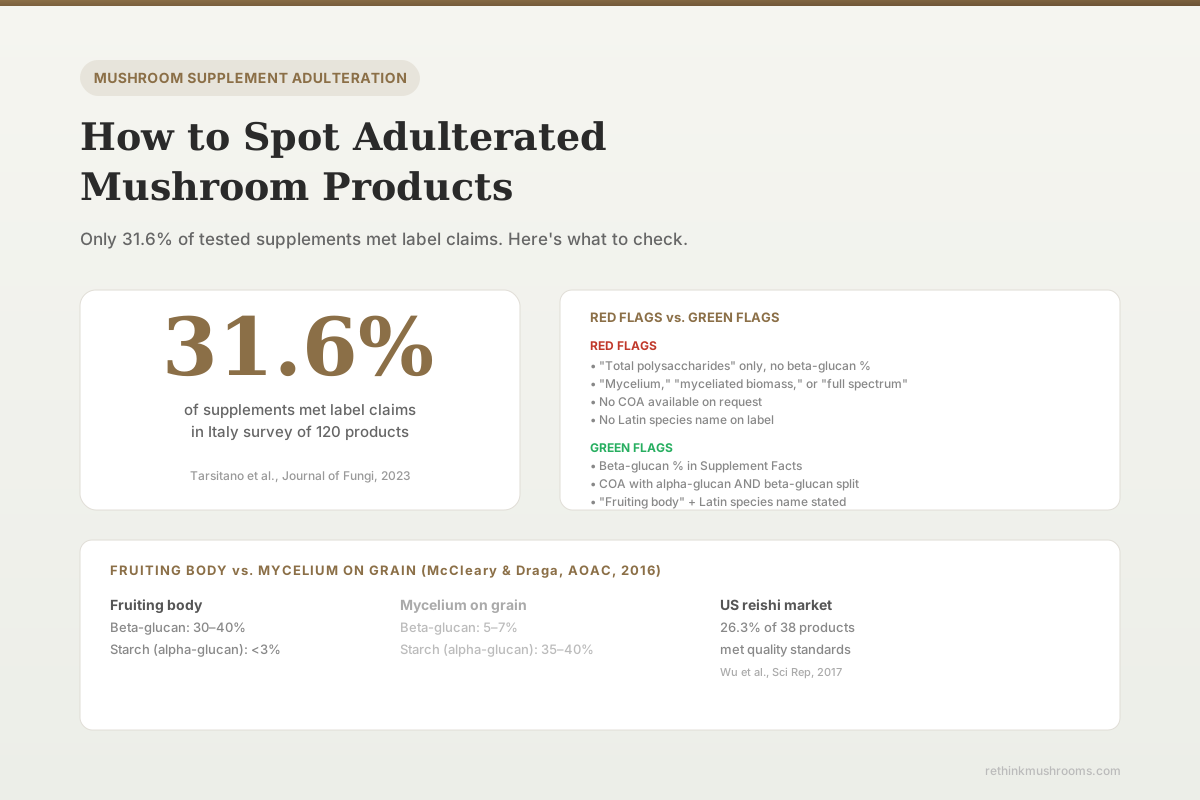
Red flag 1: "Total polysaccharides" listed, but no beta-glucan percentage. As above, a polysaccharide figure cannot distinguish fungal beta-glucan from grain starch, because it is the measurement taken before the starch fraction is subtracted. The absence of a specific beta-glucan percentage means there is no stated commitment to the compound that the research is about.
Red flag 2: "Mycelium," "myceliated biomass," or "full-spectrum mushroom" in the ingredient list. The first two indicate mycelium rather than harvested fruiting bodies, which means substrate is likely part of the product. "Full spectrum" is a marketing term with no regulatory definition and no enforced standard behind it — it is not a quality descriptor and does not imply anything measurable.
Red flag 3: No Certificate of Analysis (COA) available on request. Reputable brands can produce a third-party COA for the batch. If a brand cannot or will not provide one, there is no external verification of any label claim.
Red flag 4: Species name absent or ambiguous on the label. "Mushroom blend," "proprietary mushroom complex," or a common name with no Latin binomial gives you nothing to verify against. This matters directly: Risoli's samples that failed were failing on species identity, and the Ganoderma results show that even correct-genus material can be the wrong species.[1] A label that never names the species has ruled out the check in advance.
Green Flags: What High-Quality Products Provide
Green flag 1: A beta-glucan percentage in the Supplement Facts panel. A specific beta-glucan figure, as distinct from polysaccharides, indicates the brand has commissioned the assay that performs the subtraction rather than the one that does not.[3] Be wary of treating any particular percentage as a pass mark: there is no regulatory minimum, published values vary by species and by extraction, and a figure quoted without a stated method is not comparable across brands. What the presence of the number tells you is that the measurement was made at all.
Green flag 2: A COA showing both alpha-glucan and beta-glucan levels. A certificate that lists alpha-glucan and beta-glucan separately tells you the medicinal fraction and the starch fraction as two distinct numbers. This is the single most informative document a brand can provide, and the ratio between the two is more revealing than either figure alone.
Green flag 3: "Fruiting body" explicitly stated in the ingredient description. When a label states "Hericium erinaceus fruiting body" or "Ganoderma lucidum fruiting body," the manufacturer is making a specific, falsifiable raw-material claim rather than an unfalsifiable one.
Green flag 4: Species identity confirmed by an appropriate DNA method. This one requires more care than it usually receives, because not all DNA verification resolves the same question.
Verifying species identity
Four ways to answer “is this actually the species on the label?”
Each rung resolves something the one below it cannot. The bar shows how finely each method can separate one species from its close relatives — the distinction the surveys found products failing on.
- 1No resolution
The species name printed on the label
AnswersWhat the manufacturer asserts the product is.
LimitIt is a claim, not a measurement. A common name with no Latin binomial ("reishi", "mushroom blend", "proprietary complex") does not even identify which organism is being asserted.
Description of labelling practice, not a study finding
- 2Lost in powder
Morphological or biochemical inspection
AnswersWhich species a visible, intact specimen is.
LimitPowdering and extraction destroy the structures this depends on. Gunnels and colleagues reach for DNA methods precisely because supplement material can no longer be verified this way.
Gunnels et al., PLoS ONE, 2020
- 3Genus-reliable
ITS barcoding matched against a public sequence database
AnswersWhether the DNA present falls within the expected group. Reliable enough at genus level that Gunnels and colleagues confirmed Ganoderma DNA in all 7 reishi samples they sequenced.
LimitClose relatives can return near-identical matches. Risoli and colleagues found supplements labelled G. lucidum returning 100% and 99% homology with G. resinaceum and G. sichuanense — the match is real, the species on the label is still wrong.
Gunnels et al., PLoS ONE, 2020; Risoli et al., Nutrients, 2023
- 4Species-targeted
Species-specific qPCR markers
AnswersWhether one named species is present, using markers designed to separate it from close relatives and common substitutes, including within blends.
LimitCommercially available since 2025 for a handful of species, and the validation claims come from the companies selling the assays rather than from independent peer-reviewed evaluation. A brand has to have commissioned the test and be willing to show you the result.
Company announcements (Eurofins Botanicals / LeafWorks, 2024–2025) — not peer-reviewed
Rung 3 is where most consumer-facing “DNA verified” language sits. It is a real method with a real result, and it is also the rung on which Risoli and colleagues watched three different Ganoderma species return confident matches.
Gunnels et al., PLoS ONE, 2020; Risoli et al., Nutrients, 2023. Rung 4 reflects commercial product announcements, which have not been independently evaluated in the peer-reviewed literature.
Gunnels and colleagues validated ITS barcoding for reishi by amplifying and sequencing the internal transcribed spacer region with genus-specific primers across seven supplement samples — six powdered, one dried — and both best-hit BLAST and phylogenetic analysis placed all seven within a large Ganoderma lingzhi clade.[4] That is a genuine result, and it is also a seven-sample study of a single genus.
Risoli's findings show where the method's resolution runs out: sequence matching against a public database returned 100% and 99% homology to the wrong Ganoderma species.[1] The match was confident and the species was still wrong. Commercial mushroom DNA identification services launched by Eurofins Botanicals and LeafWorks in 2024 and 2025 responded to exactly this gap, using species-specific qPCR markers rather than universal markers matched against public databases. Those are company announcements rather than peer-reviewed evaluations, and should be read as such — but the distinction they draw is the same one Risoli's data demonstrates.
Reviewing the analytical landscape for botanical label-claim verification, You and colleagues place chromatographic, spectroscopic and DNA-based approaches side by side as the recognised toolkit, and note that top-selling botanical ingredients including functional mushrooms have been subject to inaccurate labelling through the addition of lower-grade ingredients, non-target plants and synthetic compounds.[6]
For more on the DNA testing methodology and what it can and cannot verify, see DNA testing for mushroom supplements: verifying species identity.
How to Read a Certificate of Analysis
A COA is a laboratory report issued for a specific batch. Here is what to look for in a mushroom supplement COA:
Alpha-glucan vs. beta-glucan split. This is the most important line. The enzymatic and acid-hydrolysis method separately quantifies alpha-glucan so that beta-glucan can be reported as the difference.[3] A certificate reporting only "polysaccharides" has not done this, and a certificate reporting beta-glucan without showing the alpha-glucan figure has done it but is not showing its work.
Heavy metals panel. Mushrooms take up metals from their substrate, so a complete COA should show testing for lead, arsenic, cadmium and mercury against stated thresholds. Risoli's group measured heavy metals alongside identity for this reason.[1]
Microbial testing. Yeast, mould, total plate count and specific pathogens should be within stated limits.
Batch/lot number. The COA should correspond to the lot number on the product in your hand. A certificate with no lot number does not describe the batch you received.
If a brand cannot provide a current batch COA showing the alpha/beta-glucan split, there is no independent verification of the beta-glucan claim — whatever the label says.
Where to spend your effort
Three tiers of check, and the question each one actually answers
Ordered by what they cost you. Each check is paired with what it cannot establish, because most consumer confusion comes from a cheap check being read as if it settled an expensive question.
What the label alone will tell you
FreeBefore you buy
This tier costs nothing and eliminates the most products. It cannot confirm quality — it can only reveal whether the brand has committed to anything checkable.
Is there a Latin binomial, not just a common name?
Tells youWhether the brand has identified which organism it claims to be selling at all.
Does not tell youWhether that organism is what is in the capsule.
Does it say "fruiting body" or "mycelium"?
Tells youWhich starting material the brand is willing to put in writing, which is the input that determines whether substrate is part of the product.
Does not tell youHow much substrate is present. The word is a sourcing claim, not a measurement.
Is a beta-glucan percentage given, or only "polysaccharides"?
Tells youWhether the brand is reporting the number that had starch subtracted out, or the number that did not.
Does not tell youWhether the stated percentage is accurate. That requires the certificate.
What a certificate of analysis adds
One emailAsk before or after purchase
A batch certificate is the highest-value document a buyer can obtain, and whether a brand will produce one is itself informative.
Alpha-glucan and beta-glucan reported separately
Tells youThe medicinal fraction and the starch fraction as distinct numbers, which is the whole point of the validated assay.
Does not tell youSpecies identity. Glucan chemistry does not tell you which mushroom the glucan came from.
A lot number matching the bottle in your hand
Tells youThat the document describes the batch you actually received.
Does not tell youAnything about other batches. A generic certificate with no lot number is a marketing document.
Heavy metals and microbial panels
Tells youWhether contaminant testing was performed against stated thresholds, which matters because mushrooms take up metals from their substrate.
Does not tell youPotency or authenticity — these are safety panels, not identity panels.
A home iodine drop test
Tells youA qualitative indication that starch is present, since iodine turns blue-black with starch and not with fungal beta-glucan.
Does not tell youHow much starch. It screens for a direction, not a quantity, and it is not a substitute for the assay.
What only instrumentation resolves
LaboratoryRealistically the brand’s job, not yours
These are the methods the published surveys used. They are listed so the reader can recognise them on a certificate, not because a consumer is expected to commission them.
DNA-based species identification
Tells youWhich species the material genuinely is — subject to the resolution limits of the specific method used.
Does not tell youPotency, contamination, or how the material was processed.
Chromatographic and spectroscopic profiling
Tells youWhether marker compounds characteristic of the claimed species are present at plausible levels.
Does not tell youAnything a buyer can act on directly, unless the brand publishes the result.
The tiers are cumulative in cost but not in coverage: no tier answers every question, and the identity question and the potency question are answered by different instruments entirely.
Method categories from You et al., Critical Reviews in Food Science and Nutrition, 2024; glucan assay from McCleary & Draga, Journal of AOAC International, 2016; iodine-starch screening from Windsor et al., International Journal of Molecular Sciences, 2025.
The Home Iodine Test
For a quick qualitative check, iodine screens for starch. Iodine turns blue-black in the presence of starch — alpha-glucan — and does not produce that reaction with fungal beta-glucan. This is not a folk method: iodine-starch assays were among the techniques Windsor and colleagues used to distinguish starch-rich fermented grain products from authentic chaga material, in combination with beta-glucan quantification and several instrumental methods.[5]
The test: disperse a small amount of the supplement in water, add a few drops of iodine solution, and observe the colour. Blue-black indicates starch is present. No colour change suggests starch is low or absent.
Practical safety
ModerateIodine solution is a diagnostic reagent, not something to consume
Concern
The home starch test involves iodine solution such as Lugol's or tincture of iodine. These are topical or laboratory preparations. Ingesting them, or drinking a test sample after adding them, can cause gastrointestinal irritation and — with repeated or larger exposures — interfere with thyroid function. Iodine also stains skin, fabric and surfaces.
What the research says
Run the test in a disposable or dedicated container, discard the tested material rather than consuming it, keep the solution away from children, and follow the handling directions on the product you bought. Do not use the tested portion of supplement afterwards.
Particularly relevant for: Anyone with thyroid disease, iodine sensitivity, or who is pregnant or breastfeeding should be particularly cautious with iodine preparations and should speak to a clinician before handling them.
What to do
Test a small sample you intend to throw away.
General handling guidance for iodine preparations; the analytical use of iodine-starch assays is described in Windsor et al., International Journal of Molecular Sciences, 2025
Why This Situation Persists Under Current Regulation
Under the Dietary Supplement Health and Education Act of 1994, dietary supplements are regulated as a category of food and do not require pre-market FDA approval. DSHEA set out the legal definition, labelling requirements and adverse event reporting process, and the FDA has issued current Good Manufacturing Practice guidance covering preparation, packaging, labelling and storage. But as Bailey summarises, efficacy is not required under US law, and the resulting quality and safety of available products can be highly variable — especially for botanical and herbal products.[7] The constraints she identifies are structural: the sheer number of products and manufacturing facilities, and a lack of validated analytical methods covering every ingredient in the marketplace.
The scale problem has grown considerably. Reviewing thirty years of DSHEA, Wallace and Koturbash note that the US supplement market went from roughly 4,000 products in 1994 to more than 80,000 today, representing a domestic market of about $60 billion.[8] They record that scientists, public health officials, clinicians, consumer advocacy organisations and the FDA itself have all called for reform of what has been described as outdated regulation, and identify trustworthy supply chains, increased adherence to quality standards, additional labelling requirements and enhanced post-market surveillance as what a safer marketplace would require.
The FDA can act against products found to be unsafe or misbranded after they reach market, but enforcement capacity is limited relative to a market of that size. Both quality surveys discussed in this article were conducted by independent academic researchers, not by regulators.
For detail on how FDA enforcement actually works for mushroom supplements, see FDA and mushroom supplements: how DSHEA shapes what companies can and can't say and FDA warning letters to mushroom companies: what gets flagged.
For context on related claims like GRAS status and what they actually certify, see GRAS status for mushroom ingredients: what it means.
The Bottom Line
Two independent surveys found most sampled mushroom supplements inconsistent with their labels: 6 of 19 Italian products matched their labelled species (Risoli et al., 2023) and 5 of 19 US reishi batches had measured ingredients accordant with their labels (Wu et al., 2017). Both are small, single-market samples and neither establishes market-wide prevalence. The recurring mechanism is industry practice rather than deliberate fraud — mycelium grown on grain carries its substrate into the finished powder, and standard "polysaccharide" figures cannot expose it because the validated assay derives beta-glucan by subtracting alpha-glucan from total glucan, a subtraction a polysaccharide number has never had applied (McCleary & Draga, 2016). Windsor et al. (2025) confirmed starch-rich composition in fermented grain products and its absence in authentic material. Practical verification runs in tiers: read the label for a Latin binomial, a fruiting-body claim and a beta-glucan percentage; request a batch COA showing the alpha/beta-glucan split; treat a home iodine test as a screen for starch rather than a measurement. DNA verification is real but method-dependent — ITS barcoding placed all 7 reishi samples in the right clade (Gunnels et al., 2020) yet returned 99–100% homology to the wrong Ganoderma species in Risoli's sample. Because DSHEA requires no pre-market approval and no demonstration of efficacy (Bailey, 2020) across a market that has grown from about 4,000 products to over 80,000 (Wallace & Koturbash, 2025), consumer-level verification remains the primary check available at the point of purchase.
This article is educational and is not medical advice. It describes how to evaluate product quality documentation, not whether any mushroom supplement is appropriate for you. Talk to a qualified healthcare professional before starting a supplement, particularly if you are pregnant or breastfeeding, take prescription medication, or have a diagnosed health condition.
Frequently Asked Questions
Sources & References
- 1RTHM-01778·Risoli, Samuele et al. (2023). “Mushroom-Based Supplements in Italy: Let's Open Pandora's Box..” Nutrients.Study breakdown →PubMed →↩
- 2RTHM-00499·Wu, Ding-Tao et al. (2017). “Evaluation on quality consistency of Ganoderma lucidum dietary supplements collected in the United States..” Scientific reports.Study breakdown →PubMed →↩
- 3RTHM-00438·McCleary, Barry V et al. (2016). “Measurement of β-Glucan in Mushrooms and Mycelial Products..” Journal of AOAC International.Study breakdown →PubMed →↩
- 4RTHM-00615·Gunnels, Tess et al. (2020). “The ITS region provides a reliable DNA barcode for identifying reishi/lingzhi (Ganoderma) from herbal supplements..” PloS one.Study breakdown →PubMed →↩
- 5RTHM-02209·Windsor, Coleton et al. (2025). “What This 2025 Chaga Supplement Authentication Study Actually Found.” International journal of molecular sciences.Study breakdown →PubMed →↩
- 6RTHM-02031·You, Hong et al. (2024). “Label compliance for ingredient verification: regulations, approaches, and trends for testing botanical products marketed for "immune health" in the United States..” Critical reviews in food science and nutrition.Study breakdown →PubMed →↩
- 7RTHM-01165·Bailey, Regan L (2020). “Current regulatory guidelines and resources to support research of dietary supplements in the United States..” Critical reviews in food science and nutrition.Study breakdown →PubMed →↩
- 8RTHM-02200·Wallace, Taylor C et al. (2025). “DSHEA 1994 - Celebrating 30 Years of Dietary Supplement Regulation in the United States..” Journal of dietary supplements.Study breakdown →PubMed →↩