Reishi Foundation & Science
93% mislabeled
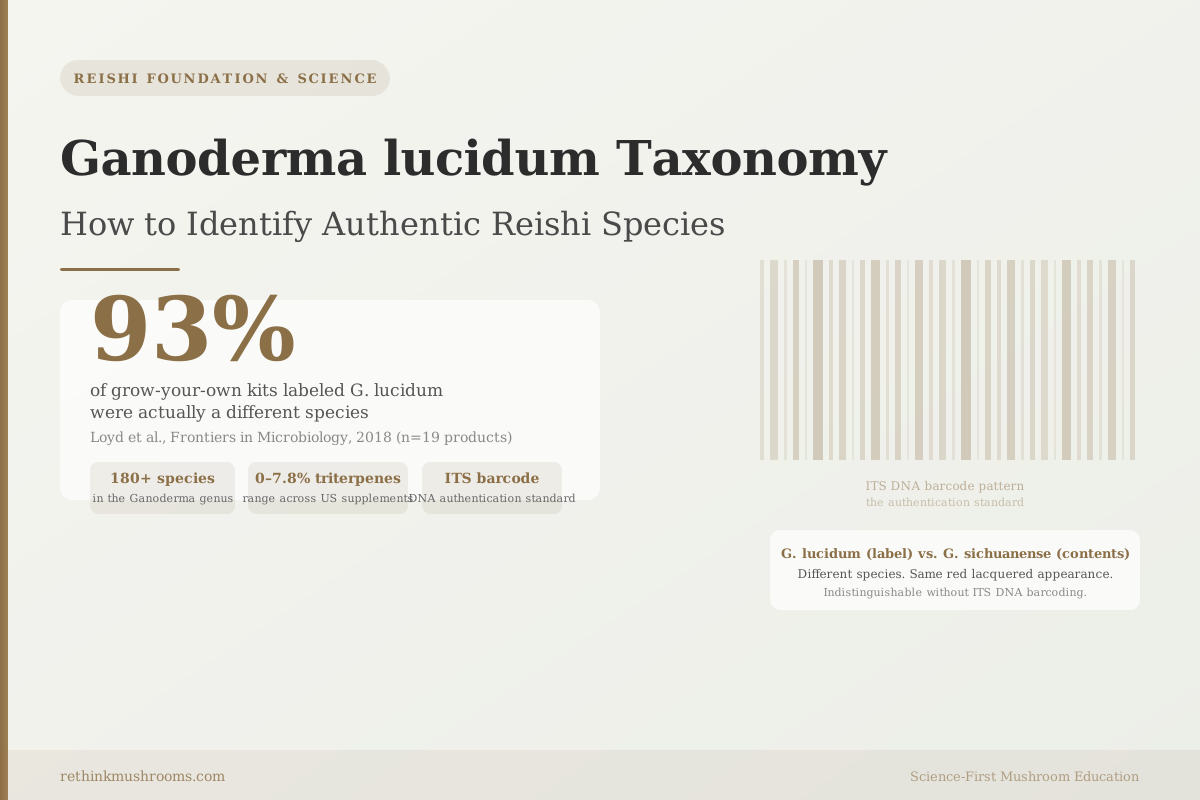
In a 2018 DNA analysis of 19 commercial reishi products, 93% of grow-your-own kits labeled Ganoderma lucidum actually contained a different species, G. sichuanense. The supplement label and the contents were two different organisms.
Loyd et al., Frontiers in Microbiology, 2018
180+
described Ganoderma species worldwide
0–7.8%
triterpene content range across 11 US reishi supplements (Wu et al., 2017)
ITS barcode
the gold-standard DNA method for authenticating Ganoderma species
Loyd et al., Frontiers in Microbiology, 2018
 View as image ↗
Pick up any reishi supplement and the label almost certainly says Ganoderma lucidum. That name appears on bags of dried mushroom, capsule bottles, and tinctures across the world. There's one problem: it's almost certainly taxonomically wrong.
A 2018 study by Loyd and colleagues tested 19 commercial reishi products using DNA barcoding. In grow-your-own kits labeled G. lucidum, 93% actually contained G. sichuanense. In dried products, half were mislabeled. The mushroom in the package was not the species on the label.[2]
This isn't a story about fraud. It's a story about taxonomy catching up with commercial labeling practices that are decades old. Understanding Ganoderma lucidum taxonomy requires understanding why the name got so confused in the first place, what the DNA evidence now shows, and why the distinction matters for anyone buying reishi products.
This article is one of five in our Reishi Foundation cluster. For the full overview of reishi's research profile, start with What Is Reishi Mushroom? The Science Behind the "Mushroom of Immortality".
Key Takeaways
- A 2018 DNA analysis of 19 commercial reishi products found 93% of grow-your-own kits and 50% of dried products labeled G. lucidum actually contained G. sichuanense, a different species
- G. lucidum sensu stricto (in the narrow, technically correct sense) is a European species; the Asian medicinal mushroom used in traditional medicine is G. lingzhi, reclassified in 2012
- The ITS region of ribosomal DNA is the validated molecular barcode for distinguishing Ganoderma species in herbal supplements, confirmed in a 2020 study by Gunnels and colleagues
- Species mislabeling correlates with compound content variation: a 2017 analysis of 11 US reishi supplements found triterpene content ranging from undetectable to 7.8% and polysaccharide content from 1.1% to 5.8%
- Morphological identification of Ganoderma species is unreliable without DNA confirmation because several species share the lacquered red cap appearance traditionally associated with G. lucidum
- Authentic reishi supplements should specify the species name (G. lingzhi or G. sichuanense), state the plant part used (fruiting body vs. mycelium), and ideally provide third-party testing showing beta-glucan and triterpene content
The 93% Problem: What DNA Testing Found in Commercial Reishi Products
In 2018, Loyd and colleagues at the University of Tennessee collected 19 commercially available reishi products and subjected them to DNA barcoding analysis. The methodology was straightforward: extract DNA from each product, amplify the internal transcribed spacer (ITS) region of the ribosomal DNA, and compare the sequence to a reference database of known Ganoderma species.[2]
The results were striking. In grow-your-own kits, which market the living mushroom spawn to cultivators, 93% of products labeled G. lucidum contained G. sichuanense instead. In dried mushroom products, 50% were mislabeled. Even among finished supplements, the species identity rarely matched what was printed on the label.[2]
This finding wasn't isolated. A separate 2020 study by Gunnels and colleagues validated the ITS barcoding approach and confirmed its reliability for distinguishing Ganoderma species in herbal supplements. The authors specifically addressed authentication in the commercial supply chain, providing the scientific standard against which any verification claim should be judged.[1]
Why does this happen so consistently? The answer lies in the taxonomy itself.
Why G. lucidum on the Label Is Almost Always Wrong
The name Ganoderma lucidum has a specific technical meaning in mycology. G. lucidum sensu stricto (the species in the narrow sense, as originally described) is a European fungus. Its native range centers on Europe. The Asian mushroom that has been used medicinally for two millennia in China, Japan, and Korea is a different organism.
The Asian medicinal species was formally separated and reclassified as Ganoderma lingzhi by Sheng H. Wu, Y.C. Dai, and Ryvarden in 2012. Before that reclassification, the two species had been lumped under the G. lucidum umbrella for decades, because they share a similar appearance. The name G. sichuanense, found in most of Loyd's commercial samples, refers to yet another closely related but distinct species that is widely cultivated in China.
The practical consequence: the name G. lucidum on a commercial reishi product is almost certainly a legacy label applying a European scientific name to an Asian fungus, one that has been taxonomically distinguished for over a decade but where commercial nomenclature hasn't caught up.
This is compounded by the size of the genus. Ganoderma includes over 180 described species worldwide. Many share a lacquered, kidney-shaped cap appearance. Visual identification alone cannot reliably distinguish them.
For readers interested in how the different species compare in terms of their compound profiles and medicinal properties, Red Reishi vs. Other Ganoderma Species: Key Differences covers this in depth.
The ITS Barcode: How Scientists Identify Ganoderma Species
Morphological identification — looking at physical features like cap shape, surface texture, pore density, and spore characteristics — was the traditional method for distinguishing fungi. For many common species it works reasonably well. For Ganoderma, it doesn't. Multiple species within the genus share too many visual features to be reliably distinguished by appearance alone.
Molecular authentication using the ITS region of ribosomal DNA is the current scientific standard. The ITS region (formally: the internal transcribed spacer 1 and 2 regions flanking the 5.8S gene in ribosomal RNA) evolves fast enough between species to serve as a reliable genetic fingerprint but conserved enough within species to be consistent across samples.
Gunnels and colleagues' 2020 study validated this approach specifically for Ganoderma in herbal supplement contexts. The authors demonstrated that ITS sequencing reliably distinguishes the commercially relevant Ganoderma species from each other with high confidence, making it the preferred method for supplement authentication.[1]
In practice, ITS barcoding works like this: extract the ITS region from the product DNA, sequence it, and compare to the NCBI GenBank database or a curated Ganoderma reference library. The result is a species match with a percentage similarity score. Reputable supplement manufacturers who invest in molecular authentication provide a Certificate of Analysis (CoA) that includes species identity confirmed by ITS analysis.
Most manufacturers don't do this. The 93% mislabeling rate in the Loyd study reflects how rarely this verification actually happens in the supply chain.
What Authentic Reishi Looks Like: Morphological Clues
Morphological identification won't confirm species identity, but it can screen for obvious adulteration. Here's what Ganoderma lingzhi (the Asian medicinal species most likely to be in a legitimate reishi product) actually looks like in its mature fruiting form:
Cap (pileus): Kidney- to fan-shaped, typically 5-25 cm across. The upper surface is glossy and lacquered, with a warm reddish-brown to dark red color, often with concentric zones of different shades. The lacquered appearance is caused by thick-walled surface cells secreting shiny compounds.
Stem (stipe): Lateral (attached to the side of the cap), often with a darker surface. Wild specimens may have a long, twisted stem. Cultivated specimens often have shorter, thicker stems.
Pore surface: The underside is covered in tiny pores (not gills). Fresh specimens have a white to cream pore surface that bruises brownish. Dried pore surfaces are typically cream to light brown.
Spore print: Rusty brown to cocoa brown. This is one of the most reliable macroscopic features.
Flesh: Corky to woody, whitish to cream, unchanged when cut.
The problem is that G. lucidum, G. lingzhi, G. sichuanense, G. tsugae, and several other species all share most of these features. An experienced mycologist looking at a fresh specimen can sometimes distinguish them by subtle differences in stipe attachment and spore dimensions, but in a dried or processed product, these distinctions disappear. DNA barcoding is the only reliable method.
Why Species Identity Affects What You're Actually Getting
The mislabeling issue would be a minor technicality if all Ganoderma species had identical compound profiles. They don't.
Wu and colleagues' 2017 analysis of 11 US commercial Ganoderma lucidum dietary supplements found dramatic variation in active compound content across products. Triterpene content ranged from undetectable to 7.8%. Polysaccharide content ranged from 1.1% to 5.8%. These are the two primary compound classes associated with reishi's documented biological activities, and a product at the low end contains essentially none of one and a fraction of the other compared to a product at the high end.[3]
Some of this variation reflects species differences. G. lingzhi and G. sichuanense are not identical in their compound profiles. Some reflects growing conditions, substrate (wood type), and developmental stage at harvest. But species identity is a contributing factor, and it's the factor that can be definitively verified through DNA analysis.
Compounding this is the beta-glucan measurement problem. McCleary and Draga's 2016 work developed and validated standardized methods for measuring beta-glucan content in mushroom products and found significant variation across products, partly due to different measurement methods producing incompatible results.[4] A product claiming 30% beta-glucan may have measured that number using a method that isn't comparable to how another brand measures 15% beta-glucan. Without standardized testing methods, label claims are difficult to evaluate.
For the detailed picture of what compound variation means for the pharmacological effects, Reishi Bioactive Compounds: Triterpenes, Polysaccharides, and Sterols covers how compounds differ and what extraction methods affect.
How to Verify Your Reishi Supplement Is Authentic
Based on the research reviewed above, here is what rigorous verification of a reishi product looks like:
Step 1: Check the species name. The label should ideally say Ganoderma lingzhi or specify G. sichuanense, not just G. lucidum. The G. lucidum label is almost certainly a legacy designation. This alone doesn't disqualify a product (the underlying mushroom may still be fine) but tells you whether the manufacturer understands the taxonomy.
Step 2: Confirm the plant part. The label should specify fruiting body, mycelium, or a combination. Research on the traditional medicinal mushroom is primarily conducted on fruiting body extracts. Mycelium-based products may differ significantly in compound content, particularly beta-glucan levels.
Step 3: Look for a Certificate of Analysis with species identity. Reputable manufacturers who've done ITS barcoding or equivalent molecular authentication will provide a CoA showing the species confirmed. Ask for it directly if it's not publicly available.
Step 4: Check beta-glucan content. A verified beta-glucan content of 15% or above is a reasonable expectation for a quality fruiting body extract. Under 10% in a product claiming to be full-spectrum fruiting body deserves scrutiny.
Step 5: Check triterpene content. Triterpenes are the compound class most associated with reishi's distinctive bitter taste and several of its studied effects. They're often measured as total triterpenoids. Products showing 0 to negligible triterpene content may be missing a significant part of the compound profile.
The ITS barcoding standard and the compound content verification together give the most complete picture available to a consumer. No public database yet exists for direct product lookup, so requesting documentation from brands directly remains the most practical approach.
For readers interested in the detailed science behind DNA-based mushroom authentication, DNA Testing for Mushroom Supplements: Verifying Species Identity goes deeper on the methodology. And for how extraction methods affect which compounds end up in a supplement, see Double-Extraction Mushroom Tinctures: Why Alcohol and Water Captures More Compounds.
What This Means for Research Interpretation
There's a subtler consequence of the mislabeling problem that affects how to read the scientific literature.
Much of the published research on Ganoderma lucidum was conducted using commercially sourced specimens or products that may not have been rigorously authenticated to the species level. If a pharmacological study from 2005 used material labeled G. lucidum that was actually G. lingzhi or G. sichuanense, the study's findings still describe what that specific material does. But they don't cleanly map to any particular commercial product unless that product's species identity is also verified.
This isn't a reason to dismiss the research. The three closely related species likely share many of the same bioactive compounds. But it is a reason to hold compound-level claims carefully, particularly when evaluating whether a product with specific compound claims actually contains those compounds at the levels shown to produce effects in a study.
The research on whole Ganoderma products and extracts describes real biological effects. What it can't tell you is whether a specific product on a shelf contains the same material. Species authentication and compound testing close that gap.
The Bottom Line
The label "Ganoderma lucidum" on commercial reishi products is taxonomically imprecise in virtually all cases: the Asian medicinal mushroom is G. lingzhi or G. sichuanense, not G. lucidum sensu stricto. A 2018 DNA analysis of 19 commercial products found 93% of grow-your-own kits were mislabeled, and 50% of dried products. The only reliable authentication method is ITS DNA barcoding, validated by Gunnels and colleagues in 2020. Species mislabeling matters because compound content varies dramatically across commercial products, from undetectable to 7.8% triterpenes in one 2017 US supplement analysis. Verification requires a Certificate of Analysis with species confirmation, stated beta-glucan content, and ideally triterpene measurement.
Frequently Asked Questions
Sources & References
- 1RTHM-00615·Gunnels, Tess et al. (2020). “The ITS region provides a reliable DNA barcode for identifying reishi/lingzhi (Ganoderma) from herbal supplements..” PloS one.Study breakdown →PubMed →↩
- 2RTHM-00981·Loyd, Andrew L et al. (2018). “Identifying the "Mushroom of Immortality": Assessing the Ganoderma Species Composition in Commercial Reishi Products..” Frontiers in microbiology.Study breakdown →PubMed →↩
- 3RTHM-00499·Wu, Ding-Tao et al. (2017). “Evaluation on quality consistency of Ganoderma lucidum dietary supplements collected in the United States..” Scientific reports.Study breakdown →PubMed →↩
- 4RTHM-00438·McCleary, Barry V et al. (2016). “Measurement of β-Glucan in Mushrooms and Mycelial Products..” Journal of AOAC International.Study breakdown →PubMed →↩