Lion's Mane Bioactive Compounds
A–H the original hericenones
Hericenones A through H were the first geranyl-resorcinol compounds isolated from Lion's Mane fruiting bodies. They anchor most of the NGF literature, but the most-cited claims about them are more cautious than supplement marketing suggests — and a 2021 total synthesis revised structures that had stood for decades.
Kobayashi et al., Journal of Organic Chemistry, 2021
A–H
the original hericenone series; 24+ natural hericenones are now described in the wider literature
2021
year a total synthesis revised a long-standing hericenone structure assignment
0
hericenones found in Lion's Mane mycelium — these are fruiting-body compounds
Kobayashi et al., Journal of Organic Chemistry, 2021
 View as image ↗
In 1991, Hirokazu Kawagishi's laboratory isolated the first hericenones from Lion's Mane fruiting bodies. Over the following years, the series was extended through hericenone H — the original, best-characterized set of aromatic geranyl-resorcinol compounds from the Hericium erinaceus fruiting body. These eight are what most people mean by "the hericenones," and their structures have been progressively refined, including a notable correction published as recently as 2021.
It is worth being precise from the outset: hericenones A–H are not the complete set of these compounds. A 2026 scoping review catalogues 24 known natural hericenones plus a semisynthetic derivative.[3] The A–H series remains the foundational, most-studied subset — but "the full library" is now considerably larger than the original alphabet.
These compounds are central to the nerve growth factor (NGF) story around Lion's Mane. Not beta-glucans. Not general polysaccharides. The hericenones — and structurally related hericerin derivatives — are the fruiting-body compounds most often linked to neurotrophic activity in the laboratory. As this article will show, that link is real but more nuanced than headline claims suggest.
The broader bioactive compound landscape in medicinal mushrooms sets the context. This article maps the hericenone series specifically: what these compounds are, what the NGF research actually demonstrates, what recent work has corrected and confirmed, and why they are found only in the fruiting body.
Key Takeaways
- Hericenones A–H are geranyl-resorcinol meroterpenoids from Lion's Mane fruiting bodies. They are the original, best-characterized series — but a 2026 scoping review now lists 24 natural hericenones, so A–H is a foundational subset rather than the complete set.[3]
- The NGF evidence is more cautious than commonly stated: Phan/Lai (2013) showed aqueous extract of H. erinaceus induced NGF and amplified the effect of exogenous NGF in NG108-15 cells — not a per-compound potency ranking of purified hericenones.[2]
- Mori et al. (2008) found that Lion's Mane extract induced NGF in human astrocytoma cells via JNK signaling — but that purified hericenones C, D, and E failed to induce NGF in that assay, concluding the active compounds "are not hericenones."[1]
- Kobayashi et al. (2021) completed the first total synthesis of hericenones C–H and revised the structure of a previously "putative" hericenone (3-hydroxyhericenone F → hericenone Z), establishing structure-activity relationships against ER-stress-induced cell death.[5]
- Wang et al. (2025) used LC-MS/MS against authentic synthetic standards to confirm hericenones C–H and their biosynthetic intermediates in fruiting body extracts, with the n-hexane fraction giving the highest recovery.[7]
- Martínez-Mármol et al. (2023) found that hericerin derivatives (NDPIH and hericene A) promote neurite outgrowth in hippocampal neurons and converge on ERK1/2 signaling — partly independent of the TrkB receptor — and improved hippocampal memory in mice.[6]
- Chen et al. (2017) sequenced the H. erinaceus genome; notably, terpenoid biosynthesis genes were generally upregulated in mycelia, while the polyketide synthase gene was upregulated in the fruiting body — a nuance often oversimplified in supplement marketing.[4]
What Hericenones Are: The Compound Class From the Fruiting Body
Hericenones are a class of aromatic meroterpenoids found in the fruiting body of Hericium erinaceus. A meroterpenoid is a compound built from two biosynthetic parts: one derived from terpene building blocks (the chemical family that includes essential oils, plant sterols, and carotenoids) and one derived from a different pathway. In hericenones, the two parts are a resorcinol ring (an aromatic ring with two hydroxyl groups, built by polyketide chemistry) and a geranyl chain (a ten-carbon terpene unit).
This combined geranyl-resorcinol structure is what gives hericenones their drug-like properties. The aromatic ring carries the biological activity; the geranyl chain provides lipophilicity — fat-like solubility — that lets these molecules cross cell membranes. Because hericenones are small and lipophilic, they have the structural profile of molecules that can cross the blood-brain barrier by passive diffusion. That is a structural argument, not a demonstrated pharmacokinetic fact: direct human data on hericenone brain penetration is not available, and the claim should be read as plausible rather than proven.
Friedman's 2015 review in the Journal of Agricultural and Food Chemistry catalogued the chemistry and bioactivity of Hericium erinaceus compounds, distinguishing the fruiting-body hericenones from the mycelium-derived erinacines.[3] The two classes have largely non-overlapping distributions: a product made from fruiting body contains hericenones; a product made from mycelium contains erinacines. This separation is the pharmacological basis for the "full spectrum" argument in Lion's Mane formulation.
The Hericenone Series: What the NGF Evidence Actually Shows
All hericenones share the geranyl-resorcinol scaffold. What distinguishes them are small modifications — different side-chain lengths, different hydroxyl or carbonyl placements, different degrees of unsaturation. The natural temptation is to rank them by potency, but the published evidence supports far less precision than that exercise implies.
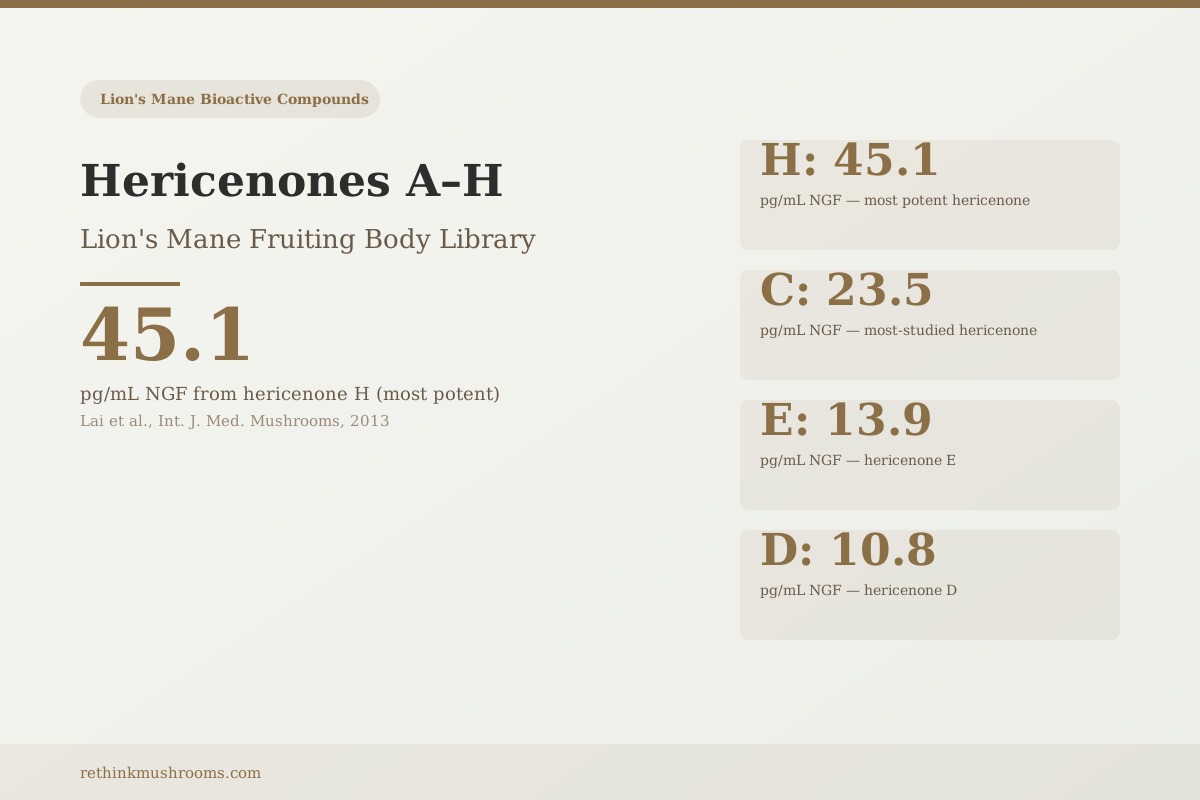
The most important correction to the popular narrative is this: purified individual hericenones often perform poorly in NGF assays, while crude extracts perform well. This is not a footnote — it is one of the most consistent and counterintuitive findings in the literature.
Lai and colleagues' 2013 study in the International Journal of Medicinal Mushrooms used aqueous extract of Hericium erinaceus — not purified hericenones — and tested it on NG108-15 neuroblastoma-glioma cells.[2] The combination of 10 ng/mL exogenous NGF with 1 µg/mL mushroom extract produced the highest neurite-outgrowth increase (about 60.6%). The extract induced extracellular NGF secretion and amplified the effect of added NGF — but the study did not measure or rank the NGF output of individual purified hericenones A through H, and notably the extract did not protect cells against oxidative stress.
Lai et al. (2013) · International Journal of Medicinal Mushrooms
- Population
- NG108-15 neuroblastoma-glioma cells (cell culture)
- Intervention
- Aqueous H. erinaceus extract, alone and combined with exogenous NGF
- Comparator
- NGF alone / untreated controls
- Finding
- Extract (1 µg/mL) plus NGF (10 ng/mL) gave the largest neurite-outgrowth increase (~60.6%) and induced extracellular NGF secretion. The study used whole extract, not purified individual hericenones, and reported no per-compound NGF potency ranking. The extract showed no neuroprotection against oxidative stress.
positive Positive for extract-driven NGF activity; does not support per-hericenone pg/mL potency claims.
Lai et al., Int J Med Mushrooms, 2013 (PMID 24266378)
Mori and colleagues' 2008 study in Biological & Pharmaceutical Bulletin makes the point even more sharply.[1] Testing ethanol extracts of four edible mushrooms on 1321N1 human astrocytoma cells, only Hericium erinaceus extract promoted NGF mRNA expression — and it did so in a concentration-dependent way, via the JNK (c-Jun N-terminal kinase) signaling pathway. The conditioned medium then enhanced neurite outgrowth in PC12 cells, demonstrating the astrocyte-mediated, indirect mechanism: the extract prompts glial cells to make and secrete NGF, which then acts on neurons. Critically, however, the study reported that purified hericenones C, D, and E failed to promote NGF gene expression in these cells, and the authors concluded the active NGF-inducing compounds in the extract "are not hericenones."
That finding does not abolish the hericenones' relevance, but it does reframe it. The robust, reproducible NGF effect belongs to the extract; attributing it cleanly to named purified hericenones overstates what the foundational assays show.
For hericenones A, B, F, and G, granular NGF data from purified-compound assays is sparse to absent in the published literature. Early papers described their isolation and noted some biological activity, but quantitative per-compound NGF measurements of the kind sometimes quoted online are not well supported by the primary sources.
A more detailed treatment of hericenone C specifically is in Hericenone C and NGF Synthesis: The Key Mechanism. The overview of hericenones alongside their mycelium counterparts is in Hericenones and Erinacines: Lion's Mane's Brain-Boosting Compounds.
- Cell studiescompleted
Multiple in-vitro studies: extracts induce NGF (Mori 2008, Lai 2013); purified hericenones are inconsistent.
- Animal studiescompleted
Mice fed H. erinaceus extract / hericerin derivatives show increased neurotrophin signaling and improved memory (Mori 2008; Martínez-Mármol 2023).
- Case reportsmissing
No hericenone-specific human case data.
- Small human trialsmissing
Human trials use whole Lion's Mane preparations, not isolated hericenones.
- Large RCTsmissing
- Meta-analysismissing
Hericenone-specific evidence is preclinical: strong in cell and animal models for extracts and related derivatives, with no human trials of isolated hericenones. Human Lion's Mane trials test whole preparations, where the active compound is not cleanly attributable to a single hericenone.
Mori 2008; Lai 2013; Martínez-Mármol 2023; Wang 2025
The Structure Revision of 2021
In 2021, Kobayashi and colleagues published the first total chemical syntheses of hericenones C through H in the Journal of Organic Chemistry.[5] Building these molecules from scratch did more than confirm their structures — it allowed the team to revise a long-standing misassignment.
The revision concerned a compound previously reported as "putative 3-hydroxyhericenone F." Through careful analysis of the cyclization chemistry and NMR spectroscopy, Kobayashi's group showed that this compound was in fact the 5-exo cyclization product of epoxyhericenone C, which they named hericenone Z. The correction matters because structures used as references in research and quality testing need to be right; structure-activity conclusions built on a wrong skeleton must be re-examined.
The synthesis also enabled a systematic structure-activity study. The team evaluated the compounds for neuroprotective effects against endoplasmic reticulum (ER) stress-dependent cell death (induced with tunicamycin and thapsigargin). Among everything assayed, a linoleate-containing hericenone analogue — a regioisomer of hericene D — had the most potent neuroprotective effect. This establishes the hericenone scaffold as a pharmacological lead structure: a natural skeleton that can be modified to design better candidates.
How 2025 Research Confirmed the Series in Real Extracts
The Kobayashi synthesis established correct structures from first principles. Wang and colleagues' 2025 study in the Journal of Natural Products took the complementary step: analytical confirmation in real fruiting-body material.[7]
The team reasoned that the chemical synthesis route might mirror the natural biosynthetic pathway, then went looking for the predicted intermediates in the mushroom itself. They fractionated the n-hexane-soluble portion of the fruiting bodies and analyzed every fraction by liquid chromatography coupled with tandem mass spectrometry (LC-MS/MS), comparing each against authentic synthetic standards — chemically pure reference samples made in the lab.
The analysis confirmed the endogenous existence of the synthesized hericenone products and intermediates, including a dehydrated form they elucidated as a distinct compound, and proposed a plausible biosynthetic pathway. Finding biosynthetic intermediates in the tissue is direct evidence of active hericenone biosynthesis in the fruiting body.
The Wang study's practical lesson is about extraction: the n-hexane (non-polar) fraction carried these lipophilic compounds. Manufacturers using ethanol extraction capture a different profile, and hot-water extraction captures essentially none of these compounds — a relevant point for anyone comparing tinctures, powders, and dual extracts.
Beyond NGF: The 2023 Discovery That Updates the Mechanism
The standard model of how these compounds work — extract stimulates astrocytes to secrete NGF, NGF acts on neurons — is correct as one mechanism. Martínez-Mármol and colleagues' 2023 study in the Journal of Neurochemistry added another.[6]
The researchers purified active compounds from Hericium erinaceus based on their ability to promote neurite outgrowth in hippocampal neurons. The standouts were N-de phenylethyl isohericerin (NDPIH), an isoindoline compound, and its hydrophobic derivative hericene A — hericerin-class derivatives structurally related to the hericenones. These promoted extensive axon outgrowth and neurite branching even without serum, indicating potent intrinsic neurotrophic activity.
Mechanistically, the effect converged on ERK1/2 signaling — proteins inside cells that relay growth and survival signals to the nucleus. Inhibiting the TrkB receptor (the BDNF receptor) only partly blocked the effect, and NDPIH activated ERK1/2 even in cells lacking TrkB. The authors described this as a neurotrophic pathway that runs partly independent of TrkB while still converging on ERK1/2 — a broader engagement point than NGF secretion alone. Mice fed H. erinaceus crude extract and hericene A showed increased neurotrophin signaling and significantly improved hippocampal memory, connecting the molecular finding to a behavioral outcome.
The important caveat: the headline-grabbing compounds here are hericerin derivatives, not the classic hericenones A–H. The work expands the relevant compound family beyond the original series rather than re-proving the original series.
Why These Compounds Are Fruiting-Body Associated: The Genomic Picture
Chen and colleagues' 2017 study in Scientific Reports sequenced the Hericium erinaceus genome (39.35 Mb, 9,895 gene models) and analyzed expression patterns.[4] The genome contains a large family of cytochrome P450 enzymes and three gene clusters related to terpene biosynthesis plus one polyketide synthase (PKS) cluster.
Here the popular narrative needs care. The study found that terpenoid biosynthesis genes were generally upregulated in mycelia, while the PKS gene was upregulated in the fruiting body. Because hericenones are meroterpenoids that combine a polyketide-derived resorcinol with a terpene-derived geranyl group, the fruiting-body-associated piece aligns with the polyketide machinery rather than with the terpene clusters in any simple way. The clean "three terpene clusters make hericenones in the fruiting body" story is an oversimplification; the genomic data shows a more divided picture of where each pathway component is most active.
More recent biochemistry has begun to fill in the actual hericenone-specific steps — for example, characterizing the prenyltransferase enzymes that attach the geranyl group to orsellinic acid to form the committed hericenone precursor. The practical takeaway for formulation is unchanged and well-supported: mycelium-on-grain products are not a reliable source of hericenones, because the fruiting-body chemistry that produces and accumulates them is not reproduced in grain-grown mycelium.
Safety
LowHericenone content is not the same as a clinical dose
Concern
Most evidence on hericenones is from cell and animal models, not human trials of isolated compounds. Supplement labels that quote per-hericenone potency figures or 'NGF percentage' claims are extrapolating well beyond what the primary literature supports.
What the research says
Treat hericenone-specific marketing claims as preliminary. Human Lion's Mane evidence is based on whole fruiting-body preparations, not purified hericenones, and even those trials are early-stage.
Particularly relevant for: Anyone choosing a Lion's Mane product based on advertised hericenone or NGF numbers.
What to do
Prefer fruiting-body products with transparent sourcing, and treat specific 'pg/mL NGF' or single-compound potency claims with skepticism.
Mori 2008; Lai 2013; Friedman 2015
For supplement formulation, the genomic and analytical findings converge on one defensible point: hericenones are fruiting-body compounds, and products built from mycelium grown on grain cannot be assumed to contain meaningful hericenone levels. The erinacines article on BBB crossing covers the parallel question for the mycelium-exclusive compounds. This article is educational and is not medical advice; consult a qualified clinician before using Lion's Mane to address any health condition.
The Bottom Line
Hericenones A–H are geranyl-resorcinol meroterpenoids from Lion's Mane fruiting bodies — the original, best-characterized series, though 24+ natural hericenones are now described. The NGF evidence is more cautious than commonly claimed: extracts reliably induce NGF (Mori 2008; Lai 2013), but purified hericenones C, D, and E failed to induce NGF in Mori's astrocytoma assay, and no robust per-compound pg/mL potency ranking exists in the primary literature. The 2021 Kobayashi total synthesis revised a "putative" hericenone structure (to hericenone Z) and built structure-activity data against ER stress; the 2025 Wang LC-MS/MS study confirmed hericenones C–H and their intermediates in fruiting-body extracts. Martínez-Mármol's 2023 work shifted attention to hericerin derivatives (NDPIH, hericene A) that engage ERK1/2 partly independent of TrkB and improved memory in mice.
Frequently Asked Questions
Sources & References
- 1RTHM-00268·Mori, Koichiro et al. (2008). “Nerve growth factor-inducing activity of Hericium erinaceus in 1321N1 human astrocytoma cells..” Biological & pharmaceutical bulletin.Study breakdown →PubMed →↩
- 2RTHM-00295·Lai, Puei-Lene et al. (2013). “Neurotrophic properties of the Lion's mane medicinal mushroom, Hericium erinaceus (Higher Basidiomycetes) from Malaysia..” International journal of medicinal mushrooms.Study breakdown →PubMed →↩
- 3RTHM-00371·Friedman, Mendel (2015). “Chemistry, Nutrition, and Health-Promoting Properties of Hericium erinaceus (Lion's Mane) Mushroom Fruiting Bodies and Mycelia and Their Bioactive Compounds..” Journal of agricultural and food chemistry.Study breakdown →PubMed →↩
- 4RTHM-00858·Chen, Juan et al. (2017). “Genomic and transcriptomic analyses reveal differential regulation of diverse terpenoid and polyketides secondary metabolites in Hericium erinaceus..” Scientific reports.Study breakdown →PubMed →↩
- 5RTHM-01372·Kobayashi, Shoji et al. (2021). “Total Synthesis, Structure Revision, and Neuroprotective Effect of Hericenones C-H and Their Derivatives..” The Journal of organic chemistry.Study breakdown →PubMed →↩
- 6RTHM-01746·Martínez-Mármol, Ramón et al. (2023). “Hericerin derivatives activates a pan-neurotrophic pathway in central hippocampal neurons converging to ERK1/2 signaling enhancing spatial memory..” Journal of neurochemistry.Study breakdown →PubMed →↩
- 7RTHM-02204·Wang, Junhong et al. (2025). “Uncovering Hericenones from the Fruiting Bodies of Hericium erinaceus through Interdisciplinary Collaboration..” Journal of natural products.Study breakdown →PubMed →↩