Mushroom Coffee & Functional Beverages
80% cordycepin lost
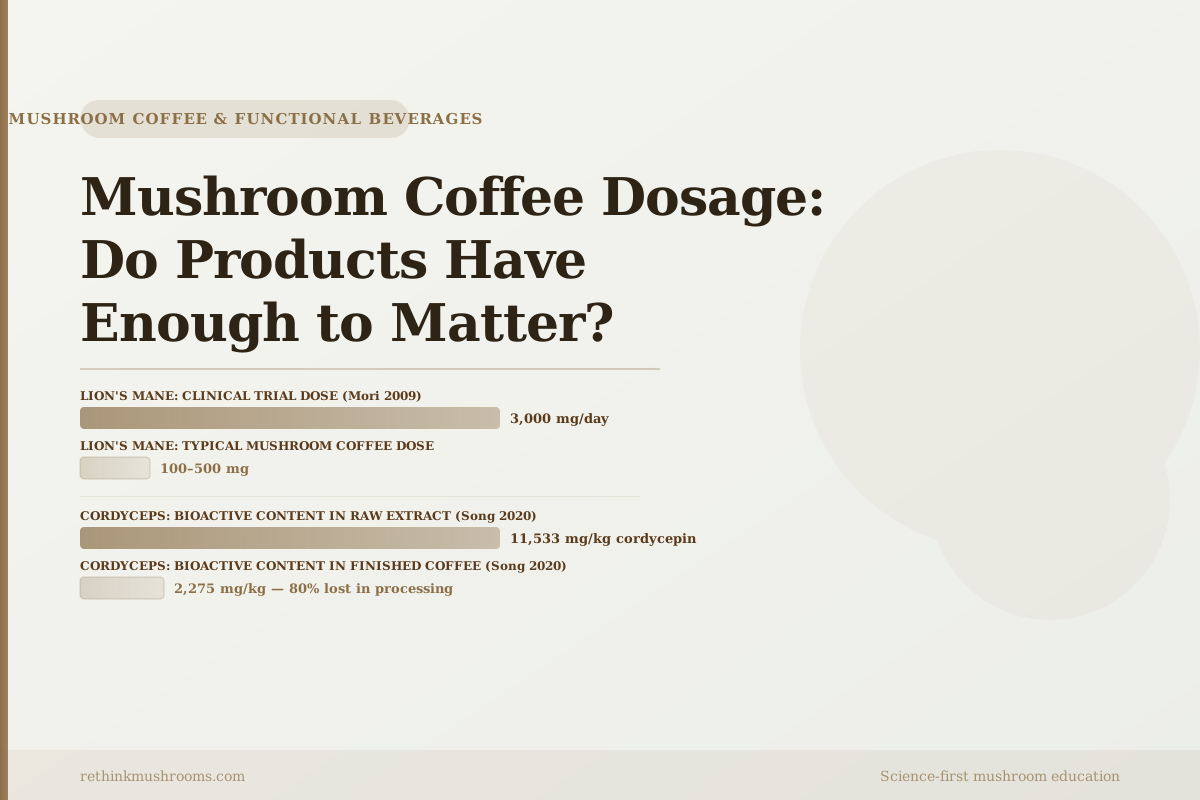
A laboratory analysis of finished mushroom coffee found that cordycepin, the key bioactive compound in Cordyceps, drops by roughly 80% during coffee processing compared to raw extract.
Song, Preventive Nutrition and Food Science, 2020
2.03%
beta-glucan in finished coffee vs. 3.79–8.57% in raw mushroom (Song 2020)
3,000mg/day
Lion's Mane dose in the landmark cognitive RCT — Mori et al., 2009
100–500mg
typical mushroom extract per serving in commercial products
Song, Preventive Nutrition and Food Science, 2020
 View as image ↗
In 2020, a food scientist named Song built a functional Cordyceps coffee and then measured exactly how much mushroom remained in the finished cup.[1] The result is the most important number in the mushroom coffee dosage debate, and no competitor site has cited it: about 80% of cordycepin, the primary active compound in Cordyceps, was destroyed during coffee processing. Beta-glucan, the polysaccharide linked to most of mushroom coffee's immune claims, dropped from a range of 3.79 to 8.57 percent in the raw extract to 2.03 percent in the finished product.
That is before we even get to the question of how much mushroom was in the product to begin with.
The research on medicinal mushrooms themselves is legitimate. The human trials are real. But the journey from "a peer-reviewed study found Lion's Mane improves cognition" to "this cup of mushroom coffee will improve your cognition" involves two problems that most consumers don't know about: a processing degradation problem and a dose gap problem. This article works through both with the actual data.
For full background on what mushroom coffee is and what the evidence says across all species, see Mushroom Coffee: What Is It and Does It Actually Work?
Key Takeaways
- Song 2020 found that about 80% of cordycepin and 50–75% of beta-glucan are destroyed during coffee processing — before per-serving dose is even considered
- Mori 2009 used 3,000mg of Lion's Mane per day for 16 weeks to produce cognitive effects; most mushroom coffee products contain 100–500mg of total mushroom extract per serving
- Docherty 2023 found acute cognitive effects in 41 healthy young adults using a Lion's Mane supplement at doses substantially higher than those in typical coffee products
- Menon 2025 systematic review confirms Lion's Mane cognitive evidence is dose-dependent, and most commercial products do not disclose whether their doses reach clinical thresholds
- Ontawong 2024 is the only peer-reviewed RCT testing a Cordyceps beverage on immune markers in healthy adults — its dose is the closest benchmark for what a Cordyceps drink needs to contain to show effects
- Parcell 2004 found zero endurance benefit from Cordyceps sinensis, highlighting that species and dose both determine whether Cordyceps produces any result at all
What Coffee Processing Actually Does to Mushroom Bioactives
Song's 2020 study is the only peer-reviewed investigation of what happens to mushroom bioactives when they go through coffee processing.[1] Song used extracts from three mushrooms, Cordyceps militaris, Phellinus linteus, and Inonotus obliquus (Chaga), applied to green coffee beans before roasting, then analyzed the finished coffee.
The findings for cordycepin were stark. Before processing: 11,533.22 mg/kg in the mushroom extract. After the coffee was finished: 2,274.70 mg/kg. That is a loss of roughly 80%.
Beta-glucan content told a similar story. In raw mushroom, the content ranged from 3.79% to 8.57% depending on species. In the finished coffee: 2.03%. That is a 50 to 75% reduction depending on which mushroom you started with.
One finding went the other direction. Polyphenol content in the finished coffee (37.34 mg GAE/g) was actually higher than in the raw mushroom extract (23.17 mg GAE/g). Coffee beans are naturally polyphenol-rich, and the combination appears to add up rather than subtract. This doesn't rescue the cordycepin or beta-glucan picture, but it is honest data, and it suggests that polyphenol-related effects of mushroom coffee may be more robust than compound-specific claims.
A 2024 compositional study by Kała and colleagues[2] is the first peer-reviewed analysis of actual commercial coffee products containing Cordyceps militaris and Hericium erinaceus fruiting bodies. Kała's team found that indole compounds, phenolic acids, and sterols were present in the finished products. This confirms that some bioactives survive the process. But quantifying how much, and whether those amounts reach clinical relevance, requires a comparison to the doses that produced effects in human trials.
A 2025 review by Yang and colleagues[3] is the first systematic review focused specifically on medicinal mushroom applications in functional foods and beverages, including health-boosting drinks. The review confirms that bioactive stability in food matrices varies significantly with temperature, pH, and processing method. The gap between raw mushroom chemistry and finished beverage chemistry is a real and documented phenomenon.
The Lion's Mane Dose Gap: 3,000mg in Studies vs. 100-500mg in Your Cup
The most-cited Lion's Mane cognitive study is the 2009 Mori RCT.[4] Mori enrolled 30 older adults with mild cognitive impairment and gave half of them 3g of Lion's Mane powder per day for 16 weeks. Cognitive scores improved significantly compared to placebo. When participants stopped taking it, scores declined, suggesting the effect was real but required continued consumption.
The dose Mori used: 3,000mg per day.
The dose in most mushroom coffee products: 100 to 500mg per serving.
At one serving per day, a typical mushroom coffee user is getting 6% to 17% of the dose that produced cognitive effects in the landmark trial. At two servings, 12% to 33%.
A 2023 pilot RCT by Docherty and colleagues[5] tested Lion's Mane in 41 healthy young adults aged 18 to 45, a population closer to the typical mushroom coffee consumer than Mori's older adults with mild cognitive impairment. After a single acute dose, participants completed cognitive tasks faster. After 28 days, stress scores were lower, though that difference did not reach statistical significance. The dose Docherty used was substantially higher than what most commercial mushroom coffee products contain.
A 2025 systematic review by Menon and colleagues[6] synthesized the full body of Lion's Mane supplementation research. The review found promising evidence for cognitive outcomes. It also found that effectiveness is dose-dependent, and that most published trials used extracts standardized for active compound content, something most mushroom coffee products do not disclose.
One additional variable widens the gap further: extract concentration ratios. A product label that reads "200mg Lion's Mane extract (10:1)" means the extract was concentrated from ten times its weight in raw mushroom. In theory, 200mg of a 10:1 extract represents 2,000mg of raw mushroom equivalent. In practice, most mushroom coffee brands do not clarify whether they use raw powder or a concentrated extract, or what the concentration ratio is. Without that information, it is impossible to compare a product's label dose to the doses used in clinical trials.
Cordyceps in Coffee: The Beverage RCT and What Its Dose Tells Us
In 2024, Ontawong and colleagues[7] published what is currently the only peer-reviewed randomized controlled trial testing a Cordyceps militaris beverage on immune markers in healthy adults. This is the study closest to the real-world use case of drinking a mushroom beverage, not a capsule, not a lab experiment, an actual drink in an actual clinical trial.
The trial found that the Cordyceps beverage modulated immune markers in healthy adults compared to the control group. The dose and beverage format used in that trial is the closest published benchmark for what a Cordyceps-containing drink needs to contain to produce measurable immune effects in humans.
A 2025 meta-analysis by Shu and colleagues[8] synthesized the evidence for fungal supplementation on endurance capacity, immune function, and blood markers in athletes. The meta-analysis found positive effects across the included trials. The studies in the analysis used supplementation protocols with doses that, again, generally exceed what mushroom coffee products contain per single serving.
The null result is as informative as the positive data. Parcell and colleagues[9] tested Cordyceps sinensis (CordyMax Cs-4) supplementation in trained cyclists and found zero improvement in endurance performance compared to placebo. Two lessons apply directly to mushroom coffee. First, species matters: Cordyceps sinensis and Cordyceps militaris are different organisms with different biochemical profiles and different evidence bases. A product that lists only "Cordyceps" without specifying the species is withholding information relevant to the claim. Second, even at a dose intended to be therapeutic, Cordyceps does not automatically produce performance effects. Dose, species, and the fitness level of the consumer all interact.
Clinical Trial Doses vs. Mushroom Coffee Doses: A Direct Comparison
This comparison uses dose ranges from the peer-reviewed studies cited in this article and typical commercial product ranges based on publicly disclosed label information.
| Mushroom | Dose in human trials | Typical product dose per serving | Evidence source |
|---|---|---|---|
| Lion's Mane | 1,000–3,000 mg/day | 100–500 mg | Mori 2009 (3,000mg, MCI adults); Docherty 2023 (healthy adults) |
| Cordyceps militaris | 1,000–3,000 mg/day | 100–500 mg | Ontawong 2024 (beverage RCT, immune); Shu 2025 (meta-analysis) |
| Cordyceps sinensis | Therapeutic doses tested | 100–500 mg | Null result at tested doses (Parcell 2004) |
Note: products that use concentrated extracts may deliver more raw mushroom equivalent per milligram than these numbers suggest. But without label disclosure of extract ratios, that cannot be verified. The typical product dose in this table reflects what is typically visible on labels.
The gap between clinical and product doses is not unique to mushroom coffee. Many supplement categories face the same issue. What distinguishes mushroom coffee is that the dose gap sits on top of the processing degradation layer. A capsule containing 500mg of Lion's Mane extract delivers 500mg to your digestive tract. A coffee product that started with 500mg of mushroom extract but lost 80% of its primary compound during roasting delivers something chemically different from both the capsule and the raw ingredient.
The Label Transparency Problem: Why You Can't Always Tell What You're Getting
Most major mushroom coffee brands use proprietary blends. A proprietary blend lists the combined weight of all mushrooms in a single number without breaking out individual doses. A label that reads "Functional Mushroom Blend 1,500mg" might contain 1,200mg of Chaga and 300mg of Lion's Mane, or some other distribution entirely. US regulations do not require brands to disclose individual ingredient doses within a proprietary blend.
The extract ratio problem adds a second layer of opacity. "Mushroom extract" and "mushroom powder" are not interchangeable. An extract has been processed to concentrate specific compounds; a powder is typically dried fruiting body or mycelium that has been ground. A brand using a 10:1 extract at 200mg is theoretically delivering the biological equivalent of 2,000mg of raw mushroom. A brand using raw powder at 200mg is delivering 200mg. Without this disclosure, comparison to clinical trial doses is not possible from the outside.
The fruiting body versus mycelium question adds a third layer. Mycelium is the root-like underground structure of the fungus; the fruiting body is the visible mushroom. The two have different bioactive compound profiles. A product listing "Hericium erinaceus mycelium" is a chemically different product from one using fruiting body, and most of the clinical evidence, including the Mori 2009 and Docherty 2023 trials, used fruiting body preparations. For a full breakdown of this distinction, see Fruiting Body vs. Mycelium: The Great Mushroom Supplement Debate.
What transparent labeling looks like: individual mushroom doses disclosed separately (not combined in a blend), specification of raw powder versus extract, extract concentration ratio if applicable (e.g., "10:1"), and identification of fruiting body versus mycelium. Brands that provide all four of these data points give consumers the information needed to compare against clinical trial evidence.
Does the Dosing Gap Mean Mushroom Coffee Is Useless?
No. But the honest answer requires holding two things at the same time.
The underlying mushroom research is legitimate. Mori 2009 produced real cognitive effects in a randomized controlled trial. Ontawong 2024 showed immune effects from an actual Cordyceps beverage. The Menon 2025 systematic review found genuine promise in the Lion's Mane literature. Shu 2025 found effects on endurance and immune function across multiple trials. This is not junk science, and dismissing it wholesale would be as misleading as overstating it.
The processing and dosing problems are also real. Song 2020 is a peer-reviewed study, not a theoretical concern. The dose gap between clinical trials and commercial products is documented and significant.
A reasonable reading of the full evidence is this: mushroom coffee may deliver some benefit, particularly from compounds that are stable to heat processing. The polyphenol finding from Song 2020 is one example — polyphenols were actually higher in the finished coffee than in the raw extract, and both coffee and mushrooms contribute polyphenols with documented antioxidant effects. Whether any mushroom-specific benefit survives the combination of processing losses and sub-clinical doses is genuinely unknown.
For consumers who want mushroom-specific effects at clinically studied doses, standalone mushroom supplements in capsule or tincture form avoid the processing problem entirely. For a comparison of formats by bioavailability, see Bioavailability by Supplement Form: What Gets Absorbed? For a look at specific brands and how they compare on label transparency and dose disclosure, see MUD/WTR, Ryze, and Four Sigmatic: Mushroom Coffee Compared. And for those interested in mushroom beverages without the high-heat processing problem that Song 2020 identified, Mushroom Matcha and Tea: Functional Beverages Beyond Coffee covers formats brewed at lower temperatures.
The Bottom Line
The peer-reviewed evidence on medicinal mushrooms is real, but two problems separate that evidence from what most mushroom coffee products deliver. First, Song 2020 found that approximately 80% of cordycepin and 50–75% of beta-glucan are lost during coffee processing. Second, the dose gap is substantial: clinical trials that showed Lion's Mane cognitive effects used 1,000–3,000mg per day, while most products contain 100–500mg per serving. Label transparency compounds the problem: proprietary blends and undisclosed extract ratios make it impossible to evaluate most products against published evidence. Whether any benefit survives both filters is currently unknown.
Frequently Asked Questions
Sources & References
- 1RTHM-00656·Song, Hyo-Nam (2020). “Functional Cordyceps Coffee Containing Cordycepin and β-Glucan..” Preventive nutrition and food science.Study breakdown →PubMed →↩
- 2RTHM-00882·Kała, Katarzyna et al. (2024). “Coffee with Cordyceps militaris and Hericium erinaceus Fruiting Bodies as a Source of Essential Bioactive Substances..” Pharmaceuticals (Basel.Study breakdown →PubMed →↩
- 3RTHM-02215·Yang, Jing-Ya et al. (2025). “Innovative applications of medicinal mushrooms in functional foods and nutraceuticals: a focus on health-boosting beverages..” Frontiers in cellular and infection microbiology.Study breakdown →PubMed →↩
- 4RTHM-00165·Mori, Koichiro et al. (2009). “Improving effects of the mushroom Yamabushitake (Hericium erinaceus) on mild cognitive impairment: a double-blind placebo-controlled clinical trial..” Phytotherapy research : PTR.Study breakdown →PubMed →↩
- 5RTHM-00821·Docherty, Sarah et al. (2023). “The Acute and Chronic Effects of Lion's Mane Mushroom Supplementation on Cognitive Function, Stress and Mood in Young Adults: A Double-Blind, Parallel Groups, Pilot Study..” Nutrients.Study breakdown →PubMed →↩
- 6RTHM-00943·Menon, Arya et al. (2025). “Benefits, side effects, and uses of Hericium erinaceus as a supplement: a systematic review..” Frontiers in nutrition.Study breakdown →PubMed →↩
- 7RTHM-00899·Ontawong, Atcharaporn et al. (2024). “A randomized controlled clinical trial examining the effects of Cordyceps militaris beverage on the immune response in healthy adults..” Scientific reports.Study breakdown →PubMed →↩
- 8RTHM-00951·Shu, Meng-Yuan et al. (2025). “Effects of fungal supplementation on endurance, immune function, and hematological profiles in adult athletes: a systematic review and meta-analysis..” Frontiers in nutrition.Study breakdown →PubMed →↩
- 9RTHM-00075·Parcell, Allen C et al. (2004). “Cordyceps Sinensis (CordyMax Cs-4) supplementation does not improve endurance exercise performance..” International journal of sport nutrition and exercise metabolism.Study breakdown →PubMed →↩