Mushroom Coffee & Functional Beverages
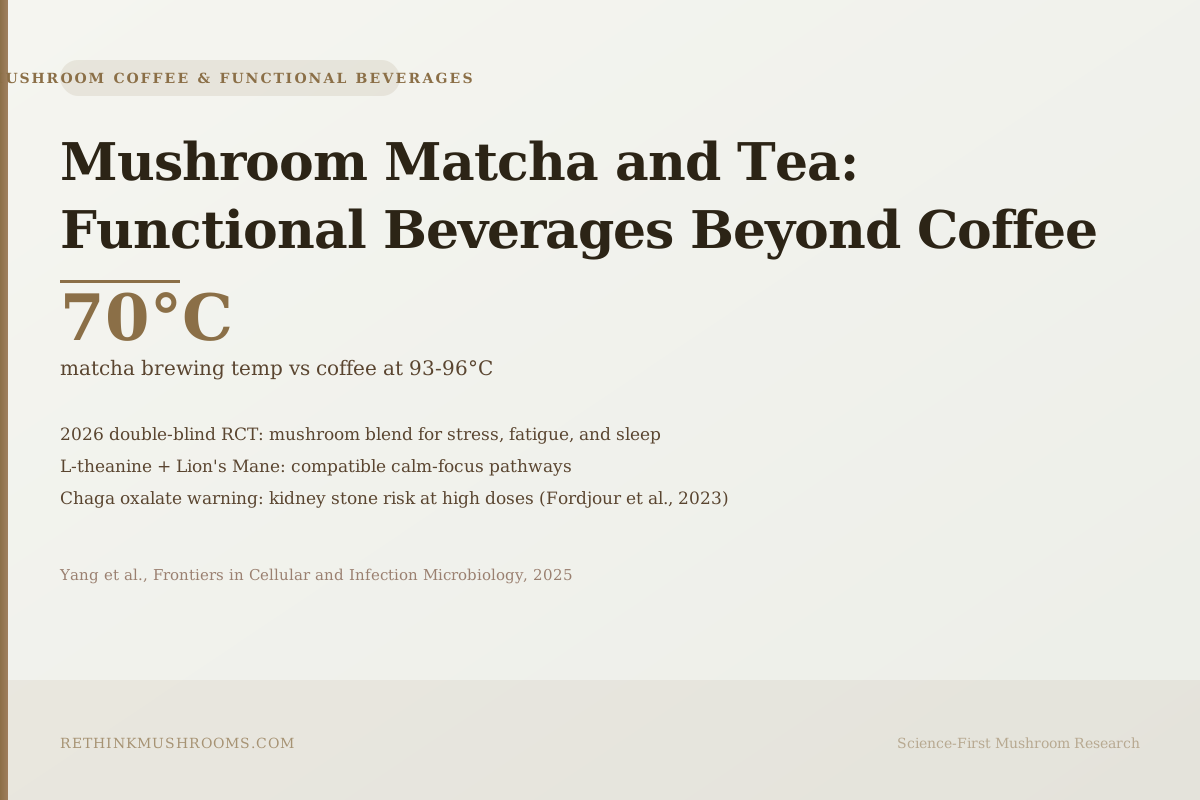
70°C brewing temp
Matcha brews 20-25 degrees cooler than coffee. A 2025 systematic review of medicinal mushrooms in functional beverages found that bioactive compounds show temperature-dependent stability in food matrices — lower heat may preserve more active compounds.
Yang et al., Frontiers in Cellular and Infection Microbiology, 2025
2026 RCT
first double-blind trial on a mushroom blend for stress, fatigue, and sleep
L-theanine synergy
matcha's focus compound and Lion's Mane work via compatible attention pathways
Oxalate risk
Chaga's antioxidant activity comes with kidney stone risk at high doses
Yang et al., Frontiers in Cellular and Infection Microbiology, 2025
 View as image ↗
Mushroom matcha is powdered green tea blended with medicinal mushroom extracts, typically Lion's Mane for focus, Reishi for calm, or Chaga for antioxidants. It sits in a different market position than mushroom coffee: lower caffeine, a lower brewing temperature, and a target audience that wants calm alertness rather than energy and stimulation. The mushroom matcha category grew alongside the mushroom coffee boom, but the science behind it points to some genuinely distinct advantages for specific use cases.
The difference that no competitor has addressed is temperature. Coffee brews at 93-96°C. Matcha is prepared at 70-80°C. A 2025 systematic review of medicinal mushroom applications in functional foods and beverages found that bioactive compounds, particularly polysaccharides and triterpenes, show temperature-dependent stability in food matrices, with higher heat accelerating degradation.[1] Whether this produces meaningfully higher bioactive content in finished matcha products versus coffee products has not been tested head-to-head. But the plausible mechanism exists, and it's worth understanding.
For a full overview of how mushroom beverages work and what processing does to bioactive content, see the guide to mushroom coffee: what it is and does it actually work.
Key Takeaways
- Matcha brews at 70-80°C versus coffee's 93-96°C; Yang et al. (2025) found mushroom bioactives show temperature-dependent stability, making the cooler format potentially better at preserving heat-sensitive compounds, though no direct comparison study exists
- Surendran et al. (2025) tested a single dose of standardized Lion's Mane extract in a double-blind RCT of healthy young adults and found no significant overall improvement in cognition or mood; only the pegboard fine motor task showed improvement at 90 minutes — a more limited result than marketing claims for Lion's Mane typically suggest, though the study used an acute single-dose protocol rather than the chronic supplementation most products are designed for
- Mitra et al. (2024) found Reishi supplementation at 1000 mg/day improved psychological stress markers (anxiety, depression, vitality, positive well-being) in a placebo-controlled RCT — the 500 mg/day arm did not show the same benefits, making dose adequacy a relevant question for commercial products; Reishi's serotonin-related calming mechanism aligns with matcha's profile rather than opposing it as it does with caffeine
- Hisamuddin et al. (2026) conducted the first double-blind, placebo-controlled trial on a mushroom blend for stress, fatigue, and sleep combined, providing the most current clinical evidence for the calm-focus positioning of mushroom matcha
- Chaga has among the highest antioxidant capacity of any food source (Fordjour et al. 2023), but also contains extremely high oxalate concentrations; published case reports (Kikuchi 2014, Lee 2020, Kwon 2022) document oxalate nephropathy and end-stage renal disease following daily high-dose Chaga use — a real safety signal that is dose-dependent, not relevant to occasional tea consumption
- Ontawong et al. (2024) ran the only peer-reviewed RCT using an actual mushroom beverage (Cordyceps militaris), establishing what a clinical-dose functional beverage looks like and what immune effects it produced in healthy adults
What Is Mushroom Matcha? The Definition Competitors Skip
Mushroom matcha combines powdered green tea with medicinal mushroom extracts, typically Lion's Mane, Reishi, or Chaga. Unlike mushroom coffee, matcha is prepared at lower temperatures (70-80°C versus 93-96°C for coffee), potentially preserving more heat-sensitive bioactive compounds. Matcha also contains L-theanine, an amino acid that promotes calm alertness and focused attention, which works alongside Lion's Mane's cognitive effects rather than in tension with them.
Most commercial mushroom matcha products blend 500mg to 2g of mushroom extract per serving into the matcha base. The matcha itself provides roughly 25-50mg of caffeine per serving, about one-quarter to one-third of a standard coffee.
A 2025 systematic review focused specifically on medicinal mushroom applications in health-boosting beverages, examining how mushroom bioactives behave across different food matrices and preparation methods.[1] That review identified functional mushroom beverages as a category where preparation temperature and processing method substantially affect the survival of active compounds from raw material to finished drink.
Mushroom matcha targets a different consumer profile than mushroom coffee. Coffee-format products attract people looking for energy with functional additions. Matcha-format products attract people looking for sustained, anxiolytic focus, with reduced stimulation and no afternoon crash. The mushrooms used reflect this difference: Lion's Mane dominates in matcha products for its cognitive mechanism, and Reishi appears for stress and calm.
The Temperature Advantage: Why the 20-Degree Gap Matters
The most overlooked fact about mushroom matcha versus mushroom coffee is the brewing temperature difference.
Coffee brews at 93-96°C under pressure (espresso) or 90-96°C in drip and pour-over formats. Matcha is prepared by whisking dried powder in water heated to 70-80°C. The exposure time also differs: espresso takes 25-30 seconds; pour-over takes 3-5 minutes; matcha takes under one minute.
The Yang 2025 review found that different categories of mushroom bioactives have different thermal tolerances.[1] Polysaccharides including beta-glucans are relatively heat-stable, but prolonged high heat can alter their structure and potentially their receptor-binding properties. Triterpenes, which include Reishi's ganoderic acids and Chaga's betulinic acid derivatives, are more susceptible to thermal degradation.
What this means in practice: beta-glucan content may survive both preparation formats reasonably well, but the triterpene fraction, responsible for much of Reishi's stress-modulating activity, is more likely to degrade in coffee's higher-heat, longer-contact processing.
Two important caveats. First, no published study has directly compared bioactive content in a mushroom matcha product versus an equivalent mushroom coffee product from the same extract batch. The advantage is plausible and mechanistically grounded, but not yet measured. Second, for products where mushroom extract is added to the base (matcha powder or coffee) during manufacturing rather than during brewing, the relevant temperature is the manufacturing extraction temperature, not the at-home brewing temperature.
The practical reading: matcha's preparation conditions are at least no worse for mushroom bioactives than coffee's, and are plausibly better for heat-sensitive compounds. The gap is real. Its magnitude in finished products is unknown.
Temperature & Bioactive Stability
Why the 20-degree brewing gap matters
Beta-glucans survive both formats reasonably well. The heat-sensitive triterpene fraction — responsible for much of Reishi's stress-modulating activity — is more likely to degrade in coffee's higher-heat, longer-contact brewing. No study has yet measured the size of this gap in finished products.
Lion's Mane Plus L-Theanine: The Focus Case Nobody Is Making
The most scientifically interesting aspect of mushroom matcha is the combination of Lion's Mane and L-theanine working through compatible mechanisms.
L-theanine is an amino acid found almost exclusively in tea. Matcha is the most concentrated food source, providing 20-45mg per gram of powder. L-theanine promotes alpha-wave activity in the brain: a state of relaxed, attentive calm without drowsiness. It reduces physiological stress markers without causing sedation, and it counteracts caffeine's tendency to increase anxiety at higher doses.
Lion's Mane works through a different pathway. The active compounds in Lion's Mane (hericenones from the fruiting body and erinacines from the mycelium) stimulate production of nerve growth factor, a protein that supports neuron growth and maintenance. For a detailed breakdown of how these specific compounds function, see our article on hericenones and erinacines: Lion's Mane's brain-boosting compounds.
A 2025 double-blind, randomized, placebo-controlled cross-over trial in healthy adults aged 18–35 tested 3g of a standardized Lion's Mane fruiting body extract (10:1) for acute effects on cognition and mood.[2] The study found no significant overall improvement in composite measures of cognitive function or mood at 90 minutes post-dose. However, participants did show improved performance on the pegboard test — a fine motor skill task — at 90 minutes, representing the one domain where a significant benefit emerged. The researchers concluded that any acute benefits may be task- or domain-specific, and called for further investigation into chronic supplementation and optimal dosing. This is a more limited result than most Lion's Mane marketing claims suggest.
The limitation of the Surendran 2025 trial is its design: a single acute dose rather than the multi-week supplementation protocol most products are designed around. Longer-term trials in different populations have shown more consistent cognitive benefits. The point remains that Lion's Mane's mechanisms (nerve growth factor stimulation, hericenone compounds) and L-theanine's alpha-wave focus effects are pharmacologically compatible pathways — working toward calm, sustained attention rather than acute stimulation — which makes the combination more internally coherent in a low-caffeine matcha base than in a high-caffeine coffee format. High caffeine activates the sympathetic nervous system in a way that can suppress the calm attentional state that L-theanine supports.
This does not mean mushroom matcha outperforms mushroom coffee for cognitive outcomes. No comparative trial exists. What the mechanism picture shows is that the ingredient combination in mushroom matcha is more internally consistent for the calm-focus use case.
Reishi in Matcha: Working With the Format, Not Against It
Reishi is the second most common mushroom in matcha products, and its inclusion makes pharmacological sense here in a way it does not in coffee.
A 2024 double-blind, placebo-controlled RCT tested Reishi (Ganoderma lucidum) supplementation in female college students at two doses: 500 mg/day and 1000 mg/day for 30 days, measuring effects on psychological stress markers, cardiovascular parameters, and fitness outcomes.[3] The 1000 mg/day group showed significant improvements in anxiety, depression, vitality, and positive well-being compared to placebo, as well as improvements in cardiovascular fitness parameters (VO2max, PWC170). The 500 mg/day group showed partial and smaller effects that did not reach the same significance threshold for psychological outcomes. This dose-dependency is relevant for evaluating mushroom matcha products: most commercial products deliver 500 mg to 2 g of total mushroom extract per serving, and whether the Reishi fraction specifically reaches 1000 mg — the effective dose in the Mitra trial — varies by product. This is among the most recent controlled evidence for Reishi's stress-modulating effects in a healthy young adult population, a closer analog to the typical mushroom matcha consumer than older studies in clinical populations.
A 2021 mouse study found that Reishi promotes sleep through a pathway involving gut bacteria and serotonin, a neurotransmitter involved in mood regulation and sleep onset.[4] The researchers identified specific gut microbiome shifts that mediated the effect. This is preclinical evidence only, but it establishes a plausible serotonin-related mechanism for Reishi's calming properties.
That serotonin pathway matters for understanding Reishi in different beverage formats. In mushroom coffee, Reishi (which acts via a sleep-promoting, serotonin-adjacent pathway) is combined with caffeine (which acts via adenosine receptor antagonism to promote wakefulness). These are opposing mechanisms in the same cup. In mushroom matcha, the base beverage contains L-theanine (which reduces stress arousal without sedation) and a fraction of the caffeine. Reishi's calming mechanism aligns with matcha's profile rather than fighting it.
For a brand-by-brand look at which coffee products include Reishi and whether their doses overlap with clinical trial doses, see our comparison of MUD/WTR, Ryze, and Four Sigmatic mushroom coffee.
The 2026 RCT: The Strongest Evidence for Calm Focus and Fatigue Reduction
The most directly relevant clinical trial for what mushroom matcha is trying to achieve was published in 2026.
Hisamuddin and colleagues conducted a double-blind, placebo-controlled, randomized trial testing a mushroom blend supplement on stress, fatigue, and sleep quality in healthy adults.[5] This is the first published trial to combine all three outcomes that mushroom matcha brands most commonly claim in a single rigorous controlled study. The double-blind design eliminates the placebo effect as an explanation.
The study used a mushroom blend, which is closer to the real-world composition of commercial mushroom matcha products than a single-species trial. The 2026 publication date makes it the most current human evidence available for these specific endpoints.
Important limitations: this was a supplement capsule trial, not a beverage trial. The doses used may not match what is present in commercial matcha products. Specific species identities and their proportions in the blend affect how directly the findings apply to any particular product.
What the Hisamuddin 2026 RCT establishes: mushroom blend supplementation can produce measurable effects on stress, fatigue, and sleep in a controlled human trial. That is the foundational claim underlying mushroom matcha marketing. The evidence now exists at the level of double-blind RCT. The gap between capsule trials and beverage products, particularly around dose adequacy, is covered in detail in our article on whether mushroom coffee products have enough mushroom to matter.
- Animal & mechanism studiescompleted
Reishi promotes sleep via a gut-microbiota and serotonin pathway in mice (Yao 2021)
- Small human RCTscurrent
Double-blind RCTs on single mushrooms — Lion's Mane acute dose (Surendran 2025, null overall result; fine motor improvement only), Reishi 1000mg/day for stress (Mitra 2024) — and a mushroom blend for stress, fatigue, and sleep (Hisamuddin 2026); plus the only Cordyceps beverage RCT (Ontawong 2024, n=10/group)
- Large beverage-format RCTmissing
No large trial has tested a finished mushroom matcha beverage at typical commercial doses
- Meta-analysismissing
No pooled analysis of mushroom matcha or tea for calm-focus endpoints yet exists
The mushrooms in matcha have double-blind RCT support when tested as supplements, and one Cordyceps beverage RCT exists. What is missing is a trial of mushroom matcha itself as a finished drink at the doses products actually deliver.
Yao et al. 2021; Surendran et al. 2025; Mitra et al. 2024; Hisamuddin et al. 2026; Ontawong et al. 2024
Chaga Tea: High Antioxidants and One Safety Warning
Chaga is the oldest mushroom tea. Populations across Siberia and northern Russia have brewed Inonotus obliquus, a parasitic conk that grows on birch trees, as a dark, earthy beverage for centuries. Modern mushroom tea products frequently include Chaga extract for its antioxidant properties.
A 2023 comprehensive review documented Chaga's antioxidant, anti-inflammatory, antiviral, and potential anti-cancer activity, drawing on available preclinical and limited clinical literature.[6] Chaga's antioxidant capacity ranks among the highest measured in any food source, driven primarily by its polyphenol and melanin content.
Chaga contains extremely high oxalate concentrations. Oxalates bind calcium in the kidney and can form stones. The risk is dose-dependent and cumulative. Occasional Chaga tea at standard serving sizes carries minimal risk for most people. Daily high-dose consumption is a different matter: published case reports have documented oxalate nephropathy in people who consumed Chaga regularly at high volumes. Kikuchi et al. 2014 documented the first published case — a 72-year-old woman who consumed 4–5 teaspoons of Chaga powder daily for 6 months and required hemodialysis due to oxalate nephropathy.[8] Lee et al. 2020 reported end-stage renal disease (ESRD) in a 49-year-old man after years of daily high-dose Chaga consumption, with measured Chaga oxalate content of 14.2g per 100g dry weight — several times the typical dietary intake.[9] Kwon et al. 2022 reported acute oxalate nephropathy manifesting as nephrotic syndrome in a 69-year-old man who consumed 10–15g of Chaga powder daily for 3 months.[10]
Traditional Siberian Chaga tea preparation uses small amounts simmered at below-boiling temperatures for 15-30 minutes. The oxalate risk case reports all involved much higher consumption — 4–15g daily for months to years. The safety signal is real but dose-dependent and context-specific.
Chaga Safety
ModerateHigh-dose Chaga and oxalate kidney risk
Concern
Chaga is rich in oxalates, which bind calcium and can form kidney stones. Published case reports document oxalate nephropathy — and in one case end-stage renal disease — in people who consumed Chaga tea daily at high volumes, often with pre-existing kidney stone risk.
What the research says
Occasional Chaga tea at standard serving sizes carries minimal risk for most people. The danger is dose-dependent and cumulative, not from a single cup.
Particularly relevant for: People with a history of kidney stones, reduced kidney function, or diabetes-related kidney risk should be especially cautious.
What to do
Keep Chaga intake occasional rather than daily-high-dose, and consult a clinician before regular use if you have any kidney risk factors. This is general information, not medical advice.
Kikuchi et al. 2014 (Clin Nephrology); Lee et al. 2020 (J Korean Med Sci); Kwon et al. 2022 (Medicine); Fordjour et al. 2023 review (Front Pharmacology)
Traditional preparation: simmer dried Chaga chunks or powder in 500ml of water at 70-80°C for 15-30 minutes. Do not boil. Strain if using chunks. The flavor is dark and earthy, with slightly sweet, vanilla-like undertones from the vanillin content of birch bark.
Cordyceps Beverages: What the Only Beverage-Format RCT Found
Most clinical evidence for medicinal mushrooms comes from capsule or tablet trials, not beverages. The exception in the peer-reviewed literature is a 2024 randomized controlled trial that specifically tested a Cordyceps militaris beverage on immune response in healthy adults.
Ontawong and colleagues found that the Cordyceps beverage produced measurable changes in immune markers compared to placebo in their trial of healthy adult participants.[7] Specifically, NK cell activity significantly increased in male participants at 4 weeks and in female participants at 8 weeks of consumption, and within-group analysis showed reductions in inflammatory markers (IL-1β in men, IL-6 in women). An important caveat: the trial enrolled only n=10 per gender per arm — a very small sample — so these findings, while statistically significant within groups, require replication in larger trials before strong conclusions can be drawn. This is nonetheless the only peer-reviewed RCT designed around a functional mushroom in an actual liquid beverage format, as opposed to a capsule mimicking beverage consumption. The dose used in the Ontawong trial (2.85 mg of cordycepin delivered via fermented Cordyceps beverage over 8 weeks) sets the benchmark for what a Cordyceps-containing beverage needs to provide to produce immune effects in humans.
Cordyceps is less common in mushroom matcha than in coffee products. The energy and performance associations of Cordyceps map more naturally onto coffee's stimulant profile than matcha's calm-focus positioning. But Cordyceps does appear in some matcha and functional tea blends, and the Ontawong 2024 data provides the strongest clinical reference point for evaluating those products.
How to Make Mushroom Tea at Home
Mushroom matcha: Sift 1-2 teaspoons of matcha powder into a bowl. Add mushroom extract powder (typically 500mg to 1g of Lion's Mane, Reishi, or a blend). Pour 70-80°C water (around 160-175°F) over the powder and whisk using a zigzag motion until fully combined and frothy. Avoid water above 80°C to limit both catechin degradation in the matcha and thermal degradation of heat-sensitive mushroom bioactives.
Chaga tea (traditional): Simmer dried Chaga chunks or powder in 500ml of water at 70-80°C for 15-30 minutes. Strain before drinking if using chunks. The resulting liquid is dark, earthy, and mildly sweet. Do not boil; high heat does not improve extraction and may accelerate degradation of heat-sensitive compounds.
Reishi tea: Reishi's ganoderic acid content makes it intensely bitter. Most people find reishi more palatable in extract powder form, mixed into matcha or another base, than as a standalone tea. If brewing whole slices: simmer dried Reishi in water for 30-45 minutes and strain. Combining with other flavors helps offset bitterness.
Lion's Mane tea: Fresh Lion's Mane sliced and simmered for 15-20 minutes produces a mild, slightly sweet broth. Powdered Lion's Mane extract dissolves readily in warm water and can be added to any tea base.
For a full overview of how hot water, alcohol, and dual extraction methods compare for different mushroom bioactive classes, see our guide to double-extraction mushroom tinctures. For anyone curious about fermented mushroom beverages as a category, our article on fermented mushroom beverages: kombucha, beer, and beyond covers how the fermentation process interacts with mushroom bioactives.
The Bottom Line
Mushroom matcha combines green tea with medicinal mushroom extracts in a format that is pharmacologically more coherent for calm focus than mushroom coffee. The lower brewing temperature, the L-theanine compatibility with Lion's Mane's nerve growth factor mechanism, and Reishi's calming pathway all align with the matcha base. The clinical picture is nuanced: Surendran 2025 found no significant acute cognitive improvement from a single Lion's Mane dose (only a fine motor task improved); Mitra 2024 found meaningful Reishi benefits specifically at 1000 mg/day; and the 2026 Hisamuddin double-blind RCT on mushroom blends for stress, fatigue, and sleep provides the most current multispecies evidence. Key gaps remain: no published study has directly compared bioactive content in matcha versus coffee products, and no large human trial has tested mushroom matcha as a finished beverage at typical commercial doses.
Frequently Asked Questions
Sources & References
- 1RTHM-02215·Yang, Jing-Ya et al. (2025). “Innovative applications of medicinal mushrooms in functional foods and nutraceuticals: a focus on health-boosting beverages..” Frontiers in cellular and infection microbiology.Study breakdown →PubMed →↩
- 2RTHM-00952·Surendran, Geyan et al. (2025). “Acute effects of a standardised extract of Hericium erinaceus (Lion's Mane mushroom) on cognition and mood in healthy younger adults: a double-blind randomised placebo-controlled study..” Frontiers in nutrition.Study breakdown →PubMed →↩
- 3RTHM-00895·Mitra, Sudeep et al. (2024). “Efficacy of Lingzhi or Reishi Medicinal Mushroom Ganoderma lucidum (Agaricomycetes) Supplementation on Psychological Stress and Selective Fitness Profile Parameters in Female College Students in West Bengal, India..” International journal of medicinal mushrooms.Study breakdown →PubMed →↩
- 4RTHM-00731·Yao, Chunyan et al. (2021). “Ganoderma lucidum promotes sleep through a gut microbiota-dependent and serotonin-involved pathway in mice..” Scientific reports.Study breakdown →PubMed →↩
- 5RTHM-00959·Hisamuddin, Ahmad Safiyyu'd-Din et al. (2026). “Adaptogenic Effects of Mushroom Blend Supplementation on Stress, Fatigue, and Sleep: A Randomised, Double-Blind, and Placebo-Controlled Trial..” Brain and behavior.Study breakdown →PubMed →↩
- 6RTHM-01694·Fordjour, Eric et al. (2023). “Chaga mushroom: a super-fungus with countless facets and untapped potential..” Frontiers in pharmacology.Study breakdown →PubMed →↩
- 7RTHM-00899·Ontawong, Atcharaporn et al. (2024). “A randomized controlled clinical trial examining the effects of Cordyceps militaris beverage on the immune response in healthy adults..” Scientific reports.Study breakdown →PubMed →↩
- 8RTHM-00329·Kikuchi, Yuko et al. (2014). “Chaga mushroom-induced oxalate nephropathy..” Clinical nephrology.Study breakdown →PubMed →↩
- 9RTHM-00630·Lee, Sua et al. (2020). “Development of End Stage Renal Disease after Long-Term Ingestion of Chaga Mushroom: Case Report and Review of Literature..” Journal of Korean medical science.Study breakdown →PubMed →↩
- 10RTHM-00775·Kwon, Ohyun et al. (2022). “Chaga mushroom-induced oxalate nephropathy that clinically manifested as nephrotic syndrome: A case report..” Medicine.Study breakdown →PubMed →↩