Mushroom Supplement Safety
22.95% above cadmium standard
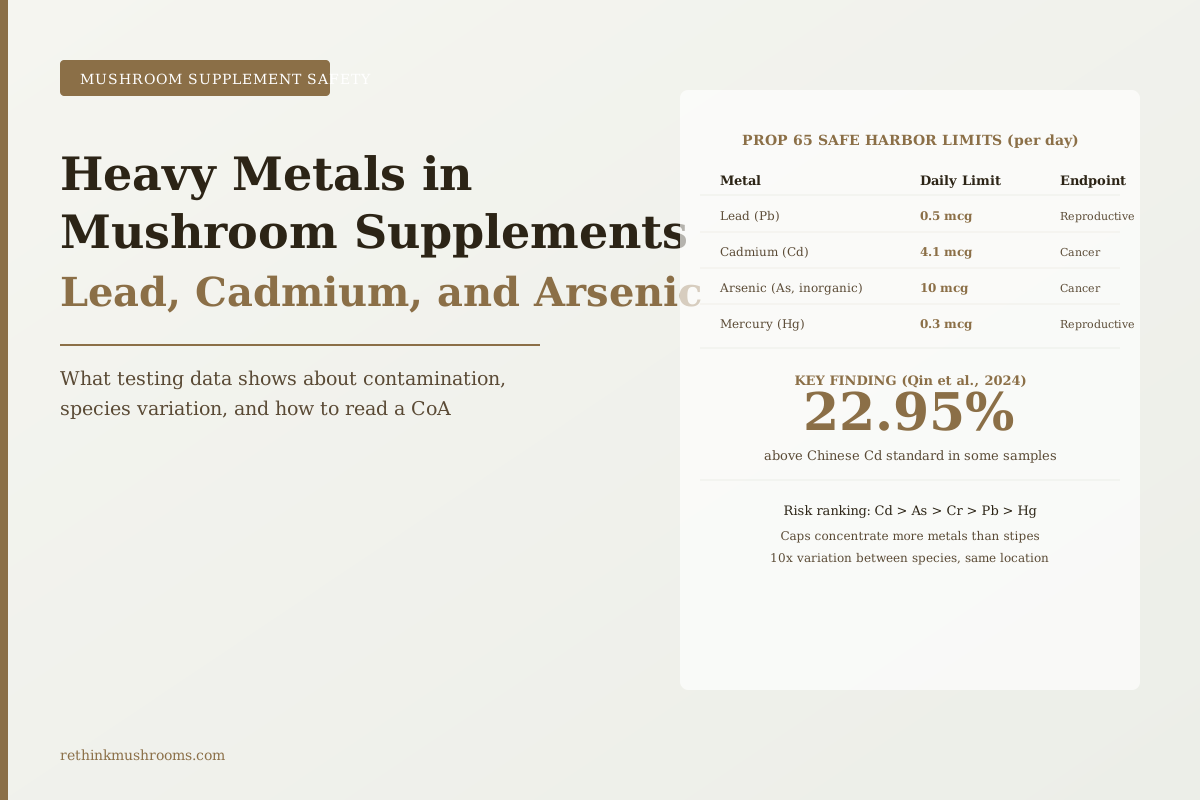
A 2024 analysis of Chinese edible mushrooms found cadmium concentrations 22.95% above the national maximum standard in some samples, with caps carrying significantly more lead, cadmium, and zinc than stipes.
Qin et al., Scientific Reports, 2024
Cd > As > Pb
risk ranking in Chinese edible mushrooms: cadmium is the primary heavy metal concern (Qin et al., 2024)
10× variation
between mushroom species collected from the same location (Liu et al., Food Chemistry, 2015)
EU limits exceeded
in some products from Italy's regulated mushroom supplement market (Risoli et al., Nutrients, 2023)
Qin et al., Scientific Reports, 2024
 View as image ↗
A 2024 analysis of edible mushrooms from China's mid-western region found cadmium concentrations 22.95% above the Chinese maximum standard in some samples.[1] The same study found that mushroom caps contained more lead, cadmium, copper, and zinc than the stipes. For supplement consumers who pay a premium for fruiting body products on the assumption that caps equal quality, that second finding is worth examining.
Heavy metals in mushroom supplements (lead, cadmium, and arsenic specifically) are a genuine concern, but one that is poorly served by either dismissal or alarm. The published research provides specific numbers on which metals are present, which species and parts accumulate the most, what regulatory benchmarks mean, and how substrate quality determines contamination risk in cultivated products. This article covers all of that. For the broader picture of what makes a supplement worth buying, see how to choose a mushroom supplement.
Key Takeaways
- Cadmium is the highest-risk heavy metal in mushroom supplements: Qin et al. (2024) ranked it above arsenic, chromium, lead, and mercury, with some samples exceeding Chinese maximum standards by 22.95%
- Mushroom caps concentrate more lead, cadmium, copper, and zinc than stipes; fruiting body supplements may carry a higher metal load per gram than whole-body products
- For cultivated mushrooms, the substrate (growing medium) is the primary determinant of heavy metal content; clean certified substrates are the main protection (Ab Rhaman et al., 2021)
- Wild-harvested mushrooms carry substantially higher heavy metal risk than cultivated species; chanterelles and boletes are among the highest cadmium accumulators
- Species from the same collection area can vary 10-fold in metal concentration; species identity matters as much as sourcing region (Liu et al., 2015)
- Even EU-regulated markets have failures: Italian market analysis (Risoli et al., 2023) found heavy metal exceedances and widespread mislabeling in commercially available products
Why Mushrooms Accumulate Heavy Metals More Readily Than Most Plants
Fungi bioaccumulate heavy metals through mechanisms that differ from most plants, which is why mushroom-specific contamination data matters for supplement safety.
Most plants have cell walls made of cellulose, which provides a structural barrier that limits metal uptake from soil. Fungal cell walls use chitin (the polymer that also forms insect exoskeletons), which has a different charge profile and creates binding sites that actively capture metal ions from the surrounding growth medium. This structural difference is one reason fungi can accumulate metals at concentrations far above what the substrate itself contains.
For cultivated mushrooms, the substrate is the primary determinant of heavy metal content. Ab Rhaman and colleagues demonstrated this in 2021: contaminated or industrially sourced substrates translate directly into elevated metal concentrations in the mushroom.[2] Clean, certified substrates are the primary protection mechanism for cultivated supplement ingredients. This is why substrate sourcing and organic certification are meaningful quality signals, not because they guarantee zero contamination, but because they directly govern the primary contamination pathway.
Wild-harvested mushrooms follow different dynamics. Soil chemistry, industrial history, and proximity to contamination sources drive accumulation, and soil contamination can be highly localized. Liu and colleagues published an assessment of wild edible mushrooms in Yunnan Province in 2011 documenting species-specific bioaccumulation at rates substantially above the surrounding soil.[3] Some species, including chanterelles and boletes, bioaccumulated cadmium at concentrations far above background soil levels. This matters for supplement consumers because some commonly used mushrooms, including chaga, are primarily wild-harvested rather than cultivated.
For the broader quality landscape in the supplement market, see the mushroom supplement quality crisis: why most products fail.
The Metal Ranking: Cadmium Is the Primary Concern in Mushroom Supplements
Not all heavy metals are equally present in mushrooms or equally risky at the concentrations found. The risk ranking matters for understanding where to focus scrutiny.
Qin and colleagues' 2024 analysis across multiple edible mushroom species from China's mid-western supply region produced a risk ranking based on measured concentrations and health hazard quotients: Cd (cadmium) ranked highest, followed by As (arsenic), Cr (chromium), Pb (lead), and Hg (mercury).[1] Lead, which receives the most consumer attention in general supplement safety discussions, ranked fourth.
Fang and colleagues confirmed cadmium's dominant role in a 2014 analysis of Chinese edible mushrooms relative to other food categories: mushrooms contributed disproportionately to cadmium and mercury dietary exposure compared to their consumption volume.[5] When a supplement user adds concentrated mushroom extract to a diet that already includes mushrooms as food, the cadmium contribution compounds.
Regulatory benchmarks for heavy metals in supplement serving sizes:
California Proposition 65 safe harbor limits are the most commonly referenced benchmarks in US supplement testing because they are among the most protective:
| Metal | Prop 65 Safe Harbor Per Day | Endpoint |
|---|---|---|
| Lead | 0.5 mcg | Reproductive toxicity |
| Cadmium | 4.1 mcg | Cancer |
| Arsenic (inorganic) | 10 mcg | Cancer |
| Mercury | 0.3 mcg | Reproductive toxicity |
A Certificate of Analysis showing values below these thresholds per daily serving indicates compliance with the most stringent US consumer safety standard. Products sold in California that exceed these levels are required to carry a Prop 65 warning.
The Fruiting Body Paradox: Why Caps Carry More Metals Than Stipes
The "fruiting body only" claim in mushroom supplement marketing refers to the above-ground mushroom structure (the cap and stipe), as opposed to mycelium grown on grain substrate, which is a lower-quality starting material. The fruiting body distinction is real and meaningful for bioactive compound content. But the 2024 Qin et al. data introduces a nuance that marketing typically ignores.
The study found that mushroom caps contained significantly more lead, cadmium, copper, and zinc than the stipes.[1] Supplements made from cap material or marketed as "fruiting body caps only" may therefore carry higher metal loads per gram than whole-fruiting-body products that include stipes.
This does not mean fruiting body supplements are worse than alternatives. The beta-glucan and bioactive compound advantages of fruiting body over mycelium on grain are well-documented. A clean fruiting body supplement with verified testing is preferable to an untested mycelium product. But "fruiting body" is not itself a safety signal; it is a potency and quality signal that says nothing about contamination. The safety question requires actual testing data.
For how to evaluate this alongside other label claims, see what to look for on a mushroom supplement label and fruiting body vs. mycelium on grain: the consumer guide.
Which Species Accumulate the Most, and the 10-Fold Variation Within One Region
Species identity may be the single most important variable in mushroom heavy metal contamination, often more important than geographic region or whether the mushroom was wild or cultivated.
Liu and colleagues' 2015 Yunnan Province study measured heavy metal concentrations across multiple species collected from the same geographic area under identical environmental conditions.[4] Concentrations varied up to 10-fold between species. Two mushrooms collected meters apart in the same forest can have cadmium concentrations that differ by an order of magnitude, not because of local contamination differences, but because of species-specific bioaccumulation biology.
This finding has direct implications for supplement sourcing transparency. A product labeled "wild harvested from pristine forests" may carry very different metal loads depending on which species it actually contains; whether the label accurately reflects the species is a separate question. The Italian market study found frequent species mislabeling even in EU-regulated products.
The major Chinese mushroom cultivation and wild-harvest supply region of Jilin Province was assessed by Liu and colleagues in 2021 for lead, cadmium, mercury, and arsenic across both commercially grown and wild species.[6] Their systematic risk assessment documented contamination variability and regulatory compliance gaps that extend across a major supply region serving global supplement brands.
See heavy metal testing in mushroom supplements: what's acceptable for a practical guide to interpreting specific test results against regulatory thresholds.
What EU Market Testing Reveals About Compliance Gaps
A reasonable assumption is that products sold in heavily regulated markets like the EU carry lower contamination risk than those from markets with less oversight. The Italian market study from Risoli and colleagues challenges that assumption with specific evidence.
Risoli et al. analyzed mushroom-based supplements available in Italy's commercial market (a regulated EU market with established food supplement standards) and found widespread mislabeling, heavy metal content exceeding recommended limits in some products, dosing inconsistencies between labels and actual content, and ingredient information that didn't reflect product composition.[7]
Their characterization of the analysis as opening "Pandora's Box" reflects the scale of the problem they documented. Regulated markets require compliance claims; they do not require pre-market testing with independent verification and public disclosure. This gap between regulatory requirement and systematic testing is the mechanism through which contaminated or mislabeled products reach consumers even in regulated markets.
The US DSHEA framework has a parallel gap. Supplement manufacturers are required to ensure their products are safe and labels are truthful, but pre-market testing with public disclosure is not mandatory. Third-party certification programs (NSF International, Informed Sport, USP) provide an independent verification layer, but participation is voluntary. For the full picture of what certifications actually guarantee, see mushroom supplement certifications: USDA Organic, NSF, and more.
How to Read a Certificate of Analysis: What the Numbers Mean
A Certificate of Analysis (CoA) is a document from a laboratory that reports the results of contamination testing on a specific product batch. Requesting a CoA is the most direct way to verify that a mushroom supplement has been tested for heavy metals. Here is what to look for:
Who issued it: A CoA from the supplement company's internal lab is less meaningful than one from an independent laboratory. Look for recognizable independent labs such as Eurofins, NSF, or Covance, or confirmation that the testing was conducted by an accredited third-party facility.
What was tested: The CoA should explicitly list lead (Pb), cadmium (Cd), arsenic (As), and mercury (Hg) as separate analytes, not just "heavy metals" as a category. Arsenic should ideally be reported as inorganic arsenic, which is the toxic form, rather than total arsenic (which includes harmless organic arsenic from seafood and mushrooms).
Detection limits and results: A CoA that shows all metals as "not detected" is only meaningful if the detection limit is below the regulatory threshold. If the detection limit is 10 mcg/g and Prop 65 requires less than 0.5 mcg/serving, the test doesn't prove compliance; it just proves the test wasn't sensitive enough to detect a problem.
Per-serving vs. per-gram values: Regulatory limits are expressed per daily serving, not per gram. A CoA that reports per-gram values needs to be multiplied by serving size to compare against Prop 65 or EU limits. Some companies report unfavorably high per-gram values in products with small serving sizes, or vice versa.
Batch specificity: A CoA should reference a specific production batch, not an annual average. Heavy metal content can vary between batches based on substrate variability, so a CoA from 2022 tells you little about a product purchased in 2026.
For the practical process of evaluating a specific supplement before purchase, see what to look for on a mushroom supplement label and third-party testing for mushroom supplements: why it matters.
The Bottom Line
Heavy metals in mushroom supplements are a real concern with a specific risk profile: cadmium is the highest-risk metal, wild mushrooms carry substantially more risk than cultivated ones, and mushroom caps concentrate more metals than stipes, which complicates fruiting body marketing claims. Substrate quality is the primary protection mechanism for cultivated supplements, and a Certificate of Analysis from an independent laboratory is the only reliable way to verify that a specific batch meets regulatory thresholds. Even regulated EU markets have documented compliance failures, meaning regulatory oversight without mandatory testing disclosure does not guarantee clean products.
Frequently Asked Questions
Sources & References
- 1. Source details for this reference are not yet available.
- 2. Source details for this reference are not yet available.
- 3. Source details for this reference are not yet available.
- 4. Source details for this reference are not yet available.
- 5. Source details for this reference are not yet available.
- 6. Source details for this reference are not yet available.
- 7. Source details for this reference are not yet available.