Agaricus blazei Identity
Beta-glucan vs. mannogalactan
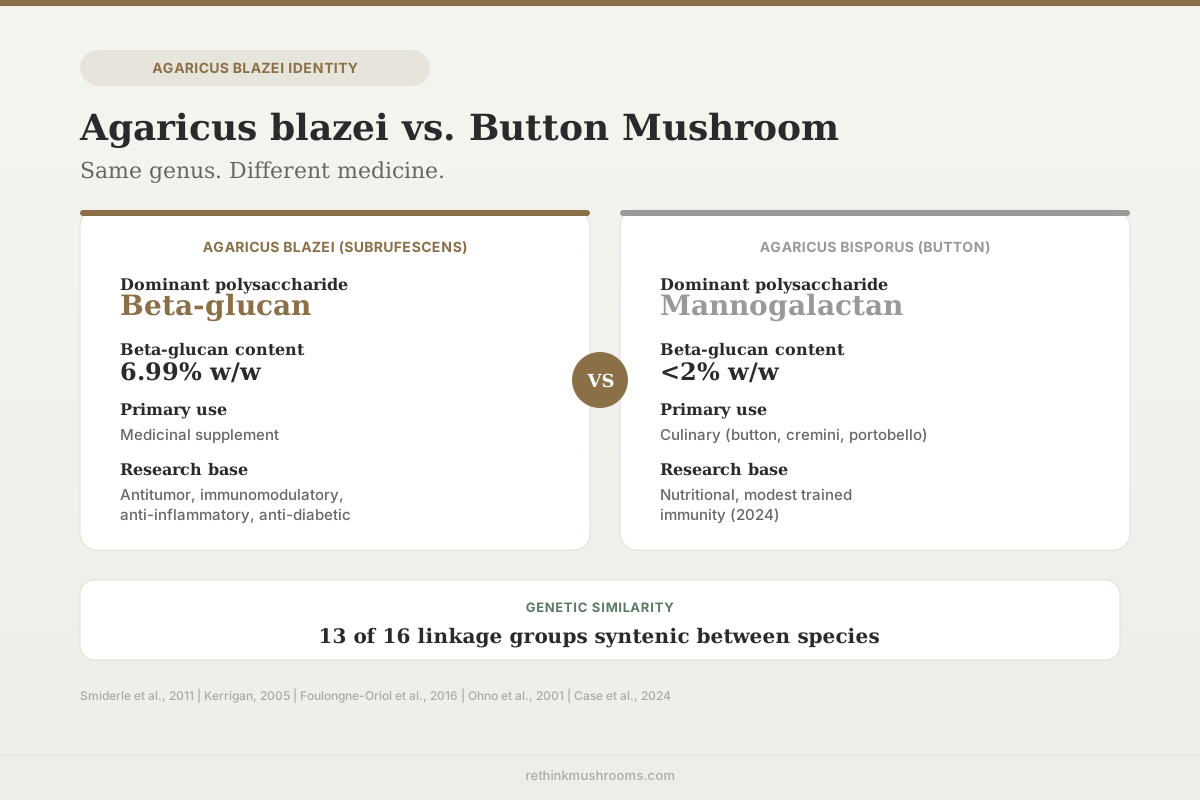
Agaricus blazei produces primarily beta-glucans while the button mushroom's main polysaccharide is mannogalactan, a fundamentally different compound.
Smiderle et al., BMC Complementary and Alternative Medicine, 2011
Same genus
both Agaricus species
13 of 16
linkage groups syntenic
6.99% w/w
blazei beta-glucan content
Smiderle et al., BMC Complementary and Alternative Medicine, 2011
 View as image ↗
The white button mushroom sitting in your grocery store and the Agaricus blazei sold in supplement capsules share a genus and look superficially similar. They are not the same organism, and their differences go far beyond appearance. When researchers at Wageningen University directly compared their polysaccharide extracts using NMR spectroscopy, they found that Agaricus blazei (technically A. brasiliensis) produces primarily beta-glucans while the button mushroom (A. bisporus) produces primarily mannogalactans.[1] That single chemical difference explains most of the gap between one mushroom that fills salads and another that fills clinical trial protocols.
This article breaks down exactly where these two species diverge: genetics, polysaccharide profiles, immunological activity, and the evidence base behind each. For a broader overview of what Agaricus blazei is, start there.
Key Takeaways
- A. blazei produces mostly beta-glucans while A. bisporus produces mostly mannogalactans as their dominant polysaccharides (Smiderle et al., 2011)
- Despite different polysaccharide profiles, both species stimulated IL-1-beta and TNF-alpha production in human monocytic cells (Smiderle et al., 2011)
- Genetic mapping revealed 13 of 16 linkage groups in A. subrufescens are syntenic with A. bisporus chromosomes (Foulongne-Oriol et al., 2016)
- A. blazei beta-glucan content measured at 6.99% w/w, while other mushroom species tested contained less than 2% (Totowiputro et al.)
- A. blazei's 1,3-beta-glucan showed antitumor activity against Sarcoma 180 in mice; no equivalent data exists for A. bisporus beta-glucans in cancer models (Ohno et al., 2001)
- Button mushroom beta-glucans can still drive trained immunity in macrophages, though less potently than yeast-derived beta-glucans (Case et al., 2024)
Same Genus, Three Names, Two Species
The naming history of Agaricus blazei is a case study in taxonomic confusion. The mushroom cultivated for medicinal purposes was discovered growing wild in Brazil in the 1970s and initially identified as A. blazei Murrill, a species originally described from Florida. It was later renamed A. brasiliensis. In 2005, Kerrigan demonstrated through DNA sequence analysis of the rDNA ITS region and mating studies that the Brazilian medicinal mushroom is actually conspecific with A. subrufescens, a species first described by American botanist Charles Horton Peck in 1893.[2] European specimens called A. rufotegulis also turned out to be the same species. A. subrufescens has taxonomic priority as the oldest valid name, but the name A. blazei persists in the supplement industry and most of the published research.
The button mushroom, A. bisporus, has never been subject to this confusion. It is the most cultivated edible mushroom in the world, sold as white button (immature, white), cremini (immature, brown), or portobello (mature, brown). Same species, different growth stages. For a full breakdown of the taxonomy confusion between A. blazei, A. subrufescens, and A. brasiliensis, see the dedicated article.
What Genetic Mapping Reveals About Their Kinship
Despite being different species, A. blazei and A. bisporus are genuinely close relatives. Foulongne-Oriol and colleagues at INRA constructed the first genetic linkage map for A. subrufescens (= blazei) using 202 markers distributed over 16 linkage groups, covering 1,701 cM.[3] Using 96 homologous loci, they demonstrated a high level of macrosynteny with the A. bisporus genome: 13 of the 16 linkage groups in A. subrufescens mapped directly onto the 13 chromosomes of A. bisporus. Only three linkage groups showed disrupted synteny.
This means the two species share a broadly conserved chromosome architecture. Their genes are arranged in similar order on similar chromosomes. The evolutionary divergence is real but relatively recent in fungal terms. Electronic mapping of A. subrufescens expressed sequence tags onto the A. bisporus genome showed homologous loci were evenly spread across chromosomes, with only a few localized hot or cold spots of homology.[3]
The practical implication: genes identified in A. bisporus (which has a fully sequenced genome and is the model organism for edible mushroom genetics) can inform research on A. blazei, and vice versa. Breeding programs could potentially use this synteny to transfer desirable traits between species. The genetic similarity makes the chemical differences between the species more striking, not less. Two species with broadly similar genomes produce dramatically different polysaccharide profiles, suggesting that a relatively small number of gene expression differences drive the divergence in bioactive compound production.
The Polysaccharide Divide: Beta-Glucans vs. Mannogalactans
The most consequential difference between the two mushrooms lies in their polysaccharide profiles. Smiderle and colleagues used GC-MS and NMR spectroscopy to characterize semi-purified extracts from both species.[1] Both species contained three types of polysaccharides: (1->6),(1->4)-linked alpha-glucan, (1->6)-linked beta-glucan, and mannogalactan. The proportions were considerably different.
A. brasiliensis (= blazei) showed a higher content of beta-glucan as its dominant polysaccharide. A. bisporus presented mannogalactan as its main polysaccharide. This is not a subtle difference. Beta-glucans and mannogalactans activate different immune pathways. The beta-glucans and blazein compounds in Agaricus blazei have been the focus of nearly all the medicinal research on this species.
Ohno and colleagues at Tokyo University of Pharmacy isolated the specific antitumor component from A. blazei and identified it as a highly branched 1,3-beta-glucan.[4] The NaOH-extracted fractions showed antitumor activity against Sarcoma 180 in ICR mice. Through chemical and enzymatic treatments, they pinpointed the active center as a 1,3-beta-glucan segment with branching. This specific structure has not been identified as a dominant component in A. bisporus.
Cross-species beta-glucan comparisons have measured A. blazei beta-glucan content at 6.99% (w/w), while other mushroom species tested contained less than 2%. A. bisporus falls into that lower range, with alpha-glucans rather than beta-glucans forming the bulk of its polysaccharide fraction. A 2018 study confirmed that the high molecular weight glucan in A. bisporus is an alpha-glucan that forms complexes with low molecular weight galactan, a fundamentally different structural arrangement from the beta-glucan-dominated profile of A. blazei.
The structural distinction matters because beta-1,3/1,6-glucans are recognized by the Dectin-1 receptor on immune cells, triggering downstream signaling cascades that activate innate immunity. Mannogalactans and alpha-glucans interact with different receptor pathways. When a supplement label says "mushroom polysaccharides," the type of polysaccharide determines the biological effect. A gram of A. blazei extract delivers a different molecular payload than a gram of A. bisporus extract.
Immunomodulatory Activity: Overlap and Divergence
Despite the polysaccharide differences, the immunological picture is more nuanced than "one works and the other doesn't." Smiderle's team found that extracts from both species stimulated transcription of pro-inflammatory cytokine genes IL-1-beta and TNF-alpha, as well as COX-2, in PMA-differentiated THP-1 cells (a human monocytic cell line).[1] Both species activated innate immune responses.
The divergence appeared under inflammatory challenge. When bacterial lipopolysaccharide (LPS) was added to simulate an infection, the A. brasiliensis (blazei) extract significantly reduced the LPS-induced cytokine production. The A. bisporus extract did not show this same anti-inflammatory modulation. This suggests that A. blazei polysaccharides can program the immune system bidirectionally: stimulating it at baseline but dampening excessive inflammatory responses when they occur. Hetland and colleagues described this as "amelioration of Th1/Th2 imbalance and inflammation," with effects documented across tumor, infection, allergy, and inflammatory bowel disease models.[5]
For A. blazei specifically, the medicinal effects span antitumor, anti-infection, and antiallergic properties mediated through stimulation of monocytes, NK cells, and dendritic cells.[5] A. bisporus lacks an equivalent body of evidence for these applications. The clinical research base for Agaricus blazei and NK cell activation has no parallel in button mushroom research.
Can Button Mushrooms Do Anything Medicinal?
The answer is not a flat no. Case and colleagues at Trinity College Dublin demonstrated in 2024 that beta-glucans from A. bisporus can drive trained immunity in mouse macrophages.[6] Macrophages pre-treated with whole mushroom powder showed enhanced responses to restimulation with TLR ligands, particularly TLR-2. The trained response was modest compared to yeast-derived beta-glucans and correlated with the amount of available beta-glucans in the preparation. Enriching for beta-glucan content through simulated digestion or chemical fractionation retained or boosted the effect. Oral gavage of mushroom powder in mice altered bone marrow progenitor cell populations, shifting toward myeloid-committed progenitor cells.
This is a legitimate finding. Button mushrooms contain some beta-glucans, and those beta-glucans can train innate immune cells. The effect is weaker than what is seen with higher-beta-glucan sources, but it exists. Human monocytes treated with digested mushroom powder also showed enhanced restimulation responses, confirming cross-species relevance beyond mouse models. At the in vivo level, mice given whole mushroom powder by oral gavage showed changes in hematopoietic stem cell dynamics, with a shift toward myeloid-committed progenitors that produced macrophages with enhanced trained responses.
The practical question is whether eating button mushrooms in dietary quantities delivers enough beta-glucan to produce a measurable immune effect in humans. That study has not been done. The Case et al. data suggests possible benefit from regular dietary consumption, but the gap between gavage-fed mice and a human eating mushrooms with dinner remains unquantified.
Why One Is a Supplement and the Other Is a Side Dish
The difference in research trajectories is not arbitrary. A. blazei has a long history of traditional use in Brazil ("Cogumelo do Sol") and Japan (Himematsutake), where it has been prescribed for cancer prevention, diabetes, and immune support.[7] The mushroom was brought to Japan in the 1960s and rapidly became one of the country's most popular and most expensive medicinal mushrooms. Firenzuoli and colleagues reviewed the literature and confirmed immunomodulatory and antimutagenic properties in vitro and in vivo, while noting ongoing safety concerns related to agaritine content.[7]
A Phase I clinical study by Ohno and colleagues enrolled 78 cancer patients in remission and tested 1.8, 3.6, or 5.4 g of A. blazei powder daily for 6 months.[8] Adverse events occurred in 12% of patients, most digestive (nausea, diarrhea), with one case of liver dysfunction related to food allergy. No dose-dependent adverse events were observed. This represents safety data that simply does not exist for A. bisporus in a supplement context because nobody studies button mushrooms as supplements.
The commercial reality also matters. A. bisporus is grown industrially on every continent and costs a few dollars per kilogram. A. blazei is more expensive to cultivate, has lower yields, and is primarily sold as a dried powder or extract at supplement-grade prices. The market positions reflect both the chemical differences and the research investment.
Both species contain agaritine, a hydrazine derivative that has shown mutagenic properties in some test systems. Firenzuoli's review flagged agaritine as a "perplexing concern" requiring full toxicological evaluation.[7] Cooking substantially reduces agaritine levels, which is relevant for A. bisporus (typically eaten cooked) but less so for A. blazei (typically consumed as a dried, uncooked supplement). This is an area where the button mushroom has a practical safety advantage that the supplement form does not.
For Agaricus blazei dosing guidance based on clinical trial protocols, see the dedicated article. For A. blazei's effects on allergies and Th1/Th2 balance, see the dedicated review.
The Bottom Line
Agaricus blazei and the common button mushroom (A. bisporus) share a genus and conserved chromosome architecture, but their polysaccharide profiles diverge sharply. A. blazei produces primarily beta-glucans with documented immunomodulatory, antitumor, and anti-inflammatory properties in preclinical and limited clinical research. A. bisporus produces primarily mannogalactans and contains less beta-glucan, though its beta-glucans can still drive trained immunity at lower potency. The medicinal research base for A. blazei is substantial; for A. bisporus, it is minimal. They are related, but functionally different organisms.
Frequently Asked Questions
Sources & References
- 1RTHM-00234·Smiderle, Fhernanda R et al. (2011). “Polysaccharides from Agaricus bisporus and Agaricus brasiliensis show similarities in their structures and their immunomodulatory effects on human monocytic THP-1 cells..” BMC complementary and alternative medicine.Study breakdown →PubMed →↩
- 2RTHM-00081·Kerrigan, Richard W (2005). “Agaricus subrufescens, a cultivated edible and medicinal mushroom, and its synonyms..” Mycologia.Study breakdown →PubMed →↩
- 3RTHM-00425·Foulongne-Oriol, Marie et al. (2016). “The Genetic Linkage Map of the Medicinal Mushroom Agaricus subrufescens Reveals Highly Conserved Macrosynteny with the Congeneric Species Agaricus bisporus..” G3 (Bethesda.Study breakdown →PubMed →↩
- 4RTHM-00038·Ohno, N et al. (2001). “Antitumor beta glucan from the cultured fruit body of Agaricus blazei..” Biological & pharmaceutical bulletin.Study breakdown →PubMed →↩
- 5RTHM-00215·Hetland, Geir et al. (2011). “The Mushroom Agaricus blazei Murill Elicits Medicinal Effects on Tumor, Infection, Allergy, and Inflammation through Its Modulation of Innate Immunity and Amelioration of Th1/Th2 Imbalance and Inflammation..” Advances in pharmacological sciences.Study breakdown →PubMed →↩
- 6RTHM-00867·Case, Sarah et al. (2024). “β-glucans from Agaricus bisporus mushroom products drive Trained Immunity..” Frontiers in nutrition.Study breakdown →PubMed →↩
- 7RTHM-00131·Firenzuoli, F et al. (2008). “The Medicinal Mushroom Agaricus blazei Murrill: Review of Literature and Pharmaco-Toxicological Problems..” Evidence-based complementary and alternative medicine : eCAM.Study breakdown →PubMed →↩
- 8RTHM-00229·Ohno, Satoshi et al. (2011). “Phase I Clinical Study of the Dietary Supplement, Agaricus blazei Murill, in Cancer Patients in Remission..” Evidence-based complementary and alternative medicine : eCAM.Study breakdown →PubMed →↩