Mushroom Anatomy and Bioactives
Sporoderm barrier
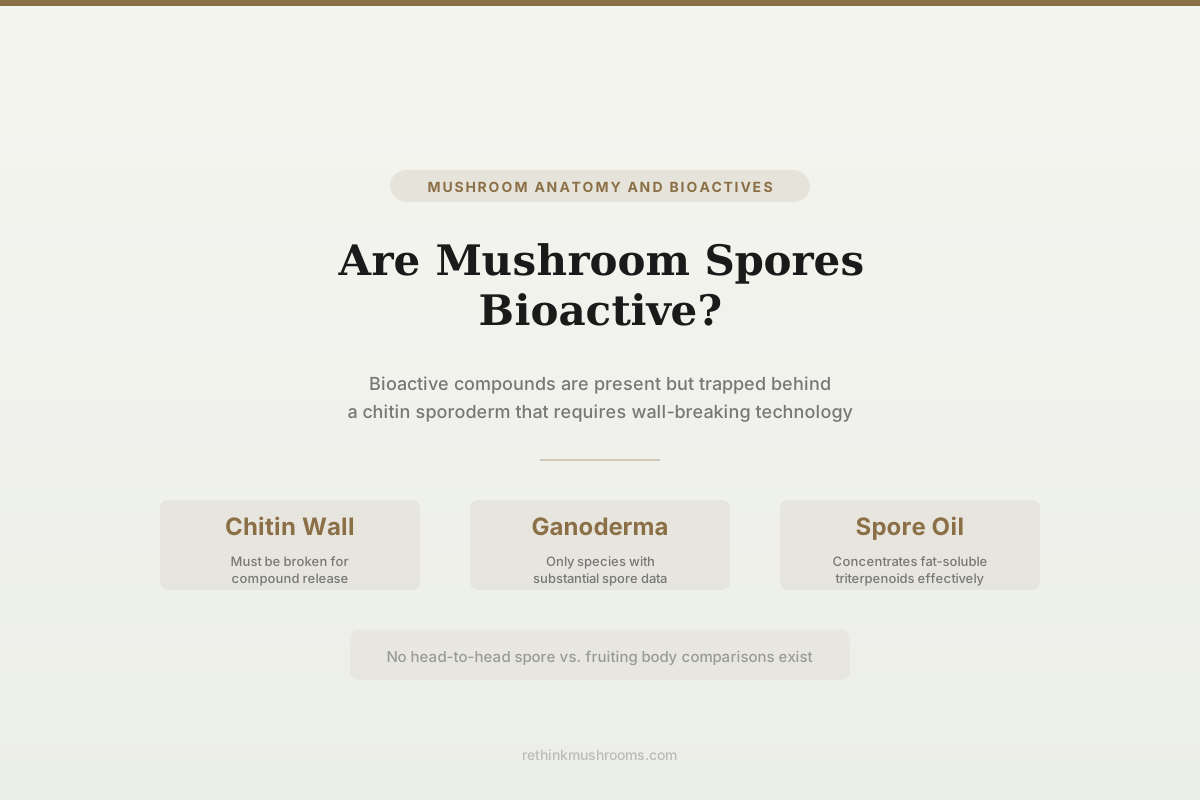
Mushroom spores contain bioactive compounds but a double-layered chitin sporoderm blocks their release, requiring wall-breaking technology for biological activity.
Wang et al., Natural Product Research, 2017
Ganoderma
spores most studied for bioactivity
Chitin Wall
must be broken for compound release
6 Studies
on spore compounds and processing
Wang et al., Natural Product Research, 2017
 View as image ↗
Mushroom supplements come from three main anatomical sources: fruiting bodies (the visible mushroom), mycelium (the underground network), and spores (the reproductive cells). Spore-based products, particularly from Ganoderma lucidum (reishi), have become a significant market segment. But the question of whether spores are genuinely bioactive is more nuanced than marketing suggests. Spores do contain triterpenoids, polysaccharides, lipids, and other compounds with documented biological activity. However, those compounds are locked behind a double-layered chitin sporoderm that resists digestion, and unbroken spores may pass through the GI tract with minimal compound release. For a broader comparison of which mushroom parts are most medicinal, the pillar article covers the full anatomy question.
This article examines what published research actually shows about spore bioactivity: what compounds they contain, why the sporoderm matters, what wall-breaking technology accomplishes, and where the evidence stands for specific health claims.
Key Takeaways
- Ganoderma lucidum spores contain triterpenoids, polysaccharides (beta-D-glucans), fatty acids, sterols, and proteins, but bioactive compound concentrations differ from fruiting body profiles (Soccol et al., 2016)
- A water-soluble beta-D-glucan isolated from Ganoderma spores had a molecular weight of 1.72 x 10^4 Da and consisted primarily of glucose and galactose (Dong et al., 2012)
- The double-layered chitin sporoderm prevents compound release; broken-wall spore preparations contain higher extractable carbohydrates and amino acids than unbroken spores (Wang et al., 2017)
- Spore oil extracted by supercritical CO2 from broken-wall spores contains triterpenoids and fatty acids with documented anti-tumor and immunomodulatory properties in preclinical models
- Mushroom spores represent the reproductive phase and contain bioactive compounds optimized for spore survival and germination, not necessarily for the same functions as fruiting body metabolites (Liu et al., 2025)
- Claims that spores are "more potent" than fruiting bodies lack systematic head-to-head comparison data for most species
What Compounds Do Mushroom Spores Actually Contain?
Soccol et al. (2016) reviewed the pharmacological properties of biocompounds specifically from Ganoderma lucidum spores, the most extensively studied spore source.[1] The spores contain multiple compound classes:
Triterpenoids: Ganoderic acids and related lanostane-type triterpenoids are present in spores, though some research suggests spore powder contains lower triterpenoid concentrations than fruiting bodies. The specific triterpenoid profile differs between spores and fruiting bodies, with some compounds unique to or enriched in spores.
Polysaccharides: Beta-glucans with immunomodulatory activity are present in spore cell walls. Dong et al. (2012) isolated a water-soluble beta-D-glucan from Ganoderma spores with a molecular weight of 1.72 x 10^4 Da, composed primarily of glucose and galactose.[2]
Lipids: Spore oil, extracted from broken-wall spores using supercritical CO2, contains fatty acids (oleic, linoleic, palmitic), triterpene acids, and sterols. This lipid fraction has attracted particular commercial interest because it concentrates fat-soluble bioactive compounds.
Proteins and amino acids: Spores contain enzymes and structural proteins, though at lower concentrations than in mycelial preparations.
Liu et al. (2025) provided the most comprehensive recent review of mushroom sexual spore biology, noting that spore bioactive compound profiles reflect their reproductive function.[3] Spores are optimized for survival during dispersal and germination, which means they contain protective compounds (antioxidants, antimicrobials, UV-absorbing pigments) that may differ from the metabolites produced by actively growing mycelium or mature fruiting bodies. This biological context is important: spore compounds evolved for spore survival, not necessarily for the same biological functions as fruiting body triterpenoids or mycelial polysaccharides.
The Sporoderm Problem: Why Processing Matters
The most critical quality factor for spore products is whether the sporoderm (spore wall) has been broken. Mushroom spores are enclosed in a double-layered wall: an outer exosporium and an inner endosporium, both containing chitin, a structural polysaccharide that human digestive enzymes cannot degrade.
Wang et al. (2017) demonstrated the challenge and its solution by combining chemical reaction with physical actuation to break Ganoderma spores.[4] The sporoderm's resistance to enzymatic digestion means that intact spores pass through the gastrointestinal tract with minimal compound release. Breaking the sporoderm through mechanical grinding, ultrasonic processing, or chemical treatment exposes the internal contents to extraction and absorption.
Broken-wall spore preparations (BSG) contain higher extractable total carbohydrates and amino acids than unbroken spore preparations (UBSG). The bioactive compound content does not change (the same compounds are present in both), but bioavailability changes dramatically. A spore product with 99% wall-breaking rate delivers a fundamentally different biological exposure than the same product with 50% or 0% wall-breaking.
This distinction matters for consumer evaluation. Products claiming "spore powder" without specifying wall-breaking rate or technology may deliver minimal bioactive compounds despite containing the right raw material. Products that specify "broken-wall" or "cracked-shell" spore powder address this issue, though independent verification of wall-breaking rates is rare.
Multiple wall-breaking methods exist with different trade-offs. Mechanical grinding (ball milling) is the most common industrial method, achieving high breaking rates but generating heat that can degrade thermolabile compounds. Ultrasonic processing breaks walls with less heat but may be less thorough. Chemical methods (enzymatic or acid treatment) can achieve high breaking rates but may alter the chemical profile of the released compounds. The choice of method affects not just how many spores are broken but what compounds survive the processing intact. No comparative study has evaluated how different wall-breaking methods affect the final bioactive compound profile of the same starting spore batch.
Ganoderma Spore Oil: The Concentrated Lipid Fraction
Ganoderma lucidum spore oil (GLSO) has become the premium spore-derived product category. Extracted from broken-wall spores using supercritical CO2, GLSO concentrates the fat-soluble triterpenoids and fatty acids while excluding the polysaccharide fraction.
Published research attributes multiple pharmacological activities to GLSO: anti-tumor effects in cell culture and animal models, immunomodulatory activity, hepatoprotective effects, and antioxidant capacity. The triterpenoid content of GLSO, particularly ganoderic acids, provides anti-inflammatory and cytotoxic activity. The fatty acid profile (predominantly oleic and linoleic acids) contributes to cardiovascular health potential.
However, systematic comparisons between GLSO and fruiting body extracts for the same endpoints are limited. Most GLSO studies test the oil in isolation without a fruiting body control group, making it impossible to determine whether spore-derived compounds are more, less, or equally effective as fruiting body compounds for any given outcome.
The supercritical CO2 extraction process itself contributes to product quality variation. Temperature, pressure, and extraction time all affect which compounds end up in the final oil. Two GLSO products from different manufacturers using different extraction parameters could have meaningfully different triterpenoid profiles even if both start with the same raw spore material. No industry standard exists for GLSO composition, and third-party testing rarely includes triterpenoid profiling.
One clinical study deserves mention despite its limitations. A trial of Ganoderma spore powder in breast cancer patients undergoing endocrine therapy found improvements in cancer-related fatigue scores. While this is among the few human studies using spore products specifically, the study used whole spore powder (not oil), making it difficult to attribute effects to specific spore compounds versus general beta-glucan immune modulation that any mushroom preparation might provide.
Spore Polysaccharides: A Distinct Fraction
Dong et al. (2012) isolated and characterized a specific polysaccharide from Ganoderma spores, providing structural data that distinguishes spore polysaccharides from those in fruiting bodies and mycelium.[2] The water-soluble beta-D-glucan had a backbone of (1->3)-linked beta-D-glucopyranose with branches at O-6, a structure consistent with immunomodulatory beta-glucans from other mushroom sources.
The molecular weight (1.72 x 10^4 Da) places this polysaccharide in a similar range to the immunoactive 10-20 kDa fraction identified in Antrodia camphorata mycelium, suggesting that polysaccharides from different mushroom parts and species may share structural features relevant to immune receptor binding. Whether spore-derived polysaccharides have the same immunomodulatory potency as fruiting body-derived polysaccharides per milligram has not been directly tested.
For a comparison of how mycelium, fruiting body, and spore bioactives differ across species, the dedicated sibling article maps these differences more comprehensively.
Beyond Ganoderma: Do Other Mushroom Spores Matter?
The vast majority of spore bioactivity research focuses on Ganoderma lucidum. For other medicinal mushroom species, spore-specific data is limited:
Cordyceps: Cordyceps sinensis produces spores (ascospores), but most Cordyceps research and products use mycelium (Cs-4 fermentation) or fruiting bodies. Spore-specific bioactivity data for Cordyceps is minimal.
Agaricus blazei: Spore preparations exist commercially, but the research base focuses on fruiting body and mycelial extracts. Whether Agaricus spores offer bioactivity beyond what fruiting bodies provide is undocumented.
Psilocybin mushrooms: Psilocybin and psilocin are present in spores of Psilocybe species, though at variable concentrations. This is relevant to the legal status of spores (which are legal in many jurisdictions because spore possession is not regulated) but not to the medicinal mushroom context.
Antrodia camphorata: Antrodia produces basidiospores rarely and in small quantities. Virtually all Antrodia research uses fruiting bodies or mycelium. Spore-based Antrodia products do not exist in the commercial market.
The Ganoderma-centric nature of spore research creates a knowledge gap. Bioactivity claims for spore products from non-Ganoderma species are largely extrapolated from Ganoderma data, an assumption that may not hold given the different metabolite profiles across species.
The reason for Ganoderma's dominance in spore research is partly practical: reishi mushrooms produce enormous quantities of spores (a single fruiting body can release billions), making collection commercially viable. Species that produce fewer spores or disperse them less predictably do not generate enough raw material for commercial spore products. This biological constraint means that "mushroom spore supplements" will likely remain a predominantly Ganoderma category for the foreseeable future, regardless of whether other species' spores prove bioactive in laboratory settings.
The "Spores Are More Potent" Claim
Some marketing materials claim that mushroom spores are "more concentrated" or "more potent" than fruiting bodies. The evidence for this claim is mixed:
For triterpenoids: Some studies found lower triterpenoid content in spores compared to fruiting bodies. The specific triterpenoid profile differs, so spores may contain unique compounds not found in fruiting bodies, but total triterpenoid concentration may be lower.
For polysaccharides: Spore polysaccharides are present but constitute a smaller fraction of total spore mass compared to fruiting body polysaccharide content. The chitin-heavy sporoderm means a large portion of spore "polysaccharide" is structural chitin rather than bioactive beta-glucan.
For spore oil (GLSO): As a concentrated lipid extract, GLSO does contain high concentrations of fat-soluble triterpenoids per milliliter. But this reflects the extraction and concentration process, not an inherent superiority of spore-derived versus fruiting body-derived triterpenoids.
For overall potency: No published systematic comparison has tested equivalent doses of spore extract versus fruiting body extract from the same species in the same disease model. Without such head-to-head data, potency claims in either direction are unsupported.
What the Evidence Supports and What It Does Not
Supported: Mushroom spores (primarily Ganoderma) contain bioactive compounds including triterpenoids, polysaccharides, and lipids. Broken-wall processing is necessary for meaningful compound release. Spore oil concentrates fat-soluble bioactives effectively.
Not supported: Claims that spores are universally "more potent" than fruiting bodies. Claims that unbroken spore powder delivers bioactive compounds efficiently. Extrapolation of Ganoderma spore data to spore products from other species. Claims of clinical efficacy for spore products based solely on compositional analysis.
Unknown: Optimal wall-breaking rate for maximum bioavailability. Whether spore-unique compounds offer therapeutic advantages over fruiting body compounds. Long-term safety profiles of concentrated spore oil products. How spore processing affects individual compound stability. Whether the immune effects of spore polysaccharides differ qualitatively from fruiting body polysaccharides, or whether both simply provide beta-glucan-mediated receptor activation through the same Dectin-1 and TLR pathways. The minimum effective dose of broken-wall spore powder for any measurable health outcome in humans.
For the broader question of which mushroom parts provide which benefits, see mycelium, sclerotium, and spores and sclerotia in medicinal mushrooms.
The Bottom Line
Mushroom spores, particularly from Ganoderma lucidum, contain triterpenoids, polysaccharides, and lipids with documented bioactivity in preclinical models. The double-layered chitin sporoderm prevents compound release from intact spores, making wall-breaking processing essential for any biological effect. Spore oil (GLSO) concentrates fat-soluble triterpenoids effectively. However, claims that spores are "more potent" than fruiting bodies lack systematic comparison data, and most spore bioactivity research is limited to Ganoderma. For non-Ganoderma species, spore-specific bioactivity data is minimal to nonexistent.
Frequently Asked Questions
Sources & References
- 1RTHM-00448·Soccol, Carlos Ricardo et al. (2016). “Pharmacological Properties of Biocompounds from Spores of the Lingzhi or Reishi Medicinal Mushroom Ganoderma lucidum (Agaricomycetes): A Review..” International journal of medicinal mushrooms.Study breakdown →PubMed →↩
- 2RTHM-00248·Dong, Qun et al. (2012). “A novel water-soluble β-D-glucan isolated from the spores of Ganoderma lucidum..” Carbohydrate research.Study breakdown →PubMed →↩
- 3RTHM-00938·Liu, Dongmei et al. (2025). “Sexual spores in mushrooms: bioactive compounds, factors and molecular mechanisms of spore formation..” Archives of microbiology.Study breakdown →PubMed →↩
- 4RTHM-00496·Wang, Jiajia et al. (2017). “Breaking the sporoderm of Ganoderma lucidum spores by combining chemical reaction with physical actuation..” Natural product research.Study breakdown →PubMed →↩