Wood Ear Bone Health
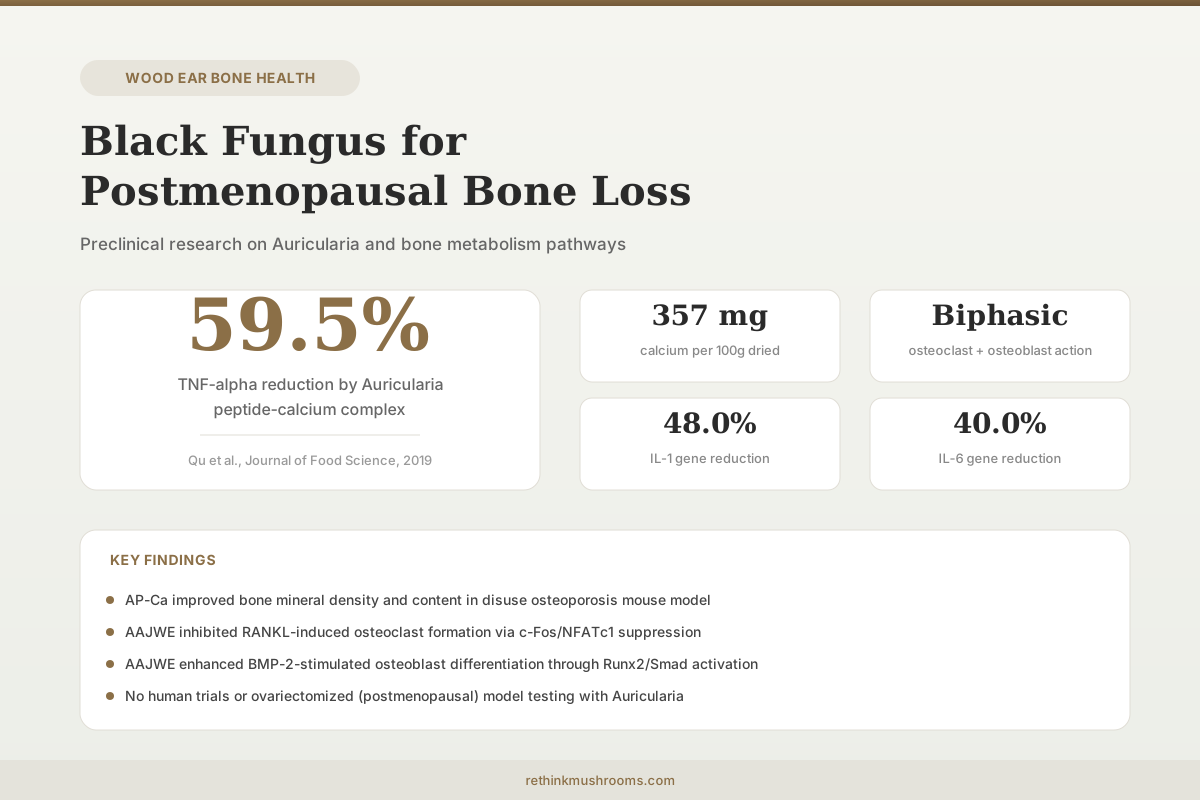
59.5% TNF-α Reduction
An Auricularia-derived peptide-calcium complex reduced expression of TNF-alpha, a cytokine central to estrogen-deficiency bone loss, by 59.5% in a disuse osteoporosis model.
Qu et al., Journal of Food Science, 2019
357 mg Calcium
per 100g dried black fungus
Biphasic Action
inhibits osteoclasts, promotes osteoblasts
All Preclinical
zero human trials on bone outcomes
Qu et al., Journal of Food Science, 2019
 View as image ↗
Postmenopausal bone loss is driven by estrogen withdrawal, which unleashes inflammatory cytokines (TNF-alpha, IL-1, IL-6) that accelerate osteoclast formation and tip the balance toward net bone resorption. Black fungus (Auricularia auricula-judae) has attracted research attention for its effects on several of these same pathways: a peptide-calcium complex from its protein hydrolysates reduced pro-inflammatory bone resorption genes by 40-59% in a rodent model, while a water extract simultaneously inhibited osteoclast differentiation and enhanced osteoblast formation in cell culture.[1][2] For the detailed molecular mechanisms behind these effects, see Auricularia and osteoblast differentiation.
The research is entirely preclinical. No human trial has tested Auricularia supplementation on bone mineral density in postmenopausal women. What exists is a set of cell culture and rodent studies that identify plausible biological mechanisms. This article maps those mechanisms onto what is known about postmenopausal bone physiology to evaluate whether the preclinical signals have clinical relevance.
Key Takeaways
- An Auricularia peptide-calcium complex (AP-Ca) downregulated TNF-alpha, IL-1, and IL-6 gene expression by 59.5%, 48.0%, and 40.0% respectively in a disuse osteoporosis mouse model (Qu et al., 2019)
- Auricularia water extract (AAJWE) inhibited RANKL-induced osteoclast formation while dose-dependently promoting BMP-2-stimulated osteoblast differentiation in cell culture (Kim et al., 2024)
- AP-Ca improved bone mineral density, bone mineral content, and bone organic content in tail-suspension mice compared to calcium carbonate controls (Qu et al., 2019)
- Dried black fungus contains approximately 357 mg calcium per 100g alongside iron, phosphorus, and ergosterol (Liu et al., 2021)
- A combination of Lentinus edodes and Grifola frondosa extracts reduced trabecular bone loss at the lumbar spine in ovariectomized rats, the standard model for postmenopausal osteoporosis (Erjavec et al., 2016)
- Zero clinical trials have tested any Auricularia preparation on bone density, fracture risk, or bone turnover markers in postmenopausal women
Why Postmenopausal Bone Loss Is Different
Postmenopausal osteoporosis is not simply age-related bone thinning. Estrogen suppresses the production of TNF-alpha, IL-1, and IL-6 from bone marrow stromal cells, T cells, and monocytes. When estrogen levels drop during menopause, these cytokines surge, directly stimulating RANKL expression and osteoclast precursor recruitment.[3] The result is a period of accelerated bone resorption that outpaces bone formation, with women losing 2-3% of bone mass annually in the first 5-7 years after menopause.
This cytokine-driven mechanism is important context for evaluating Auricularia research because several studies have shown the mushroom's polysaccharides and peptides reduce the exact same inflammatory mediators that drive postmenopausal bone loss. The question is whether these effects, demonstrated in cell culture and rodents, translate to human bone tissue.
The Peptide-Calcium Complex: Direct Bone Evidence
Qu et al. (2019) prepared a novel Auricularia auricula peptide-calcium complex (AP-Ca) by chelating calcium with bioactive peptides derived from the mushroom's protein hydrolysates, then tested it in a tail-suspension mouse model of disuse osteoporosis.[1]
In vitro, AP-Ca increased calcium content and alkaline phosphatase (ALP) activity in osteoblasts cultured in a two-dimensional rotating wall vessel, a system that simulates microgravity conditions. In vivo, AP-Ca supplementation improved bone mineral density, bone mineral content, and bone organic content compared to calcium carbonate controls.
The anti-inflammatory effect was striking: AP-Ca downregulated IL-1 gene expression by 59.5%, TNF-alpha by 48.0%, and IL-6 by 40.0%. These three cytokines are the same ones released during estrogen withdrawal. While the study used a disuse model rather than an ovariectomy (estrogen-deficiency) model, the downstream cytokine targets overlap substantially with postmenopausal bone loss pathways.
The peptide-calcium chelation approach matters because traditional calcium supplements (calcium carbonate, calcium citrate) have relatively poor bioavailability. Peptide-mineral chelates can improve absorption because the peptide protects the mineral from precipitation in the alkaline intestinal environment and facilitates transport across the intestinal epithelium. Whether AP-Ca specifically outperforms standard calcium supplements in human absorption studies is untested.
Biphasic Bone Activity: Osteoclast Inhibition and Osteoblast Promotion
Kim et al. (2024) published the most mechanistically detailed bone study on Auricularia to date, testing a water extract (AAJWE) on both sides of the bone remodeling equation.[2]
On the resorption side, AAJWE inhibited RANKL-induced osteoclast formation in RAW 264.7 macrophage cells without cytotoxic effects. TRAP staining confirmed reduced multinucleated osteoclast differentiation. The mechanism involved suppression of c-Fos and NFATc1 transcription factors through inhibition of ERK and JNK phosphorylation in the RANKL signaling cascade.
On the formation side, AAJWE dose-dependently increased ALP expression during BMP-2-stimulated osteoblast differentiation. The extract enhanced BMP-2-induced osteogenesis through activation of Runx2 (the master osteoblast transcription factor) and Smad phosphorylation.
This biphasic activity is relevant to the postmenopausal context because estrogen deficiency shifts both sides of the equation: osteoclast activity increases while osteoblast recruitment and function decline. An agent that addresses both simultaneously would theoretically be more effective than targeting one arm alone. Current osteoporosis drugs are typically either anti-resorptive (bisphosphonates, denosumab) or anabolic (teriparatide), but rarely both.
The limitation: this was a cell culture study with no in vivo confirmation of bone density improvement. The concentrations used in vitro may not be achievable in bone tissue after oral consumption of mushroom extracts. For a deeper analysis of the BMP-2/Smad/Runx2 pathway findings, see Auricularia and osteoblast differentiation.
Anti-Inflammatory Pathways and Bone Resorption
Beyond the two direct bone studies, Auricularia polysaccharides have demonstrated anti-inflammatory effects in several models that indirectly relate to bone metabolism.
Auricularia polysaccharides reduced TNF-alpha and IL-6 in a hepatic fibrosis model while enhancing short-chain fatty acid (SCFA) metabolism through gut microbiota modulation.[4] A glucuronoxylogalactoglucomannan isolated from Auricularia decreased IL-1beta, IFN-gamma, and TNF-alpha mRNA levels in a dose-dependent manner in LPS-stimulated THP-1 cells.[5]
In a nutritional obesity model, Auricularia polysaccharide supplementation decreased systemic inflammatory factor levels and alleviated liver histomorphology changes.[6]
The connection to bone: TNF-alpha, IL-1, and IL-6 are the primary cytokines that drive osteoclastogenesis through RANKL upregulation. Any agent that reduces these cytokines systemically could theoretically reduce bone resorption. But the studies listed above measured these cytokines in liver tissue, gut mucosa, and cell culture, not in bone marrow or bone tissue. Cytokine reduction in one tissue does not guarantee the same effect in another. Bone marrow has its own microenvironment with distinct regulatory mechanisms.
For a comprehensive overview of Auricularia polysaccharide mechanisms, see the wood ear and bone health: osteoporosis research analysis.
Nutritional Composition: Calcium, Iron, and Vitamin D Precursors
Black fungus contains a notable mineral profile. Per 100g of dried mushroom, analyses have found approximately 357-614 mg of calcium, 35.5 mg of iron, 314 mg of phosphorus, and 12.5% protein.[7] The calcium content places it among the higher plant-based calcium sources, though bioavailability from a fungal matrix differs from dairy or supplement calcium and has not been directly measured.
Auricularia also contains ergosterol, the fungal precursor to vitamin D2. When exposed to UV light, ergosterol converts to vitamin D2, which contributes to calcium absorption and bone mineralization. The ergosterol content in Auricularia species ranges from 2,290 to 6,200 micrograms per gram of dry weight, though the vitamin D2 yield depends entirely on UV exposure during cultivation or processing. Most commercially dried black fungus receives minimal UV exposure, making its effective vitamin D2 content variable and often low.
Iron is relevant because iron deficiency, common in postmenopausal women, has been associated with lower bone density in observational studies. Black fungus is recognized as one of the highest iron sources among edible fungi, though the non-heme iron form has lower bioavailability than heme iron from animal sources. Phosphorus, another key mineral for hydroxyapatite crystal formation in bone, is present at 314 mg per 100g dry weight.
The mineral profile is further complemented by trace elements. Tang et al. (2024) reviewed the full bioactive compound landscape of Auricularia polysaccharides, identifying antioxidant and immunomodulatory activities beyond simple nutrient provision.[5] The distinction matters: mineral content makes black fungus a reasonable dietary calcium source, but the polysaccharide and peptide fractions are the compounds with demonstrated bone cell effects. Whether consuming whole black fungus delivers enough of these bioactive fractions to influence bone metabolism is unstudied.
The nutritional profile supports black fungus as a bone-relevant food, but nutritional composition alone does not demonstrate a therapeutic effect on bone density. Many calcium-rich foods exist. The research question is whether Auricularia's bioactive compounds (polysaccharides, peptides) provide effects beyond basic mineral nutrition.
Mushroom Extracts in Ovariectomized Rat Models
The ovariectomized (OVX) rat is the standard preclinical model for postmenopausal osteoporosis because removing the ovaries eliminates estrogen production and produces rapid bone loss that mirrors the early postmenopausal period.
Erjavec et al. (2016) tested water extracts from four mushroom species (Trametes versicolor, Grifola frondosa, Lentinus edodes, and Pleurotus ostreatus) in OVX rats fed mushroom blends for 42 days.[8] Extracts from T. versicolor, G. frondosa, and L. edodes inhibited osteoclast activity in vitro, while L. edodes extract increased osteoblast mineralization. A combination of L. edodes and G. frondosa extracts reduced trabecular bone loss at the lumbar spine compared to OVX controls.
Ohyama et al. (2014) tested an ethanol extract of Pleurotus eryngii in OVX rats and found it partially preserved bone metabolism markers.[9]
Lindequist (2021) reviewed the broader evidence for medicinal mushrooms in osteoporosis, identifying positive results across genera including Cordyceps, Ganoderma, Grifola, Lentinula, Phellinus, Pleurotus, and Trametes.[3] The review noted that most evidence comes from in vitro assays and animal studies, with very few clinical trials.
Auricularia was not among the species tested in these OVX rat studies. This is a critical gap: the most directly relevant preclinical model for postmenopausal bone loss has not been used with Auricularia extracts. The biphasic study (Kim et al., 2024) used cell culture, and the peptide-calcium study (Qu et al., 2019) used a disuse model, not an estrogen-deficiency model. Whether Auricularia extracts would preserve bone in an estrogen-deficient environment remains unknown.
For more on calcium and mineral absorption from wood ear, see wood ear and calcium absorption: mineral research and wood ear and calcium absorption: vitamin D and bone mineral density research.
The Gut-Bone Axis: An Emerging Connection
A growing body of preclinical research has identified the gut microbiome as a regulator of bone metabolism. Gut bacteria influence calcium absorption, produce short-chain fatty acids (SCFAs) that modulate immune cell activity, and regulate systemic inflammation through intestinal barrier function. Estrogen deficiency alters gut microbiota composition, which may contribute to the inflammatory cascade that drives postmenopausal bone loss.
Auricularia polysaccharides are indigestible fermentable fibers that reach the colon intact and serve as substrates for bacterial fermentation. Zhang et al. (2025) demonstrated that Auricularia polysaccharides enhanced SCFA metabolism and modulated gut microbiota composition while reducing TNF-alpha and IL-6 in a hepatic fibrosis model.[4] Liu et al. (2022) showed that Auricularia polysaccharide supplementation altered gut bacterial populations and reduced inflammatory markers in a nutritional obesity model.[6]
The hypothetical chain: Auricularia polysaccharides reach the colon, feed SCFA-producing bacteria, SCFAs reduce systemic inflammation, lower inflammation reduces RANKL-driven osteoclastogenesis, and bone resorption slows. Each link in this chain has some preclinical support, but the complete pathway has never been tested end-to-end, and no study has measured bone outcomes after Auricularia-mediated gut microbiota changes. The gut-bone axis is a plausible but unproven mechanism for Auricularia's potential bone effects.
Evidence Gaps and Limitations
The distance between current evidence and clinical application is substantial:
No human data. Zero clinical trials have measured bone mineral density, bone turnover markers (CTX, P1NP, osteocalcin), or fracture outcomes in postmenopausal women taking any Auricularia preparation.
No OVX model testing. The standard preclinical model for postmenopausal osteoporosis has not been used with Auricularia extracts. The disuse model (Qu et al., 2019) shares downstream cytokine targets but has a fundamentally different mechanism of bone loss.
No bioavailability data. The cell culture concentrations used in Kim et al. (2024) may not be achievable in bone tissue after oral consumption. No pharmacokinetic study has tracked Auricularia peptides or polysaccharides to bone tissue.
Extract variability. Water extracts, ethanol extracts, and peptide hydrolysates contain different compound profiles. Results from one preparation cannot be assumed for another. Commercial black fungus products vary widely in processing and would not deliver the same compounds used in research.
Positive publication bias. Small preclinical studies with negative results are less likely to be published, potentially overstating the strength of current evidence.
The preclinical signals are biologically plausible given the cytokine overlap between Auricularia's anti-inflammatory effects and the cytokine-driven mechanism of postmenopausal bone loss. But biological plausibility is the lowest tier of evidence. Most compounds with preclinical promise fail in clinical translation.
The Bottom Line
Auricularia auricula-judae research has identified two direct bone effects: a peptide-calcium complex that improved bone parameters while reducing TNF-alpha, IL-1, and IL-6 in a disuse osteoporosis model, and a water extract with biphasic activity that inhibited osteoclasts and promoted osteoblasts in cell culture. These mechanisms overlap with postmenopausal bone loss pathways driven by estrogen-deficiency cytokine release. The evidence is entirely preclinical, with no human trials, no ovariectomized rat model testing, and no bioavailability data for bone tissue.
Frequently Asked Questions
Sources & References
- 1RTHM-00584·Qu, Hang et al. (2019). “Anti-Disuse Osteoporosis Activity of a Complex of Calcium-Binding Peptide from Auricularia auricula Protein Hydrolysates..” Journal of food science.Study breakdown →PubMed →↩
- 2RTHM-00885·Kim, Shin-Hye et al. (2024). “The Biphasic Activity of Auricularia Auricula-Judae Extract on Bone Homeostasis through Inhibition of Osteoclastogenesis and Modulation of Osteogenic Activity..” Journal of microbiology and biotechnology.Study breakdown →PubMed →↩
- 3RTHM-00701·Lindequist, Ulrike et al. (2021). “Medicinal Mushrooms for Prevention and Therapy of Osteoporosis (Review)..” International journal of medicinal mushrooms.Study breakdown →PubMed →↩
- 4RTHM-00956·Zhang, Lu et al. (2025). “Auricularia auriculaPolysaccharides Exert Anti-inflammatory Effects in Hepatic Fibrosis by the Gut-Liver Axis and Enhancing SCFA Metabolism..” Journal of agricultural and food chemistry.Study breakdown →PubMed →↩
- 5RTHM-00913·Tang, Jun et al. (2024). “Structural properties, bioactivities, structure-activity relationships and bio-applications of polysaccharides from Auricularia auricula: A review..” International journal of biological macromolecules.Study breakdown →PubMed →↩
- 6RTHM-00781·Liu, Qian et al. (2022). “Dietary Supplementation of Auricularia auricula-judae Polysaccharides Alleviate Nutritional Obesity in Mice via Regulating Inflammatory Response and Lipid Metabolism..” Foods (Basel.Study breakdown →PubMed →↩
- 7RTHM-00702·Liu, Enchao et al. (2021). “Review on Auricularia auricula-judae as a Functional Food: Growth, Chemical Composition, and Biological Activities..” Journal of agricultural and food chemistry.Study breakdown →PubMed →↩
- 8RTHM-00424·Erjavec, Igor et al. (2016). “Mushroom Extracts Decrease Bone Resorption and Improve Bone Formation..” International journal of medicinal mushrooms.Study breakdown →PubMed →↩
- 9RTHM-00341·Ohyama, Y et al. (2014). “Effect of the ethanol extract of Pleurotus eryngii on bone metabolism in ovariectomized rats..” Climacteric : the journal of the International Menopause Society.Study breakdown →PubMed →↩