Chaga and Antiviral Activity
3.82 μg/mL IC50 vs HSV-1
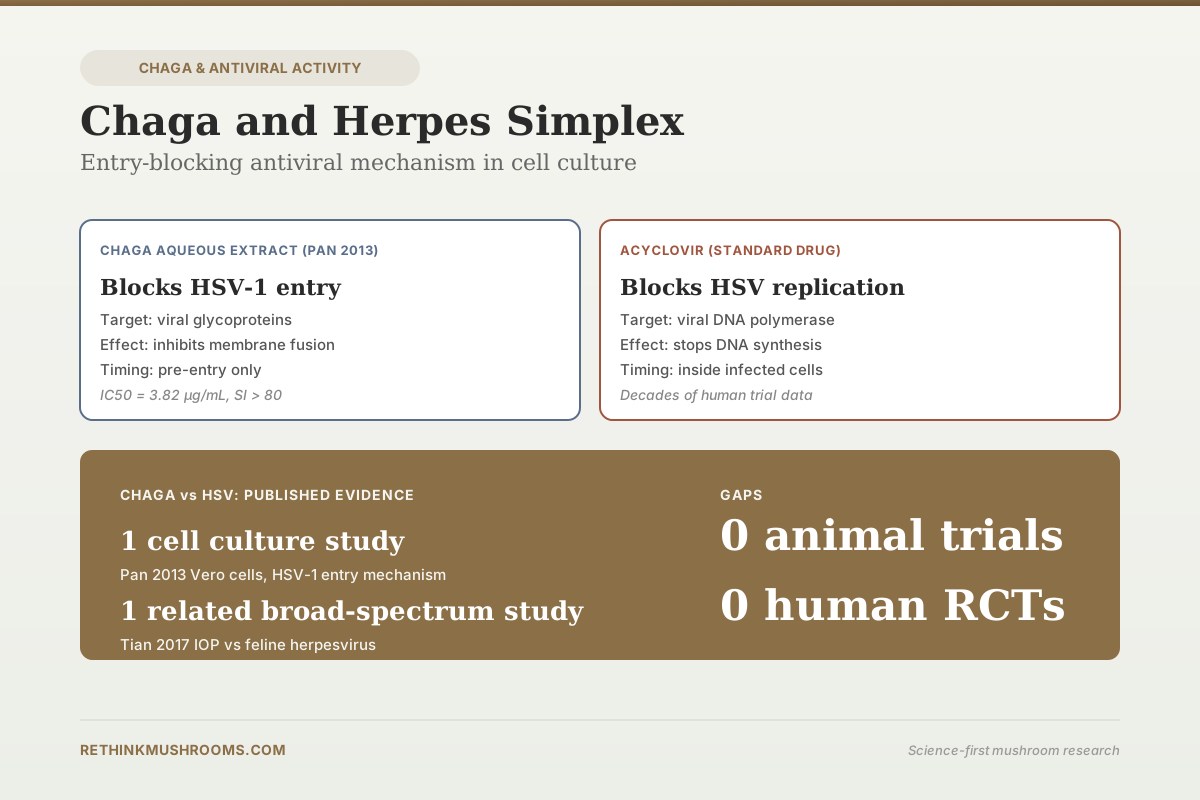
Aqueous chaga extract inhibited HSV-1 infection with 50% inhibitory concentration of 3.82 μg/mL in the plaque reduction assay, acting by blocking virus-induced membrane fusion during cell entry.
Pan et al., International Journal of Medicinal Mushrooms, 2013
Entry blocker
chaga acts before viral DNA replication, not like acyclovir
Selection index >80
antiviral effect at doses well below cellular cytotoxicity threshold
0 Human Trials
no published clinical trial of chaga for any herpes simplex outcome
Pan et al., International Journal of Medicinal Mushrooms, 2013
 View as image ↗
The chaga anti-herpes story is a narrow one in the published literature. One well-designed cell culture study has characterized the mechanism in detail. A small number of related studies extend the pattern to other herpesvirus species. No animal infection study, no human clinical trial, no standardized product has been tested. This article walks through the exact findings and the mechanism Pan and colleagues identified, then traces what would be required to extend the preclinical signal into a clinical claim. For the broader chaga-against-viruses picture, see our chaga and viruses review.
The mechanism matters here because it is unlike any prescription herpes drug. Acyclovir, valacyclovir, and famciclovir all work inside infected cells, blocking viral DNA polymerase to stop replication. Chaga's aqueous extract acted outside the cell, preventing virus-induced membrane fusion at the entry step. This is a different target and a different kill window, which opens theoretical use cases the nucleoside analogues cannot fill, and closes ones they do fill well.
Key Takeaways
- Aqueous chaga extract (AEIO) inhibited HSV-1 infection with IC50 of 3.82 μg/mL in plaque reduction assay and 12.29 μg/mL in HSV-1/blue assay in Vero cells (Pan et al., International Journal of Medicinal Mushrooms, 2013)
- The mechanism is inhibition of viral-induced membrane fusion at the entry step, acting on viral glycoproteins, distinct from nucleoside analog antiherpetics like acyclovir (Pan et al., International Journal of Medicinal Mushrooms, 2013)
- 50% cellular cytotoxicity was >1 mg/mL and selection index was >80, indicating the antiviral effect occurs at doses well below cell-damaging concentrations in vitro (Pan et al., International Journal of Medicinal Mushrooms, 2013)
- Inonotus obliquus polysaccharide (IOP) showed broad-spectrum antiviral activity against feline calicivirus, feline herpesvirus 1, feline influenza, panleukopenia, and infectious peritonitis virus by blocking viral binding and absorption (Tian et al., International Journal of Biological Macromolecules, 2017)
- Melanins, polysaccharides, triterpenoids, and polyphenols have all been implicated in chaga's antiviral activity across different compound-target pairings (Duru et al., Phytotherapy Research, 2019)
- Zero published studies have tested chaga in animal HSV infection models or in humans with herpes simplex
How HSV Actually Infects a Cell
Herpes simplex virus enters host cells through a choreographed sequence. Viral glycoprotein C and B first bind heparan sulfate proteoglycans on the cell surface. Glycoprotein D then binds one of several entry receptors (HVEM, nectin-1, nectin-2, or 3-O-sulfated heparan sulfate). This binding triggers conformational changes in a glycoprotein complex that drives viral envelope-cell membrane fusion. The viral capsid enters the cytoplasm, travels to the nuclear membrane, and injects the HSV DNA genome into the nucleus, where replication begins.
Any step in this sequence is a potential antiviral target. Acyclovir and related nucleoside analogs target steps inside the cell, specifically viral DNA polymerase during replication. Entry inhibitors target the outside steps: attachment, receptor binding, or membrane fusion. The two classes have complementary profiles. Nucleoside analogs shut down replication in already-infected cells. Entry inhibitors prevent new cell infection but do nothing to cells the virus has already reached.
Pan and colleagues' 2013 data places chaga aqueous extract in the entry inhibitor category. The mechanism they identified acts on viral glycoproteins to prevent the fusion step. This has specific implications for when chaga could theoretically help and when it could not. Acute outbreak reduction in established lesions is primarily a replication problem. Transmission prevention and very early reactivation interception are primarily entry problems. In vitro mechanism does not automatically translate to either clinical scenario without direct testing.
The Pan 2013 Study in Detail
Pan and colleagues prepared aqueous extract from Inonotus obliquus and tested it in Vero cells, the African green monkey kidney cell line standard for HSV work.[1] They ran three types of assays: plaque reduction, a blue-staining HSV-1 quantification assay, and a time-course mechanism study.
Antiviral potency:
- IC50 in plaque reduction assay: 3.82 μg/mL
- IC50 in HSV-1/blue assay: 12.29 μg/mL
- 50% cellular cytotoxicity (CC50): greater than 1 mg/mL
- Selection index (CC50/IC50): greater than 80
A selection index above 10 is generally considered promising in initial antiviral screening; above 50 is strong. Chaga's >80 indicates a meaningful therapeutic window in cell culture.
Mechanism characterization:
- Time course analysis: the extract was most effective when present before or during early infection
- Effective stage analysis: the activity mapped to the entry step, not post-entry replication
- Fusion inhibition assay: directly demonstrated blocked virus-induced membrane fusion
The authors concluded that AEIO effectively prevented HSV-1 entry by acting on viral glycoproteins, leading to prevention of membrane fusion. The paper explicitly noted that this mechanism is different from nucleoside analog antiherpetics. For the more narrowly in vitro-focused article on this same research area, see our chaga and HSV in vitro antiviral piece.
Tian 2017 and the Broader Herpesvirus Picture
Tian and colleagues in 2017 tested Inonotus obliquus polysaccharide (IOP) against a panel of feline viruses, including feline herpesvirus 1 (FHV-1), feline calicivirus, feline influenza H3N2 and H5N6, panleukopenia virus, and infectious peritonitis virus.[2] FHV-1 is in the same Alphaherpesvirinae subfamily as HSV-1 and HSV-2.
Key findings:
- IOP exhibited anti-FCV activity with low cytotoxicity
- Mechanism: direct inhibitory action on virus particles through blocking viral binding and absorption
- Broad-spectrum activity across the tested feline viruses including FHV-1
The entry-blocking mechanism echoes Pan's HSV-1 finding but with a different compound class (polysaccharide rather than aqueous extract) and a different target species. The convergence suggests that entry inhibition is a robust chaga mechanism across herpesviruses and not specific to aqueous extract preparations. It does not establish clinical efficacy in any host, but it does suggest that if chaga is going to work against human HSV, the mechanism will most likely be entry inhibition rather than replication inhibition.
For human relevance, feline herpesvirus is not the same virus as HSV-1 or HSV-2. Cross-species antiviral predictions require caution. What the Tian data adds is mechanistic breadth, not direct human applicability. Our chaga and influenza article addresses the influenza side of the same broad-spectrum finding.
Which Chaga Compounds Are Doing the Work
Chaga extracts contain multiple compound classes, and different classes contribute to different biological activities. For HSV entry inhibition specifically, the candidate compounds include:
Melanins. Chaga contains substantial melanin content derived from birch phenolic precursors. Published reports outside the HSV-1 literature describe chaga melanin activity against HSV-2, HIV-1, West Nile, and influenza virus. Melanins are large, negatively-charged polymers that can interact with viral glycoproteins electrostatically. This is a plausible mechanism for entry inhibition that matches Pan's observation.
Polysaccharides. Tian's feline virus work identified polysaccharide as the active compound class. Polysaccharides can block viral attachment by competing for heparan sulfate-like interactions or by directly coating viral particles.
Triterpenoids and polyphenols. Both classes have broad antimicrobial and antiviral activity profiles across the mushroom literature. Their specific contribution to chaga's HSV activity has not been isolated.
Aqueous extract integration. Pan's preparation was a whole aqueous extract containing multiple compound classes. Whether the active ingredient is melanin, polysaccharide, a specific phenolic, or a synergistic combination has not been resolved by fractionation studies in HSV contexts.
Szychowski and colleagues' 2021 review and Duru and colleagues' 2019 review both place chaga's antiviral activity in the context of this multi-compound profile.[3][4] Both concluded that the preclinical antiviral signal is consistent across studies but clinical translation has not occurred.
The Clinical Gap
The published preclinical HSV literature consists of essentially one detailed mechanism study (Pan 2013) plus supporting broader-spectrum work (Tian 2017 in feline viruses, plus melanin activity reports). No in vivo HSV infection model has been tested with chaga. No human trial has been registered or published. The implications:
Dose translation is not established. Pan's 3.82 μg/mL IC50 is a cell culture concentration. Translating that to a daily oral or topical human dose requires pharmacokinetic data (oral absorption, tissue distribution, metabolism) that chaga lacks.
Topical versus oral is unclear. The entry inhibition mechanism is most relevant at the infection site: skin, mucosa, or the epithelial surface where the virus attempts to enter. Whether oral chaga reaches therapeutic tissue concentrations at any feasible dose is unknown. A topical chaga preparation could in principle be tested directly, but none has been in a published trial.
Prophylactic versus treatment window matters. Entry inhibitors are most useful before or at the earliest moment of viral exposure. For recurrent oral or genital HSV, the initial reactivation is already happening in established neurons before skin lesions appear. An entry inhibitor at the skin level could theoretically reduce lesion severity or cell-to-cell spread, but this specific outcome has not been measured.
Comparison to established antivirals is missing. Acyclovir's clinical benefit on HSV outbreak duration, viral shedding, and transmission is measured in decades of trial data. Chaga has none of that for any endpoint.
Why the Entry Mechanism Is Pharmacologically Distinctive
Most research-stage anti-HSV compounds are nucleoside analogs or polymerase inhibitors that block intracellular replication. These drugs work because they accumulate in infected cells and interrupt the DNA replication machinery. Their limitations are also intracellular: in latent neurons where viral DNA is dormant, they have no target.
An entry inhibitor has an opposite profile. Its target is on the outside of the cell, at the point where a virion attempts to fuse with the membrane. This has three practical implications.
First, it can theoretically protect uninfected cells by preventing virus spread to them, even in the middle of an active outbreak. Second, it cannot act on already-infected cells, so it will not shorten lesion duration in the same way a replication inhibitor does. Third, because the target is extracellular, the compound does not need to be taken up by cells to work, which can simplify topical delivery and reduce concerns about cellular toxicity.
Research-stage entry inhibitors for HSV have historically struggled with clinical development because they typically have narrow windows of action. Pre-exposure or point-of-exposure use is where they shine, and that clinical niche has not been a priority for HSV drug development. Chaga's entry inhibition mechanism, if it replicates in larger studies, would sit in this same niche.
Whether that niche is commercially viable is a separate question from whether it is clinically useful. Vaginal microbicides for HSV-2 prevention, for example, have clear public health rationale but have struggled with trial success, funding, and regulatory pathways. A topical chaga formulation tested in this framework is not a commercial priority for any party currently funding natural product research.
The Safety Context
Chaga's general safety record is reviewed in our chaga long-term safety article and the combination safety article. The main documented concern is renal: chronic chaga powder has been linked to oxalate nephropathy in two case reports (Kikuchi 2014; Lee 2020). This safety signal constrains any potential chronic-use anti-HSV protocol, since suppressive therapy for recurrent HSV is typically daily for months or years. A topical preparation would carry less of this concern, but no topical chaga HSV product has been clinically tested.
What Would Confirm the Effect
A meaningful human HSV trial of chaga would need: a standardized chaga preparation with characterized melanin, polysaccharide, and oxalate content; a route of administration matched to the mechanism (topical for direct entry inhibition, oral with pharmacokinetic data if systemic); a population defined by documented HSV-1 or HSV-2 infection; and hard endpoints (lesion duration, viral shedding measured by PCR, recurrence frequency). Such a trial has not been published or registered at the time of writing.
A more immediate next step in the preclinical chain would be an animal HSV infection model (mouse or guinea pig HSV-2 genital or ocular infection) testing chaga against known antivirals. That study has also not been published. The research chain between Pan's 2013 cell culture finding and any human application is essentially unbroken silence.
The Bottom Line
Pan and colleagues in 2013 showed that aqueous chaga extract inhibits HSV-1 infection in Vero cells with an IC50 of 3.82 μg/mL, acting by blocking virus-induced membrane fusion at the entry step via viral glycoprotein interaction. This mechanism differs from acyclovir and related nucleoside analogs that block replication inside infected cells. Tian 2017 extended the entry-blocking finding to feline herpesvirus and other feline viruses using chaga polysaccharide. Candidate active compounds include melanins, polysaccharides, and polyphenols, but the exact contribution of each to human HSV activity has not been isolated. Zero in vivo animal HSV studies and zero human clinical trials of chaga for herpes simplex have been published.
Frequently Asked Questions
Sources & References
- 1RTHM-00300·Pan, Hong-Hui et al. (2013). “Aqueous extract from a Chaga medicinal mushroom, Inonotus obliquus (higher Basidiomycetes), prevents herpes simplex virus entry through inhibition of viral-induced membrane fusion..” International journal of medicinal mushrooms.Study breakdown →PubMed →↩
- 2RTHM-00492·Tian, Jin et al. (2017). “Identification of Inonotus obliquus polysaccharide with broad-spectrum antiviral activity against multi-feline viruses..” International journal of biological macromolecules.Study breakdown →PubMed →↩
- 3RTHM-00553·Duru, Kingsley C et al. (2019). “The pharmacological potential and possible molecular mechanisms of action of Inonotus obliquus from preclinical studies..” Phytotherapy research : PTR.Study breakdown →PubMed →↩
- 4RTHM-00722·Szychowski, Konrad A et al. (2021). “Inonotus obliquus - from folk medicine to clinical use..” Journal of traditional and complementary medicine.Study breakdown →PubMed →↩