Mushrooms and Sustainability
5 billion tonnes / year
Global agricultural and agro-industrial lignocellulosic waste reaches the scale of several billion tonnes annually. Mushroom cultivation is one of the few biological processes that converts this low-value carbon stream into food and downstream material feedstocks.
Grimm & Wösten, Applied Microbiology and Biotechnology, 2018; Leong et al., Bioresource Technology, 2022
Input Valorisation
cellulose and lignin to edible fruiting body
Spent Substrate
a second feedstock, not a waste stream
Mycelium Materials
packaging, insulation, composite foam
Grimm & Wösten, Applied Microbiology and Biotechnology, 2018; Leong et al., Bioresource Technology, 2022
 View as image ↗
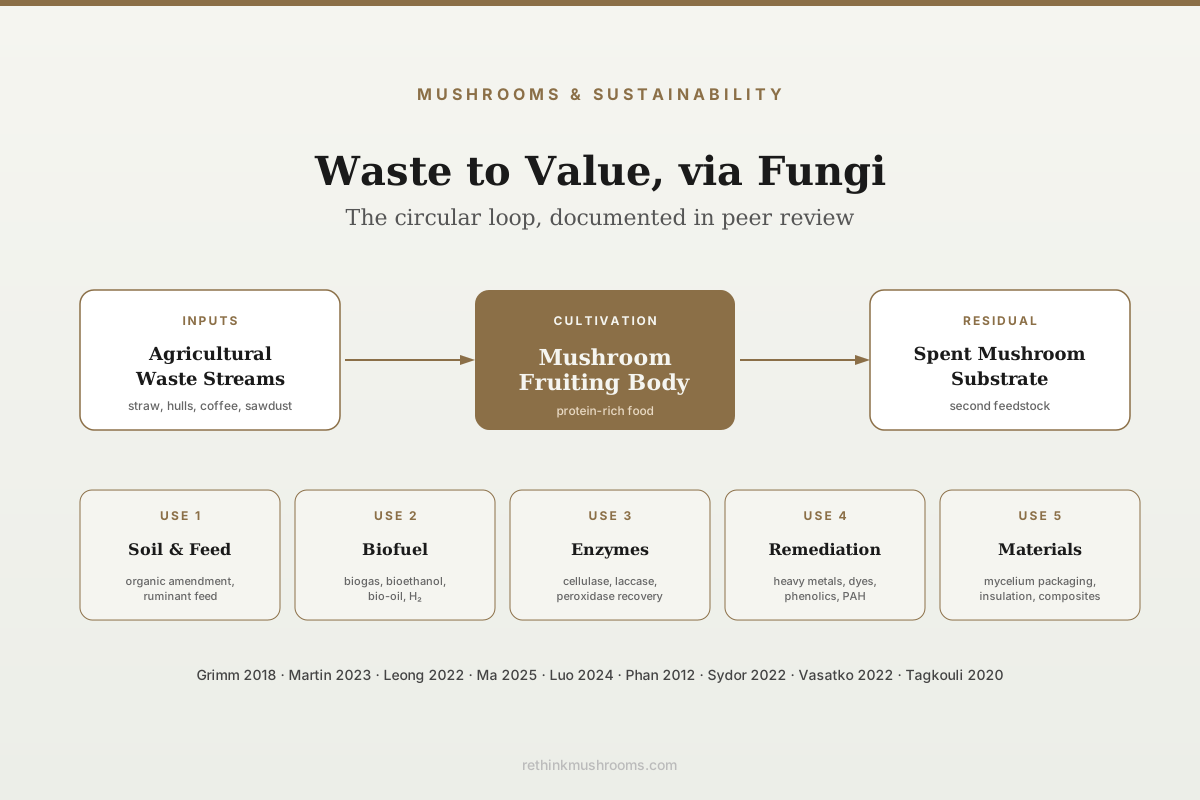
Mushroom cultivation sits in an unusual position in the bioeconomy. The inputs are low-value agricultural by-products that otherwise require disposal (cereal straw, cottonseed hull, coffee grounds, sawdust), and both the primary output (edible fruiting body) and the residual output (spent mushroom substrate, SMS) have established downstream uses. The full-loop picture justifies the circular economy framing better than most plant agriculture does, and the peer-reviewed literature in the last decade has mapped the pathways in detail. Grimm and Wösten (2018), writing in Applied Microbiology and Biotechnology, set out the conceptual case explicitly: mushroom cultivation transforms lignocellulosic agricultural side streams into protein-rich food, and the leftover SMS feeds applications ranging from animal feed to biofuel to packaging material.[1] Subsequent reviews have quantified and extended the map.
For broader context on the environmental case, see mushrooms and sustainability: the environmental case for fungi, and the linked deep-dives in mushroom farming and carbon footprint: environmental analysis, mushroom packaging and materials: the mycelium revolution and mycoremediation: how mushrooms clean up pollution.
Key Takeaways
- Grimm & Wösten (2018) mapped mushroom cultivation as a circular-economy process converting lignocellulosic agricultural by-products into food plus high-value SMS feedstock
- Martin & Hernandez-Rubio (2023) and Ma et al. (2025) reviewed SMS valorisation pathways covering animal feed, soil amendment, biofuels, enzymes, and bioremediation substrates
- Leong et al. (2022) surveyed SMS-to-biofuel conversion, with routes to biogas, bioethanol, bio-oil and hydrogen depending on the pretreatment and conversion process
- Phan & Sabaratnam (2012) reviewed lignocellulosic enzymes (cellulases, laccases, peroxidases) carried over in SMS that have industrial applications in bleaching, textile processing and pollutant degradation
- Sydor et al. (2022) and Vasatko et al. (2022) reviewed mycelium-based composite materials, reporting thermal insulation and acoustic absorption properties competitive with petroleum-derived foams
- Tagkouli et al. (2020) demonstrated that Pleurotus species cultivated on agricultural and agro-industrial by-products produced edible fruiting bodies with intact free amino acid profiles, closing the food side of the loop
The Input Side: Mushrooms As Lignocellulose Valorisers
Most of the global biosphere's fixed carbon sits in lignocellulose, the structural polymer composite of plant cell walls. Cellulose, hemicellulose and lignin together make up the bulk of crop residues, straw, hulls, sawdust, coffee grounds, brewing spent grain and similar side streams. These materials are difficult to digest. Monogastric animals cannot extract most of the energy, and lignin in particular resists biological breakdown. White-rot and brown-rot fungi, including most cultivated mushroom species, carry the specialised enzyme systems that decompose this material: cellulases, hemicellulases, laccases, manganese peroxidases, lignin peroxidases. That enzymatic capability is the biological basis for the circular economy role.
Grimm and Wösten (2018) framed the opportunity in terms of scale.[1] Global lignocellulosic waste from agriculture sits in the billions of tonnes per year. Mushroom cultivation currently processes a small fraction of this, but the technical pathway is established and scalable. Agaricus bisporus cultivation uses composted wheat straw and poultry manure. Pleurotus ostreatus and other oyster mushrooms grow on a wide range of substrates including straw, cottonseed hull, coffee grounds, sawdust and paper mill sludge. Lentinula edodes (shiitake) grows on hardwood sawdust and logs. Each of these substrates has a conventional disposal cost; each becomes a feedstock for food production in the mushroom system.
Tagkouli and colleagues (2020) tested three Pleurotus species cultivated on agricultural and agro-industrial by-products and measured free amino acid profiles in the resulting fruiting bodies.[2] The study confirmed that mushrooms grown on by-product substrates retained nutritionally meaningful amino acid composition, which is the bottom-line requirement for the food-side claim. The protein is not just metabolic mass, it is qualitatively complete.
The Output Side: Spent Mushroom Substrate As A Second Feedstock
For every kilogram of fresh mushroom produced, several kilograms of SMS are left behind. Globally, SMS production runs at tens of millions of tonnes annually. Historically this material was treated as an agricultural waste, often landfilled or open-burned, both of which carry environmental costs and neither of which captures any of the residual value. The peer-reviewed literature now maps several valorisation pathways in detail.
Martin and Hernandez-Rubio (2023) reviewed SMS exploitation potential across applications and value-added products.[3] Ma and colleagues (2025) provided a more recent comprehensive review summarising the current state and future of SMS green applications, from soil amendment and animal feed through to energy recovery and biomaterials.[4] Luo and colleagues (2024) independently reviewed SMS recycling status and development, converging on the same set of pathways.[5]
The main documented reuse pathways:
- Second-stage mushroom cultivation. SMS from one species can support cultivation of another. Residual nutrients and decomposed lignocellulose remain accessible to subsequent fungi.
- Soil amendment and organic fertiliser. SMS is rich in organic matter, nitrogen and mineralised micronutrients. Field application improves soil structure, water-holding capacity and crop yield when applied at appropriate rates.
- Animal feed. Residual protein and digestible fibre make SMS a candidate for ruminant feed supplementation, with the caveat that species-specific digestibility and heavy-metal loading must be verified.
- Enzyme recovery. Phan and Sabaratnam (2012) reviewed the lignocellulosic enzymes (cellulases, xylanases, laccases, peroxidases) retained in SMS at the end of fruiting, along with their industrial applications.[6]
- Bioremediation substrate. The residual enzyme activity and biosorption capacity make SMS a candidate for removing heavy metals, dyes and organic pollutants from contaminated water and soil.
- Biofuel feedstock. The partially decomposed lignocellulose is a conversion substrate for several biofuel pathways.
- Packaging and composite materials. Mycelium-bonded materials can use SMS or fresh substrate as the structural matrix.
Each pathway has an active scientific literature and some level of commercial deployment. The reviews converge on the conclusion that SMS is best understood as a second feedstock, not a waste stream.
Energy: From Mushroom Substrate To Biofuel
The biofuel potential of SMS is one of the most active areas. Leong and colleagues (2022) reviewed the state of SMS valorisation for low-carbon biofuel production, covering four main conversion routes.[7]
- Anaerobic digestion to biogas. SMS is a reasonable anaerobic digestion substrate, producing methane-rich biogas that can be burned for heat, converted to electricity or upgraded to pipeline-quality natural gas. Gas yields are sensitive to SMS composition and pretreatment.
- Bioethanol via saccharification and fermentation. Residual cellulose and hemicellulose in SMS can be enzymatically saccharified to fermentable sugars, then fermented to ethanol. Yields are modest compared with dedicated energy crops, but the substrate carries no opportunity cost.
- Pyrolysis to bio-oil. Thermochemical conversion of SMS at moderate temperatures under low oxygen yields a bio-oil fraction usable as a liquid fuel or chemical feedstock, plus biochar that has its own soil-amendment value.
- Dark fermentation to hydrogen. An emerging pathway converting residual carbohydrate fractions of SMS into hydrogen gas, which is higher-value but technically demanding.
Leong 2022 concluded that SMS-to-biofuel is technically established, but economic competitiveness with conventional biofuel feedstocks depends on SMS transport logistics, pretreatment cost and co-location with mushroom farms. The circular-economy framing, where biofuel production displaces SMS disposal cost, tilts the economics favourably at the farm scale.
Bioremediation And Enzyme Reuse
The enzymatic capability that lets mushrooms break down lignin also lets them break down structurally similar environmental contaminants. Phan and Sabaratnam (2012) reviewed the lignocellulosic enzyme pool in SMS and its applications, including pulp bleaching, textile dye decolourisation, phenolic compound degradation and polycyclic aromatic hydrocarbon (PAH) breakdown.[6]
SMS used as a bioremediation medium works through several mechanisms: residual enzyme activity catalyses degradation of target pollutants, the physical biomass serves as a biosorbent that removes heavy metals from aqueous solution, and the microbial community carried in SMS continues to metabolise organic contaminants. The Ma 2025 and Luo 2024 reviews catalogued documented uses in treating industrial wastewater, remediating contaminated soil and polishing dye-heavy textile effluent.[4] [5]
The related mycoremediation literature on live mycelium is covered in mycoremediation: how mushrooms clean up pollution.
Mycelium As A Composite Material
A distinct branch of the circular economy story uses mycelium itself, not just SMS, as the structural matrix for composite materials. Sydor and colleagues (2022) reviewed fungi used in mycelium-based composites and their application recommendations, identifying Ganoderma, Pleurotus and Trametes as the dominant genera in this application.[8] Vasatko and colleagues (2022) reported basic material properties: thermal conductivity low enough to compete with polystyrene insulation, acoustic absorption comparable to commercial sound-dampening foams and mechanical properties suitable for non-structural applications such as packaging, panelling and insulation.[9]
The mycelium composite production process is itself a waste valorisation loop. The substrate is typically agricultural side stream (straw, hemp hurd, sawdust), the bonding agent is fungal hyphae that grow through and bind the substrate, and the final product is biodegradable. End-of-life disposal is composting rather than landfilling or incineration.
For a dedicated treatment of this application area see mushroom packaging and materials: the mycelium revolution.
Food-System Integration
The food-system integration of mushroom cultivation with agricultural waste streams has a long empirical track record and is the area where the circular economy claim is most robust. Coffee roasting produces silverskin and brewing produces spent coffee grounds; both are established substrates for Pleurotus cultivation. Brewing spent grain supports Pleurotus and Lentinula. Cotton gin waste supports Volvariella volvacea. Rice and wheat straw support Agaricus, Pleurotus and Volvariella.
Tagkouli 2020 is the most direct demonstration of output quality on by-product substrates.[2] Three Pleurotus species (P. ostreatus, P. eryngii, P. citrinopileatus) cultivated on agricultural and agro-industrial by-products produced fruiting bodies with intact free amino acid profiles. The measured composition supports the claim that mushrooms cultivated on waste substrates are not nutritionally compromised relative to conventional substrate cultivation.
At the food-system level, the circular loop can close tightly. A coffee roaster sends spent grounds to a mushroom farm. The farm produces edible oyster mushrooms. The SMS goes to soil amendment on a nearby vegetable farm, which supplies the cafeteria that serves the coffee. Several commercial operations have implemented versions of this loop, with the viability depending on transport distance, substrate cleanliness and market price for SMS applications.
Limits Of The Circular Vision
The circular economy framing for mushrooms is scientifically supportable, but several limits should be stated plainly.
Scale is a real constraint. Global mushroom production is growing rapidly, but even at several-percent annual growth the fraction of global lignocellulosic waste that passes through mushroom cultivation remains small. The circular economy pathway is a component of the waste-valorisation solution, not the whole solution.
Heavy-metal concentration in SMS can render some downstream uses problematic. Mushrooms bioaccumulate metals from substrate, and SMS inherits both the metal load of the original substrate and any additional concentration from mycelial activity. Using SMS as animal feed or as soil amendment on food-crop fields requires verification that the metal load is below relevant limits. For high-metal SMS, bioremediation or biofuel applications are safer end uses than food-chain reintroduction.
Enzyme activity in SMS declines over storage. The peak cellulase and laccase activity is in fresh end-of-fruiting SMS, and delayed processing loses some fraction of the enzyme-recovery value. The logistical challenge is that mushroom farms produce SMS continuously and downstream processors often cannot absorb the output continuously.
Biofuel economics depend on oil prices and subsidy regimes. Leong 2022 was clear that SMS-to-biofuel is technically viable but not always economically competitive with fossil alternatives in the absence of disposal-cost avoidance or carbon-pricing mechanisms.[7] The circular economy argument often depends on a policy environment that internalises waste-disposal and carbon costs.
Mycelium composite materials are real but remain limited to non-structural applications. Vasatko 2022 and Sydor 2022 both noted that the mechanical properties of current mycelium composites cannot substitute for load-bearing concrete, steel or engineered wood.[8] [9] The material substitution case is strongest against expanded polystyrene, polyurethane foam and other packaging and insulation applications where mechanical demands are modest.
Finally, most of the reviewed literature is a mix of laboratory-scale research and demonstration-scale operation. Commercial-scale validation of the full waste-to-value loops is limited to a small number of operations. The scientific pathway is established; the industrial scale-up is partial.
What The Evidence Supports
The peer-reviewed evidence supports a precise set of claims:
- Mushroom cultivation converts lignocellulosic agricultural by-products into protein-rich food with intact nutritional composition
- Spent mushroom substrate is a secondary feedstock with documented uses in soil amendment, animal feed, enzyme recovery, bioremediation and biofuel production
- The lignocellulosic enzyme pool in SMS has industrial applications in several process industries
- Mycelium-based composite materials have properties competitive with petroleum-derived foams for non-structural packaging and insulation applications
- The circular economy claim for mushrooms is scientifically defensible, within the scale limitations of current production and the substrate-specific metal-loading caveats
The Bottom Line
Mushroom cultivation is one of the few established biological processes that converts lignocellulosic agricultural waste into nutritionally complete food and a secondary feedstock with multiple downstream applications. Grimm & Wösten 2018 framed the circular loop; Martin 2023, Leong 2022, Ma 2025 and Luo 2024 reviewed the SMS valorisation pathways covering animal feed, fertiliser, enzymes, biofuels and bioremediation; Sydor 2022 and Vasatko 2022 reviewed mycelium composite materials with competitive thermal and acoustic properties. Scale, heavy-metal loading and policy-dependent economics limit how much of global waste the pathway currently captures.
Frequently Asked Questions
Sources & References
- 1RTHM-00511·Grimm, Daniel et al. (2018). “Mushroom cultivation in the circular economy..” Applied microbiology and biotechnology.Study breakdown →PubMed →↩
- 2RTHM-00658·Tagkouli, Dimitra et al. (2020). “Free Amino Acids in Three Pleurotus Species Cultivated on Agricultural and Agro-Industrial By-Products..” Molecules (Basel.Study breakdown →PubMed →↩
- 3RTHM-00844·Martín, Carlos et al. (2023). “Spent substrate from mushroom cultivation: exploitation potential toward various applications and value-added products..” Bioengineered.Study breakdown →PubMed →↩
- 4RTHM-00940·Ma, Xiaoyu et al. (2025). “Spent mushroom substrate: A review on present and future of green applications..” Journal of environmental management.Study breakdown →PubMed →↩
- 5RTHM-00893·Luo, Jiahao et al. (2024). “Status and development of spent mushroom substrate recycling: A review..” Journal of the Air & Waste Management Association (1995).Study breakdown →PubMed →↩
- 6RTHM-00260·Phan, Chia-Wei et al. (2012). “Potential uses of spent mushroom substrate and its associated lignocellulosic enzymes..” Applied microbiology and biotechnology.Study breakdown →PubMed →↩
- 7RTHM-00778·Leong, Yoong Kit et al. (2022). “Valorization of spent mushroom substrate for low-carbon biofuel production: Recent advances and developments..” Bioresource technology.Study breakdown →PubMed →↩
- 8RTHM-00797·Sydor, Maciej et al. (2022). “Fungi in Mycelium-Based Composites: Usage and Recommendations..” Materials (Basel.Study breakdown →PubMed →↩
- 9RTHM-00800·Vašatko, Hana et al. (2022). “Basic Research of Material Properties of Mycelium-Based Composites..” Biomimetics (Basel.Study breakdown →PubMed →↩