Synthetic vs Natural Psilocybin
0 head-to-head human bioequivalence trials
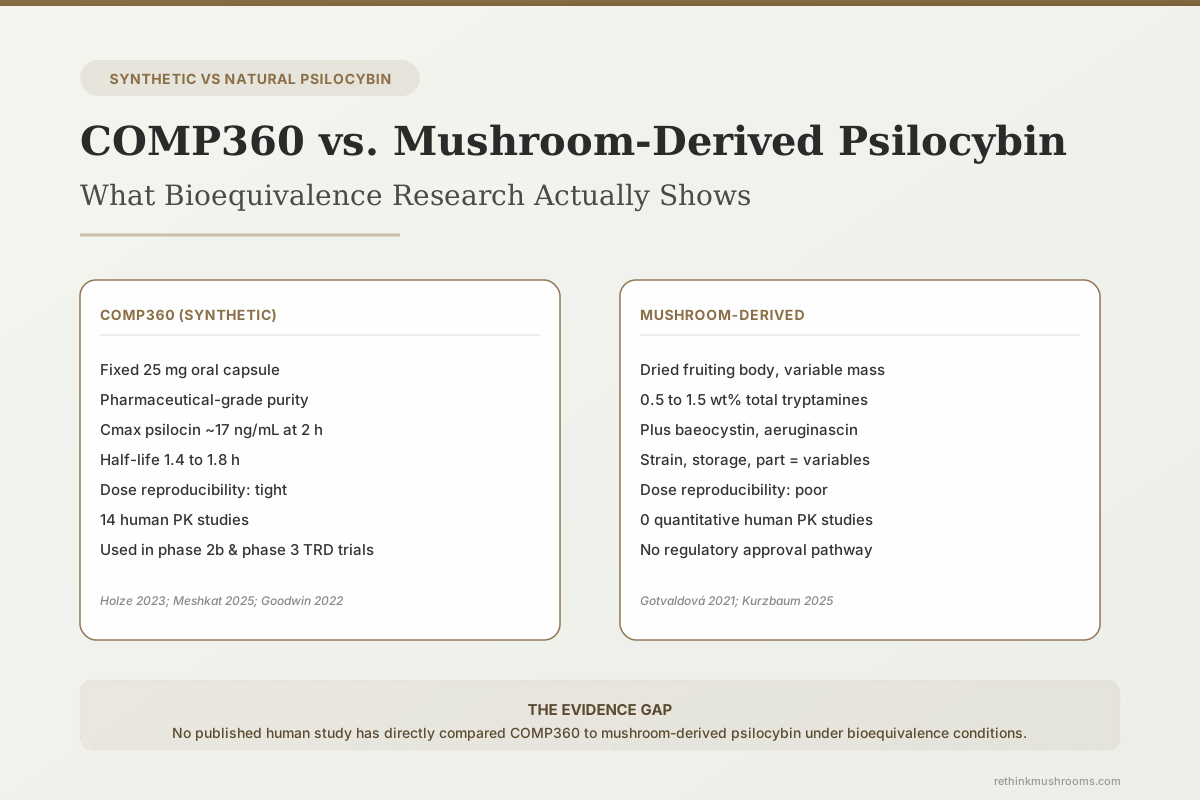
No published human trial has directly compared COMP360 synthetic psilocybin to a matched dose of mushroom-derived psilocybin. Bioequivalence claims rest on pharmacokinetic inference from separate studies, not on a regulatory bioequivalence comparison.
Meshkat et al., Pharmaceutics, 2025
25 mg COMP360
single fixed oral dose used in Compass phase 2 and phase 3 trials
0.5 to 1.5 wt%
tryptamine content range in Psilocybe cubensis fruiting bodies
~3 h
psilocin plasma elimination half-life after oral psilocybin
Meshkat et al., Pharmaceutics, 2025
 View as image ↗
The question of whether COMP360 and mushroom-derived psilocybin are bioequivalent sits at the intersection of pharmaceutical chemistry, pharmacokinetics, and regulatory policy. The informal version of the question is: if a single mushroom-derived dose delivers the same milligrams of psilocybin as a 25 mg COMP360 capsule, does it produce the same plasma psilocin exposure and the same subjective and clinical effects? The formal version is whether the two products meet the regulatory definition of bioequivalence, which requires a specific head-to-head study design. This article examines what has actually been measured, what has only been inferred, and why the distinction matters for interpreting the clinical record. For background on the product itself, see COMP360: Compass Pathways' synthetic psilocybin explained. For the broader framing question, see synthetic vs. natural psilocybin: does the source matter?.
Key Takeaways
- Meshkat et al. (2025), in a systematic review of 14 pharmacokinetic studies including 112 healthy participants, reported psilocin Tmax values of 1.8 to 4 hours, elimination half-lives of 1.5 to 4 hours, and bioavailability of 52.7 ± 20%, all measured using synthetic psilocybin rather than mushroom extract (Pharmaceutics)
- Brown et al. (2017), using synthetic psilocybin at 0.3, 0.45, and 0.6 mg/kg in 12 healthy adults, showed linear psilocin pharmacokinetics with a 3-hour elimination half-life and less than 2% renal clearance of intact psilocin (Clinical Pharmacokinetics)
- Holze et al. (2023) measured fixed doses of 15, 25, and 30 mg synthetic psilocybin in 79 healthy subjects and reported maximal psilocin concentrations of 11, 17, and 21 ng/mL, reached at approximately 2 hours, with subjective effects lasting 5.5 to 6.4 hours (Clinical Pharmacology and Therapeutics)
- Gotvaldová et al. (2021) analyzed Psilocybe cubensis fruiting bodies and found caps contained roughly 1.03 wt% tryptamines versus 0.52 wt% in stipes, with high between-specimen variability that would translate directly into dose variability for any extract-based product (Drug Testing and Analysis)
- Goodwin et al. (2022) tested COMP360 at 25, 10, and 1 mg in 233 patients with treatment-resistant depression and reported a MADRS score reduction of 12.0 points at 25 mg versus 5.4 points at 1 mg over 3 weeks (New England Journal of Medicine)
- Hasler et al. (1997), using synthetic psilocybin by both oral and intravenous routes in humans, established that ingested psilocybin is rapidly dephosphorylated to psilocin and that oral psilocin bioavailability is a fraction of intravenous exposure, establishing the reference data that underlies every later oral PK study (Pharmaceutica Acta Helvetiae)
What COMP360 Is, in Pharmaceutical Terms
COMP360 is a proprietary synthetic formulation of psilocybin developed by Compass Pathways. Every capsule contains a fixed mass of synthetic psilocybin as the active pharmaceutical ingredient, manufactured under pharmaceutical-grade conditions with defined purity, stability, and dissolution specifications. The phase 2b trial reported by Goodwin et al. (2022) in the New England Journal of Medicine used three fixed doses (25 mg, 10 mg, and 1 mg) administered to 233 patients across 22 sites in 10 countries.[1] The 25 mg dose produced a least-squares mean MADRS reduction of 12.0 points at week 3 compared with 5.4 points for the 1 mg active control. The long-term follow-up published by Goodwin et al. (2025) tracked outcomes over extended observation.[2]
The same chemical entity, the psilocybin molecule, is present in both COMP360 and a Psilocybe fruiting body. The pharmaceutical question is whether the formulation, the purity, and the coadministered compounds change what the body sees after ingestion. For the broader debate on whether non-psilocybin mushroom compounds meaningfully alter the response, see the entourage effect debate: do other mushroom compounds matter?.
What Bioequivalence Actually Means
Bioequivalence is a regulatory term with a specific meaning. Two products are bioequivalent when their rate and extent of absorption, expressed as area under the plasma concentration-time curve (AUC) and maximum plasma concentration (Cmax), fall within defined statistical bounds, typically 80 to 125% of each other on a 90% confidence interval, after a crossover study in the same subjects. The study design is prescriptive: same participants, same conditions, both products, plasma samples analyzed by validated assays. No such study has been conducted comparing COMP360 to a mushroom extract.
What exists instead is pharmacokinetic data on synthetic psilocybin in one set of studies and chemical data on mushroom tryptamine content in a separate set. Bioequivalence inferences combine these, but they are inferences, not measurements.
The Synthetic Pharmacokinetic Record
The pharmacokinetics of synthetic psilocybin have been characterized in detail. Hasler et al. (1997) established the foundational profile, administering both oral and intravenous psilocybin to human volunteers and measuring plasma psilocin by HPLC with electrochemical detection.[3] They showed that ingested psilocybin is rapidly dephosphorylated in the gut and liver to psilocin, the active metabolite that crosses the blood-brain barrier and binds 5-HT2A receptors. Free psilocybin is not detectable in plasma after oral dosing.
Brown et al. (2017) extended this to escalating oral doses of 0.3, 0.45, and 0.6 mg/kg in 12 healthy adults using a validated LC-MS/MS assay.[4] Psilocin pharmacokinetics were linear across the dose range. The elimination half-life was 3.0 ± 1.1 hours. Renal clearance of intact psilocin accounted for less than 2% of total clearance, consistent with extensive hepatic glucuronidation. The authors concluded that a 25 mg oral flat dose approximates the exposure of a 0.3 mg/kg weight-adjusted dose in an average adult. That calculation underlies the 25 mg COMP360 dose selection.
Holze et al. (2023) then characterized the fixed-dose pharmacokinetics directly, giving 15, 25, or 30 mg synthetic psilocybin to 79 healthy volunteers.[5] Maximal plasma psilocin concentrations were 11 ng/mL at 15 mg, 17 ng/mL at 25 mg, and 21 ng/mL at 30 mg, reached at approximately 2 hours. Elimination half-lives ranged from 1.4 to 1.8 hours across doses. Subjective effect duration averaged 5.5 to 6.4 hours and scaled with dose.
Meshkat et al. (2025) synthesized the available pharmacokinetic literature in a systematic review of 14 studies covering 112 healthy human participants.[6] Across studies, Tmax ranged 1.8 to 4 hours, elimination half-life ranged 1.5 to 4 hours, and oral psilocin bioavailability was reported at 52.7 ± 20% in the one study that measured it against intravenous reference. Metabolism is primarily CYP2D6 and CYP3A4-mediated, with secondary contributions from monoamine oxidase A, producing 4-hydroxyindole-3-acetic acid and 4-hydroxytryptophol. Every study in this review used synthetic psilocybin. None used mushroom extract.
What Mushrooms Actually Contain
A Psilocybe cubensis fruiting body is not a clean chemical delivery system. Gotvaldová et al. (2021) quantified tryptamine content across parts of the fruiting body, storage conditions, and processing methods using ultra-high-performance liquid chromatography coupled with mass spectrometry.[7] Caps contained approximately 1.03 wt% total tryptamines; stipes contained 0.52 wt%. Mycelium contained 0.47 wt% psilocin specifically, with no detectable psilocybin. Basidiospores contained no tryptamines. Between-specimen variability was high enough that part-of-mushroom differences were not statistically significant, a finding that itself makes the dose reproducibility problem explicit.
The same paper showed that storage conditions materially change delivered dose. Freezing fresh mushrooms at −80 °C produced the highest degradation of tryptamines; drying and storing in the dark at room temperature produced the lowest. These are not fringe effects. They change how much psilocybin is actually in the mushroom at the moment a subject ingests it.
Kurzbaum et al. (2025) reviewed strain-level variation in Psilocybe cubensis, covering cultivation technique, genetics, and psychoactive compound content.[8] Different strains grown under different conditions produce different ratios of psilocybin, psilocin, baeocystin, norbaeocystin, and aeruginascin. This is not a narrow range. Reported psilocybin content spans roughly fivefold or more between strains and growth conditions.
A natural product dosed by dried mushroom mass therefore has three stacked sources of variability: strain, growth and storage conditions, and part of the fruiting body used. Even a perfectly weighed 5-gram dose of dried P. cubensis could contain anywhere from roughly 25 to over 75 mg of psilocybin depending on these variables. This is the formulation problem a pharmaceutical product is designed to eliminate.
The Minor Tryptamines
Mushrooms contain psilocybin alongside baeocystin, norbaeocystin, aeruginascin, and norpsilocin. Whether these compounds add, modify, or have no effect on the pharmacology is the empirical question behind the entourage hypothesis.
Sherwood et al. (2024) tested norpsilocin and analogue activity in receptor binding and mouse behavioral assays.[9] Norpsilocin bound 5-HT2A and induced a head-twitch response in mice after intraperitoneal administration but not after oral administration, indicating poor oral bioavailability. This matters directly for the bioequivalence question: a compound that does not survive first-pass metabolism cannot contribute to the exposure profile of an orally ingested mushroom. Baeocystin and norbaeocystin have shown similar or weaker activity in comparable assays. The minor tryptamines may contribute to a mushroom-derived dose, but the evidence that they meaningfully shift the plasma psilocin curve or the subjective experience in humans has not been demonstrated.
Psilocin itself has been characterized in detail in non-CNS tissues. Wiens et al. (2024) showed that psilocin modulates microglial neuroimmune functions through 5-HT2 receptor-dependent signaling, establishing an effect pathway that is independent of the minor tryptamines.[10]
What a Bioequivalence Study Would Need to Show
A formal bioequivalence study would administer matched psilocybin doses (for example, 25 mg as COMP360 and 25 mg as a chemically quantified mushroom extract) to the same healthy volunteers on separate occasions, sample plasma psilocin at standardized timepoints, and compare AUC and Cmax within the 80 to 125% regulatory window. Secondary endpoints would include Tmax, half-life, metabolite ratios, and subjective effect profiles using validated psychometric instruments.
No such study has been published. The closest available data are parallel comparisons across separate studies using different participants, different doses, different assay methods, and different subjective effect instruments. These comparisons suggest that a chemically matched dose should produce broadly similar psilocin exposure, because psilocin is psilocin regardless of origin. But "should" is inference, not measurement.
Three specific uncertainties remain unresolved in the absence of a direct study. First, whether mushroom matrix components alter the rate of psilocybin dephosphorylation or psilocin absorption. Second, whether beta-carbolines or other mushroom compounds inhibit monoamine oxidase A at physiologically relevant concentrations in humans, which would change psilocin clearance. Third, whether the minor tryptamines contribute measurably to subjective effects at real-world mushroom doses.
Why Clinical Trials Use Synthetic
Regulators require a defined active pharmaceutical ingredient with documented purity, stability, and dose reproducibility for any new drug approval. A mushroom extract fails on multiple counts: active ingredient content varies between batches, degrades under storage, and coexists with unquantified minor compounds. Kirlic et al. (2025) described the Compass Psychological Support Model used in COMP360 trials, noting that consistent psychological support depends on consistent dosing, which depends on a consistent active ingredient.[11] The regulatory path for a natural-product psilocybin product would require either standardization to within tight specification limits or a demonstration that the variability does not affect safety or efficacy. Neither has been shown. See why clinical trials use synthetic psilocybin for the full regulatory rationale.
Aaronson et al. (2024) provides a second example of synthetic psilocybin use in a clinical setting, testing a single 25 mg dose in treatment-resistant bipolar type II depression across 15 participants in an open-label trial.[12] The design again specifies synthetic psilocybin because the regulatory and dosing requirements demand it.
Limitations and What the Evidence Does Not Support
The pharmacokinetic record for synthetic psilocybin is reasonably characterized in healthy adults. It is less characterized in patient populations, in older adults, in people taking concomitant serotonergic medications, and under real-world administration conditions. The pharmacokinetic record for mushroom-derived psilocybin in humans is effectively nonexistent as a quantitative, prospective dataset. Historical self-report data on mushroom ingestion is not a substitute for a controlled pharmacokinetic study.
The absence of a direct bioequivalence study means that claims on either side, that COMP360 and mushroom extract are the same or that they are meaningfully different, are based on inference from incomplete datasets. The honest answer is that the question has not been directly tested in humans. The chemistry predicts broad similarity at matched psilocybin doses. The formulation variability predicts that mushroom dosing will be less reproducible in practice. Neither prediction has been confirmed in a regulatory-grade comparison.
The Bottom Line
No published human study has directly compared COMP360 to mushroom-derived psilocybin under bioequivalence conditions. The synthetic psilocybin pharmacokinetic record shows linear, reproducible psilocin exposure with a 1.5 to 4 hour half-life and 25 mg producing Cmax of roughly 17 ng/mL. Mushroom fruiting bodies contain 0.5 to 1.5 wt% tryptamines with high between-specimen variability, making chemically matched dosing difficult in practice. The question of whether matched doses produce equivalent clinical effect remains inferred from separate datasets rather than measured in a head-to-head trial.
Frequently Asked Questions
Sources & References
- 1RTHM-00761·Goodwin, Guy M et al. (2022). “Single-Dose Psilocybin for a Treatment-Resistant Episode of Major Depression..” The New England journal of medicine.Study breakdown →PubMed →↩
- 2RTHM-00926·Goodwin, Guy M et al. (2025). “Results From a Long-Term Observational Follow-Up Study of a Single Dose of Psilocybin for a Treatment-Resistant Episode of Major Depressive Disorder..” The Journal of clinical psychiatry.Study breakdown →PubMed →↩
- 3RTHM-00021·Hasler, F et al. (1997). “Determination of psilocin and 4-hydroxyindole-3-acetic acid in plasma by HPLC-ECD and pharmacokinetic profiles of oral and intravenous psilocybin in man..” Pharmaceutica acta Helvetiae.Study breakdown →PubMed →↩
- 4RTHM-00461·Brown, Randall T et al. (2017). “Pharmacokinetics of Escalating Doses of Oral Psilocybin in Healthy Adults..” Clinical pharmacokinetics.Study breakdown →PubMed →↩
- 5RTHM-00830·Holze, Friederike et al. (2023). “Pharmacokinetics and Pharmacodynamics of Oral Psilocybin Administration in Healthy Participants..” Clinical pharmacology and therapeutics.Study breakdown →PubMed →↩
- 6RTHM-00945·Meshkat, Shakila et al. (2025). “Pharmacokinetics of Psilocybin: A Systematic Review..” Pharmaceutics.Study breakdown →PubMed →↩
- 7RTHM-00688·Gotvaldová, Klára et al. (2021). “Stability of psilocybin and its four analogs in the biomass of the psychotropic mushroom Psilocybe cubensis..” Drug testing and analysis.Study breakdown →PubMed →↩
- 8RTHM-00932·Kurzbaum, Eyal et al. (2025). “Exploring Psilocybe cubensis Strains: Cultivation Techniques, Psychoactive Compounds, Genetics and Research Gaps..” Journal of fungi (Basel.Study breakdown →PubMed →↩
- 9RTHM-00908·Sherwood, Alexander M et al. (2024). “Psychedelic-like Activity of Norpsilocin Analogues..” ACS chemical neuroscience.Study breakdown →PubMed →↩
- 10RTHM-00914·Wiens, Kennedy R et al. (2024). “Psilocin, the Psychoactive Metabolite of Psilocybin, Modulates Select Neuroimmune Functions of Microglial Cells in a 5-HT2 Receptor-Dependent Manner..” Molecules (Basel.Study breakdown →PubMed →↩
- 11RTHM-00930·Kirlić, Namik et al. (2025). “Compass Psychological Support Model for COMP360 Psilocybin Treatment of Serious Mental Health Conditions..” The American journal of psychiatry.Study breakdown →PubMed →↩
- 12RTHM-00863·Aaronson, Scott T et al. (2024). “Single-Dose Synthetic Psilocybin With Psychotherapy for Treatment-Resistant Bipolar Type II Major Depressive Episodes: A Nonrandomized Open-Label Trial..” JAMA psychiatry.Study breakdown →PubMed →↩